FlowersMarket.ro Case Study: From Website Rebuild to Search-Ready Authority
Case study summary: FlowersMarket.ro, also known by searches such as Flowers Market Holland, became one of AYSA’s earliest MVP testers while going through a broader website and SEO rebuild. The work was not only about rankings. It covered infrastructure, structure, brand clarity, commercial pages, search intent, visual trust and a repeatable execution workflow.
The strongest lesson is simple: AI visibility does not start inside ChatGPT. It starts with a website that is fast enough, clear enough, crawlable enough and authoritative enough to be understood by search systems. AYSA helped turn that work into a more operational loop: monitor, prepare, approve, execute.
The context: a flower marketplace that needed more than “SEO work”
FlowersMarket.ro operates in a market where search behavior is mixed. Some users search by brand. Others search by category, price, location, wholesale intent, flower type, supplier intent or business planning questions. That creates a more complex SEO challenge than a simple service website.
For a flower marketplace, visibility is not only about one homepage ranking. The site has to communicate what it is, who it serves, what categories matter, why users should trust it, and how search engines should understand the business. It also has to support both classic Google searches and the new answer-style journeys where AI systems summarize options, compare providers and choose sources to cite.
That is why the project became a broader rebuild. The goal was not to add a few pages and hope for rankings. The goal was to make the website easier to crawl, easier to understand, easier to trust and easier to improve over time.
The challenge: search engines cannot recommend what they cannot understand
Many SMEs treat SEO as a campaign. In reality, the base layer is operational. If the website structure is confusing, the infrastructure is weak, the content is generic and the business positioning is unclear, every new article has to fight against the same foundation problems.
FlowersMarket.ro needed work across several layers:
- Website foundation: a cleaner, more reliable base for crawling, rendering and future improvements.
- Information architecture: a clearer structure for commercial and informational intent.
- Brand understanding: stronger signals around the FlowersMarket.ro / Flowers Market Holland identity.
- Search intent coverage: pages and content that match how users actually search in this category.
- Trust and visual clarity: a more credible presentation, not just more text.
- Execution workflow: a way to keep improving without turning SEO into endless manual work.
This is the part many SEO reports miss. The report can show issues. But somebody still has to fix them, prioritize them, publish changes, monitor impact and continue. That execution gap is exactly why AYSA was created.
What changed behind the scenes
The work combined strategic SEO, technical cleanup, website refactoring and early AYSA execution workflows. In plain language, the site had to become more useful to humans and more readable to machines.
Before the rebuild
- Search visibility depended too heavily on isolated pages.
- The website needed a clearer structure for commercial discovery.
- Brand and category signals needed stronger alignment.
- SEO work risked becoming manual and reactive.
After the rebuild direction
- A cleaner website foundation for ongoing SEO execution.
- Better structure around user intent and business categories.
- Stronger brand clarity for FlowersMarket.ro and Flowers Market Holland searches.
- Early AYSA MVP workflows for monitoring, preparing and approving work.
The key areas were:
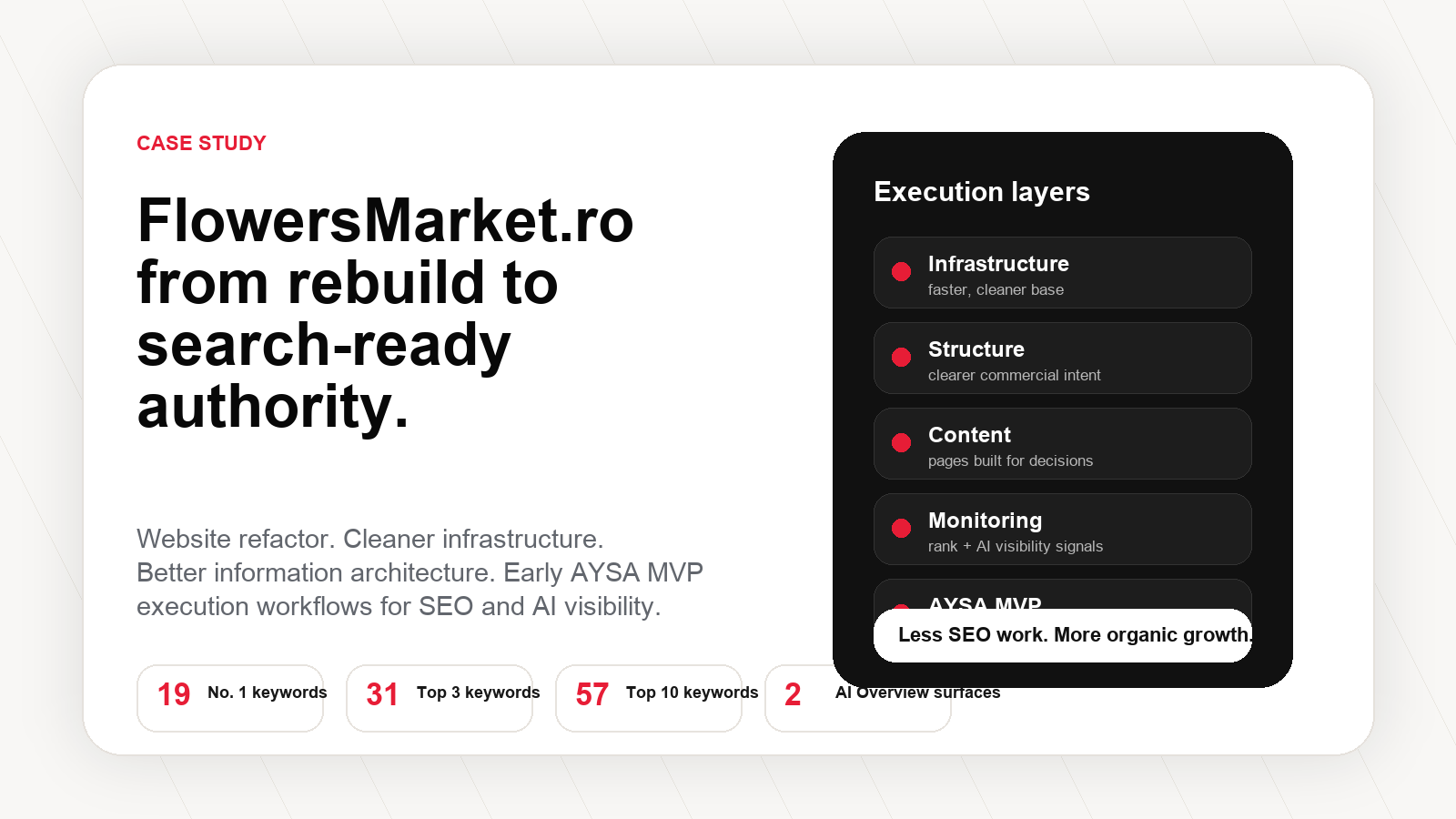
- Infrastructure refactor: improving the technical base so the website could support stronger SEO work over time.
- Structure refactor: organizing content around how people search for flower market, wholesale, location and product-related intent.
- Image and trust layer: making the site feel more credible and aligned with the real business behind it.
- Content and topical coverage: expanding beyond simple pages into useful search journeys.
- Internal linking: helping important topics support each other semantically.
- Monitoring: using ranking and visibility signals to decide where work should continue.
Search signals we can see
Position tracking data for the period 13 May 2026 to 19 May 2026 shows a strong visibility footprint across brand, commercial and category-related searches. These are not lifetime claims and they should not be read as guarantees. They are a snapshot of search visibility after the rebuild and ongoing SEO execution work.
- 19 tracked keywords appeared in position 1.
- 31 tracked keywords appeared in the top 3.
- 57 tracked keywords appeared in the top 10.
- Tracked terms included searches such as flowers market holland, flower market, piata de flori bucuresti, holland flower market, flori en gros and depozit flori afumati.
- The export also reported two tracked surfaces marked as AI Overview, including queries related to depozit plante bucuresti and a floristry business-planning topic.
The AI visibility point is especially important, but it should be handled responsibly. A few AI-style surfaces do not prove permanent AI dominance. They do show that when a website has clearer structure, stronger topical coverage and better search presence, it becomes easier to test, monitor and improve for AI-assisted discovery.
AYSA’s role: from SEO ideas to approved execution
FlowersMarket.ro was among the early businesses that tested the AYSA MVP direction. That matters because the project was not just about agency-style recommendations. It was about building a practical workflow where the system can help surface opportunities, prepare actions and move work forward after approval.
In the AYSA model, SEO does not stop at “we found an issue.” The agent should help answer the next questions:
- Which pages need attention first?
- Which topics are missing?
- Which pages already have signals but need better answers?
- Where should internal links be strengthened?
- Which technical issues affect crawlability or indexability?
- Which authority-building opportunities make sense?
- What can be prepared for approval and execution?
For FlowersMarket.ro, the value was not only automation. It was controlled automation: the business context remains important, the user can approve important changes, and AYSA helps reduce the manual overhead that normally slows SEO down.
What other SMEs can learn from this
The FlowersMarket.ro case is useful because it is not a fantasy story about one magic tactic. It is a practical example of how modern search visibility is built in layers.
First, the website has to be technically usable. Second, the structure has to match how people search. Third, the content has to answer real decisions. Fourth, the brand has to be clear enough to be understood as an entity. Fifth, the site needs continuous monitoring and execution, because search behavior changes quickly.
That is also why AI visibility is not separate from SEO. If a website wants to appear in answer-style systems, it needs the same foundations: crawlable pages, clear entities, useful content, internal links, authority signals and ongoing updates. AI search does not remove the need for SEO. It raises the standard for execution.
For business owners, the conclusion is direct: you do not need another dashboard you cannot interpret. You need a system that turns website opportunities into approved work.
Less SEO work. More organic growth.
Build a website that search engines and AI systems can actually understand.
AYSA monitors SEO, AEO and AI visibility signals, prepares website improvements, asks for approval and executes accepted changes inside your website workflow.