
High-Impact Technical SEO Changes Without the Panic: A Safer Way to Ship, Test, and Protect Traffic
Technical SEO improvements can unlock crawling, indexing, and visibility gains—but the same changes can quietly erase organic traffic when they ship without validation. Here’s a practical, business-first framework to prioritize, test, launch, and monitor the technical updates that matter most.

By Marius Dosinescu / AYSA.ai
Technical SEO is where growth-minded businesses accidentally light money on fire.
Not because technical SEO is “too hard,” but because the highest-impact changes (URL updates, redirects, canonicals, robots rules, navigation shifts, migrations) behave like production engineering. If you ship them without a release plan, you’re not “doing SEO.” You’re running a live experiment on revenue.
This editorial is built from the core idea in Search Engine Land’s guidance on implementing high-impact technical SEO changes safely—evaluating recommendations, prioritizing resources, and preventing costly mistakes before they reach production—then expanded into a full, practical framework you can actually run inside a business. Source: Search Engine Land.
Concise summary

- High-impact technical SEO changes are release events. Treat them like code: scope, test, approve, monitor, and be ready to roll back.
- Most “SEO audit issues” are not equal. Prioritize by Impact × Risk × Effort and by how directly the change supports business outcomes.
- The big five risk zones are URL changes/redirects, canonical templates, Robots.txt rules, Internal linking/navigation, and migrations.
- SMEs don’t fail because they lack tools. They fail because changes get implemented partially, incorrectly, or without Monitoring and accountability.
- AYSA fits where execution breaks down: continuous monitoring, change preparation, approval-based execution, and validation so you stop shipping SEO mistakes.
Table of contents

- The new reality: technical SEO is now a release-management problem (not an SEO checklist)
- Why “high impact” and “high risk” are the same thing in technical SEO
- The “Impact × Risk × Effort” model for prioritizing technical SEO changes
- From audit to implementation: where good recommendations go to die
- The five change types that most often break organic traffic (and how to ship them safely)
- 1) URL changes & redirects: the equity-preservation game
- 2) Canonicals: the easiest way to de-index your own site by accident
- 3) robots.txt & indexing controls: when “efficiency” becomes invisibility
- 4) Internal linking & navigation: the quiet rewiring of discovery
- 5) Site migrations: a bundle of risks pretending to be one project
- A practical QA checklist (pre-launch, launch day, post-launch)
- SME scenario: a local clinic redesign that keeps rankings (instead of losing them)
- What agencies and in-house teams must change in 2026+
- How AYSA reduces implementation risk: monitored, approval-based execution
- What to do next
- Sources and further reading
The new reality: technical SEO is now a release-management problem (not an SEO checklist)
In most businesses, technical SEO “work” is treated like paperwork:
- An audit gets delivered.
- A list of issues gets turned into tickets.
- Engineering “tries to fix” the issues between real priorities.
- Everyone assumes improvements will just show up in Google.
That process fails because technical SEO is not a list of best practices. It’s a set of changes to a production system that:
- Search engines must re-crawl and re-interpret,
- Often impacts thousands of URLs at once,
- Can permanently disrupt discovery if you send the wrong signal.
If you run a business, you already understand this pattern. You wouldn’t ship a pricing change, checkout change, or tracking change without QA and monitoring. Technical SEO deserves the same discipline because the blast radius is similar: revenue, lead flow, and CAC.
This is why the Search Engine Land article is directionally correct: the “hard part” isn’t finding the recommendations; it’s evaluating, prioritizing, and implementing safely—across teams—before mistakes hit production (source).
Why “high impact” and “high risk” are the same thing in technical SEO
Technical SEO changes are high-impact when they alter how bots and humans navigate the site. That’s also why they’re high-risk: you’re changing the pathways and signals that search engines rely on.
Let’s translate this into plain business terms:
- URL changes are like changing your physical store address. If you don’t forward mail, customers never arrive.
- Canonicals are like telling Google “this isn’t the real store—go to that other location instead.”
- robots.txt is your “do not enter” sign. Put it on the wrong door and your best aisle becomes invisible.
- Internal links/navigation are your store layout. If you hide the checkout behind a back hallway, sales drop.
- Migrations are remodeling the building while staying open.
In other words: technical SEO is an operational risk problem. The goal isn’t to be afraid of changes—it’s to ship them with control.
The “Impact × Risk × Effort” model for prioritizing technical SEO changes
Most organizations have the same problem: too many recommendations, too little development time, and not enough shared language between SEO and engineering.
Here’s a model that works for SMEs and enterprise teams alike:
1) Impact (business + search)
Ask:
- Which pages or templates are affected?
- Are we improving Indexing (getting pages in) or just “polishing” (metadata, minor warnings)?
- Does this touch revenue pages: services, categories, product pages, location pages, lead forms?
Important nuance from the source: audits often flag what’s easy to measure (e.g., missing meta descriptions) rather than what matters most. Automated warnings are a starting point, not a priority list (Search Engine Land).
2) Risk (blast radius + reversibility)
Ask:
- If this goes wrong, how many URLs are impacted?
- Can we roll it back quickly?
- Will Google interpret it as a permanent signal (canonicals, redirects), or a temporary one?
3) Effort (engineering + coordination cost)
Effort isn’t just development time. It’s:
- QA time,
- Stakeholder alignment time,
- Edge-case handling (international, parameters, faceted nav, legacy redirects),
- Monitoring and follow-up.
A simple prioritization grid you can run in 30 minutes
Put every recommendation into one of four buckets:
- Quick wins (High impact / Low risk): e.g., fixing broken internal links to priority pages, correcting sitemap errors, removing accidental Noindex on key templates.
- Strategic projects (High impact / High risk): URL restructures, canonical template changes, major navigation shifts, migrations.
- Maintenance (Low impact / Low risk): small metadata cleanups on non-priority pages, minor header tag consistency fixes.
- Defer (Low impact / High risk): “clean” refactors that risk indexing stability with no measurable business upside.
If you do nothing else, do this. Most businesses ship the reverse: high risk with unclear upside, because it “looks correct” in an audit report.
From audit to implementation: where good recommendations go to die
A technical SEO audit is a diagnosis. Implementation is surgery.
Most Organic traffic losses don’t come from “Google updates.” They come from the gap between a recommendation and its production reality:
- Tickets get rewritten and lose context.
- “Equivalent” redirects are mapped incorrectly.
- Templates differ across site sections.
- Staging and production behave differently.
- Someone merges a last-minute change without SEO review.
The Search Engine Land article emphasizes that technical SEO success requires more than identifying opportunities. It requires clear documentation, testing, post-launch validation, and cross-team coordination (source).
That’s the operational heart of technical SEO in 2026: a controlled system for shipping changes safely.
The five change types that most often break organic traffic (and how to ship them safely)
If you run a website long enough, you will touch these five areas. And if you touch them casually, you will eventually lose traffic. Not “maybe”—eventually.
Let’s go through each with:
- What it is in business terms,
- What usually goes wrong,
- How to implement safely.
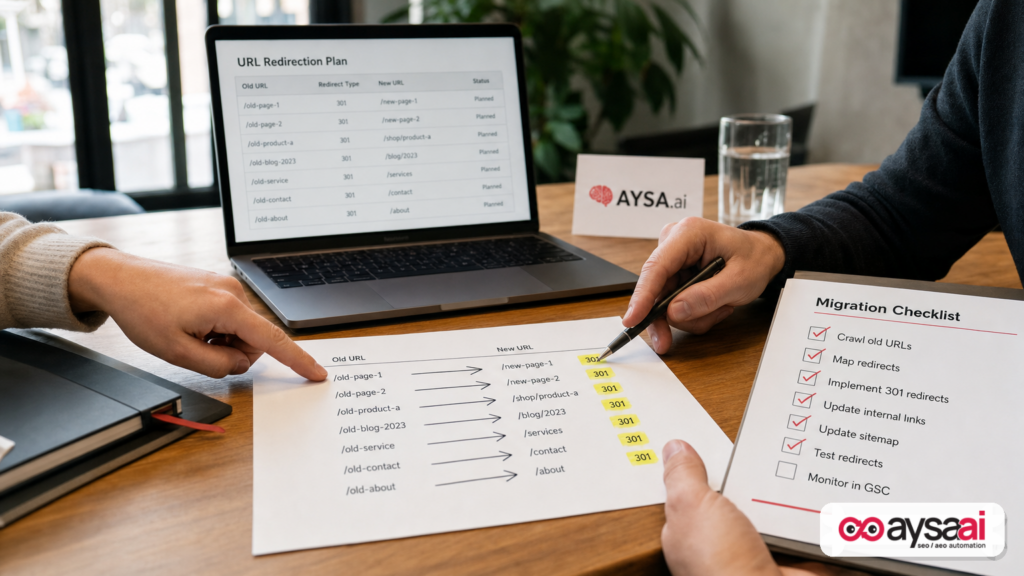
1) URL changes & redirects: the equity-preservation game
URL changes happen for good reasons: reorganizing services, renaming categories, simplifying structure, rebranding, consolidating thin pages. The risk is that search engines treat a new URL as a new page. If you don’t carry signals forward, you reset history.
What usually goes wrong
- Missing redirects for long-tail pages (often the ones driving the most intent).
- Bad mapping: redirecting many old URLs to a homepage or generic category, which weakens relevance.
- Redirect chains (A → B → C), which waste crawl and reduce signal clarity.
- Internal links aren’t updated, so the site keeps pointing to old URLs.
- Sitemaps still list old URLs, slowing re-discovery.
The source stresses redirect planning, testing in a dev environment, and post-launch verification, plus updating internal links and XML sitemaps (Search Engine Land).
How to ship URL changes safely
- Create a redirect map from every old URL to its best new equivalent. No “close enough” shortcuts.
- Prefer 1:1 mapping where possible. If you must consolidate, do it intentionally (and expect volatility).
- Test redirects before launch in staging or a controlled environment.
- Update internal links so your own pages reinforce the new structure.
- Update XML sitemaps and submit/monitor in Google Search Console after launch.
Primary reference for sitemaps and GSC workflows: Google Search Central: Sitemaps.
2) Canonicals: the easiest way to de-index your own site by accident
Canonicals are a hint to search engines about which URL is the “preferred” version when duplicates exist (parameters, faceted navigation, print pages, near-duplicate variants). Used correctly, canonicals consolidate signals and reduce internal competition. Used incorrectly, they tell Google to ignore pages you actually want indexed.
What usually goes wrong
- Template-wide canonical mistakes: one wrong canonical in a theme can affect thousands of pages.
- Self-referential canonicals missing or inconsistent across page types.
- Canonical targets that 404 or redirect, creating a signal mess.
- Conflicting signals: canonical says A, internal links emphasize B, sitemap lists C.
Search Engine Land highlights that canonical errors can be hard to spot once deployed at scale and can cause key pages to lose visibility or drop out of the index (source).
How to ship canonical changes safely
- Define canonical rules per template (product, category, blog, location, search results).
- Validate canonical targets (200 status, correct content, indexable).
- Spot-check at scale: don’t test 3 URLs—test 300 across patterns.
- Align signals: canonicals, internal links, sitemaps, and hreflang (if relevant) should point to the same “truth.”
Primary reference: Google Search Central: Canonicalization.
3) robots.txt & indexing controls: when “efficiency” becomes invisibility
robots.txt controls crawler access. It’s often used to reduce crawl waste (filters, internal search, low-value parameter pages). But robots mistakes don’t “slightly hurt.” They can remove entire sections of the site from discovery.
What usually goes wrong
- Overly broad disallow rules that block important directories.
- Shipping a staging robots.txt (common during redesigns) that blocks everything.
- Confusing robots blocking with noindex: robots prevents crawling; noindex is a separate directive and requires the page to be crawlable to be seen.
The source calls out that a small robots.txt change can have sitewide implications and must be tested, reviewed, and verified after launch (Search Engine Land).
How to ship robots changes safely
- Write rules for patterns you truly understand. If you can’t explain what URLs match, don’t ship it.
- Maintain an allowlist mentality for key sections: ensure critical directories remain crawlable.
- Document intent (why this rule exists) so it doesn’t get “optimized” away later.
Primary reference: Google Search Central: robots.txt.
4) Internal linking & navigation: the quiet rewiring of discovery
Internal links do two things at once:
- They help users find what they need.
- They help crawlers discover and understand what matters.
Internal linking is “safe” when it’s incremental (a few contextual links). It becomes high-risk when you change navigation, global menus, category structure, or templated link modules across the site.
What usually goes wrong
- Orphaned pages: pages no longer linked internally, so discovery slows or stops.
- Navigation hides revenue pages under more clicks, reducing crawl priority and user engagement.
- Accidental links to staging/non-public URLs during redesigns.
- Mass changes without measurement: you don’t notice the drop until weeks later.
The source emphasizes that large-scale navigation updates can affect thousands of pages and are far riskier than adding a handful of links (Search Engine Land).
How to ship internal linking changes safely
- Inventory key pathways: homepage → top categories/services → money pages.
- Protect important hubs: ensure category/service pages remain prominently linked.
- Measure before/after in Search Console (coverage, indexing, performance) and analytics (landing page sessions, conversions).
Monitoring workflows belong here: AYSA Monitoring.
5) Site migrations: a bundle of risks pretending to be one project
Migrations combine all the previous risks into a single launch:
- URLs and redirects,
- canonicals,
- robots and indexation directives,
- internal linking and navigation,
- content changes, template changes, performance changes.
The Search Engine Land piece is clear: migrations are inherently risky, even when well planned, because so many moving pieces can fail simultaneously; that’s why documentation, QA, post-launch testing, and monitoring are non-negotiable (source).
What usually goes wrong
- Redirect coverage gaps (long tail pages forgotten).
- Indexing directives flip (noindex, robots blocks) when staging settings leak.
- Canonical/hreflang mismatches after CMS changes.
- Sitemaps and internal links don’t match new reality.
- Analytics/tracking breaks, so you can’t even measure the damage accurately.
How to ship a migration safely
If you’re an SME, here’s the simplest way to stay safe:
- Freeze scope: avoid stacking “nice to have” changes onto a migration.
- Build a migration runbook: redirect map, canonical rules, robots rules, sitemap plan, internal linking plan, measurement plan.
- Stage and QA: crawl staging, compare patterns, test edge cases.
- Launch with monitoring: treat launch week like an incident-response period, not a celebration.
Primary reference (general): Google Search Central: SEO Starter Guide (useful baseline; Google’s migration-specific documentation isn’t included in the provided research context, so rely on internal runbooks and conservative practices).
A practical QA checklist (pre-launch, launch day, post-launch)
Here’s the checklist I want SMEs and agencies to adopt. Not because it’s “perfect,” but because it’s repeatable.
Pre-launch (staging or dev)
- Crawl staging (or at minimum, test representative URL patterns) and confirm status codes, canonicals, meta robots, and internal links match expectations.
- Redirect validation: sample test the mapping and check for chains and loops.
- Robots sanity check: confirm no blanket blocks exist; confirm key directories are crawlable.
- Indexability audit: ensure revenue templates are indexable (noindex is intentional where present).
- Sitemap preview: confirm new sitemaps include only canonical, indexable URLs (and exclude parameter junk).
- Analytics and tag verification plan: know what “healthy” looks like on day one.
Launch day (first 60–120 minutes)
- Check robots.txt live first. If it’s wrong, nothing else matters.
- Test redirects live (top 50–200 URLs across patterns).
- Spot-check canonical tags on key templates.
- Confirm server responses (no unexpected 5xx, no mass 404s).
- Verify sitemap availability and submit in Google Search Console if changed.
Post-launch (first week)
- Monitor Search Console: coverage/indexing shifts, crawl stats, performance changes.
- Monitor analytics: organic landing page sessions and conversions by template.
- Re-crawl production to compare against staging expectations and catch drift.
- Resolve issues fast: prioritize anything that blocks crawling/indexing or breaks top landing pages.
This is where systems beat heroics. Monitoring isn’t an “SEO tool feature.” It’s how you know the release worked. AYSA’s monitoring workflow is designed for this reality: AYSA Monitoring.
SME scenario: a local clinic redesign that keeps rankings (instead of losing them)
Consider a multi-location physical therapy clinic. The owner wants a redesign and “cleaner URLs.” The dev team proposes changing:
- /services/back-pain-treatment → /treatments/back-pain
- /locations/san-diego → /clinics/san-diego-ca
- removing the old blog categories from navigation
This is how clinics lose leads for 6–12 months—because local service pages and location pages are usually the revenue engine.
What a safe implementation looks like
- Decision checkpoint: Are the new URLs meaningfully better for users and internal organization? If yes, proceed. If it’s vanity, defer.
- Redirect mapping: 1:1 redirects for every service and location page (no homepage dumping).
- Internal links: update navigation and in-content links to point directly to new URLs so the site stops “remembering” the old structure.
- Canonicals: ensure each new page canonicalizes to itself (unless there’s a deliberate duplicate strategy).
- Robots check: confirm that /clinics/ isn’t disallowed by an old staging rule or an overbroad directory rule.
- Monitoring: set alerts for spikes in 404s, drops in clicks for top location pages, and unusual index coverage changes.
Notice what’s missing: arguing about title tag length or rewriting meta descriptions for pages that don’t drive business. That stuff can be helpful, but it won’t save you from technical errors that block discovery.
If you’re a clinic, hotel, florist, home service brand, or any local business, the principle is the same: protect the URLs that already rank and convert, and treat structural changes as risk-managed releases.
Related reading lead from the source page that’s useful for local operators: How semantics and topical authority improve local SEO (Search Engine Land).
What agencies and in-house teams must change in 2026+
Here’s my opinionated take: the SEO industry has over-invested in diagnosing and under-invested in shipping.
Audits, crawls, and reports are abundant. What’s scarce is a reliable system that ensures:
- the recommendation is correct for the business,
- the implementation matches the intent,
- the launch is validated,
- the impact is monitored,
- issues are caught early and resolved fast.
For agencies
- Stop handing over “lists.” Provide a launch plan, QA plan, and a measurement plan for any high-risk change.
- Write tickets like an engineer. Include examples, URL patterns, rules, and acceptance criteria (the source explicitly calls for clear documentation and defined success criteria).
- Be present at launch. Not for optics—because production deviates from staging in ways you can’t predict.
For in-house teams
- Adopt approval gates. High-impact SEO changes should require explicit signoff (SEO + engineering).
- Require a rollback path. If you can’t revert quickly, limit scope and ship in smaller batches.
- Make monitoring an owner’s responsibility. If nobody owns it, it won’t happen.
This operational shift matters more as search becomes more blended across classic results and AI-driven experiences. If your site becomes harder to crawl, harder to interpret, or inconsistent in canonical/indexing signals, you’re not just risking “rankings”—you’re risking whether your pages are even eligible to be surfaced.
For businesses thinking beyond classic SEO into AI discovery, start here: AYSA AI Search Visibility.
How AYSA reduces implementation risk: monitored, approval-based execution
Most SMEs don’t have an SEO engineering team. They have:
- a founder or marketing manager,
- a dev resource (in-house or freelance),
- an agency (sometimes),
- and a site that changes constantly.
That’s exactly where technical SEO breaks: changes happen, but accountability is blurry.
AYSA is built to close the gap between “we know what to do” and “it shipped correctly.” The model is simple:
- Monitor your site for the signals that matter (indexability, visibility, and technical regressions): AYSA Monitoring
- Prepare changes with context, examples, and a clear intent (so implementation matches the recommendation)
- Ask for approval before executing high-impact updates (approved execution, not silent changes)
- Execute accepted changes and then validate outcomes against expectations
In practical terms, AYSA helps teams avoid the common failure modes called out in the source article: misunderstandings, assumptions, overlooked details, and lack of post-launch monitoring (Search Engine Land).
If you want to explore how AYSA supports technical and AI-era search execution, start here:
What to do next
If you’re planning (or already mid-flight on) a high-impact technical SEO change, take these steps in order:
- Inventory what’s changing (URLs, templates, robots, canonicals, navigation). If you can’t list it, you can’t manage it.
- Rank each change by Impact × Risk × Effort. Identify what’s high-risk and deserves extra QA.
- Create acceptance criteria: what does “correct” look like on 20 sample URLs across patterns?
- Build a pre-launch QA plan (crawl, rules validation, redirect tests, indexability checks).
- Schedule post-launch validation (first hour, first day, first week) and assign an owner.
- Set monitoring and alerts for 404 spikes, indexing drops, and top landing page declines.
- Document rollback steps before you launch, not after.
If your team needs a system to support continuous monitoring and approval-based execution—so technical SEO changes don’t quietly break growth—evaluate AYSA’s workflow approach: AYSA Monitoring and AI SEO Tools.
Sources and further reading
- Search Engine Land: How to safely implement high-impact technical SEO changes
- Google Search Central: robots.txt
- Google Search Central: Canonicalization
- Google Search Central: Sitemaps overview
- Google Search Central: SEO Starter Guide
- Search Engine Land: How semantics and topical authority improve local SEO
- Search Engine Land: How SEO reduces blended customer acquisition costs
Continue the AI search topic inside AYSA.
Use these pages to connect the article with AI SEO tools, AI visibility monitoring, AI Overviews and approved website execution.
Turn this topic into a website action plan.
Use these AYSA hubs to move from reading to technical fixes, AI visibility monitoring, research, glossary context and approval-first SEO execution.

