
Beyond Google: A Practical Playbook For Winning Visibility In AI Answer Engines, Privacy Search, And Regional Platforms
Google is still the default—but the fastest-growing visibility risk for SMEs isn’t “ranking lower in Google,” it’s being absent from the engines people use when they want an instant answer, more privacy, or local-first results. Here’s how alternative search engines actually work, what changes for marketing, and a step-by-step plan (with AYSA) to monitor and execute improvements safely.

By Marius Dosinescu / AYSA.ai
Most businesses still treat “search” like it’s synonymous with Google. That habit made sense for a long time. But the reality now is simpler and more uncomfortable: customers are asking questions in AI answer engines, shopping and validating in different ecosystems, and researching in regional platforms that do not behave like Google at all.
You don’t have to quit Google. You do have to stop assuming Google is the only gateway to discovery.
This editorial is a practical playbook for SMEs and agencies that want visibility across:
- AI Search and answer engines (where the “result” is often a synthesized answer with citations)
- General web alternatives (where features like visual search or different SERP layouts change behavior)
- Privacy-first and control-first engines (where tracking and personalization work differently)
- Regional search ecosystems (where local platforms dominate and “webpages” are only part of the experience)
The reference point for this article is Search Engine Journal’s overview of alternative search engines, which is worth reading as a broad catalog: Search Engine Journal: 21 Alternative Search Engines You Can Use Instead of Google. I’m not going to re-list them as a directory. Instead, I’m going to explain what changed, why it matters commercially, and exactly what to do next.
Concise summary (read this first)

Search has fragmented into multiple “best tools” depending on intent. When users want a fast, cited explanation, they choose an Answer engine. When they want privacy, they choose engines that don’t build a personal history. When they want local truth in another market, they choose regional platforms with their own content layers.
That changes SEO from “rank a page” to “prove a claim across sources.” In AI answers, you’re competing to be cited. In privacy-first search, you’re competing without personalization crutches. In regional engines, you’re competing inside ecosystems (maps, blogs, Q&A, platform content) not just on the open web.
The winners will treat visibility like operations. Monitor how you appear, prepare improvements, get approval, and execute continuously. That is exactly where AYSA fits: monitor visibility and signals, prepare</em recommended site changes, ask for approval, then execute</em accepted updates safely at scale. Start here: AI Search Visibility.
Key takeaways
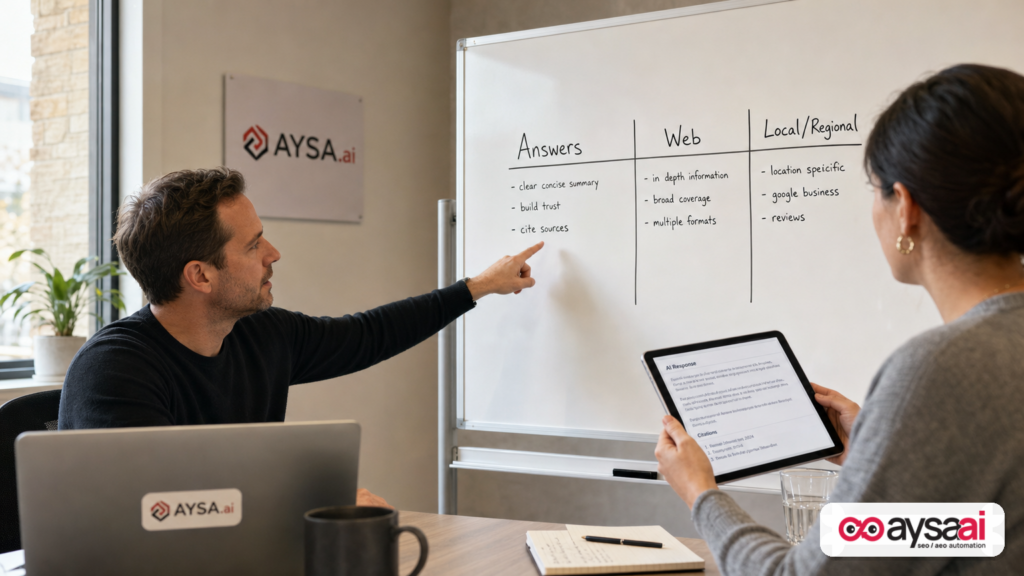
- Alternative engines are not “just smaller Googles.” Many aren’t even web indexes—they’re answer interfaces, social platforms, archives, or specialized databases.
- AI answers shift the battleground to citations. If your brand isn’t cited, it may be absent from the customer’s decision path—even if you “rank” traditionally.
- Privacy-first search reduces the impact of personalization. Your fundamentals (clarity, structure, topical authority, speed, and Crawlability) matter more.
- Regional platforms require localization in sources, not just translation. What ranks is often hosted within those ecosystems (community posts, Q&A, local publishers).
- Execution velocity is now a competitive advantage. The companies that ship improvements weekly will outrun companies that do quarterly “SEO projects.”
Table of contents

- The new search reality: it’s not “Google vs. everyone,” it’s intent vs. interface
- A practical taxonomy of “alternative search” (so you don’t optimize blindly)
- AI answer engines: how visibility works when the SERP is a paragraph
- What to learn from ChatGPT and Perplexity—even if referral traffic is small
- General web alternatives: Bing and Yahoo (and why they still matter)
- Regional engines: Baidu, Naver, Yandex, and the “ecosystem” problem
- Privacy and control-first search: Brave, DuckDuckGo, Startpage, Kagi
- Search with different funding models: Ecosia, KARMA, Yep (and what to assume)
- Specialist search tools: social, professional, archives, computation, and open media
- What can go wrong: hallucinations, mis-citations, outdated pages, and brand risk
- What SMEs should monitor now (weekly/monthly) to stay visible
- What agencies should rethink: reporting and execution in a multi-engine world
- Where AYSA fits: monitoring + approved execution for AI search visibility
- What to do next (the action list)
- Sources and further reading
The new search reality: it’s not “Google vs. everyone,” it’s intent vs. interface
Businesses often interpret “alternative search engines” as a market-share conversation: Google is huge, everyone else is small, therefore it doesn’t matter. That logic was always incomplete—and now it’s actively risky.
People pick the search tool that reduces friction for the job they’re doing:
- “Explain this and cite sources” → they reach for an AI answer engine.
- “I want results without being tracked” → they use a privacy model they trust.
- “Show me what people in Korea/China/Russia are actually reading” → they use regional platforms, not translated Google results.
- “Find this from a photo” → they use visual search features where they work best.
- “Find what the company actually said” → they search the platform where it was posted (social/pro networks).
So the strategic question is no longer, “Which engine has the biggest market share?” It’s:
- Where do my customers go for each stage of decision-making?
- What sources do those engines cite or prioritize?
- Can my site and brand be understood, trusted, and summarized correctly?
Search Engine Journal’s catalog is helpful as a menu of options across AI answers, general web search, privacy-focused engines, regional engines, and specialist tools (SEJ article). What matters for your business is turning that menu into a playbook.
A practical taxonomy of “alternative search” (so you don’t optimize blindly)
“Alternative search engines” is an overloaded phrase. Some alternatives are full web search engines; others are front-ends powered by major providers; others are not web search at all.
Category 1: AI search and answer engines
These tools aim to return a synthesized answer, usually with citations, and keep context across follow-up questions. Search Engine Journal highlights ChatGPT and Perplexity as leading examples in this category (source).
Optimization reality: You’re not just trying to “rank.” You’re trying to be a trustworthy, easily cited source for the specific claim the engine is answering.
Category 2: General web search alternatives
These behave more like classic search engines—web, images, news, video—often with additional AI layers. SEJ calls out Microsoft Bing and Yahoo Search in this category.
Optimization reality: Classic SEO fundamentals still apply, but SERP Features, layout differences, and integrated tools (like visual search) can shift click behavior.
Category 3: Regional engines and ecosystems
SEJ lists Baidu, Naver, Yandex, and Sogou, noting their importance in China, South Korea, and Russia and their surrounding content ecosystems.
Optimization reality: This is as much localization and ecosystem strategy as it is “SEO.” You may need content inside those platforms (or partnerships with local publishers) in addition to your own site.
Category 4: Privacy-first and control-first search
SEJ includes Brave Search, DuckDuckGo, Startpage, and Kagi—each with different approaches to privacy, Indexing, and user control.
Optimization reality: Personalization is often reduced, and user trust is higher. Your content has to be clear, structured, and credible without relying on brand familiarity.
Category 5: Alternative funding models
SEJ covers engines like Ecosia and KARMA Search (cause-oriented) and Yep (developer/API and alternative indexing motivations).
Optimization reality: Don’t assume unique ranking systems. Treat them as distribution surfaces, validate where results come from, and focus on clean technical fundamentals.
Category 6: Specialist search tools
SEJ includes platform search (x.com, LinkedIn), archival search (Wayback Machine), slide search (SlideShare), computation (WolframAlpha), and open media catalogs (Openverse).
Optimization reality: Your site might be irrelevant here; your content format, licensing, or presence on the platform is what matters.
AI answer engines: how visibility works when the SERP is a paragraph
When an AI engine answers a question directly, two things happen to your marketing funnel:
- The click becomes optional. The user may get what they need without visiting your site.
- The citation becomes the new “ranking.” If you’re cited, you’re part of the decision. If you’re not, you may not exist.
This is why “AI Search Optimization” isn’t just a buzzword. It’s a change in interface and behavior: the interface can satisfy intent without a click; behavior shifts from “scan 10 blue links” to “accept an answer unless something feels off.”
What AI engines tend to reward (without promising guarantees)
We should be careful: these systems don’t publish full ranking algorithms in a way we can treat as deterministic. But we can still be practical about what consistently makes content more citable and less misread:
- Clear, atomic statements (definitions, specifications, policies, steps) that can be quoted without losing meaning.
- Strong entity signals (who you are, what you do, where you operate, who is responsible for content).
- Well-structured pages (headings that match questions, concise summaries, FAQ blocks where appropriate).
- Freshness where it matters (pricing pages, availability, timelines, compliance claims).
- Evidence and references (your claims backed by documentation, standards, or clear policies).
In other words: AI engines make the cost of vague marketing copy painfully visible.
New KPI: “Cited share of voice,” not just “rank”
In a classic SEO report, you track rankings, traffic, conversions. In AI answers, you also need to track:
- Which questions in your niche produce AI answers?
- Which sources get cited?
- Whether the answer accurately reflects your brand, products, and policies
- Whether outdated or low-quality sources are being used instead
This is why we built AYSA’s monitoring-first approach. Start with monitoring visibility patterns, then implement fixes safely with approval gates: AYSA Monitoring.
What to learn from ChatGPT and Perplexity—even if referral traffic is small
Search Engine Journal highlights two tools in particular under “AI Search and Answer Engines”: ChatGPT and Perplexity (SEJ).
I care about them for one reason: they are a controlled environment to test the questions your customers ask and the sources the model chooses to cite.
ChatGPT: the conversation is the product
SEJ’s description is the key: ChatGPT is useful when the user needs a conversation, not just a new keyword query each time. That matters because customer journeys aren’t single questions. They are sequences:
- “What’s the best X?”
- “Compare X vs Y for my situation.”
- “What are the downsides?”
- “How much does it cost?”
- “What should I ask a vendor?”
In a conversational interface, context compounding becomes your risk. If your brand is introduced incorrectly early in the conversation, the user may never correct it. Your job is to make it easy for the engine to get the facts right.
SEJ notes that ChatGPT can retrieve current web information and link to sources, and that you should open citations because it can misread sources or miss nuance. That’s not a criticism—it’s the operational reality for businesses: you need to verify how you are represented.
Perplexity: citations are the experience
Perplexity’s interface pushes source-backed answers. SEJ also calls out that follow-up questions preserve context and that there are tier-dependent limitations and narrowing options. The important business angle is this:
Perplexity is a “citation laboratory” for your category.
Even if Perplexity sends less traffic than Google, it reveals what sources are considered “explainers” in your market. If your competitors are cited and you are not, you have a content and authority gap that will likely show up elsewhere too.
SEJ references an SEJ piece on why SEO experts should care about Perplexity, emphasizing it as a test bench. I agree with that framing. Use it as a diagnostic tool, not just a traffic source.
Practical tests you can run this week
- Brand definition test: “What is [Your Company]?” Does the answer match your positioning?
- Comparison test: “[Your product] vs [competitor] for [use case].” Which sources get cited?
- Policy test: “Does [your company] offer refunds / trials / same-day appointments?” Are the facts correct?
- Local intent test (if applicable): “Best [service] in [city].” Are directories beating real providers?
If the answers are wrong or thin, you don’t argue with the model. You improve the web footprint the model learns from: your site structure, clarity, and the third-party sources that corroborate you.
General web alternatives: Bing and Yahoo (and why they still matter)
SEJ positions Microsoft Bing as a “full-service alternative” and calls out Visual Search as a concrete reason to use it (SEJ). That one detail is a reminder: engines matter because of features, not ideology.
Bing: don’t treat it as “Google #2”
Bing is valuable for businesses for three practical reasons:
- Different SERP layouts can change click distribution (especially for commerce, images, and video).
- Different defaults (browser/OS integrations) can concentrate certain audiences.
- Different feature emphasis like visual search workflows.
If your product is visually identifiable (apparel, decor, home improvement, plants, beauty), visual search is not a gimmick—it’s a different entry point. Your image SEO, product markup, and image naming/alt text become more than a compliance exercise; they become discoverability infrastructure.
Yahoo: ecosystem-driven search
SEJ’s framing is also right: Yahoo Search is compelling mostly if users already live in Yahoo’s content ecosystem (news/finance). The key operational insight for businesses is that ecosystem-driven search tends to amplify:
- publisher content (news, explainers)
- structured data and knowledge-style answers
- well-cited sources rather than thin affiliate pages
SEJ notes Yahoo’s Scout initiative and its use of multiple components (including citations and grounding). The conclusion is straightforward: if your industry depends on credibility signals, you want to be a citable source, not just a landing page.
Regional engines: Baidu, Naver, Yandex, and the “ecosystem” problem
If your business has international exposure—customers, suppliers, investors, partners—or you’re doing competitive research, regional engines are not optional. SEJ highlights Baidu (China), Naver (South Korea), and Yandex (Russia) as major regional environments, and also includes Sogou with its WeChat search angle (SEJ).
Here’s the mistake companies make: they treat regional engines as “Google, but in another language.” That is rarely true.
The ecosystem problem: results aren’t only webpages
SEJ notes that Baidu’s environment includes maps, an encyclopedia (Baike), Q&A (Zhidao), and documents (Wenku). Naver blends news, maps, cafés/communities, blogs, and Q&A (Knowledge iN). This is the ecosystem problem:
The content that shapes perception is often hosted inside the platform’s own properties and community layers.
If you only translate your English homepage and hope it ranks, you’re not competing in the right arena. You need a localized source strategy:
- Local terminology research (what people actually call the problem/product)
- Local corroboration (local publishers, communities, official listings)
- Local formats (Q&A participation, community posts, platform-native content where appropriate)
What businesses should do (without pretending one-size-fits-all)
I’m not going to claim a universal playbook for Baidu/Naver/Yandex—each market has legal, cultural, and platform nuances, and you should use official webmaster resources where available (SEJ mentions Naver Search Advisor as the official starting point).
But there are cross-market principles that reduce risk:
- Separate “brand presence” from “website traffic.” In ecosystems, you may need presence where the audience spends attention, not just links to your domain.
- Audit what ranks for local terms. Identify whether results favor communities, marketplaces, publishers, or company sites.
- Build a source map. List the top domains and platform properties that are repeatedly visible; decide where you can contribute legitimately.
- Localize proof, not slogans. Policies, pricing, shipping/returns, compliance—these are the facts engines summarize and users rely on.
If you want to do this systematically, you need monitoring that doesn’t stop at “Google US.” This is exactly the sort of multi-surface visibility problem where continuous monitoring plus controlled execution is the only scalable approach (AYSA Monitoring).
Privacy and control-first search: Brave, DuckDuckGo, Startpage, Kagi
This category isn’t about novelty—it’s about trust. SEJ outlines multiple approaches:
- Brave Search: independent index + ranking controls (“Goggles”)
- DuckDuckGo: privacy-first model; sources often include Bing plus other inputs
- Startpage: privacy intermediary for results from major providers
- Kagi: paid, ad-free search with user-level control over domains and “lenses”
(All referenced in SEJ’s overview: SEJ.)
Why this matters to businesses
Privacy and control-first search tends to reduce reliance on behavioral profiling. That means two things:
- Your content quality and clarity matter more than your retargeting machine.
- Brand trust is built by consistency across sources. If your site says one thing and third-party sources suggest another, you lose.
What to optimize (practical, non-theoretical)
- Clean technical accessibility: crawlable pages, fast loading, no broken canonicals, no blocked resources that hide content from crawlers.
- Information architecture that matches real questions: service pages that actually explain, not just sell; clear FAQs; policies in plain English.
- Domain and content consistency: the same name, same descriptions, same key facts across your site, profiles, and citations.
- Less fluff, more proof: examples, constraints, pricing logic, documented processes.
In Kagi’s case (as described by SEJ), users can boost or block domains. That is an uncomfortable truth: some users will literally downrank your site if you waste their time. That should pressure us toward usefulness.
Search with different funding models: Ecosia, KARMA, Yep (and what to assume)
SEJ lists Ecosia (climate mission), KARMA Search (animal welfare/biodiversity mission), and Yep (Ahrefs-built search and developer-facing APIs) (SEJ).
Here’s the business trap: assuming these engines have unique ranking systems that require unique “SEO tricks.” Often, the more honest approach is:
- Assume fundamentals first. Many engines blend sources or use major providers for parts of results.
- Validate, don’t guess. If a service offers a way to inspect provider info (SEJ notes Ecosia’s provider documentation and controls), use it.
- Optimize for clarity, crawlability, and credibility. Those translate across engines.
For SMEs, the commercial decision is usually not “Should we do special Ecosia SEO?” It’s:
- Do our customers care about these missions?
- Does aligning with them strengthen brand trust?
- Are we visible and accurate when searched there?
Yep is interesting for a different reason: SEJ notes its developer/API angle and the presence of a first-party crawler/index/ranking claims on its current page. For most SMEs, that’s not an immediate channel—unless your audience is technical or your product is developer-facing. But it’s a signal of where the web is headed: search indexes are becoming infrastructure for agents and applications, not only for consumers.
Specialist search tools: social, professional, archives, computation, and open media
SEJ’s list includes specialist tools such as x.com, LinkedIn, Wayback Machine, SlideShare, WolframAlpha, and Openverse (SEJ). Even if your team never calls these “search engines,” customers use them to find evidence.
Platform search (x.com, LinkedIn): visibility is content operations
When a user wants to know what a company or person said, platform search can be the fastest way. This is not a classic SEO issue—it’s a publishing discipline issue:
- Do you publish clear updates that can be referenced later?
- Are statements consistent with your site policies and product pages?
- Can a journalist, partner, or customer validate claims quickly?
If your site says one thing and an executive post suggests another, AI answer engines can pick up the inconsistency and “average” it into confusion.
Wayback Machine: reputation, receipts, and accountability
Archives matter in disputes, compliance, and trust-building. If you change pricing, terms, or claims, people can and do check historical snapshots. The business lesson: treat critical pages like contracts. Keep change logs and be careful with silent edits.
WolframAlpha: when correctness matters more than persuasion
Some user intents are computational or definitional. You might not “rank” there, but your content should respect this reality: there are questions where marketing language is disqualifying. Provide precise specs, constraints, and definitions for product pages and technical docs.
Openverse and reusable media discovery
If you publish images, diagrams, or creative assets and want them reused legitimately, licensing and metadata matter. This isn’t only for creators; it matters for SaaS companies, educators, and ecommerce brands that publish guides and visuals. Make it easy for others to attribute you correctly.
What can go wrong: hallucinations, mis-citations, outdated pages, and brand risk
AI answers with citations feel trustworthy, but the operational reality is messy. SEJ explicitly warns to check citations because AI answers can hallucinate or misread sources even when links are present. Businesses must treat this as a brand risk domain, not a curiosity.
Four common failure modes
- Citation drift: A citation is present but doesn’t actually support the nearby claim.
- Outdated truth: The engine summarizes an old policy page, old blog post, or scraped snippet that no longer applies.
- Entity confusion: Brands with similar names get merged; locations get mixed; product versions get conflated.
- Local directory dominance: For local intent, directories and aggregators get cited instead of the business itself, leading to wrong hours, wrong pricing, wrong services.
How to reduce risk (the practical approach)
- Make your “truth pages” obvious: one canonical page for pricing, one for returns, one for appointments, one for shipping, etc.
- Write for extractability: include short summaries that can be quoted; define terms; avoid ambiguous qualifiers.
- Keep critical facts consistent across the web: site, profiles, partners, directories, industry listings.
- Monitor AI answers: not once—continuously.
This is where execution discipline matters. If you find incorrect AI summaries, the fix is usually not “complain to the model.” The fix is: correct the web signals and keep them correct.
What SMEs should monitor now (weekly/monthly) to stay visible
If you’re a founder or operator, you do not need 40 dashboards. You need a small number of checks that catch 80% of risk.
Weekly checks (30–60 minutes)
- Your brand query in at least one answer engine: Is the description accurate? Are citations credible?
- Your top 5 “money questions”: “cost,” “near me,” “best,” “vs,” “reviews,” “return policy,” etc.—whatever drives decisions in your market.
- One competitor comparison query: Are they being cited as the default option? Why?
- Your top local intent query (if relevant): Are directories outranking and out-citing you?
Monthly checks (2–4 hours)
- Content freshness audit: pricing, shipping/returns, service coverage, compliance disclaimers.
- Technical health scan: indexation anomalies, broken pages, canonical mistakes, slow templates.
- Source footprint review: what third-party pages are ranking/cited for your brand and category.
If you want a system to do this continuously without turning it into a full-time job, use an execution platform that can monitor, propose changes, and push approved updates—without risky manual interventions. This is the operational model we built around at AYSA: AI SEO Tools.
What agencies should rethink: reporting and execution in a multi-engine world
Agencies are going to feel this shift earlier than most SMEs, because clients will ask: “Why am I not showing up in AI answers?”
Here’s what needs to change:
1) Reporting must include “answer visibility,” not just rank/traffic
Classic rank trackers were built for 10 blue links. You need to show:
- Which queries produce AI answers
- Whether the client is cited
- Which sources are cited instead
- Accuracy issues and brand risk items
2) Strategy must become “source strategy”
In an AI-citation world, “content strategy” expands to include the sources that corroborate you:
- industry publications
- documentation and standards
- local listings
- platform-native content where appropriate
3) Execution is the bottleneck, not ideas
The uncomfortable truth: most SEO programs don’t fail because the strategist is wrong. They fail because changes take too long to ship, or ship inconsistently.
That’s why “approved execution” matters. In real organizations, you need guardrails:
- recommendations prepared with context
- stakeholder approval workflows
- controlled publishing and rollback
- continuous monitoring after deployment
This is exactly the lane for AYSA’s model: monitor → prepare → approve → execute. If you’re an agency, start with the platform overview: AYSA Pricing.
Where AYSA fits: monitoring + approved execution for AI search visibility
Most “AI search visibility” conversations stall at theory: structure your content, add schema, write better FAQs, build authority. All true. But businesses don’t win on truths they don’t implement.
AYSA is built for the gap between knowing and doing:
- Monitor: Track visibility and signals across the surfaces that matter (AI answers, search behaviors, and the site’s technical/content signals that support them). See: Monitoring.
- Prepare: Turn findings into concrete, page-level change proposals (content improvements, internal linking opportunities, technical fixes).
- Ask for approval: No black-box automation that can damage brand voice or compliance. Humans approve what goes live.
- Execute: Publish accepted changes reliably and continuously—because velocity is now a ranking factor in practice (not algorithmically, but competitively).
If you’re new to this shift, start with our overview on AI search visibility: AI Search Visibility. If you want to explore related guidance, our blog is here: AYSA Blog.
A concrete SME scenario: the local clinic that “disappeared” in AI answers
Let’s make this real.
Business: A multi-location dental clinic in a mid-sized U.S. metro area.
Problem: The clinic ranks well in Google for branded terms and some service queries. But patients increasingly ask AI tools: “Do they accept my insurance?” “Do they do emergency visits?” “What’s the difference between Invisalign and braces here?” The AI answers cite directories and old blog posts, not the clinic’s own pages. The AI answer implies outdated hours and a service they stopped offering.
Impact: Calls drop for high-intent questions. Front desk spends more time correcting misunderstandings. Reviews mention “they said online you…” which the clinic never said—an AI summary did.
What we do (the practical playbook)
- Identify the clinic’s “truth pages”: insurance, emergency policy, hours, locations, pricing ranges, services offered.
- Rewrite for extractability: short opening summaries, clear bullet points, explicit constraints (e.g., “emergency visits available until X time”).
- Unify entity signals: consistent NAP, consistent location details, consistent naming across the website and profiles.
- Reduce outdated citations: update or consolidate old blog posts, add clear “last updated” context where appropriate, and avoid leaving contradictory pages live.
- Monitor AI answers monthly: verify that answers cite the clinic’s pages more often, and that the summaries match reality.
Where AYSA fits: This is not a one-time project. Policies change, hours change, insurance lists change. AYSA’s monitoring and approved execution model is built for ongoing correctness, not a quarterly “SEO sprint.”
What to do next (the action list)
- Pick your top 20 customer questions. Not keywords—questions. Include “vs,” “cost,” “near me,” “how long,” “is it worth it,” “refund,” “warranty,” “availability.”
- Test them in one AI answer engine and one general web engine. Record: answer quality, citations, whether you are cited, and whether the answer is accurate.
- Build or fix “truth pages.” Create one canonical source for each critical fact category (pricing logic, policies, service scope, location details).
- Rewrite intros for extractability. Add a short summary that an AI can quote without distortion.
- Remove contradictions. Consolidate overlapping pages, update outdated posts, ensure consistent claims across your site.
- Strengthen corroboration. Ensure reputable third-party references are accurate (profiles, directories, local listings, partners). Don’t chase links; chase consistency and credibility.
- Operationalize it. Set monitoring and a publishing cadence. If you can’t execute weekly, you will be outpaced.
- Use AYSA to systematize execution. Start with monitoring: AYSA Monitoring and AI search visibility: AI Search Visibility.
Sources and further reading
- Search Engine Journal — 21 Alternative Search Engines You Can Use Instead of Google
- Search Engine Journal — AI Search (category)
- Search Engine Journal — SEO (category)
- Search Engine Journal — Technical SEO (category)
- Search Engine Journal — Local SEO (category)
- Search Engine Journal — Google Updates (history)
Related AYSA resources
Continue the AI search topic inside AYSA.
Use these pages to connect the article with AI SEO tools, AI visibility monitoring, AI Overviews and approved website execution.
Turn this topic into a website action plan.
Use these AYSA hubs to move from reading to technical fixes, AI visibility monitoring, research, glossary context and approval-first SEO execution.