
The Next Google Update Won’t Be an Update: How “Knowledge Drift” in AI Answers Will Replace Index Chasing
Stop matching traffic drops to update dates. The bigger risk is silent knowledge drift inside AI assistants: what they “remember” about your business can change on a cycle you can’t see. Here’s how to monitor it, fix it, and operationalize AEO/GEO with approved execution.

For most of the last 15+ years, businesses learned a reflex: if traffic drops, look for a Google update date, match the timeline, and explain what happened.
That reflex is becoming less useful—not because Google stopped updating, but because the most business-critical changes may shift above the index. The new risk is “knowledge drift”: AI assistants quietly changing what they state as facts about your company, your products, your policies, and your reputation. No ranking signal dashboard. No confirmed rollout. Just a different answer.
This editorial is inspired by analysis published by Search Engine Journal. I’m not here to repeat it—I’m here to push it into an operational playbook for SMEs and agencies, and to explain what this means for how we build and run search visibility systems at AYSA.
Concise summary

- Traditional SEO incident response (“what update caused this?”) is a lagging strategy in AI search.
- Google research points toward models that refresh internal knowledge on a schedule that may be invisible externally—meaning answers can change without an index update.
- The business risk shifts from “Ranking Volatility” to “belief volatility”: wrong facts can harden into AI memory and become harder to correct.
- The operational response is Monitoring + entity fact hygiene + rapid Approved Execution.
- AYSA’s role: monitor what AI systems say, prepare fixes, ask for approval, execute accepted changes—repeat on a cadence.
Key takeaways (print this for your next leadership meeting)
- Stop anchoring explanations to named updates. They’re not the only (or even main) driver of AI answer shifts.
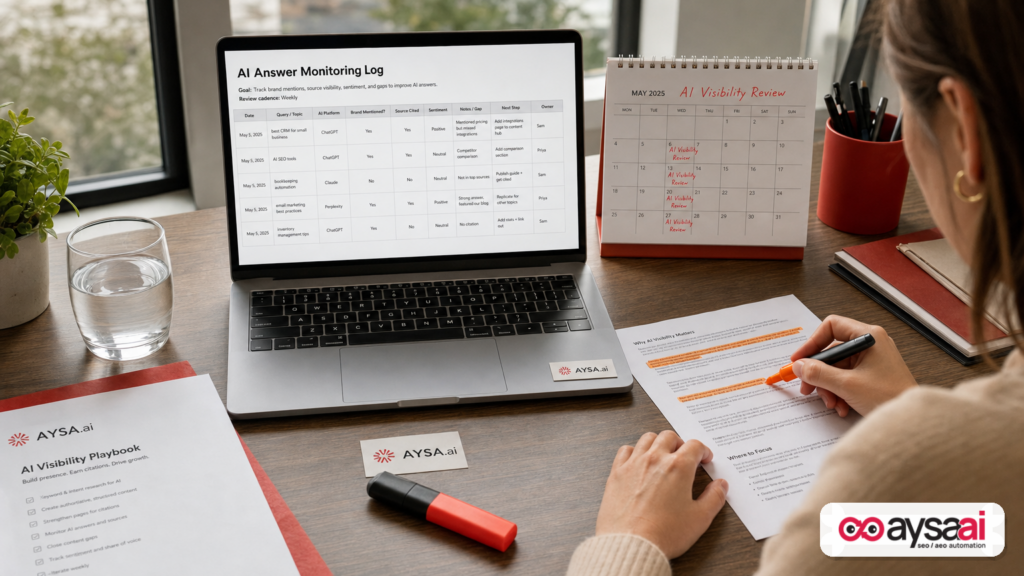
- Track “answer drift,” not just traffic. Log what assistants claim about your brand over time, including non-retrieved (“from memory”) responses.
- Make your facts boring and consistent. A single authoritative source of truth—then propagate it everywhere you control.
- Correct contradictions fast. Conflicts across your own site, listings, PDFs, old press releases, and partner directories are now a compounding risk.
- Operationalize approvals. In the AI era, speed matters—but so does governance. “Approved execution” is the difference between progress and fear.
Table of contents

- Why this matters now: AI answers are becoming the first impression
- The shift: from ranking changes to belief changes
- What Google research is signaling (without assuming deployment)
- Updates went quiet once already—this is the next layer
- Being “seen” isn’t being “learned”: the new funnel
- What can go wrong: contradictions, confidence, and synthetic rehearsal
- A concrete SME scenario: when a wrong answer costs real money
- What businesses should monitor now (and why traffic alone is too late)
- Entity fact hygiene: the playbook for staying consistent across the web
- Content design for AI memory: build “fact documents,” not brochures
- What agencies need to rethink: from campaigns to continuous assurance
- Where AYSA fits: monitoring + preparation + approved execution
- What to do next (action list)
- Sources and further reading
Why this matters now: AI answers are becoming the first impression
Whether we like it or not, AI-generated answers are increasingly the “front door” to brands. That includes Google’s AI experiences, but also the broader assistant ecosystem that customers use for:
- “Is this company legit?”
- “What’s their return policy?”
- “Do they serve my area?”
- “Which option is best for my situation?”
The business issue isn’t philosophical. It’s practical: an assistant can confidently summarize you in a way that feels final to a buyer. If the summary is incomplete or wrong, you don’t just lose a click—you lose trust at the decision moment.
This is why AI search visibility can’t be treated as a “future channel.” It’s already shaping brand perception in the present, even when it’s hard to attribute in your analytics.
If you’re new to the concept, start here: AYSA AI Search Visibility.
The shift: from ranking changes to belief changes
Classic SEO is largely about retrieval: Google crawls, indexes, and ranks documents. Yes, it’s more complicated in reality—but the unit of competition is still “which page wins which query.”
AI answers introduce a second unit of competition: which claims become durable beliefs inside the model.
Here’s the difference in plain business terms:
- Index/ranking problems = “We’re not showing up.”
- Model-belief problems = “We’re being described incorrectly—even when we do show up.”
The second one is more dangerous because it can suppress demand. A bad description can stop a customer before they ever search deeper, click, or compare.
What Google research is signaling (without assuming deployment)
The Search Engine Journal piece points to a Google Research discussion of a “sleep” style training lifecycle—where a model learns during use (“wake”), then periodically consolidates what it picked up into longer-term parameters (“sleep”), followed by internal rehearsal (“dreaming”).
We need to be careful here. Research isn’t the same as a shipping feature. The source itself is clear about the caveats: experiments, unknown compute costs, unknown timelines, and no direct statement that Google’s flagship consumer models use the approach today.
But research can still matter operationally. It can reveal direction. And the direction is the important part for businesses:
- Today: you worry about the training cutoff as a fairly fixed boundary—what the model “knows” versus what it must retrieve.
- Tomorrow: the boundary may move on a schedule you don’t see. Knowledge refresh becomes a cadence, not an announced milestone.
If that design shows up in production systems (at Google or elsewhere), then the practical “update” isn’t an index push. It’s a quiet re-weighting of what the model believes about the world—including your brand.
That’s why I agree with the spirit of SEJ’s argument: the next “update” that matters might not look like an update at all.
Updates went quiet once already—this is the next layer
Google has publicly described making changes to Search constantly, while formally highlighting only a small subset. The industry adapted by ritualizing the named updates: correlate dates, explain volatility, and propose fixes.
But the AI layer changes the failure mode:
- In classic search, you could often see the shift: rankings moved, Impressions moved, Clicks moved.
- In AI answers, the shift can happen as language: tone, confidence, selection, inclusion/exclusion, or an incorrect “fact” that suddenly appears.
Some AI answers will cite sources; some won’t. Some will retrieve; some will respond from internal memory. The result is a perception layer that doesn’t behave like ten blue links. That means you need monitoring designed for language drift, not only SERP drift.
Being “seen” isn’t being “learned”: the new funnel
A hard truth in AI search: the model can read something without committing it to durable memory.
In business terms, you now have a funnel that looks like this:
- Published: you put facts on your site.
- Discovered: crawlers/assistants can access them.
- Retrieved: the system chooses to pull and cite them for a specific answer.
- Learned/consolidated: the system internalizes certain claims as durable knowledge.
- Repeated: those claims show up as “what the assistant knows” across many prompts.
SEOs used to focus heavily on steps 1–3. AI-era visibility requires you to manage step 4 risk: what gets retained, mixed, and repeated—sometimes without retrieval.
What can go wrong: contradictions, confidence, and synthetic rehearsal
Let’s translate the risk into failure cases an owner will recognize.
1) Contradictions become fuel for the wrong story
If your facts are inconsistent across the web—different refund windows, different addresses, different “we’ve been in business since” dates—then assistants can produce blended answers that sound plausible but are wrong.
In classic SEO, inconsistencies mostly hurt local packs, trust signals, and conversion. In AI search, inconsistencies can shape what is retained as the “most consistent” narrative.
2) Retrieved facts feel tentative; internal facts feel confident
When an assistant cites a page, it can hedge: “According to…” or “It appears…” When it replies from internal memory, it often sounds more definitive. For a buyer, definitive language reads like authority.
That’s why a wrong internalized “fact” is worse than a wrong citation. One feels like a mistake; the other feels like a conclusion.
3) Synthetic rehearsal can change emphasis without new inputs
The SEJ piece highlights an uncomfortable implication: if models rehearse internally on generated samples, brand descriptions can drift even when you didn’t publish anything new. That’s hard to prove from the outside, but it matches what many practitioners experience: “We changed nothing—why is the answer different?”
From a business standpoint, you should assume language drift is normal and build monitoring accordingly.
4) Fixing gets harder after the model “commits”
When a wrong fact is just a retrieval problem, you can often fix it by updating the canonical page and waiting for recrawl/retrieval. When a wrong fact becomes embedded as internal knowledge, correction can require repeated reinforcement across multiple sources and time. True “unlearning” remains a hard research area across the industry.
So the best strategy is prevention + early detection.
A concrete SME scenario: when a wrong answer costs real money
Consider a regional ecommerce business: a specialty home goods store that ships nationwide, but also runs a small showroom locally.
They run a seasonal promotion: “Free returns within 30 days.” Last year it was 14 days. Some old PDF still floats around (or a reseller site scraped an old policy). A directory listing summarizes them incorrectly. The brand’s own site is correct—but only on one page deep in the help center.
A customer asks an AI assistant: “What’s the return policy for [Brand]?”
The assistant replies, confidently: “They offer returns within 14 days.”
What happens next?
- The buyer who needs flexibility chooses a competitor.
- Your paid search still performs “fine,” but conversion rate softens.
- Your team blames creatives, then blames pricing, then blames “the economy.”
- No one realizes the issue is a wrong fact being repeated upstream.
This is why traffic is a lagging indicator in AI search. By the time it shows up in GA4, you’re already paying for it.
What businesses should monitor now (and why traffic alone is too late)
If you take one operational change from this article, make it this: sample what AI assistants say about you on a schedule, and track drift the way you would track rankings or reviews.
At minimum, build a monitoring set that covers:
Entity facts (the “business card”)
- Legal name / DBA
- Locations / service areas
- Hours (for local businesses)
- Ownership/founders (if relevant)
- Years in business
- Guarantees, refunds, warranties
- Insurance/licensing (for regulated services)
Offers and constraints (the “fine print” customers care about)
- Shipping times, delivery cutoffs
- Pricing boundaries (“starting at”, minimums)
- Eligibility limitations (who you do/don’t serve)
- Appointment lead times
Reputation and comparisons (the “decision accelerators”)
- “Is [Brand] legit?”
- “Pros/cons of [Brand]”
- “[Brand] vs [Competitor]”
- “Best [product/service] for [use case]”
Memory-only prompts (reduce retrieval)
You want some prompts that encourage the assistant to answer without browsing or citations, because those reveal what it will say when it’s “speaking from memory.” This won’t be perfect across systems, but you can standardize a testing method per platform and compare over time.
The goal isn’t to “catch the model.” The goal is to build a baseline so you can see change.
AYSA’s monitoring philosophy lives here: AYSA Monitoring.
Entity fact hygiene: the playbook for staying consistent across the web
If I could rename “SEO” for 2027 planning, I’d call a big chunk of it digital consistency engineering.
Because in AI search, contradictions don’t just confuse crawlers—they create training and consolidation ambiguity.
Step 1: Create a single source of truth (SSOT) you actually maintain
Not a slide deck. Not a founder’s memory. A maintained set of facts with owners and timestamps.
- Who owns each field (address, policy, product specs)?
- Where is it published?
- When did it change last?
Step 2: Propagate to everything you control
Start with your own properties:
- Homepage / About
- Contact page
- Help center
- Location pages
- Product pages (where policies impact conversion)
Then handle external profiles you can edit. The SEJ page itself links to topical hubs like SEO and AI Search—use those as research leads for which ecosystems are changing fast, but keep your operational focus on the places your buyers actually encounter you.
Step 3: Hunt conflicts like you hunt broken checkout flows
Conflicts usually live in:
- Old PDFs and press releases
- Outdated partner pages
- Scraped reseller descriptions
- Old blog posts that mention discontinued offers
This is unglamorous work. It’s also high leverage.
Step 4: Make claims verifiable
Where possible, add:
- Dates (“Policy updated: Oct 2026”)
- Plain language summaries
- Clear definitions (what “free returns” excludes)
- Contact paths for disputes
The point is to reduce ambiguity for both humans and machines.
Content design for AI memory: build “fact documents,” not brochures
Most small businesses write web pages like brochures: persuasive, brand-forward, and vague. That style is fine for some contexts, but it’s not ideal when your problem is factual drift.
The SEJ source emphasizes that the research inputs were documents—clean containers of information. That aligns with what we see broadly in AI systems: structured, declarative writing is easier to ingest, summarize, and compare.
What a “canonical facts” page should look like
For SMEs, I recommend a set of short, self-contained pages, each focused on a single fact cluster. For example:
- Returns & refunds (policy, time window, exclusions, process)
- Shipping & delivery (carriers, timelines, cutoffs, regions)
- Service area (cities/regions, what’s included/excluded)
- Pricing framework (starting prices, minimums, what affects cost)
Make each page:
- Dated
- Declarative (short sentences, minimal fluff)
- Internally consistent with every other mention of the same facts
- Easy to link from customer-facing pages
Is this just “add schema”?
No. Structured data can help, but it’s not a magic wand. Your words still matter. Your consistency still matters. And assistants don’t only consume schema—they consume the total information environment around your brand.
Think of schema as packaging, not the product itself.
What agencies need to rethink: from campaigns to continuous assurance
Agencies grew up around campaigns, sprints, and launches. AI search pushes us toward something more like security operations: continuous monitoring, triage, and remediation.
Here’s what I believe agencies must update in their model:
1) Reporting can’t be SERP-only
Leadership reporting should include:
- AI answer snapshots for priority topics
- Drift logs (“what changed since last month?”)
- Fact integrity scorecards (where contradictions still exist)
2) SLAs should include “time to correction,” not just “time to publish”
When wrong facts spread, speed matters. You need a workflow that can:
- Detect a drift
- Propose a fix
- Get approval
- Ship changes safely
- Verify that the answer actually changed
3) Governance must be a feature, not a blocker
Many teams freeze because they fear breaking the site, upsetting legal, or creating brand risk. That fear is rational. But the response shouldn’t be “do nothing.” It should be: build an approval system that makes change safe.
This is where an approved execution model becomes a competitive advantage—especially for agencies serving regulated or risk-sensitive businesses.
Where AYSA fits: monitoring + preparation + approved execution
At AYSA, we’re building for the reality that “visibility” is no longer only about ranking. It’s also about representation: what AI systems claim about you, and whether those claims stay accurate over time.
AYSA is designed as an execution system that:
- Monitors your AI search visibility and drift signals on a cadence (Monitoring).
- Prepares recommended changes (content, technical, internal consistency improvements) based on what’s observed.
- Asks for approval before making changes—so owners and teams maintain governance.
- Executes accepted website changes quickly and safely—because speed is now part of quality.
This is the difference between “we noticed the assistant is wrong” and “we fixed the underlying information environment so it becomes consistently right.”
If you want the tool-level overview of how this fits into modern search, see: AI SEO Tools.
If you’re evaluating whether this is worth operationalizing, start with pricing and scope clarity: AYSA Pricing.
And if you want more thinking like this, the running editorial library is here: AYSA Blog.
A practical action plan (30/60/90 days)
You don’t need to predict Google’s next architecture shift to protect your business. You need a system that is resilient to silent change.
Next 30 days: baseline and inventory
- Create your SSOT facts list (name, address, policies, service area, differentiators that must be correct).
- Build a monitoring prompt set (entity, offers, reputation, comparisons).
- Capture baseline answers from the AI assistants your customers use.
- Identify contradictions across your site (especially old pages and PDFs).
Next 60 days: publish canonical fact documents
- Publish or rewrite canonical pages for returns, shipping, service area, pricing framework, and key constraints.
- Make facts easy to find from top navigation or footer (don’t bury them).
- Remove or clearly label outdated content (archive pages, add update notes).
- Update major profiles/listings you control to match the SSOT.
Next 90 days: institutionalize drift ops
- Set a monitoring cadence (weekly for volatile offers; monthly for stable categories).
- Define escalation rules (what drift requires same-day action vs. backlog).
- Create an approval workflow (who signs off, how quickly, with what evidence).
- Measure outcomes (not just traffic—also conversion rate changes, branded search behavior, customer support contacts that indicate confusion).
What to do next (action list)
- Pick 10 “must-be-true” facts about your business. Write them down. Assign owners.
- Run 15 prompts across AI assistants and log the exact outputs.
- Highlight anything incorrect or overly vague (vagueness is how mistakes grow).
- Publish one canonical fact page this week (returns, shipping, or service area are usually highest impact).
- Set a recurring calendar reminder to re-sample answers.
- Adopt approved execution: prepare changes, get sign-off, ship, verify.
My AYSA perspective: the real moat is operational
In every era of search, there’s a temptation to chase the latest mechanism—new schema, new markup, new prompt tricks, new “AI optimization hacks.”
Those tactics come and go. The moat that lasts is operational:
- Do you know what the market’s AI systems say about you today?
- Can you detect drift before it hits revenue?
- Can you ship corrections quickly with governance?
- Can you maintain consistency across your ecosystem over time?
If the next phase of search includes silent knowledge refresh cycles, the winners won’t be the teams who guess the date of the next “update.” They’ll be the teams who treat AI answers like a living surface area—monitored, maintained, and corrected continuously.
Sources and further reading
- Search Engine Journal: Google’s Next Update Won’t Touch The Index, And Nobody Will Announce It
- SEJ: AI Search coverage hub
- SEJ: SEO coverage hub
- SEJ: Google Updates history (context for the ‘update ritual’)
Appendix: A starter prompt set (copy/paste into your monitoring log)
Use these as a baseline and adapt them to your business. For consistent monitoring, keep the wording stable so you can compare outputs over time.
Entity facts
- “What is [Brand]?”
- “Where is [Brand] located? Do they serve [City/State]?”
- “How long has [Brand] been in business?”
- “Is [Brand] part of another company?”
Policies and constraints
- “What is [Brand]’s return policy?”
- “How long does shipping take from [Brand]?”
- “Does [Brand] offer warranties or guarantees?”
- “What does [Brand] cost? What makes the price go up or down?”
Comparisons and recommendations
- “[Brand] vs [Competitor]: which is better for [use case]?”
- “What are the pros and cons of [Brand]?”
- “Recommend the best [product category] for [need]—include [Brand] if relevant.”
Trust and reputation
- “Is [Brand] legit? Any complaints?”
- “What do customers say about [Brand]?”
Log outputs with timestamps. Highlight drift. Treat it like a core business signal—not an SEO curiosity.
Continue the AI search topic inside AYSA.
Use these pages to connect the article with AI SEO tools, AI visibility monitoring, AI Overviews and approved website execution.
Turn this topic into a website action plan.
Use these AYSA hubs to move from reading to technical fixes, AI visibility monitoring, research, glossary context and approval-first SEO execution.