
“Goodbye SEO” Is a Great Soundbite—and a Terrible Strategy: How To Win in AI Answers Without Losing Organic Search
AI assistants are changing how people discover brands—but that doesn’t make SEO obsolete. The practical path forward is layered visibility: technical SEO + content that answers intent + measurable AI citations (AEO/GEO). Here’s how to operate that system—without chasing hype.

By Marius Dosinescu (AYSA.ai)
“Goodbye SEO” is a perfect headline. It’s short, provocative, and designed to travel. It also risks pushing businesses into the worst possible move right now: abandoning the only channel that still reliably feeds every other discovery system—organic search.
This editorial was prompted by reporting in Search Engine Journal about a tension that’s becoming common in 2026: executives market “AI visibility” as the next era, while their own product documentation acknowledges that SEO remains foundational. In the piece, Salesforce CEO Marc Benioff promoted an AI visibility tool with “Goodbye SEO,” while Salesforce’s own SEO/AEO guide (linked from the product page) reportedly states that SEO isn’t going away and remains the foundation.
That contrast is not just corporate messaging. It’s the reality of the market: AI assistants are changing how people choose brands, but they’re built on top of the web. And the web still runs on Crawlability, content, authority, and measurable demand.
What follows is not a news rewrite. It’s a pragmatic operating playbook: what changed, what didn’t, where the risks are, and what SMEs and agencies should do next—especially if they feel squeezed between “traditional SEO,” “AI answers,” and the reality that budgets and teams aren’t scaling as fast as expectations.
Concise summary

- AI assistants can reduce Clicks for some query types, but that doesn’t eliminate SEO; it changes what “winning” looks like.
- AEO/GEO is not a replacement for SEO. It is a second visibility layer that depends on the first.
- Businesses need a two-metric system: organic performance + AI visibility (citations, mentions, recommendations), tracked side-by-side.
- The highest ROI work is still execution: fix technical foundations, publish/refresh intent-led content, build authority, then measure AI inclusion.
- AYSA.ai fits where teams struggle most: Monitoring, preparing prioritized changes, requesting approval, and executing accepted changes—consistently.
Key takeaways (print this for your next leadership meeting)
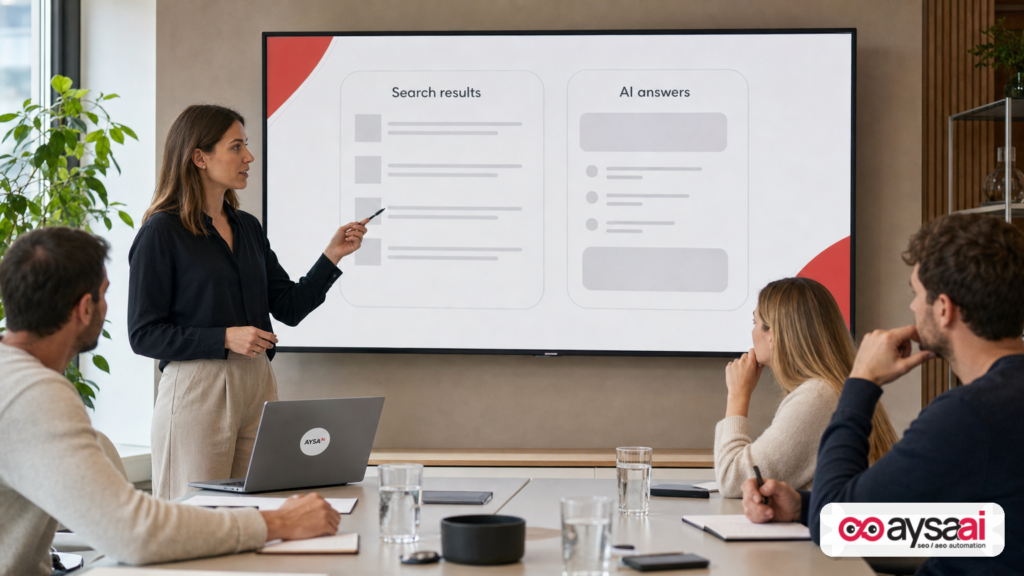
- Don’t “pivot away from SEO.” Pivot away from SEO-as-rankings-only.
- Assume mixed behavior: the same customer may use Google at 9am, ChatGPT at noon, and maps at 6pm.
- Measure outcomes, not nostalgia: calls, leads, revenue, bookings—not only sessions and clicks.
- Build “answerable” assets: pages, data, and proof that AI systems can confidently summarize and cite.
- Choose tools that improve decisions and execution, not just dashboards that restate the problem.
Table of contents

- The real story behind “Goodbye SEO” (and why it spread so fast)
- What actually changed: from rankings to recommendations
- What didn’t change: the web is still the substrate
- The new visibility stack: SEO + AEO/GEO (two layers, one audience)
- “No click, no referral”: true sometimes—and misleading as a strategy
- The measurement reset: what to track now
- What can go wrong (and where teams waste money)
- An SME scenario: the local clinic that ‘lost clicks’ but gained patients
- What agencies should rethink (deliverables, pricing, and accountability)
- Why execution is the moat (and why most programs stall)
- Where AYSA fits: monitor → prepare → approve → execute
- What to do next (action list)
- Sources and further reading
The real story behind “Goodbye SEO” (and why it spread so fast)
When an influential CEO says “Goodbye SEO,” a few things happen immediately:
- Marketing leaders panic because they already feel behind on AI.
- Boards and exec teams hear a clean narrative: “Old channel dead, new channel here.”
- Budgets move—often before anyone defines what success means in the new world.
The SEJ report captured a telling contrast: a “goodbye” message used to market an AI visibility tool, while Salesforce’s own guide—linked from that tool’s page—frames SEO as “still the foundation.” That’s not hypocrisy; it’s a snapshot of what every serious enterprise knows: you can’t build AI visibility on a broken website, thin content, or a weak brand footprint.
In other words: the soundbite is optimized for distribution. The guide is optimized for reality.
As operators, we should treat “SEO is dead” statements as a signal to ask better questions:
- Which queries are actually moving to AI assistants?
- Which products/services require trust, comparison, and proof?
- What portion of demand is still expressed through search engines, maps, marketplaces, and social?
- What does the funnel look like when the first touch is an AI answer?
What actually changed: from rankings to recommendations
The shift isn’t that “people don’t search anymore.” The shift is that more journeys begin with a question answered by an interface that may not send a click.
That changes the competitive game in three ways:
1) The unit of competition is no longer just a blue link
In classic SEO, you compete for a ranking position and then fight for a click. In AI-mediated discovery, you compete for inclusion in:
- a synthesized answer
- a shortlist of recommended brands
- a “best option for you” suggestion
- a cited source list (when citations are provided)
That is not fundamentally different from SEO. It’s a different presentation layer for the same underlying job: being the most credible, relevant option.
2) The funnel can compress
Some users will go from question → shortlist → purchase without visiting ten pages. That’s real. It’s also not universal. High-consideration purchases still require proof: pricing, policies, reviews, specs, comparisons, returns, guarantees, clinical credentials, regulatory info, implementation docs, etc.
3) Brand recall becomes measurable in new ways
If an AI assistant repeatedly mentions your company for a category, that’s effectively a new kind of “impression.” But unlike search Impressions, it’s harder to measure and easier to misread.
This is where executives are directionally correct: we need measurement for AI visibility. But the operational conclusion should be “expand measurement,” not “delete SEO.”
What didn’t change: the web is still the substrate
Even if AI assistants reduce some clicks, they still need source material. When your site is:
- hard to crawl
- thin on substance
- unclear on entities (who you are, what you offer, where you operate)
- missing proof (case studies, references, policies)
- slow, broken, or duplicative
…you don’t just lose rankings. You reduce the chance that any system—human or machine—will trust you enough to recommend you.
That’s why Salesforce’s own guide (per SEJ’s reporting) calls SEO the foundation. It’s also why the Palmata launch messaging referenced by SEJ reportedly said SEO remains essential.
So what’s the right mental model?
SEO is infrastructure. AEO/GEO is distribution within AI answer layers. You can’t sustainably scale the distribution layer while neglecting the infrastructure.
The new visibility stack: SEO + AEO/GEO (two layers, one audience)
The most useful line in SEJ’s summary is that SEO and AEO are “two visibility layers for the same audience.” That’s exactly right. Your customer didn’t split into two species. Their interfaces multiplied.
Here’s how I recommend businesses structure their thinking in 2026–2027:
Layer 1: Technical and indexation fundamentals (SEO infrastructure)
- Crawlability and indexation hygiene
- Clean information architecture and internal linking
- Page performance and mobile usability
- Structured data where appropriate (product, organization, local business, FAQ where valid, etc.)
- Canonicalization, duplication control, and parameter handling
Layer 2: Content that earns selection (SEO + AEO content)
- Pages built around real intents (not keyword lists)
- Clear definitions, comparisons, and decision support
- Evidence: reviews, testimonials (where compliant), case studies, certifications
- Up-to-date policies and transparent pricing ranges where possible
- Unique data and POV (the stuff competitors can’t easily replicate)
Layer 3: Authority and entity credibility (brand signals)
- Earned mentions and PR (quality over volume)
- Consistent business information across the web
- Author and company credibility signals
- Community presence and partnerships
Layer 4: AI visibility measurement and iterative improvement (AEO/GEO ops)
- Tracking prompts, brand mentions, and citations over time
- Identifying where AI answers are wrong, incomplete, or biased
- Publishing clarifying content that corrects the record
- Aligning content to the way AI systems summarize categories
Most companies are trying to start at Layer 4 because it’s new and shiny. That’s backwards. Layer 4 works best when Layers 1–3 are healthy.
“No click. No referral.” True sometimes—and misleading as a strategy
One claim highlighted in the SEJ coverage is that AI answers can result in “no click” and “nothing in your analytics.” That can happen. But the strategic leap—therefore SEO is irrelevant—is flawed for several reasons:
1) Not every query becomes a zero-click outcome
Even historically, Google had plenty of “zero-click” behaviors (knowledge panels, featured snippets, local packs). Yet SEO remained valuable because discovery is not one format. AI increases that pressure, but it doesn’t eliminate the need for content and pages that close the deal.
2) “No click” doesn’t mean “no influence”
If an AI assistant recommends your brand and the user later searches your name directly, or goes to your app, or visits you through another channel, your analytics may not attribute the original influence correctly. The right response is better measurement and better messaging, not abandonment.
3) The absence of referral data is a measurement problem, not a growth strategy
Businesses shouldn’t confuse “harder to measure” with “not worth doing.” Instead:
- tighten brand and conversion tracking
- use surveys (“How did you hear about us?”)
- track branded demand trends
- monitor AI visibility as a leading indicator
That aligns with what SEJ reported Salesforce’s guide recommends: tracking both organic metrics and AI citation metrics side-by-side.
The measurement reset: what to track now
If you’re an SME or a non-SEO executive, here’s the simplest way to think about measurement in the AI era:
Classic SEO tells you: “Did we get discovered?”
AI visibility tells you: “Did we get recommended?”
Business metrics tell you: “Did we get paid?”
Minimum viable scorecard for SMEs
You do not need 80 KPIs. You need a small set that creates accountability.
Organic search (SEO) metrics
- Organic conversions (leads, sales, bookings) by landing page category
- Non-branded organic clicks and impressions (directional trend)
- Top landing pages: growth/decline + why
- Index coverage / crawl errors (basic health)
AI visibility (AEO/GEO) metrics
- Brand mentions in AI answers for priority topics
- Citations/attributions when provided
- Share of voice in “recommended brands” outputs (directional, not perfect)
- Accuracy checks: does AI describe your offering correctly?
Business outcome metrics
- Revenue / qualified leads from all channels
- Branded search trend (people looking for you)
- Sales cycle velocity (especially for B2B/SaaS)
Important: AI visibility metrics are still maturing. Treat them like early SEO metrics in 2008—useful, directional, and easy to game. Keep the accountability anchored to outcomes.
What can go wrong (and where teams waste money)
Whenever a new channel narrative emerges, the market produces two things quickly: good innovation and bad incentives. Here are the common failure modes I’m seeing (and the SEJ article’s discussion hints at several of them):
Risk 1: Buying measurement without buying capability
Monitoring what AI systems say about your brand is useful. But monitoring is not improvement. If you don’t have a reliable engine to ship content fixes, technical fixes, and proof assets, you’ll accumulate dashboards instead of growth.
Risk 2: Confusing simulation with reality
Some tools promise to simulate how changes will affect AI outputs. Treat this carefully. AI systems are probabilistic, and their outputs vary by prompt, context, user history, and model updates. Simulations can help you prioritize, but they’re not guarantees.
Risk 3: Over-optimizing for the “AI answer format” and under-investing in proof
Businesses might rewrite every page to be “answer-friendly” while removing the credibility elements that actually convince customers: details, policies, comparisons, and constraints. AI answers can drive interest, but your website closes the loop.
Risk 4: Letting “SEO is dead” become an excuse to stop doing hard work
Technical clean-up, content refreshes, internal linking, and structured data are not glamorous. They’re also the compounding edge. If your competitor keeps doing them while you chase novelty, you will lose both classic rankings and AI inclusion.
Risk 5: Turning AEO into a new kind of snake oil
The SEJ article referenced pushback from respected SEO professionals about AI search relying on many of the same fundamentals as SEO and about the difference between monitoring and improving outcomes. That skepticism is healthy. The industry needs it—because the temptation to sell “AI optimization” as magic is enormous.
An SME scenario: the local clinic that ‘lost clicks’ but gained patients
Let’s make this concrete with a scenario I see often.
Business: A multi-location dental clinic (SME, 10–30 employees).
Problem: Organic sessions drop 15% over a quarter. The owner hears “AI answers mean no clicks” and wants to stop paying for SEO content and “focus on AI.”
Reality: New patient bookings are flat-to-up, but attribution is messy. Calls are up. “Near me” visibility is mixed. AI assistants sometimes recommend competitors when users ask “best dentist for implants near me,” and sometimes they misstate the clinic’s financing options.
What we do in a sane operating model
- Step 1: Protect fundamentals. Ensure service pages are indexable, fast, internally linked, and location pages are consistent.
- Step 2: Expand “proof content.” Create clear implant financing, aftercare, and candidacy pages. Add clinician credentials and process explanations that can be summarized accurately.
- Step 3: Build local authority signals. Ensure citations are consistent and the site clearly communicates service areas.
- Step 4: Monitor AI descriptions. Identify inaccuracies (financing, eligibility, hours, services) and publish precise, easy-to-quote clarifications.
- Step 5: Measure bookings, not clicks. Keep SEO metrics, but elevate outcomes.
In this scenario, “Goodbye SEO” would have been a self-inflicted wound. The clinic doesn’t win by chasing mention counts. It wins by being the easiest safe recommendation—human or machine—and by converting that interest with clarity and trust.
What agencies should rethink (deliverables, pricing, and accountability)
AI answers don’t just change business behavior. They change agency incentives.
Deliverables that are aging out
- “We will deliver X keywords in top 3 positions.” (Overly simplistic in 2026.)
- Content plans built primarily on keyword volume tables without intent mapping.
- Link building measured by quantity over relevance and brand impact.
Deliverables that are aging in
- Visibility coverage maps: Which intents are we present for—across search and AI answers?
- Entity and trust work: Structured data hygiene, about pages, author signals, policies, and brand proofs.
- Refresh and consolidation: Updating old assets, reducing duplication, and strengthening internal linking.
- AI answer QA: Monitoring accuracy and correcting misconceptions through published assets.
- Operational excellence: Faster shipping of approved changes.
Pricing reality
Clients will not pay more for “one more dashboard.” They will pay for:
- revenue protection
- faster iteration
- measurable coverage gains
- reduced internal burden (less back-and-forth with dev teams)
If your agency doesn’t control execution, your strategy will underperform. AI didn’t create that truth—it exposed it.
Why execution is the moat (and why most programs stall)
Here’s the uncomfortable truth: most SEO programs fail for the same reason most “AI optimization” programs will fail—they don’t ship enough improvements.
It’s rarely because the team lacks ideas. It’s because execution gets stuck in:
- ticket backlogs
- CMS limitations
- stakeholder approvals
- legal/compliance review
- content bottlenecks
- fear of breaking templates
And now we’re adding another layer: monitoring AI outputs, crafting new assets, and updating pages more frequently. If you can’t execute consistently, you’ll lose to the competitor who can—even if they have fewer ideas.
This is exactly where an “approved execution system” becomes strategic, not tactical.
Where AYSA fits: monitor → prepare → approve → execute
At AYSA.ai, we treat SEO, AEO, and GEO as one operational system: visibility is earned through consistent, approved execution.
Here’s how to think about AYSA in this “SEO vs AI search” debate:
1) Monitoring that reflects reality
You need to know what’s happening across classic search performance and AI visibility signals. AYSA supports that operational layer through monitoring designed to keep teams aligned on what changed and what matters.
2) Preparation: turn insights into a prioritized plan
Most tools stop at “here’s what’s wrong.” AYSA is built to prepare the actual changes: technical fixes, content updates, internal link improvements, and structured enhancements—so teams don’t stall in analysis.
3) Approval: governance without paralysis
In the real world, changes require sign-off. AYSA’s model is built around proposing changes and asking for approval before executing—so SMEs and teams keep control while moving faster. This is the difference between “automation” and “safe automation.”
4) Execution: shipping improvements that compound
Visibility gains—whether in Google or AI answers—are a byproduct of shipping. AYSA executes accepted website changes, keeping the program moving.
If you want the overview of how we approach AI-driven discovery specifically, start here: AI search visibility. If you’re evaluating tools, this page is the simplest entry point: AI SEO tools. For packaging and cost, see pricing. And for ongoing editorial guidance, visit the AYSA blog.
How to operate your 2027 visibility plan (practical framework)
If you’re leading marketing for an SME or mid-market company, here’s an operating framework that won’t whiplash every time a CEO posts a hot take.
Phase A: Stabilize the foundation (30–45 days)
- Fix indexation and canonicalization issues
- Ensure key category/service pages are internally linked from navigation and context
- Audit duplication and thin pages (merge or improve)
- Improve speed and mobile UX where it blocks conversions
- Confirm structured data basics where relevant
Phase B: Build “answerable” decision content (45–90 days)
- Publish comparison content customers actually ask for (alternatives, “best for,” “X vs Y”)
- Create pages that clarify constraints (pricing ranges, requirements, availability, geography)
- Add proof sections: case studies, reviews policy, certifications, FAQs (where appropriate)
- Update top-performing older pages to match current needs and language
Phase C: Expand distribution and measurement (ongoing)
- Track AI mentions/citations for priority topics
- Run “accuracy audits” and publish corrections
- Strengthen authority through PR, partnerships, and reputable mentions
- Review the scorecard monthly; decide what ships next
This is what “SEO + AEO” looks like in practice: not a pivot, a system.
What to do next (action list)
- Write down your top 20 money intents. Not keywords—intents. Example: “compare [product] vs [product],” “best [service] near me,” “pricing for [service],” “is [solution] worth it.”
- Check whether each intent has a page that deserves to be recommended. If not, create or refresh it.
- Fix crawl/indexation blockers on revenue pages first. Don’t start with the blog.
- Set a dual scorecard: organic conversions + AI visibility checks for those intents.
- Assign an execution owner. If you can’t ship 5–15 meaningful improvements per month, your program will stall.
- Choose tooling based on execution speed, not hype. Measurement matters—but only if it leads to changes.
- If you need an execution system, evaluate AYSA. Start with AI search visibility and monitoring, then review pricing.
Sources and further reading
- Search Engine Journal: Salesforce CEO Says ‘Goodbye SEO.’ Salesforce’s SEO Guide Disagrees
- Search Engine Journal: SEO
- Search Engine Journal: AI Search
- Search Engine Journal: Technical SEO
- Search Engine Journal: Local SEO
- Search Engine Journal: Enterprise SEO
- Search Engine Journal: Google Updates (history)
Editorial note (accuracy & sourcing): This article uses Search Engine Journal’s reporting as a research input and links to it as the primary source. I did not reproduce Salesforce documentation or product pages directly because they were not included as primary links in the provided research context. Where specific product capabilities or quotes were referenced, they are treated as reported by SEJ and discussed as analysis rather than independently verified claims.
Continue the AI search topic inside AYSA.
Use these pages to connect the article with AI SEO tools, AI visibility monitoring, AI Overviews and approved website execution.
Turn this topic into a website action plan.
Use these AYSA hubs to move from reading to technical fixes, AI visibility monitoring, research, glossary context and approval-first SEO execution.