
AI Search Is Driving Leads—Here’s How to Measure It (Before You “Optimize” Anything)
AI chat and answer engines are already influencing how customers discover businesses—but most of that demand shows up as “direct” or disappears in attribution. Here’s a practical, SME-friendly measurement framework to track AI-influenced leads across calls, forms, and sales—plus how to operationalize it with approved execution.

AI Search is no longer just a visibility game. It’s becoming a measurable source of discovery—and for many businesses it’s already influencing leads in ways your analytics stack can’t cleanly attribute. If you’re still only watching “organic,” “paid,” and “direct,” you’re probably undercounting the role AI assistants play in the moment customers decide who to call, which product to buy, or which clinic to book.
This editorial is inspired by a sponsor analysis published on Search Engine Land: AI search is driving customers. Can you measure it? (CallRail). The piece makes a simple but important point: the conversation is moving from “How do I show up in AI?” to “How do I prove AI is driving business outcomes?” That shift matters—because optimization without measurement is just guesswork.
I’m Marius Dosinescu, and at AYSA.ai we build for the messy reality: you don’t need more dashboards. You need a system that monitors what’s changing, prepares what to fix, asks for approval, and then executes the accepted changes—so measurement actually turns into growth.
Concise summary
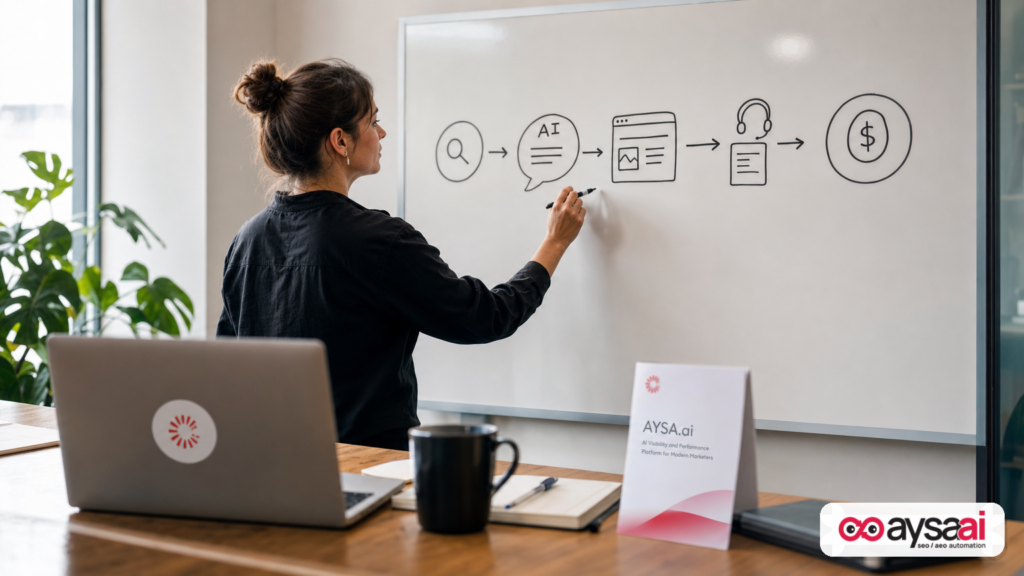
- AI platforms influence customer decisions but often collapse into “direct,” “brand,” or “unknown” in traditional analytics.
- Measurement should come before optimization: first prove AI-influenced discovery exists in your funnel; then decide what to invest in.
- You can measure AI influence today with pragmatic instrumentation: self-reported Attribution, call handling, CRM fields, and controlled experiments.
- The operational challenge is execution: even when you identify what to change (local pages, product info, trust signals), it often stalls. AYSA is built to close that loop with Approved Execution.
Key takeaways (what changed, why it matters)
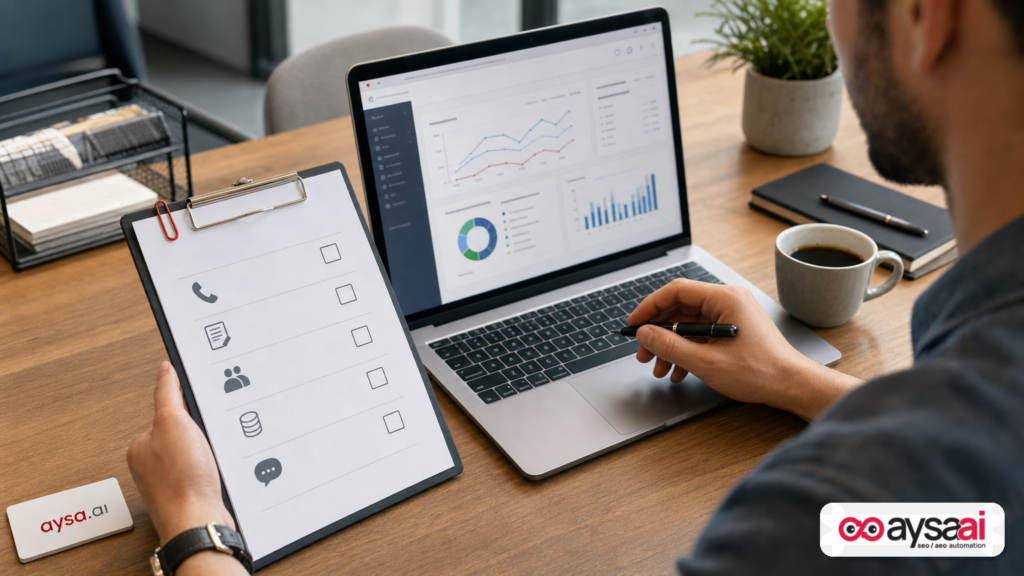
- Search journeys are fragmenting. Customers still use Google, but they also ask ChatGPT, Gemini, Perplexity-style answer engines, and in-product assistants for “best X near me” or “compare Y vs Z.”
- Attribution models weren’t designed for AI intermediaries. When an assistant recommends you, the subsequent visit might be direct, branded, or untracked—especially if the user calls.
- Lead attribution is now a competitive advantage. Businesses that can quantify AI-influenced leads will allocate budgets smarter than competitors who optimize blindly.
Table of contents

- The new attribution problem: AI didn’t replace search—it rewired the journey
- Why your analytics stack misses AI influence
- What you can measure today (without guessing prompts or models)
- AI vs SEO vs brand: what you’re actually measuring
- A practical measurement framework for AI-influenced leads
- Call-heavy businesses: how to capture AI-influenced calls without annoying customers
- Forms, ecommerce, and SaaS: how AI influence shows up in non-call funnels
- Attribution vs incrementality: why you need both (and how to run simple tests)
- What can go wrong: bad data, false certainty, and privacy pitfalls
- A concrete SME scenario: the local clinic that thought AI “wasn’t sending leads”
- What agencies should rethink: reporting, retainers, and the new “unknown” bucket
- Turning measurement into execution: how AYSA operationalizes AI attribution
- What to do next (action list)
- Sources and further reading
The new attribution problem: AI didn’t replace search—it rewired the journey
For the last 20 years, the dominant mental model was simple:
- People search (Google/Bing).
- They click a website listing or ad.
- Analytics tools attribute the visit to a source/medium.
- That visit converts (form, call, purchase).
AI doesn’t break that model by removing Google. It breaks it by inserting an intermediary layer—a conversational recommendation engine—between intent and action.
Now the journey often looks like:
- Customer asks an AI assistant for options (best roofer, best running shoes, which CRM to choose).
- Assistant suggests a shortlist and gives reasoning.
- Customer searches your brand name, types your URL, Clicks a map listing, or calls from a phone number they copied.
From the perspective of most reporting, the assistant’s influence is invisible. The final click (or call) gets credit, not the recommendation.
The Search Engine Land piece frames this correctly: AI search is becoming a new attribution challenge and measurement needs to catch up. (Again, the original source is here: Search Engine Land.)
Why your analytics stack misses AI influence
Let’s talk about how AI influence gets “lost” in real-world analytics.
1) “Direct” traffic is often a catch-all
In GA4, “Direct” doesn’t only mean “typed URL.” It’s also where sessions can land when referrer data is missing or stripped. If an AI tool opens a link in a way that doesn’t pass clean referrer/UTM information, or the user hops between apps, attribution can degrade. The result: AI influence turns into “Direct” or “Unassigned,” and your team shrugs.
2) Brand search can hide the assist
If ChatGPT recommends “Acme Dental,” the user may go to Google and search “Acme Dental hours” and click the result. Your SEO report celebrates “brand organic growth.” But the assist came from AI discovery. This matters because you’ll misallocate investment: you’ll think brand is growing organically, when actually AI is sending you people who already trust the recommendation.
3) Calls break the clickstream
The Search Engine Land article references analysis of inbound leads and calls, which highlights the core issue: phone calls are still one of the highest-intent conversion types for local services, healthcare, legal, home improvement, and high-ticket B2B. Yet calls often bypass web attribution entirely—especially if the customer calls from a number shown by an AI assistant, a directory, or a Business Profile.
4) AI is part of the “dark funnel” by default
Marketers have talked about “dark social” and “dark funnel” for years. AI is the newest member of that club: a private conversation layer where discovery happens off-site, outside your tracking pixels, and sometimes outside the web browser entirely.
What you can measure today (without guessing prompts or models)
Here’s the good news: you don’t need to know the prompt, the model, or the exact recommendation logic to measure impact. You need to measure observable business events and capture the customer’s self-reported journey in a structured way.
The Search Engine Land piece makes a critical distinction I agree with: rather than trying to infer why a business was recommended, measure when customers identify an AI platform as part of their journey. That’s a concrete starting point.
Measurable events you can instrument now
- Inbound calls: record source where possible; capture “How did you hear about us?” and tag AI mentions.
- Form fills: add a required or optional “How did you hear about us?” field with AI options.
- Bookings: include attribution capture in scheduling flows (online booking forms).
- Chats: for web chat and SMS, add a quick “What brought you here today?” and detect AI mentions.
- CRM opportunities: enforce a standardized “Discovery Source” field with AI as a selectable category.
- Sales calls: add one question to your script: “Did you find us via Google, a friend, or an AI assistant like ChatGPT?”
What not to do (yet)
- Don’t start “optimizing for AI” by rewriting the entire site based on vibes.
- Don’t assume every spike in direct traffic is AI.
- Don’t publish AI-themed pages (“We are the best AI-recommended plumber”) hoping it hacks the system.
Measure first. Then you’ll know if you’re solving a real problem or chasing a story.
AI vs SEO vs brand: what you’re actually measuring
One reason AI measurement feels confusing is that businesses mix together three different concepts:
- SEO (Search Engine Optimization): improving your visibility and conversion performance in traditional search engines.
- AEO/GEO (Answer/Generative Engine Optimization): improving your likelihood of being mentioned or recommended in AI answers.
- Brand demand: customers seeking you out because they’ve heard of you, trust you, or were referred.
AI sits in between SEO and brand. It’s both:
- A discovery surface (like search)
- A trust amplifier (like a referral)
That means your measurement approach needs to capture two things:
- Demand creation: “We were discovered because AI suggested us.”
- Demand capture: “We converted because our site, reviews, pricing, and availability made it easy.”
If you only measure the last click, you’ll over-invest in capture and under-invest in discovery. If you only measure mentions, you’ll over-invest in “visibility” and under-invest in conversion and operations.
A practical measurement framework for AI-influenced leads
Below is a framework you can implement in weeks, not quarters. It’s built for SMEs, but agencies can productize it.
Step 1: Define what “AI-influenced” means for your business
Be explicit. Otherwise every team member will count differently.
Recommended definitions:
- AI-attributed lead: The customer explicitly says an AI assistant (e.g., ChatGPT, Gemini, Perplexity) recommended or helped them shortlist you.
- AI-assisted lead: The customer says AI helped them understand the problem, compare options, or decide what to ask—without explicitly naming a business recommendation.
- AI-suspected lead: No explicit mention, but patterns suggest AI influence (use cautiously; don’t report this as fact).
Only the first two are reliably measurable without guesswork. The third is for internal investigation.
Step 2: Capture self-reported attribution in every conversion path
Most businesses do this inconsistently. The fix is boring—but it works.
- Forms: Add a dropdown question: “How did you hear about us?” with options including: Google Search, Google Maps, Facebook/Instagram, Friend/Referral, Directory, Podcast/YouTube, and AI assistant (ChatGPT/Gemini/etc.). Include “Other (please specify).”
- Calls: Train staff to ask once, politely, and log the answer in the CRM. (If you don’t have a CRM, even a structured spreadsheet beats nothing.)
- Point-of-sale / intake: Add the same field for offline conversions.
The point isn’t perfect truth. The point is consistent signal.
Step 3: Normalize the data so it becomes reportable
Self-reported data is messy: “chatgpt,” “Chat GPT,” “the AI thing,” “my phone AI,” “Gemeni.” If you don’t normalize, you’ll undercount.
Create a controlled list in your CRM:
- AI assistant (ChatGPT)
- AI assistant (Gemini)
- AI assistant (Other/Unknown)
And create rules for mapping free text into those buckets.
Step 4: Join AI-attribution to revenue, not just leads
This is where most teams stop. They count leads and call it a day.
But the real questions are:
- Do AI-influenced leads convert to customers at a higher rate?
- Is their average order value (AOV) higher?
- Do they churn less?
- Is cost-to-serve different (more questions, longer sales cycle, fewer returns)?
Even without perfect tracking, you can connect AI-attributed opportunities to outcomes in your CRM. That’s enough to guide budgets.
Step 5: Report AI as a channel—carefully
In executive reporting, add an “AI assistants” line item, but keep your claims honest:
- Label it self-reported AI influence.
- Show both lead count and closed revenue.
- Show trend lines month-over-month.
This matches the spirit of the Search Engine Land argument: move from “visibility talk” to “impact proof.”
Call-heavy businesses: how to capture AI-influenced calls without annoying customers
If you’re a local service business (HVAC, plumber, roofer), a clinic (dental, dermatology), or a law firm, calls are often the highest-value leads. That’s also where AI influence is hardest to see.
A simple call script that works
Train staff to ask at the right time—after you’ve helped a little, before you hang up:
- “Quick question so we can improve our marketing—how did you hear about us?”
- If they hesitate: “Was it Google, a friend, or something like ChatGPT?”
Make the question optional. Avoid interrogating. Your goal is a signal, not a debate.
Operationally: tag it like any other lead source
Whether you use call tracking software, a VoIP provider, or a basic phone, you can still implement consistent tagging in the CRM. The key is to treat “AI assistant” like “Google Ads” or “Referral”—a first-class source category.
Quality control: listen for the words customers use
Customers won’t always say “AI search.” They’ll say:
- “I asked ChatGPT…”
- “My phone told me…”
- “I used that AI app…”
- “I asked the chatbot to find a [service] near me…”
Collect those phrases and update training and mapping rules quarterly.
Forms, ecommerce, and SaaS: how AI influence shows up in non-call funnels
Not everyone lives on phone calls. For ecommerce and SaaS, AI influence tends to show up as:
- Higher branded search (people look you up after an AI shortlist).
- More “direct” sessions (copied links, app-to-browser handoffs).
- Better-qualified traffic (they arrive pre-educated with narrower intent).
Ecommerce: treat AI as a discovery/referral hybrid
For a small ecommerce brand—say a specialty coffee roaster or a running shoe retailer—AI often acts like a comparison engine. Customers ask for “best espresso beans for a gift under $50” or “best stability shoe for flat feet.”
Practical measurement steps:
- Add “AI assistant” options to post-purchase surveys.
- In checkout, include an optional “How did you hear about us?” field (don’t add friction if conversion rates are sensitive).
- Track changes in branded search volume and direct traffic—but don’t claim causality without surveys or experiments.
SaaS: watch the evaluation stage
In B2B SaaS, AI influence often happens in the evaluation stage: “Compare tools,” “pros/cons,” “best for our use case.” That means your measurement should connect AI attribution to:
- Demo requests
- Sales-qualified leads
- Win rate
- Sales cycle length
If AI-influenced leads close faster or at higher value, that’s a strategic signal—even if volume is still small.
Attribution vs incrementality: why you need both (and how to run simple tests)
One of the “useful source links” discovered on the page list references this topic: Attribution vs. incrementality: Why you need both. While we’re not rewriting that piece, the headline captures an important idea for AI measurement.
Attribution tells you who gets credit. Incrementality tells you whether something drove additional outcomes that wouldn’t have happened otherwise.
AI is messy for attribution, so incrementality becomes even more valuable.
Simple incrementality tests you can run
- Geo test (local businesses): Improve “AI readiness” (content clarity, service pages, GBP completeness, FAQ) for one region/location first. Compare lead trends against a similar region.
- Time-based rollout: Implement AI attribution capture and on-site improvements in phases; compare pre/post with seasonality controls where possible.
- Controlled messaging: Update a subset of landing pages to answer common AI-style questions clearly; monitor conversion quality, not just volume.
Be honest: these aren’t perfect lab experiments. But they’re better than guessing.
What can go wrong: bad data, false certainty, and privacy pitfalls
AI measurement is new enough that it’s easy to build a reporting stack that looks sophisticated and tells you nothing useful.
Risk 1: “AI” becomes the new junk drawer
If staff can’t classify a lead, they’ll pick “AI” because it sounds modern. Prevent this by:
- Keeping the list short and clear.
- Training with examples.
- Auditing entries monthly.
Risk 2: Confusing correlation with causation
AI influence can rise at the same time as brand search rises for other reasons (PR, word of mouth, seasonality). Don’t overclaim. Use self-reported attribution and incremental testing to stay grounded.
Risk 3: Over-instrumentation hurts conversions
Don’t add 10 questions to your checkout or intake form. One well-placed question beats a survey that kills conversion rate.
Risk 4: Privacy and consent mistakes
Calls and chat logs can contain sensitive information. Store and process data carefully, follow applicable laws and policies, and avoid collecting more data than you need. I can’t provide legal advice here—if you operate in regulated industries, consult counsel and align with your tooling vendors’ compliance docs.
A concrete SME scenario: the local clinic that thought AI “wasn’t sending leads”
Let’s make this real with a scenario I see constantly (details anonymized and generalized):
Business: A multi-location dental clinic.
Team belief: “AI isn’t relevant for us—our patients come from Google Maps and referrals.”
Data they looked at: GA4 traffic sources and appointment form conversions.
What they missed: High-intent phone calls and branded searches that started with AI shortlisting.
What was actually happening
- A patient asked an AI assistant: “Best dentist near me for Invisalign financing.”
- The assistant suggested 2–3 clinics and what to ask about pricing.
- The patient googled the clinic name, read reviews, then called directly from the business profile.
In reporting, this looked like a mix of:
- Brand organic
- Direct
- Untracked calls
The fix (not glamorous, very effective)
- Add a single question to intake: “How did you find us?” with an “AI assistant” option.
- Train front desk to ask the question on calls and log the answer.
- Normalize free-text responses into consistent AI buckets.
- Review monthly: AI-attributed leads vs show rate vs treatment plan acceptance.
The outcome you should expect
Not “AI becomes 50% of leads.” That’s not a claim I can responsibly make here. What you should expect is:
- A non-zero number of high-intent leads start mentioning AI.
- Those leads often show up as more informed and ask better questions.
- You gain a new lever: you can decide whether to invest in content clarity, local trust signals, and answer-ready pages—based on evidence.
What agencies should rethink: reporting, retainers, and the new “unknown” bucket
Agencies are in a tough spot: clients want clean channel reporting, but user behavior is getting messier. AI makes it messier faster.
Reporting must evolve from “channels” to “influence”
If your report is only last-click channels, you’ll miss the upstream. Consider adding:
- Self-reported discovery sources (AI included)
- Brand demand indicators (branded queries in Google Search Console)
- Lead quality metrics (SQL rate, close rate)
Google Search Console is still a foundational tool for demand capture measurement; you can access it directly from Google: Google Search Console.
Retainers should include measurement operations
“We’ll optimize for AI” is not a service. It’s a promise with no yardstick.
A more defensible retainer includes:
- Attribution capture implementation
- Monthly AI-influence reporting (self-reported + outcomes)
- Content and local trust improvements tied to measured gaps
- Execution workflow (approvals, deployments, change logs)
Stop hiding behind “unknown”
AI will expand the “unknown” bucket if you let it. The agencies that win will be the ones that build a disciplined process to shrink it every month.
Turning measurement into execution: how AYSA operationalizes AI attribution
Measurement is step one. But the real pain I see in SMEs and agencies is step two: actually shipping changes consistently.
That’s the gap AYSA.ai is designed to close.
AYSA’s model: monitor → prepare → approve → execute
- Monitor what’s changing across your site, search presence, and visibility signals: AYSA Monitoring.
- Prepare recommended improvements for SEO/AEO/GEO readiness (structured content, clarity, internal linking, local pages, FAQs, trust signals).
- Ask for approval so humans stay in control of brand, compliance, and risk.
- Execute accepted website changes so the work doesn’t die in tickets and meetings.
Where AYSA fits in the AI measurement stack
AYSA isn’t a call-tracking provider and we’re not pretending to be your CRM. AYSA is the execution engine that ensures your website and content ecosystem keep pace with how AI and search are evolving. Practically, that means:
- Helping you build and maintain the pages AI assistants and humans rely on (clear services/products, policies, comparisons, FAQs, location details).
- Keeping your on-site information consistent so recommendations and conversions don’t break (hours, offerings, pricing ranges, availability cues, trust proof).
- Operationalizing SEO/AEO improvements so they ship on a predictable cadence.
If you’re early in your AI visibility journey, start here: AYSA AI Search Visibility and our toolkit overview: AYSA AI SEO Tools.
Why execution matters more in AI-era search
AI discovery is dynamic. Assistants change, their sources change, and user behavior changes. If your organization can’t ship basic improvements—like clarifying service areas, updating product detail pages, consolidating duplicate pages, or answering common questions—you’ll lose out even if you “rank.”
Execution turns measurement into compounding advantage.
What to do next (action list)
If you want a practical next-week plan, here it is.
In the next 7 days
- Define AI-attributed vs AI-assisted leads for your team (one sentence each).
- Add an “AI assistant” option to your “How did you hear about us?” form field (or create the field if it doesn’t exist).
- Update your call script so staff asks one quick attribution question and logs it.
- Create CRM buckets for AI sources and a simple normalization rule set.
In the next 30 days
- Review AI-attributed lead quality: show rate, close rate, AOV/LTV where applicable.
- Identify the “AI-ready” gaps on your site: unclear services, thin location pages, outdated FAQs, missing proof (policies, credentials, reviews guidance).
- Ship improvements in batches rather than giant redesigns.
- Add AI influence to your monthly reporting as a self-reported metric.
In the next 90 days
- Run one incrementality test (geo or phased rollout).
- Build a repeatable workflow for monitoring, approvals, and execution.
- Decide investment level based on measured outcomes, not hype.
If you want to operationalize monitoring and execution with approvals, explore AYSA’s approach and plans here: AYSA Pricing. For more playbooks like this, browse: AYSA Blog.
Sources and further reading
- Search Engine Land — AI search is driving customers. Can you measure it?
- Search Engine Land — Attribution vs. incrementality: Why you need both
- Google Search Console
- Search Engine Land — How semantics and topical authority improve local SEO
- Search Engine Land — Why creator content belongs in your AI search strategy
- Search Engine Land — How to audit your AI entity footprint
AYSA internal references
Continue the AI search topic inside AYSA.
Use these pages to connect the article with AI SEO tools, AI visibility monitoring, AI Overviews and approved website execution.
Turn this topic into a website action plan.
Use these AYSA hubs to move from reading to technical fixes, AI visibility monitoring, research, glossary context and approval-first SEO execution.

