Google AI Mode Update: Search Is Moving From Answers to Actions
Google’s AI Mode update shows where Search is heading: query fan-out, Deep Search, live help, shopping, personal context and agentic tasks. Here is what SMEs should do next.
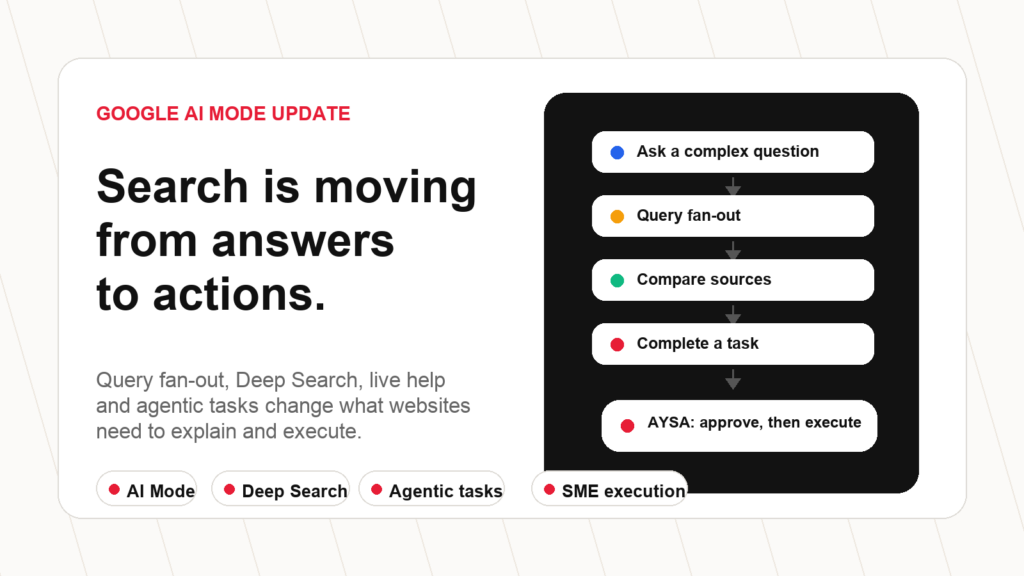
Executive summary: Google’s AI Mode update is not just a product announcement. It is a strong signal that Search is moving from “find me information” toward “help me complete a task.” Google described AI Mode capabilities including query fan-out, Deep Search, live camera-based help, shopping experiences, personal context and agentic actions. For SEO, AEO and AI visibility, the message is clear: websites need to be easier to understand, compare, cite and act on.
My opinion: SMEs should not react by chasing hacks. They should build a better execution system. The businesses that win will have clear pages, complete entity information, stronger topical coverage, cleaner technical foundations, useful category and service pages, visible trust signals and faster approved implementation. AYSA fits this shift because it turns SEO and AI visibility work into approved Website Execution, not another report that waits in a queue.
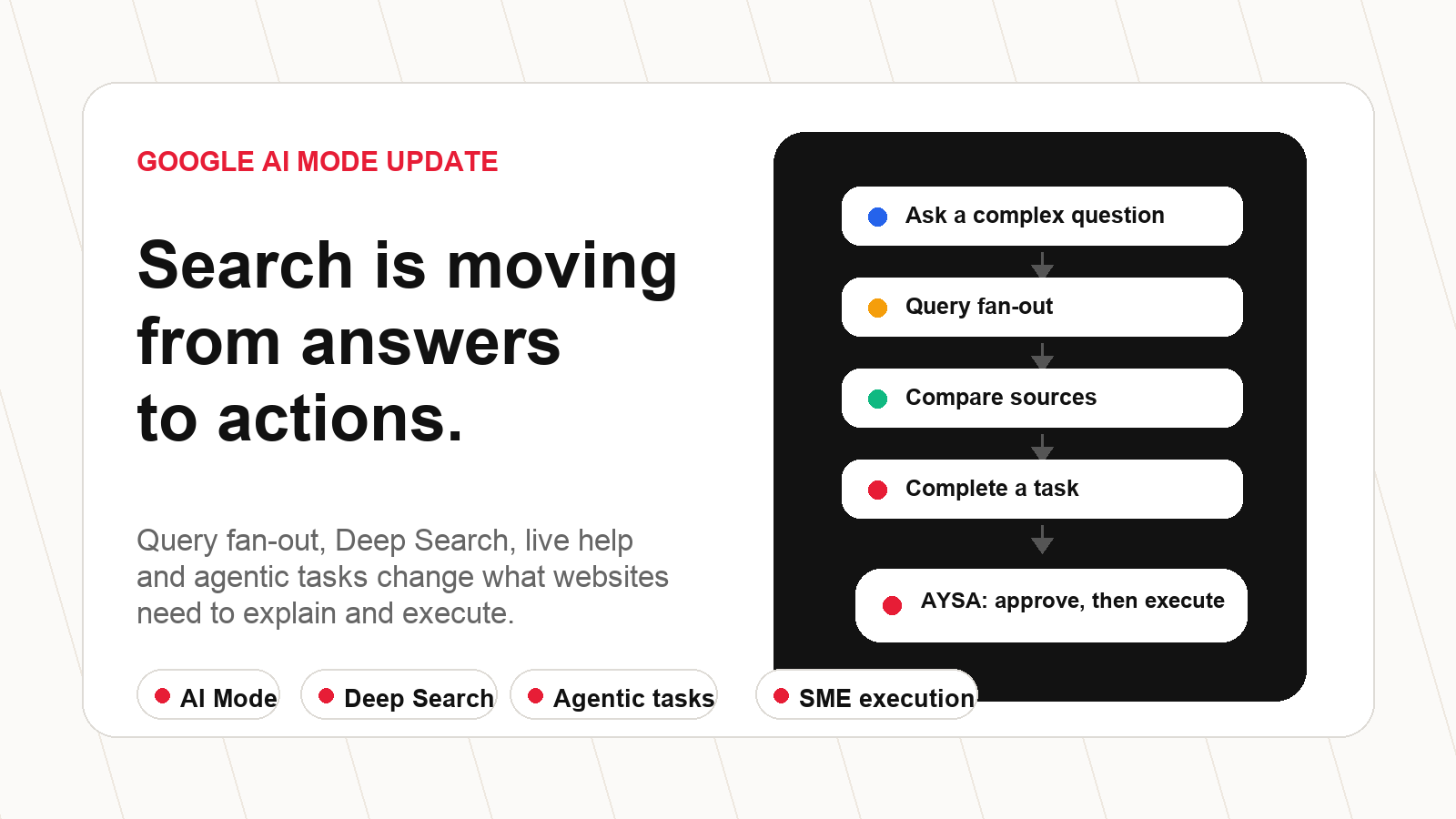
What Google announced about AI Mode
Google’s official Search AI Mode update presents AI Mode as a more capable search experience for complex questions and deeper exploration. The announcement discusses Gemini-powered experiences, query fan-out, Deep Search, live capabilities through Search Live, shopping improvements, personal context and agentic task support. In plain language, Google is building a search experience that can do more than return a list of links.
That does not mean websites stop mattering. It means websites are evaluated in more complex contexts. A user may ask one detailed question instead of several short queries. Google may break that question into subtopics, retrieve from multiple sources, synthesize a response and help the user move toward an action. The page that wins may not be the page that repeats a Keyword most often. It may be the page that provides the clearest, most trustworthy and most complete support for one part of the user’s task.
This is why AI Mode matters for business owners. It connects informational search, comparison search and action-oriented search. A user may move from research to decision inside one experience. That puts pressure on websites to be clear about products, services, prices, availability, location, policies, proof, examples and next steps.
For years, many SMEs treated SEO as a traffic channel. AI Mode makes it more obvious that SEO is also an information architecture and execution channel. If a business does not explain itself well, if important pages are thin, if Technical SEO is messy or if updates take months, the business becomes harder to understand in AI-assisted search.
Why AI Mode matters for SEO, AEO and AI visibility
The older SEO model was often simplified into “rank for the keyword.” The newer model is more demanding: be the best source, the best entity match, the clearest answer, the easiest comparison and the safest next step. This is where SEO, AEO, GEO and AI visibility start to overlap.
AEO is not just adding FAQs. GEO is not just trying to be mentioned by a chatbot. AI visibility is not just tracking whether a brand appears in a synthetic answer. The practical work is making the website easier for systems to retrieve, interpret and trust, while still serving human users first.
Google’s AI features guide keeps the advice grounded in fundamentals: create helpful, reliable, people-first content; make pages crawlable; use Structured data where appropriate; keep the technical foundation clean. The difference is that AI Mode raises the cost of slow execution. If a website needs clearer pages, better internal links, schema cleanup, technical fixes and stronger topic coverage, those changes cannot sit in a PDF for six months.
In my opinion, the AI Mode era will punish “SEO theater.” Dashboards, audits and strategy decks are not enough. A business needs a system that continuously turns findings into controlled action.
Query fan-out: one question becomes many searches
Query fan-out is one of the most important ideas behind AI Mode. Instead of treating a complex prompt as one simple query, Google can explore multiple related subqueries behind the scenes. This allows the system to answer broader, more specific or more nuanced questions.
For example, someone searching for “best private pediatric clinic in Bucharest for a toddler with recurring fever, good reviews, parking and online booking” is not asking one keyword. They are asking a task question with constraints. Relevant subtopics may include pediatric specialties, doctor availability, private clinic reviews, parking, appointment booking, location, emergency versus non-emergency care and parent trust signals.
For ecommerce, a query like “best lightweight carry-on luggage for a three-day business trip under 200 euros” may fan out into size restrictions, airline cabin rules, material, wheels, weight, durability, reviews, price, return policy and stock availability. For B2B SaaS, a query like “SEO automation tool for a small WordPress business without an agency” may require information about pricing, WordPress integration, approval workflows, content generation, technical SEO, AI visibility, support and security.
This changes content strategy. A website cannot rely only on one landing page optimized for one phrase. It needs a connected content system: product pages, service pages, comparison pages, guides, FAQs, glossary definitions, examples, help pages and internal links that explain how concepts relate to each other.
Old keyword mindset
One search term, one landing page, one ranking target. The page tries to match a phrase.
AI Mode mindset
Deep Search: why thin content becomes weaker
Google’s update describes Deep Search as a way for AI Mode to perform deeper research for more complex questions. This is important because shallow pages are less useful when the system can explore a topic from multiple angles.
Thin content does not only mean “short text.” A long page can still be thin if it does not help the user. A product page can be thin if it lacks specifications, comparison context, stock information, delivery details, reviews or compatibility. A local service page can be thin if it says “best service in town” but does not explain area, pricing, process, proof, team, certifications or when the service is a good fit. A blog article can be thin if it summarizes other articles without adding judgment, examples or practical next steps.
Deep Search makes useful depth more valuable. It does not mean every page should become massive. It means each page should answer its real job well. If the job is comparison, compare. If the job is education, explain. If the job is conversion, reduce uncertainty. If the job is support, give clear steps. The page should make the user’s next decision easier.
This is also why topical authority matters. A website that covers a topic coherently across multiple useful pages is easier to understand than a website with isolated fragments. A hotel site should connect rooms, location, parking, local attractions, business travel, cancellation policy and booking. A clinic site should connect specialties, doctors, appointments, insurance, conditions, location and trust signals. An ecommerce site should connect categories, products, buying guides, delivery, returns and comparisons.
Live capabilities and agentic tasks change what “SEO” includes
Google’s update also points toward live and agentic capabilities. This is where search moves closer to assistance. The user may not only ask for information; they may want help comparing, planning, booking, buying or completing a task.
That means SEO becomes closer to website operations. If forms are broken, if booking flows are confusing, if product availability is unclear, if contact information is hidden, if policies are vague or if pages rely on fragile scripts, the business may lose value even if it receives visibility.
This is especially important for SMEs. Many small businesses have websites that were built as brochures. AI-assisted search expects websites to behave more like reliable information and action systems. A restaurant should make menu, hours, reservation, location and dietary details easy to understand. A parking provider should explain distance, shuttle, security, pricing, booking and cancellation. A clinic should explain services, doctors, appointments and when urgent care is needed. An online store should explain variants, stock, shipping, returns and product differences.
Agentic search does not remove the need for human trust. It increases it. If the AI helps the user compare options, the website still needs to provide credible reasons to choose the business.
Shopping, product discovery and commercial SEO
Google’s AI Mode update includes shopping-related capabilities. For ecommerce businesses, this is one of the most important parts of the announcement. Product discovery is becoming more conversational and more comparative. Users can describe constraints, preferences and context, not just type a product keyword.
This has direct implications for ecommerce SEO. Product feeds, product pages, category pages, structured data, reviews, availability, pricing and return policies all become part of the trust and retrieval layer. If products are duplicated, variants are confusing, category pages are weak or structured data conflicts with visible content, the store becomes harder to use in AI-assisted shopping journeys.
For SMEs, the opportunity is significant. Big brands have resources, but small businesses can often explain niches better. A local florist can explain occasions, delivery zones, bouquet sizes and freshness guarantees. A boutique hotel can explain neighborhood, parking, breakfast, family rooms and nearby attractions. A specialized ecommerce store can provide expert buying advice that marketplaces do not. AI Mode does not automatically favor the biggest site; it favors useful, retrievable and trustworthy information.
But this only works if the information is actually present and technically accessible. Thin product pages, duplicate categories and poor internal links reduce the chance that a business is understood correctly.
What SMEs should do now
The correct response to AI Mode is not panic. It is execution discipline. Here is the practical checklist:
1. Clarify your core pages. Your homepage, service pages, product categories, pricing pages, location pages and contact pages should explain what you do, who you serve, where you operate, what users can do next and why they should trust you.
2. Build topic coverage around real decisions. Do not publish generic articles just to fill a blog. Build pages that help users compare, choose, understand risks, answer objections and complete journeys.
3. Fix technical access. Important pages should be crawlable, indexable, fast enough, internally linked and free from canonical confusion. Query parameters, duplicate URLs and broken redirects should not consume the site’s attention.
4. Make structured data consistent. Use schema where it matches visible content. Avoid duplicate or conflicting markup from multiple plugins.
5. Improve internal linking. Connect related guides, glossary terms, category pages, product pages, examples and help content. AI retrieval benefits from clear semantic relationships.
6. Monitor AI visibility and classic SEO together. Search Console, rankings, traffic, AI mentions, answer engine visibility and content gaps should be interpreted together, not as separate worlds.
7. Execute faster, but with approval. The biggest SME problem is not lack of advice. It is implementation. Technical fixes, content updates, internal links and schema improvements must move from recommendation to approved action.
Video explainer: Google AI Mode context
The video below gives extra context around the AI Mode direction and why search is becoming more conversational, multimodal and action-oriented. I am embedding it through YouTube’s privacy-enhanced domain.
Where AYSA fits: approved execution for the AI Mode era
AYSA is built around a simple belief: SEO should not stop at research. In the AI Mode era, that belief becomes even more important. Search is becoming more dynamic, more conversational and more operational. Websites need to improve continuously.
AYSA can help identify pages that receive impressions but do not satisfy intent, topics where coverage is weak, product or service pages that lack useful decision information, internal linking gaps, technical issues that reduce crawlability, schema opportunities that match visible content, AI visibility gaps and authority-building opportunities that need review.
The key is approval. AYSA prepares the work, explains why it matters, asks for approval and executes accepted changes inside the website workflow. That is different from a dashboard that only shows problems. It is also different from blind automation. Business owners stay in control, while the agent handles the repetitive execution layer.
In my opinion, this is the practical future of SEO for SMEs. AI Mode increases the number of signals, journeys and content relationships a website must manage. Human experts will still matter, but the manual workload is too large and too continuous for most small teams. The winning model is human judgment plus agentic execution.
Google’s AI Mode update should not scare businesses. It should push them to build better websites: clearer, faster, more useful, more connected and easier to act on.
Less SEO work. More organic growth.
Turn AI Mode changes into approved website execution.
AYSA monitors SEO, AEO and AI visibility, prepares improvements, asks for approval and executes accepted changes inside your website workflow.
Sources
Continue the AI search topic inside AYSA.
Use these pages to connect the article with AI SEO tools, AI visibility monitoring, AI Overviews and approved website execution.
Turn this topic into a website action plan.
Use these AYSA hubs to move from reading to technical fixes, AI visibility monitoring, research, glossary context and approval-first SEO execution.