Claude Fable 5 And The New Reality Of “Project-Scale” AI: What SMEs & Agencies Must Change In SEO Execution
Anthropic’s Claude Fable 5 signals a shift from chat-based AI to project-scale AI that can plan, code, and reason across large contexts. That changes how SEO work gets done—and why approved, monitored execution (not just content generation) becomes the real competitive edge for SMEs and agencies.

AI models are moving from “answer machines” to “project workers.” That sounds like hype until you watch what the newest models are being positioned to do: plan, write, code, interpret charts, keep context over long sessions, and push a task forward with less hand-holding.
Search Engine Journal recently covered Anthropic’s release of Claude Fable 5, describing it as Anthropic’s most capable publicly accessible model yet—especially for coding, research, and long-running work. That framing matters for SEO because modern SEO is no longer a set of isolated tactics. It’s continuous operations: technical hygiene, content systems, templates, Internal linking, schema, page experience, analytics instrumentation, and increasingly, “AI Search” visibility work that depends on consistent inputs across your site and brand footprint.
Here’s my point of view as Marius Dosinescu (AYSA.ai): the competitive advantage is shifting away from who can generate the most content or the cleverest prompt. The advantage is going to the teams that can (1) monitor what’s happening, (2) decide what matters, and (3) execute changes safely at scale—without breaking the site, polluting analytics, or creating brand/legal risk.
That’s where a system like AYSA fits: it monitors, prepares changes, asks for approval, and executes accepted website changes. As AI becomes more capable, governance and execution become the bottleneck. If you solve that bottleneck, you win.
Concise Summary
- Claude Fable 5 signals “project-scale AI”: models that can sustain attention across long tasks and help with real software and research work, not just chat replies.
- For SEO, this accelerates technical and content operations: audits, template updates, internal linking, Structured data, migrations, and site-wide fixes become easier to propose—meaning you need a safe way to ship them.
- The risk scales with capability: when AI can meaningfully change code and templates, mistakes aren’t one page—they can be 10,000 pages.
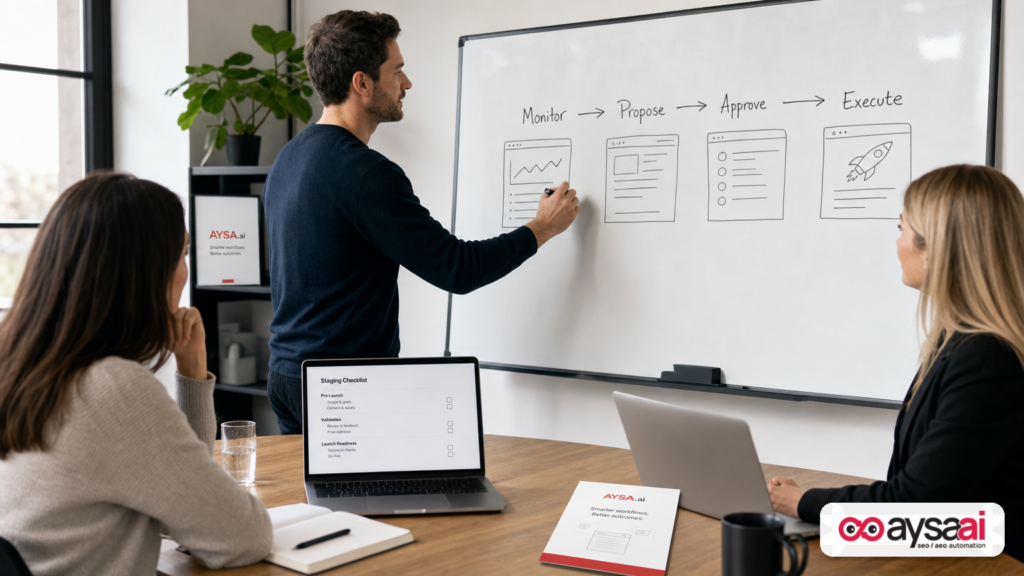
- SMEs should adopt an “Approved Execution” workflow: monitor → recommend → approve → implement → measure → rollback if needed.
- Agencies should rethink deliverables: less “reporting,” more managed execution with measurable outcomes.
Key Takeaways (Read This If You’re Busy)

- AI will compress the time between insight and change. Your process must keep up—or you’ll ship chaos faster.
- Execution beats ideation. Everyone will have access to capable models; few will have disciplined implementation.
- Technical SEO becomes continuous. Not quarterly audits—ongoing, monitored maintenance with rapid fixes.
- Content SEO becomes system design. Templates, structure, internal linking, and editorial governance matter more than raw output volume.
- Governance becomes a moat. Approvals, staging, QA, measurement, and rollback plans separate pros from amateurs.
Table of Contents

- What Changed: Why Fable 5 Is A Signal, Not Just A Model Release
- The Big Shift: From “Prompting” To “Project-Scale” AI
- What Fable 5 Suggests About The Future Of SEO Work
- Why Execution Is Now The SEO Bottleneck
- Technical SEO In The Project-Scale AI Era
- Content SEO In The Project-Scale AI Era (What “AI Content Stopped Working” Really Means)
- A Concrete SME Scenario: Local Multi-Location Service Business
- Agency Reset: New Deliverables, New Margins, New Risk
- The Hidden Risk: When AI Can Change The Site, Mistakes Scale Too
- A Practical 90-Day Plan For SMEs (Without Hiring A Bigger Team)
- Where AYSA Fits: Monitoring + Approved Execution (Not More Noise)
- What To Do Next
- Sources & Further Reading
What Changed: Why Fable 5 Is A Signal, Not Just A Model Release
Most AI announcements feel like another round of “it’s faster and smarter.” The reason the Fable 5 coverage caught attention is different: the emphasis is on sustained, autonomous work across complex tasks—especially coding, research, and long-context understanding.
According to the Search Engine Journal summary of Anthropic’s announcement, Fable 5 is positioned as:
- Stronger at software engineering and capable of working longer with less oversight.
- Improved for knowledge work like document reasoning, analysis, and chart interpretation.
- Better at vision + long-context tasks, including extracting details from complex figures and staying focused across very long inputs.
- Released with new safety limits that sometimes route requests to another model.
Even if you never use Claude, this is the direction of travel for the whole category. Models are becoming less like chatbots and more like junior operators that can carry a project forward—if you put them in a controlled workflow.
For SEO, the implications are immediate:
- Technical fixes get cheaper and faster to propose. Template refactors, schema improvements, internal linking logic, and performance optimizations are more accessible.
- Research gets less manual. Competitive reviews, content inventory analysis, SERP pattern finding, and information synthesis can happen in fewer cycles.
- Workflow matters more than talent scarcity. A small team can do what used to require a larger one—if they can execute safely.
The Big Shift: From “Prompting” To “Project-Scale” AI
Let’s name the shift plainly.
Prompt-scale AI is what most businesses have been doing: ask for a blog outline, a meta description, a few title ideas, or a simple code snippet.
Project-scale AI is different: you hand the model a goal (“fix our category templates,” “restructure our location pages,” “migrate the blog,” “build a theme,” “analyze these 300 pages”) plus context (docs, codebase, screenshots, analytics exports). The model can keep the thread across many steps, reason about dependencies, and propose a coherent plan.
The immediate upside is speed. The immediate downside is also speed—because you can now push more changes than your organization can QA or even understand.
So the real question is not “can the model do it?” The real question is:
- Who validates the change?
- Where do you stage it?
- How do you measure impact?
- How do you roll back if it goes wrong?
This is exactly why SEO is becoming an execution discipline instead of a recommendation discipline.
If you want a mental model, think about modern finance teams: software can suggest budgets, flag anomalies, and draft forecasts—but leadership still needs approvals, controls, and auditing. SEO is heading the same way.
What Fable 5 Suggests About The Future Of SEO Work
Based on the SEJ coverage, there are three capability areas that matter most to SEO operations.
Coding & site development becomes part of everyday SEO
Search Engine Journal highlighted examples and claims around Fable 5’s coding strength and ability to handle longer tasks in software engineering contexts. The editorial takeaway for SEO teams is straightforward: the wall between “SEO” and “development” keeps shrinking.
Not because SEOs suddenly become engineers—but because the path from “idea” to “pull request” becomes shorter. The model can help translate requirements into code-level changes: templates, components, structured data, redirects, internal linking logic, pagination handling, faceted navigation controls, and more.
In practical terms, expect this to show up as:
- Faster theme and template updates (WordPress, headless CMS, modern frameworks).
- Quicker debugging of indexing problems rooted in rendering, canonical tags, or duplication.
- More businesses attempting migrations and refactors—sometimes before they’re ready.
Knowledge work: turning “messy data” into decisions
Anthropic is positioning Fable 5 as stronger in document reasoning and analysis. For SEO teams, “knowledge work” is the unglamorous reality: spreadsheets of URLs, content inventories, analytics exports, Search Console queries, lists of duplicates, redirect maps, and internal link graphs.
Models that can reliably work through that mess help in two ways:
- Synthesis: turning many documents into a clear narrative (what’s broken, what’s working, what’s next).
- Prioritization: identifying high-leverage actions instead of endless backlogs.
But synthesis without execution is still theater. If your workflow ends at “recommendation,” you’ll get smarter PowerPoints and the same results.
Long context & vision: more of SEO becomes “multimodal”
SEJ’s write-up notes improvements in vision and long-context tasks, including staying focused across very long sessions and extracting information from complex figures.
That matters because SEO work increasingly includes:
- Screenshots of SERPs and site templates (“this is what Google shows,” “this is what our page renders”).
- Design files and layout constraints that affect headings, internal links, and content placement.
- Long policy and compliance docs (especially in health, finance, legal) that constrain what content can say.
The more AI can interpret these inputs, the more it can propose changes that are actually implementable—not just theoretically correct.
Why Execution Is Now The SEO Bottleneck
In the last decade, SEO bottlenecks moved around:
- First it was information scarcity (few people knew what to do).
- Then it became content production (who could publish consistently).
- Then it became authority (trust signals, links, brand).
- Now, it’s execution velocity with control.
Why? Because AI compresses time for planning and drafting, but it doesn’t automatically produce safe outcomes. It can create:
- Confidently wrong changes
- Misaligned brand messaging
- Technical regressions that tank crawling/indexing
- Duplicate and thin pages at scale
- Analytics breakage (so you can’t even see what happened)
So the winning organizations will look more like well-run product teams:
- They monitor key signals weekly (not quarterly).
- They stage and QA meaningful site changes.
- They keep a change log and rollback plan.
- They measure outcomes in business terms, not SEO vanity metrics.
This is also why I push the idea of Approved Execution. When AI can propose (or even implement) code and content changes, you need a guardrail system that routes changes through approval and keeps measurement tied to the change itself.
If you want to see what that philosophy looks like in practice, start here: AYSA Monitoring.
Technical SEO In The Project-Scale AI Era
Technical SEO used to be an audit plus a ticket list. That model breaks when AI can propose hundreds of technically “correct” fixes. The question becomes: which fixes move revenue, and which introduce risk?
Here are the technical areas that project-scale AI will pressure-test.
1) Template consistency: titles, headings, canonicals, and internal links
AI can spot inconsistent patterns across templates quickly. But the risk is that it “normalizes” everything into something bland or wrong.
What to do:
- Define non-negotiables (brand naming, legal language, medical disclaimers, etc.).
- Implement changes as template rules (not one-off edits) where possible.
- Roll out in batches and monitor impact.
AYSA’s approach is designed for this: it can monitor, prepare proposed changes, require approval, and then execute—so you get speed without losing control. See: AYSA AI SEO Tools.
2) Structured data (schema): helpful, but easy to mess up
AI can generate schema quickly, which is both great and dangerous. Incorrect schema can create misleading signals, fail validation, or become inconsistent across page types.
What to do:
- Use schema for clarity and entity understanding, not as a “ranking trick.”
- Standardize per page type: product, article, FAQ, location, service.
- Validate and monitor changes after deployment.
Primary reference: Schema.org.
3) Indexation and crawl control: the silent killer
AI is very good at suggesting rules for canonicals, noindex tags, robots.txt, and parameter handling. It’s also very good at being overconfident.
Common failure patterns include:
- Noindexing pages that actually drive leads
- Canonicalizing to the wrong “preferred” URL
- Blocking important assets or rendering resources
What to do:
- Require approval for any indexation/crawl-control change.
- Stage + test with a limited set of URLs first.
- Measure via Google Search Console trends and crawl stats.
Primary reference: Google Search Central documentation.
4) Migrations and refactors become “easier” (and that’s not always good)
When code generation and analysis improve, more teams attempt migrations: WordPress theme rebuilds, headless moves, URL structure changes, platform switches, etc.
Migrations don’t fail because people can’t write redirects. They fail because of:
- Incomplete redirect maps
- Internal link breakage
- Lost structured data
- Analytics tag loss
- Content parity issues (missing sections, missing FAQs, missing legal content)
Project-scale AI can help plan and execute migrations—but only if the business has a disciplined checklist and approval process.
Content SEO In The Project-Scale AI Era (What “AI Content Stopped Working” Really Means)
Many publishers and SMEs feel like “AI content stopped working.” What they usually mean is: “We published a lot, and it didn’t move traffic or leads.”
AI didn’t break content marketing. It exposed that most content programs were:
- Too generic
- Too similar to competitors
- Disconnected from conversion
- Not supported by internal linking and information architecture
- Not maintained
Project-scale AI pushes content SEO toward systems instead of articles.
Content system moves that matter more than “more posts”
- Content inventory + pruning: consolidating duplicates, updating winners, removing dead weight.
- Page type strategy: building strong category/service/location templates that scale quality.
- Internal linking rules: connecting pages logically so relevance and discovery improve.
- Editorial constraints: brand voice, compliance, claims you can and can’t make.
This is where long-context models shine: they can work through your existing site at scale and propose coherent restructuring. But again—without execution, you’re stuck.
If your goal is AI search visibility (AEO/GEO outcomes), you also need to ensure your site becomes a consistent, high-clarity source. AYSA’s framing here: AI Search Visibility.
What businesses get wrong about “AI content”
They treat AI like a writer. The better mental model is: AI is a production accelerator, not a strategy.
Strategy still requires:
- Customer insight (what people actually need)
- Unique proof (photos, demos, case studies, real pricing, real policies)
- Operational truth (shipping times, appointment availability, warranty terms)
AI can help articulate those things, but it can’t invent them (and it shouldn’t). Your competitive moat is the reality of your business—captured accurately on your site.
A Concrete SME Scenario: Local Multi-Location Service Business
Let’s make this real with an example that doesn’t require you to be an SEO professional.
Scenario: You run a regional dental clinic group with 8 locations. Your website has:
- 8 location pages written years ago by different people
- Service pages that don’t match what each location actually offers
- Outdated insurance and financing info
- Inconsistent NAP (name/address/phone) formatting
- Slow pages because of heavy images and plugin bloat
You decide to “use AI to fix SEO.” With prompt-scale thinking, you generate 30 blog posts about teeth whitening and call it a day.
With project-scale thinking, you do something different:
- Inventory the site: list every location/service page, its traffic, conversions, and accuracy.
- Standardize page templates: each location page has the same sections (services offered, doctors, insurance, directions, FAQs, reviews policy).
- Fix technical basics: titles, headings, schema, internal links, image optimization.
- Improve clarity for AI search: make it easy for systems to understand each location’s offerings and policies.
- Execute with approvals: changes are proposed, reviewed by operations/legal/clinic manager, then published.
- Measure and iterate: watch Search Console and lead tracking weekly.
This is exactly the kind of multi-step work that stronger models make easier to plan and draft. But the win only happens if execution is reliable.
Agency Reset: New Deliverables, New Margins, New Risk
If you run an agency, project-scale AI is both a threat and an opportunity.
The threat: “deliverables” get commoditized
Audits, keyword lists, outlines, and even decent drafts are easier to produce. Clients will ask why they’re paying for things they can generate internally.
The opportunity: agencies become execution partners
What clients can’t easily do is run a disciplined change management system across content and code while measuring business impact.
That means your differentiators shift to:
- Operating cadence: weekly monitoring and shipping cycles.
- Risk management: staging, QA, approvals, rollback planning.
- Cross-functional translation: turning SEO needs into implementable changes for dev, content, legal, and leadership.
- Outcome accountability: tying actions to revenue signals.
Project-scale AI can increase your margins if you operationalize it into a production line. It can also destroy your margins if you let it create a never-ending backlog of “possible improvements.”
If you need a way to productize monitoring and execution, start exploring how AYSA approaches that workflow: AI SEO Tools.
The Hidden Risk: When AI Can Change The Site, Mistakes Scale Too
As AI becomes more capable at coding and long-context tasks, the risk profile changes. The classic SEO risk was a bad recommendation that never got implemented. The new risk is a bad change that gets implemented everywhere.
Common “scaled mistake” categories
- Template-level meta tag changes that wipe out differentiation across pages.
- Internal linking automation that creates spammy anchors or irrelevant connections.
- Noindex/canonical changes that deindex revenue pages.
- Schema spam that creates inconsistent entity signals.
- Content rewrites that remove compliance language, pricing qualifiers, or policy clarity.
Safety limits are not your governance
SEJ noted that Anthropic introduced safeguards that route certain sensitive requests to a different model and that these triggers occur in a small percentage of sessions on average. That’s important for preventing misuse, but it is not a business governance system.
Your governance must exist even when the model is “allowed” to answer. Because most SEO failures are not malicious—they’re accidental.
A practical governance checklist:
- Approvals: who signs off on content claims, medical/financial language, and brand voice?
- Staging: where do you test changes before production?
- QA: what pages and templates get checked every time?
- Measurement: what metrics must move for a change to be considered successful?
- Rollback: how quickly can you revert?
A Practical 90-Day Plan For SMEs (Without Hiring A Bigger Team)
If you’re an SME, you don’t need “more AI.” You need a simple operating system for visibility and leads.
Here’s a practical plan you can run with a small team.
Days 1–14: Stabilize and instrument
- Confirm you have Google Search Console access and that it’s tracking the correct domain/property.
- Confirm your analytics and conversion tracking are reliable (forms, calls, bookings, purchases).
- Create a baseline: top pages, top queries, top converting landing pages.
- Set up monitoring for critical site signals (indexation changes, broken pages, template errors).
AYSA starts with exactly this kind of discipline: monitor first, then recommend and execute with approvals. Learn more: AYSA Monitoring.
Days 15–45: Fix high-leverage technical + template issues
- Clean up titles and headings on your revenue-driving templates (category/service/location).
- Ensure internal linking from high-authority pages (homepage, top blog posts) to money pages.
- Improve page speed where it’s obviously harming UX (image compression, script cleanup).
- Implement appropriate schema on key page types.
Primary references:
Days 46–75: Build content systems, not content piles
- Refresh your top 10 pages instead of publishing 50 new ones.
- Add FAQs and clarifying sections that reduce customer confusion and support AI comprehension.
- Create a consistent structure across location/service pages.
- Build internal linking rules that scale.
Days 76–90: Expand with confidence
- Identify 3–5 new page opportunities based on demand and conversion potential.
- Ship improvements in controlled batches.
- Run a monthly “brand visibility check” for how AI systems describe your business (and fix the on-site inputs that feed those outputs).
If you want ongoing ideas and frameworks, browse: AYSA Blog.
Where AYSA Fits: Monitoring + Approved Execution (Not More Noise)
Most teams don’t have a shortage of SEO ideas. They have a shortage of:
- Time
- Focus
- Developer bandwidth
- Quality assurance
- Confidence that changes won’t break something
Project-scale AI increases the volume of possible actions. AYSA’s role is to convert that volume into a controlled, measurable pipeline.
At a high level, the workflow looks like this:
- Monitor your site and search visibility signals continuously.
- Prepare recommended changes with clear rationale and expected impact.
- Request approval so humans stay accountable for what ships.
- Execute accepted changes in a structured way.
- Measure results and iterate.
If your priority is preparing for AI-driven search experiences and ensuring your brand is represented accurately and competitively, start with: AI Search Visibility.
If you’re evaluating tooling and want to understand what you get, including how approvals and execution work, see: AYSA Pricing.
What To Do Next
Use this as your immediate checklist—whether you’re an SME owner, in-house marketer, or agency lead.
- Stop measuring “AI output.” Measure shipped improvements and business outcomes (leads, bookings, revenue).
- Create an approvals policy. Decide which changes require sign-off (indexation rules, template changes, medical/financial claims, pricing).
- Adopt a weekly cadence. Monitoring + small batches of changes beats quarterly “big bang” updates.
- Prioritize templates over one-offs. Fix what scales: service/category/location templates, internal linking rules, structured data patterns.
- Build a rollback habit. Every meaningful change should have a way back.
- Choose an execution system. If you want an approach designed around monitoring, approvals, and controlled shipping, explore AYSA: AI SEO Tools.
Sources & Further Reading
- Search Engine Journal: Claude Fable 5 “Feels Next Level”
- Google Search Central documentation
- Schema.org (structured data vocabulary)
- Search Engine Journal: Latest News (context and ongoing coverage)
- Search Engine Journal: SEO section (broader context)
Related AYSA resources:
Continue the AI search topic inside AYSA.
Use these pages to connect the article with AI SEO tools, AI visibility monitoring, AI Overviews and approved website execution.
Turn this topic into a website action plan.
Use these AYSA hubs to move from reading to technical fixes, AI visibility monitoring, research, glossary context and approval-first SEO execution.