
Your Product Feed Is Now an SEO Asset: How to Own Merchant Center, Schema, and Site Data as One System
Product feeds aren’t just for Shopping ads anymore. They now influence organic rich results, free listings, and AI-driven product discovery—so SEO can’t stay out of Merchant Center. Here’s how to align your feed, structured data, and website into one reliable product truth, what breaks when you don’t, and how to operationalize shared ownership with approved execution.

Product feeds used to live in one box: “paid shopping.” If you weren’t running ads, you could ignore them. That era is over.
Today, your product feed is a core SEO asset because it influences how search engines verify, trust, and present your products across paid listings, free listings, organic Rich results, and—most importantly—AI-driven discovery and shopping experiences. If your feed, your Structured data, and your website disagree, Google (and AI systems) won’t ask you which one is right. They’ll decide. And you’ll see the result as missing products, incorrect pricing in results, suppressed visibility, or lower conversion.
This editorial is inspired by the Search Engine Journal analysis of why product feeds have become an SEO asset and why SEO teams need a seat at the Merchant Center table (Search Engine Journal source). I agree with the core thesis—and I’ll go further: for ecommerce businesses, “product data integrity” is now as foundational as Technical SEO used to be. You can’t content-market your way out of broken product truth.
Concise summary
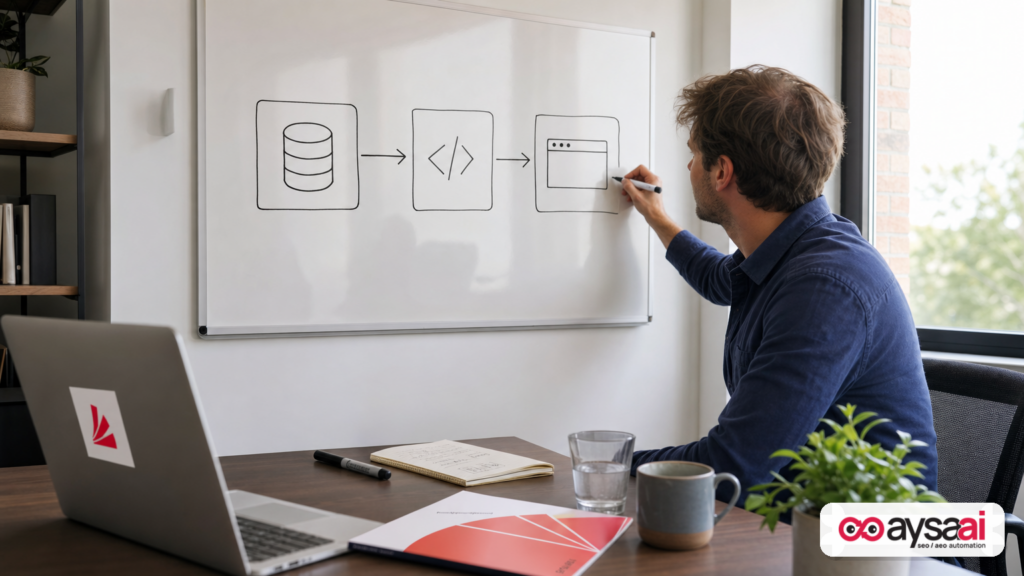
What changed: Google increasingly treats your Merchant Center data (and the product feed behind it) as a trusted product truth that interacts with on-page structured data and your website content. AI Search surfaces amplify the impact of data quality and consistency.
Why it matters: Misalignment can cause product disapprovals, incorrect prices/availability in SERPs, missing products in free listings, and weaker performance in AI-driven discovery. Even when nothing “breaks,” thin feeds can be commercially invisible.
What to do: Move from single-team ownership (PPC-only) to shared ownership (SEO + PPC + dev/data). Create one canonical product truth, align schema and feed rules to it, and monitor drift continuously.
Where AYSA fits: AYSA acts as an AI Search visibility and monitoring layer that flags inconsistencies, prepares fixes, asks for approval, and executes accepted website changes—so alignment doesn’t die in a ticket queue.
Key takeaways

- Your product feed is not “just PPC.” It’s now infrastructure for how products are discovered and verified across Google surfaces.
- There are three product truths. Merchant Center/feed data, on-page structured data, and the rendered website are distinct systems with different vocabularies and failure modes.
- Google resolves conflicts. When data conflicts, Google may choose one source, auto-update another, or reduce trust—often without a clear warning in organic.
- Feed quality is becoming a trust signal. Account health and data completeness can influence eligibility and visibility across placements.
- Execution is the bottleneck. Most teams can identify issues; fewer can reliably ship fixes quickly and safely.
Table of contents

- The shift: why the feed became an SEO asset
- The new reality: three product “truths” (and Google will pick one for you)
- What breaks in the real world (and why it’s rarely “just a PPC issue”)
- Common misalignment patterns to look for
- AI discovery and “agentic commerce”: why purchasability is now technical
- Who should own the product feed? A shared ownership model that actually works
- A practical audit: the feed–schema–site alignment checklist
- Monitoring: how to catch drift before revenue drops
- A concrete SME scenario: the home-goods store that “lost” half its catalog
- What agencies should rethink (before clients blame “SEO”)
- Where AYSA.ai fits: approved execution for product data integrity
- What to do next
- Sources and further reading
The shift: why the feed became an SEO asset
Historically, Merchant Center and product feeds were transactional plumbing for Shopping ads. PPC teams owned it because:
- the ad budget was there,
- the performance reporting was there, and
- the consequences (disapprovals) showed up there.
But that mental model assumes two things that are no longer safe assumptions:
- That paid is the only surface affected. In reality, Merchant Center powers free listings and influences how Google understands products more broadly—especially when it can cross-verify feed attributes against the site and structured data.
- That SEO’s primary product input is “the page.” In practice, SEO is now responsible for product discoverability across multiple machine-consumed representations: HTML, structured data, and merchant/graph data.
This is the part most businesses underestimate: the feed is not just a file. It’s a database-like representation of your catalog that’s easy for Google to parse, compare, and trust—if it’s consistent. Meanwhile your website is messy (in a normal way): templates, scripts, localized pricing, personalization, and infinite variation across devices. If you want AI and search engines to “understand” your product reality, the feed is a lever you can’t ignore.
In Google’s ecosystem, Merchant Center has also become a front door to product information across experiences. Search Engine Journal’s piece highlights this expanded role and argues for SEO being involved in feed ownership (SEJ). That’s not theoretical—it’s operational: if SEO is measured on organic revenue, SEO can’t treat the feed as “someone else’s database.”
The new reality: three product “truths” (and Google will pick one for you)
Most ecommerce orgs are running three parallel product systems that don’t naturally stay aligned:
Layer 1: Merchant Center (your product feed)
This is the attribute list: titles, pricing, availability, identifiers (GTIN/MPN), shipping, and more. It’s structured, explicit, and designed for database ingestion.
Layer 2: On-page structured data (schema markup)
Usually JSON-LD describing Product and Offer (price, availability, etc.). For many stores, this is generated by templates, apps, or plugins and can drift away from the visible page or the feed.
Layer 3: The website (rendered content)
This is what humans see (and what crawlers/agents attempt to fetch): displayed price, stock messaging, variant selection, shipping/returns information, canonical URLs, and Internal linking.
The “unholy trinity” framing from the SEJ piece is accurate because each layer has:
- different validation rules,
- different owners (PPC vs. SEO vs. dev/commerce ops), and
- different incentives (ad approval vs. rankings vs. site Conversion rate).
And yet all three are describing the same reality: your product catalog. When they diverge, Google has to reconcile conflicts. Sometimes you see a Merchant Center disapproval. Often you don’t—you just see suppressed visibility or inconsistent SERP Features.
What breaks in the real world (and why it’s rarely “just a PPC issue”)
When things go wrong, most teams troubleshoot only within their lane:
- PPC checks the feed status and policies.
- SEO checks indexing and structured data reports.
- Dev checks deployments, caching, and infrastructure.
That separation is exactly why issues linger. The SEJ source gives two realistic failure categories that I also see repeatedly across ecommerce operations:
Failure type 1: Visible failures (disapprovals, broken rich results)
These include obvious mismatches like price differences between feed, schema, and page. The reason these failures are so costly is not that they exist—it’s that they’re frequently “owned” by nobody. PPC sees the disapproval, but the cause might be schema markup output by a theme/app. SEO might understand schema, but may not be watching Merchant Center alerts daily. Dev can fix templates, but may not know the business impact.
Failure type 2: Invisible failures (trust erosion, suppressed visibility)
These are worse. The feed may remain technically valid, but it’s commercially weak. Titles are generic, attribute coverage is thin, variants are confusing, and taxonomy doesn’t map to how people search. Nothing throws an error, but performance quietly under-delivers.
Failure type 3: Infrastructure failures (verification breaks)
In the SEJ example, bot protection or CDN rules can block crawling. When Google can’t fetch the landing page to verify feed and structured data, products can disappear or lose eligibility—even if the feed “looks fine.” That’s why SEO has to be involved: crawlability is SEO’s home turf, but the symptom may show up first in Merchant Center.
The point: this is not a PPC problem, an SEO problem, or a dev problem. It’s a product truth problem.
Common misalignment patterns to look for
Let’s make this practical. Here are the patterns that create the most damage, the fastest—without relying on made-up stats or “secret Google factors.” These are observable system behaviors.
1) Price: gross vs. net, currency formatting, and variant selection
Price is both a user trust factor and a compliance factor. And it’s uniquely prone to drift because:
- some sites display price inclusive of tax while schema outputs ex-tax (or vice versa),
- some feeds are built from an ERP export while the site is built from a different commerce layer,
- variants can change price after selection, while schema/feed may represent a base SKU.
In the SEJ case, the schema price didn’t match the page, which then influenced Merchant Center via automatic updates. That kind of chain reaction is exactly why cross-ownership matters.
2) Availability vocabulary mismatches
Feed availability values and schema.org availability values aren’t identical. Even when they refer to the same concept, they may require different formats and rules (e.g., a URL vocabulary on schema.org). If one layer says “in stock” and another says “preorder,” you can create user-facing confusion or validation failures.
Official reference for schema availability is on schema.org itself (schema.org/InStock and related terms).
3) Variant architecture gaps (grouping, canonicals, and parent/child modeling)
Feeds often describe variants as a flat list grouped by a shared ID. On-page schema can describe a parent group with nested variants. Your website may show one URL per color, or one URL with selectable options.
When these models don’t align, you typically get one of two outcomes:
- Google has trouble consolidating signals, so variants compete or cannibalize each other.
- Google can’t reliably match feed items to landing pages, reducing coverage.
For SMEs, you don’t need perfect theoretical modeling; you need consistent mapping: one variant should resolve to one landing page truthfully, and grouping should be stable.
4) Titles written for databases, not for searchers
This is the silent killer. Platform exports often produce titles like:
- “Dress – Blue – Size 6”
- “SKU 18391 – Variant 2”
- “Office Chair Model X”
A human doesn’t search that way. Searchers use: brand + product type + differentiator + intent. SEOs already know how to build that language for page titles and headings. The feed needs the same thinking—within policy constraints and without spammy stuffing.
5) Shipping and returns: the new trust layer
Even if you’re not chasing badges or special placements, shipping and return clarity is a conversion and trust issue. Merchant ecosystems increasingly want structured shipping/returns information. If your website says one thing and your merchant data implies another, you create friction at exactly the moment the user wants to buy.
The SEJ source mentions merchant “quality” concepts and the idea that account health matters. If you want a primary reference point for how Google thinks about merchant presence, start with Merchant Center documentation from Google (note: I’m not adding a specific URL here because it wasn’t included in the supplied research context; use your existing Merchant Center Help resources as the primary source).
AI discovery and “agentic commerce”: why purchasability is now technical
Here’s my POV, as an operator who cares about business outcomes more than SEO jargon: the AI era shifts ecommerce search from ranking pages to being the most reliable product data source.
That doesn’t mean “SEO is dead.” It means the input layer changed. AI-powered surfaces can summarize, compare, and recommend products without sending the same kind of click volume we’re used to. When that happens, your competitive advantage is:
- accuracy (no mismatches),
- completeness (enough attributes to match the query), and
- verifiability (Google can confirm what you claim).
In the SEJ source, the concept of “agentic commerce” is framed around discoverability and purchasability. That’s the right frame. If an AI system is going to recommend a product, it needs structured, consistent product facts. If it’s going to help a user complete a purchase, the system needs to trust availability, price, and destination behavior.
This is where SMEs get hurt first: they often rely on default platform exports and a patchwork of plugins/apps. Everything looks fine until a template change, a tax setting change, or a CDN rule breaks verification. Suddenly, product visibility drops—not because “SEO changed,” but because the product truth fractured.
Who should own the product feed? A shared ownership model that actually works
The wrong question is: “Should SEO own the feed or should PPC own the feed?”
The right question is: “How do we create one product truth and assign clear responsibility for keeping it aligned across systems?”
Here’s a model that works for SMEs and for larger ecommerce teams. It’s not about politics; it’s about reducing time-to-fix and preventing regressions.
Principle: shared ownership, single source of truth
You want one canonical catalog truth (often your commerce platform/ERP/PIM), and you want every outward representation to be generated from it consistently:
- Feed exports should map from canonical fields with explicit transformations.
- Schema templates should map from the same canonical fields.
- On-page display should also map from canonical fields (or transformations should be mirrored).
Role clarity: who does what
- PPC (Merchant Center ops): diagnostics on feed health, policy issues, promotions, and paid performance feedback loops.
- SEO (search modeling + structured data): taxonomy, titles aligned to demand, structured data integrity, indexation and crawl verification, and organic/free listing visibility.
- Dev / commerce ops: template output, data pipelines, CDN/security rules, and release management.
Shared ownership means weekly alignment on what changed, what broke, and what needs shipping. It also means a clear escalation path when the root cause is outside one team’s tools.
A practical audit: the feed–schema–site alignment checklist
If you only take one thing from this article, take this: you need an audit that compares the same attributes across all three layers, at scale, and then keeps monitoring them.
Below is a practical checklist you can run quarterly (audit) and weekly (monitoring), even as an SME.
Step 1: Choose a representative product sample
- top revenue SKUs,
- high variant complexity (sizes/colors),
- sale items,
- preorders/backorders,
- international/currency items (if applicable).
Step 2: Compare critical attributes across feed, schema, and page
Focus on the attributes that create the most damage when wrong:
- Price: numeric value, currency, sale vs. regular price, tax inclusion, and any “valid until” logic.
- Availability: in stock/out of stock/preorder/backorder and expected dates.
- Identifiers: GTIN/MPN/brand consistency (especially for manufacturers/resellers).
- Title: human search intent vs. database naming.
- Variant handling: whether each purchasable variant maps to a valid, crawlable landing page.
- Landing page fetchability: can Googlebot access the product page reliably?
Step 3: Verify technical prerequisites (the “don’t get cute” list)
- Robots directives allow crawling where needed.
- CDN/WAF rules do not block Googlebot or key user agents.
- Canonical URLs are consistent and not flipping due to parameters.
- Product pages return 200 status codes and don’t require client-side rendering to show essential data.
Step 4: Evaluate feed taxonomy and attribute depth like an SEO would
This is the step most businesses skip because Merchant Center “accepts” the feed. But acceptance is not visibility.
- Do your titles include the words customers actually use?
- Are category mappings too broad, burying products in generic buckets?
- Do you provide enough attributes to match filters people use (size, color, material, compatibility)?
When you treat the feed as an SEO asset, you stop thinking “what fields can we fill” and start thinking “what questions does the customer ask, and can our data answer them?”
Monitoring: how to catch drift before revenue drops
Audits are snapshots. The real world changes daily:
- prices change,
- inventory shifts,
- promotions start/end,
- developers push releases,
- apps/plugins update schema output,
- security teams change bot rules.
So you need monitoring that detects drift across layers.
What to monitor weekly (minimum viable monitoring)
- Merchant Center product status changes: spikes in “not approved” or warnings.
- Price/availability mismatch sampling: compare a rotating sample of products across feed vs. on-page vs. schema.
- Crawl access: confirm key product URLs are fetchable.
- Structured data regressions: template changes that drop critical fields.
AYSA’s Monitoring is designed for exactly this kind of ongoing integrity work: it’s not just “rank tracking.” It’s “are we still telling the same product truth everywhere, and did something change?”
A concrete SME scenario: the home-goods store that “lost” half its catalog
Imagine a small ecommerce business: a home-goods store selling organizers, lamps, and seasonal decor. The owner is not an SEO specialist; they’re running operations, customer service, and fulfillment.
They run some Shopping ads, and they also rely on organic sales. One day, revenue dips. Ads suddenly deliver fewer conversions and organic product impressions soften. The owner assumes it’s “competition” or “Google update.”
What actually happened (a realistic sequence, consistent with the failure modes described in the SEJ source):
- A theme/app update changes how schema outputs price (e.g., switching to a base variant price, or excluding tax).
- Merchant Center notices inconsistent pricing between landing page and structured data and starts flagging items.
- Some products lose eligibility; others show the wrong price in free listings, hurting conversion.
- No one sees it quickly because PPC looks at disapprovals, SEO looks at rankings, and dev looks at deployments—but nobody compares all three layers.
In this scenario, the “SEO fix” isn’t writing more content. It’s restoring product truth alignment, then putting monitoring in place to prevent repeat incidents.
What agencies should rethink (before clients blame “SEO”)
If you’re an agency, here’s the hard truth: clients don’t care which team owns Merchant Center. They care whether product revenue is up or down.
Agencies should adjust service design in three ways:
1) Expand SEO scope to include Merchant Center visibility inputs
Not “manage the whole account,” but at least:
- review feed titles and taxonomy for search demand alignment,
- review schema output against feed values,
- set escalation paths for verification issues.
2) Create a cross-functional incident playbook
When product visibility drops, run the same steps every time:
- Is this a feed status issue?
- Is this a schema regression?
- Is crawling blocked or degraded?
- Did prices/availability change across systems?
3) Build delivery around execution, not recommendations
Most agencies can diagnose. Fewer can ship. But shipping is what protects revenue. That’s why “approved execution” matters: preparation, review, approval, then implementation—fast, trackable, reversible.
AYSA’s model is intentionally built around this: it identifies issues, prepares recommended site changes, asks for approval, and executes what’s accepted. For agencies, that’s leverage. For SMEs, that’s sanity.
Where AYSA.ai fits: approved execution for product data integrity
AYSA is not “another dashboard.” It’s an execution system designed for SEO/AEO/GEO work that needs to happen reliably.
Here’s how AYSA fits into this product feed + schema + website alignment problem:
1) Monitor the inputs that AI search and Google rely on
Use AYSA Monitoring to watch for drift signals: schema output changes, page fetch issues, and the kinds of technical regressions that cause verification failures. This is crucial because the first sign of a problem is often not a clean “error”—it’s performance decay.
2) Treat Merchant Center and structured data as AI Search visibility infrastructure
Product discovery increasingly happens inside AI layers that reward reliability. AYSA’s perspective on AI Search visibility is that you don’t “optimize for AI” with slogans; you optimize the data systems AI reads.
3) Use AI-powered analysis without surrendering control
At AYSA AI SEO tools, the promise is not “auto-change your store.” It’s: analyze, prepare, ask for approval, then execute accepted changes. That matters when the changes touch product templates, schema, or critical ecommerce pages.
4) Operationalize the workflow
Most product data integrity initiatives fail because they’re episodic. Someone fixes a price mismatch, then six weeks later a different update breaks it again.
AYSA helps you turn this into a system:
- recurring checks (monitoring),
- actionable recommendations (prepared changes),
- human approval (business control),
- fast implementation (execution),
- documented outcomes (accountability).
If you want to explore how this works for your store or your agency portfolio, start with pricing and the latest playbooks on the AYSA blog.
What to do next
Use this as your action plan for the next 30 days.
In the next 7 days (quick wins)
- Pick 20 products and compare price + availability across: page, schema, and feed values.
- Check crawl access for key product URLs: make sure nothing in your security/CDN blocks Googlebot.
- Review feed titles for human search phrasing (not internal SKU language).
In the next 30 days (system wins)
- Define ownership: assign a shared owner group (SEO + PPC + dev/ops) and schedule a recurring 30-minute “product truth” meeting.
- Document canonical truth: decide which system is authoritative for price, availability, and identifiers—and document transformations.
- Standardize schema templates: ensure Product/Offer markup matches what the user sees and what the feed asserts.
- Implement monitoring: set alerts for drift and regressions so the next issue is caught before revenue drops.
In the next 90 days (competitive wins)
- Deepen attribute coverage based on how customers filter and search (material, size, compatibility, etc.).
- Fix variant architecture so grouping and landing pages are stable and verifiable.
- Build an incident playbook that any team can use when visibility drops.
Sources and further reading
- Search Engine Journal: Why Your Product Feed Is An SEO Asset (And Who Should Own It)
- Schema.org: InStock
- Schema.org: OutOfStock
- Schema.org: Product
- Schema.org: Offer
AYSA internal reading:
Continue the AI search topic inside AYSA.
Use these pages to connect the article with AI SEO tools, AI visibility monitoring, AI Overviews and approved website execution.
Turn this topic into a website action plan.
Use these AYSA hubs to move from reading to technical fixes, AI visibility monitoring, research, glossary context and approval-first SEO execution.

