
Brand Is the New Backlink: The Practical Playbook for AI Search Visibility (and How to Execute It Without Guesswork)
AI Overviews, AI Mode, and chat-based answers are reshaping how customers discover businesses. The winning strategy is less about chasing clicks and more about being the brand AI can confidently name: clear entity signals, consistent facts everywhere, real experience, and structured data—executed continuously, not as a one-off project.
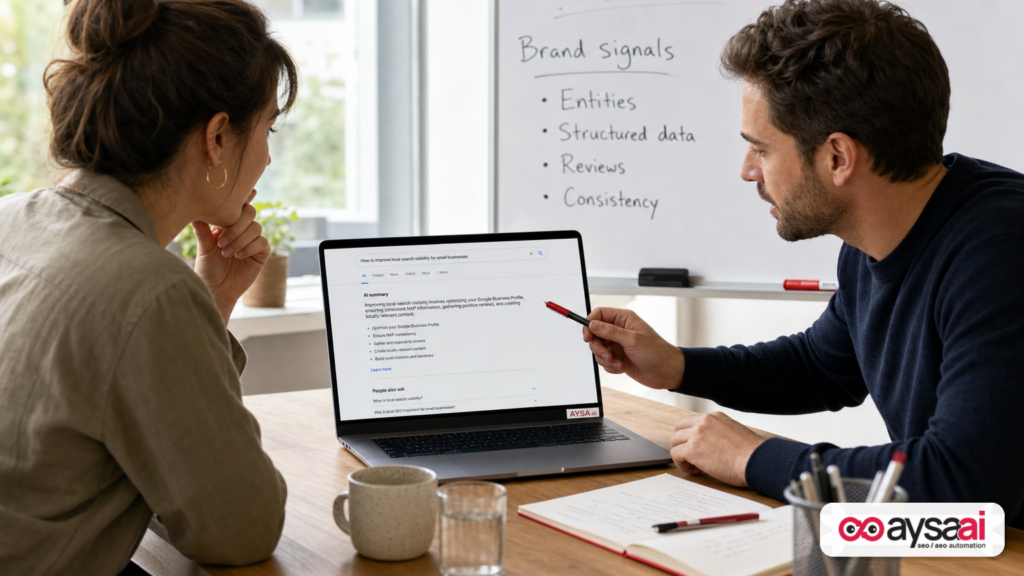
AI Search is rewriting the rules of discovery. Not because SEO “died,” but because the interface changed: customers increasingly get answers without clicking ten blue links. In that world, the primary goal shifts from “rank and win the click” to “be the brand the AI can confidently name, summarize, and recommend.”
This editorial is inspired by a WordCamp Europe panel recap published by Search Engine Journal. Their theme—brand is the new Backlink—isn’t a slogan. It’s a practical operating model for how businesses earn visibility in AI Overviews, AI Mode-style experiences, and generative answers across platforms.
Concise summary
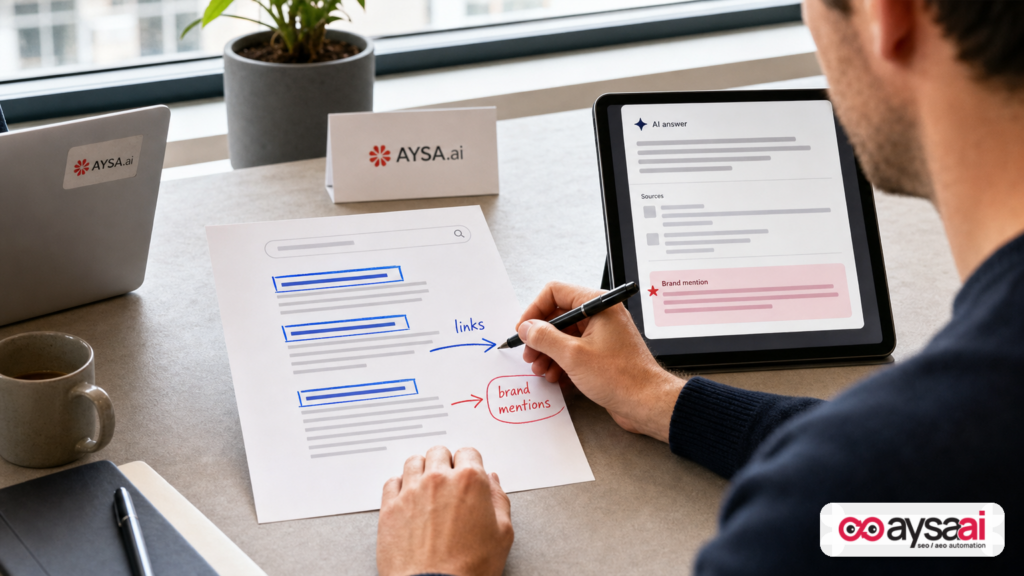
- AI answers reward clarity and confidence. If machines can’t disambiguate who you are and what you do, they’ll either ignore you or get you wrong.
- Brand signals are becoming a stand-in for trust. Not just “awareness,” but consistent facts, recognizable expertise, and widely corroborated claims.
- Entity Optimization is now table stakes. Structure your site so AI can map your business as a well-defined entity with products, locations, services, and proof.
- Experience beats commodity content. AI can generate generic pages; it can’t generate your hands-on lessons, results, and point of view.
- Execution is the moat. This isn’t a one-time SEO project; it’s a continuous cycle of Monitoring, fixing, and publishing—safely.
Table of contents

- The “Brand Is the New Backlink” Shift: What Actually Changed
- From Clicks to Citations: The New Unit of Value
- Entities, Not Keywords: How AI Systems Decide What You Are
- Structured Data Isn’t a Hack—It’s Basic Communication
- The Second “E” in E‑E‑A‑T: Why Experience Is Hard to Fake
- SEO Is Becoming Harder to Separate From Marketing (and That’s Good)
- What Goes Wrong in AI Answers (and How to Reduce Risk)
- The SME Scenario: A Local Clinic Competing in AI Answers Without a Big Brand Budget
- What Agencies Should Rethink: Deliverables, Reporting, and Retainers
- The 2026 Action Plan: A Practical Checklist for AI Visibility
- Why Execution Is the New Moat (and Where AYSA Fits)
- What to do next
- Sources and further reading
The “Brand Is the New Backlink” Shift: What Actually Changed

Historically, a lot of SEO success came down to two things:
- Relevance (do you cover the topic?)
- Authority (do reputable sites link to you?)
Authority was often operationalized as backlinks. Not because Google loved links as a concept, but because links were a scalable proxy for reputation. If many independent sources referenced you, you were more likely to be legitimate.
Now, the interface of search is changing. The Search Engine Journal panel’s core point—brand is the new backlink—captures a deeper reality: when AI systems generate answers, they gravitate toward sources they can confidently interpret and attribute.
Confidence comes from:
- Clear identity signals (who you are)
- Clear offer signals (what you sell / do)
- Clear differentiation (why you’re not interchangeable)
- Corroboration across the web (do other sources agree?)
Links still matter, but in AI-mediated discovery they’re only one part of the corroboration layer. In practice, brand presence + consistency + Entity Clarity increasingly function like “the new authority.”
From Clicks to Citations: The New Unit of Value
One of the most important ideas from the panel recap is a mindset change: don’t obsess only over Clicks if the customer’s journey is increasingly “answer-first.” In AI Overviews and similar experiences, users may:
- Read a synthesized answer
- See 1–3 recommended brands
- Click far less—or click later, after they’ve pre-qualified options
In that world, the unit of value becomes:
- Being included as a cited/recommended option
- Being described correctly (no wrong hours, wrong service area, wrong pricing model)
- Being chosen when the user moves from “research” to “decision”
This is why branding rises: a recognizable brand is easier to recall, easier to trust, and easier for an AI to recommend without fear of being wrong.
If you want a practical translation for SMEs: AI answers compress the funnel. They do part of the comparison for the user. That makes your inputs—your website, your structured data, your public profiles, your reputation signals—more consequential than ever.
To keep up, businesses need a system for continuous AI search visibility, not sporadic SEO campaigns. That’s the direction we’re building toward at AYSA, especially through our monitoring and approved execution workflow (Monitoring, AI Search Visibility).
Entities, Not Keywords: How AI Systems Decide What You Are
Keyword research still matters. But AI systems don’t “understand” the web the way a human reads it. They map information into entities (people, organizations, products, locations, services) and relationships between them.
If your business is not represented as a clear, unambiguous entity, you face three risks:
- Omission: you don’t show up in answers because the model can’t confidently connect your brand to the query.
- Misattribution: your claims, reviews, or services get blended with another company with a similar name.
- Hallucinated specifics: the model fills in gaps with plausible-sounding (but wrong) information.
That’s why the panelists emphasized making businesses “easier for AI to understand.” Put simply: the more you force an AI to infer, the more you invite error.
Build an “entity brief” for your business
If you’re an SME owner, here’s a simple exercise: write a one-page internal document (and then ensure your site matches it) with:
- Legal business name and “doing business as” variations
- Primary category (what you are)
- Primary offerings (top services/products)
- Service area or locations (with consistent addresses)
- Primary differentiators (what you do that’s not commodity)
- Proof points (certifications, awards, case studies, methodology, years in business—only what you can stand behind)
- Preferred wording for key claims (e.g., “same-day delivery in Austin” vs. “fast delivery”)
Then, ensure this is reflected across your site and your external references. This is “branding,” but in the operational sense: consistent identity and claims.
AYSA’s approach aligns with this: monitor what the web is saying, prepare fixes, and then ask you to approve changes before anything goes live. That “approved execution” model matters because brand identity changes are high-risk if done sloppily. Start here: AYSA AI SEO Tools.
Structured Data Isn’t a Hack—It’s Basic Communication
When SEOs talk about “structured data,” many business owners hear “technical stuff.” But in AI search, structured data is less about gaming rankings and more about reducing ambiguity.
At minimum, most SMEs should consider whether their site clearly communicates:
- Organization details (name, logo, URL, sameAs profiles)
- Location data (address, opening hours, phone)
- Products/services (what exists, pricing model if relevant, availability)
- Content types (FAQs, how-to steps, reviews when applicable and compliant)
This connects directly to the panel’s emphasis on data integrity and disambiguation: you’re trying to make it easy for machines to extract the right facts, every time.
Prioritize the structured data that prevents customer-facing mistakes
Not all structured data is equally valuable. If you only do a few things, start with what prevents high-cost errors:
- Wrong hours (local businesses lose real revenue)
- Wrong address/service area (wasted calls, bad reviews)
- Wrong service definitions (AI recommends you for things you don’t do)
- Wrong pricing model (especially SaaS: free vs paid vs trial)
When you execute these updates, do it carefully—technical changes can break pages or introduce inconsistencies. This is where a controlled workflow is useful: AYSA monitors, prepares the changes, and requests approval before executing them (Monitoring).
The Second “E” in E‑E‑A‑T: Why Experience Is Hard to Fake
The panel recap highlighted a point I agree with strongly: AI makes commodity content cheaper, which makes real experience more valuable.
Search Engine Journal references the idea that generic, “commodity” content is a bad bet long-term. Google’s public-facing guidance has also increasingly emphasized content that demonstrates real expertise and experience. The practical implication is straightforward: if your content reads like it could have been written by anyone, it will be treated like it could have been written by anyone.
What “experience” looks like on a business website
Experience is not:
- a glossy author bio
- a stock photo of someone holding a clipboard
- a list of generic tips
Experience is:
- specific lessons learned (“We tested X and it failed because…”)
- process transparency (how you diagnose, how you price, how you deliver)
- case studies with constraints and tradeoffs (not just “we grew 200%”—especially if you can’t verify the number)
- firsthand evidence (photos from a job site, annotated examples, before/after with context)
This is the content AI systems can’t cheaply replicate—and competitors can’t easily clone without doing the work.
Experience increases the odds of being cited
AI answer systems tend to look for original sources or content that adds something beyond a summary. The panel’s mention of Reddit is instructive: user-generated forums can surface authentic experiences and edge cases. You don’t need to “be Reddit,” but you should understand what makes it useful—real humans reporting real outcomes.
For businesses, that’s a prompt to publish more operator-grade content: build logs, teardown posts, what-we-learned writeups, and customer objections answered with specifics.
SEO Is Becoming Harder to Separate From Marketing (and That’s Good)
One of the healthiest takeaways from the panel recap is that SEO is moving closer to full-funnel marketing. That’s not a loss of identity for SEO; it’s SEO finally being treated like the business lever it always was.
In AI search environments, signals come from across the web:
- Your site
- PR mentions
- Social profiles
- Reviews and third-party listings
- Community discussions
So “AI SEO” becomes less about a single tactic and more about a coherent brand footprint.
A simple reframe for SMEs
If you’re a founder or operator, reframe SEO as:
- Distribution for your expertise
- Clarity for machines
- Confidence for buyers
Those are marketing outcomes. They just happen to affect ranking and AI visibility.
And because AI search compresses the journey, you may see fewer “vanity clicks” but more qualified leads—if you’re the brand that gets recommended and remembered.
What Goes Wrong in AI Answers (and How to Reduce Risk)
AI answers can fail in ways classic SEO didn’t. In blue-link search, if your title tag is slightly off, you might lose some CTR. In AI answers, a small inconsistency can become a confidently stated wrong answer.
Common failure modes
- Location confusion: multi-location brands get hours, phone numbers, or addresses mixed.
- Service confusion: an AI associates you with a category you used to serve (or never served).
- Pricing confusion: old pricing pages or third-party listings override current reality.
- Brand collisions: similar names cause entity merging (especially for local services and SaaS).
- Outdated claims: old blog posts outrank new ones and get summarized as current policy.
Risk reduction is mostly operational
The fix is usually not a “prompt trick.” It’s operational discipline:
- Keep a single source of truth for business facts
- Ensure the website reflects that source of truth
- Make structured data consistent with visible page content
- Monitor changes in how your brand appears
This is where execution workflows matter. A lot of businesses can identify issues. Fewer can ship fixes weekly without breaking something else. AYSA’s model—monitor, prepare, request approval, then execute—exists to make that shipping cadence safe and realistic for SMEs and agencies (AI Search Visibility).
The SME Scenario: A Local Clinic Competing in AI Answers Without a Big Brand Budget
Let’s make this real with a scenario that mirrors what I see across service businesses.
Business: a two-location physical therapy clinic in a mid-sized U.S. city.
Problem: new patients increasingly search “best PT for runners near me” or ask AI tools for “top clinics for knee pain recovery.” The clinic notices fewer website clicks but more calls mentioning “I saw you recommended.”
Where they lose today
- Their two locations have slightly different names across Google/third-party profiles.
- One location has outdated hours on an old page that still exists.
- Service pages are generic (“We treat pain”) with little proof of specialization.
- No clear “who is this for” positioning (runners, post-surgery, seniors, etc.).
What winning looks like in AI answers
They don’t need a huge PR budget. They need to become the easiest clinic for AI and humans to understand:
- One canonical brand identity across both locations (naming, descriptions, services).
- Location pages that are actually informative: who treats what, what to expect, specialties, accessibility, insurance policies (only what’s accurate).
- Experience-based content: “Return-to-running after Achilles injury: our 6-week protocol (with what changes if pain returns).”
- Structured data + internal consistency so the same facts repeat everywhere.
The business outcome that matters
The objective isn’t “more traffic.” It’s:
- More qualified inbound calls
- Fewer mismatched expectations (pricing, hours, services)
- Higher conversion rate when people do land on the site
This is why I tell SMEs: AI search visibility is not a vanity exercise. It’s reputation management at scale.
What Agencies Should Rethink: Deliverables, Reporting, and Retainers
If you run an agency, AI search is not just a new channel—it’s a new set of deliverables.
Deliverables that will matter more
- Entity clarity and knowledge hygiene: audits + fixes for brand facts across site and key profiles.
- Experience content production: founder-led, expert-led, practitioner-led content with real examples.
- Structured data implementation and QA: not “add schema,” but make it consistent and maintain it.
- AI visibility monitoring: track how a brand is represented, not just where it ranks.
Reporting needs to evolve
Classic monthly reports focused on:
- rankings
- sessions
- links
Those still matter, but they’re incomplete in AI answer environments. Agencies should add:
- Representation accuracy: is the brand described correctly?
- Inclusion frequency: do you appear as a recommended/cited option for your core intents?
- Conversion quality: are leads more qualified even if traffic is down?
I won’t pretend there’s a universal metric standard yet—platforms are still evolving. But the direction is clear: optimize for visibility + correctness + conversion, not clicks alone.
Retainers should emphasize execution velocity
The panel’s discussion implies a truth agencies often resist: the moat is no longer “knowing SEO.” It’s shipping improvements continuously while competitors are stuck in audits and decks.
That’s also why AYSA is built as an execution system, not just a reporting tool. You can explore the concept here: AI SEO Tools and pricing here: AYSA Pricing.
The 2026 Action Plan: A Practical Checklist for AI Visibility
This is the part most editorials skip. So here’s the operator-grade checklist you can actually run.
1) Stop treating “brand” as a vibe—define it as a dataset
- Write your entity brief (name, category, services, locations, differentiators)
- Decide your canonical descriptions (short and long versions)
- List your official profiles (website, social, major listings)
2) Fix on-site ambiguity first (before you “do PR”)
- Ensure each core service has a clear page: who it’s for, what it includes, proof, FAQs
- Ensure each location has a robust location page (not a thin directory)
- Remove or update outdated pages that contradict current policies
3) Implement structured data that matches visible content
- Organization and local business details
- Product/service definitions where appropriate
- FAQs only if the page actually contains the questions and answers
Important: don’t add structured data that claims things your page doesn’t support. Consistency is the point.
4) Publish experience content you can defend
- Case studies with constraints and tradeoffs
- Field notes / lessons learned
- Comparisons that show real evaluation criteria
If you’re wondering what “counts” as experience: it should include details someone couldn’t write without doing the work.
5) Earn corroboration (mentions) the slow, durable way
The panel recap notes that some campaigns produce mostly nofollow links but still help with visibility. Whether or not we can attribute that directly to any one algorithmic mechanism, the broader idea is sound: credible mentions build brand reality.
Corroboration tactics that are durable:
- Founder expertise distributed via interviews, guest commentary, podcasts
- Partnership pages with real partners
- Original research and methodology writeups people reference
- Community participation where your customers actually are
Avoid shortcuts that create a footprint of “manufactured authority.” AI systems and search engines are both moving in the direction of preferring authentic experience over synthetic promotion.
6) Monitor how AI describes you—and treat errors like revenue leaks
Monitoring is now a core capability, not an add-on. You should routinely check:
- Whether AI summaries name you for your core intents
- Whether the description is correct
- Which sources are being used to describe you
This is exactly the “always-on” layer many SMEs lack. AYSA was designed to make this practical: Monitoring and AI Search Visibility.
Why Execution Is the New Moat (and Where AYSA Fits)
Most businesses don’t fail at AI search because they lack ideas. They fail because they can’t reliably execute without breaking things or getting stuck in internal approvals.
AI search optimization creates more moving parts:
- technical updates (structured data, architecture, internal linking)
- content updates (experience pages, FAQs, comparisons)
- brand consistency updates (names, descriptions, locations)
- ongoing monitoring (representation accuracy)
That’s why AYSA positions itself as an approved execution system:
- Monitors your website and visibility signals (so you know what’s changing)
- Prepares recommended updates (technical + content + clarity)
- Requests approval (so you stay in control)
- Executes accepted changes (so improvements actually ship)
If you’re trying to compete in AI answers, execution velocity with brand safety becomes a competitive advantage. Learn more via:
What to do next
- Create your entity brief (one page) and verify your website matches it.
- Audit for contradictions: old hours, old pricing pages, outdated service definitions.
- Upgrade 3 money pages (top service/product pages) with “who it’s for,” proof, and experience-based details.
- Implement/validate structured data for Organization + key locations/services.
- Start monitoring AI representation monthly: Are you mentioned? Are you described correctly?
- Build corroboration through authentic mentions, partnerships, and expertise distribution—no shortcuts.
Sources and further reading
- Search Engine Journal: SEO Panel Agrees: Brand Is The New Backlink For AI SEO
- Search Engine Journal: SEO section (context and related coverage)
- Search Engine Journal: Latest news (search interface shifts and industry updates)
- Search Engine Journal: Google algorithm updates timeline (historical context)
- Search Engine Journal: Link building section (how authority signals are evolving)
- Search Engine Journal: Local SEO section (especially relevant for location/entity clarity)
Note: This article intentionally avoids claiming specific ranking factors, traffic changes, or numeric lifts without primary data present in the provided research context. Where outcomes are discussed, they are framed as strategy and operational risk reduction rather than guaranteed results.
Continue the AI search topic inside AYSA.
Use these pages to connect the article with AI SEO tools, AI visibility monitoring, AI Overviews and approved website execution.
Turn this topic into a website action plan.
Use these AYSA hubs to move from reading to technical fixes, AI visibility monitoring, research, glossary context and approval-first SEO execution.

