
The Future of Google Isn’t One Search Box: How SMEs Win in an AI-Fragmented SERP
Google is reshaping search into a personalized, AI-assisted, feed-driven experience—without abandoning classic results. Here’s what changed, why it matters, and a practical execution plan for SMEs and agencies to stay visible across AI Mode, AI Overviews, Discover, and traditional SERPs.

Google isn’t “dying.” It’s evolving into something more complex: a portfolio of search experiences that behave differently depending on intent, user, device, and commercial value. For small and mid-sized businesses, that’s both the risk and the opportunity.
The risk: you can do everything you used to do for SEO—rank a page, build a few links, publish a blog—and still see less measurable traffic because answers and choices get resolved inside the results. The opportunity: diversified SERPs create more entry points for visibility, trust, and conversion if you build your presence like an entity, not just a website.
This editorial is informed by analysis and reporting from Search Engine Journal’s “What The Future Of Google Looks Like” (and the broader context it points to). I’m not here to repeat it. I’m here to translate what it means for business operators and agencies—and to provide an Execution Plan that can survive a shifting SERP.
Concise summary
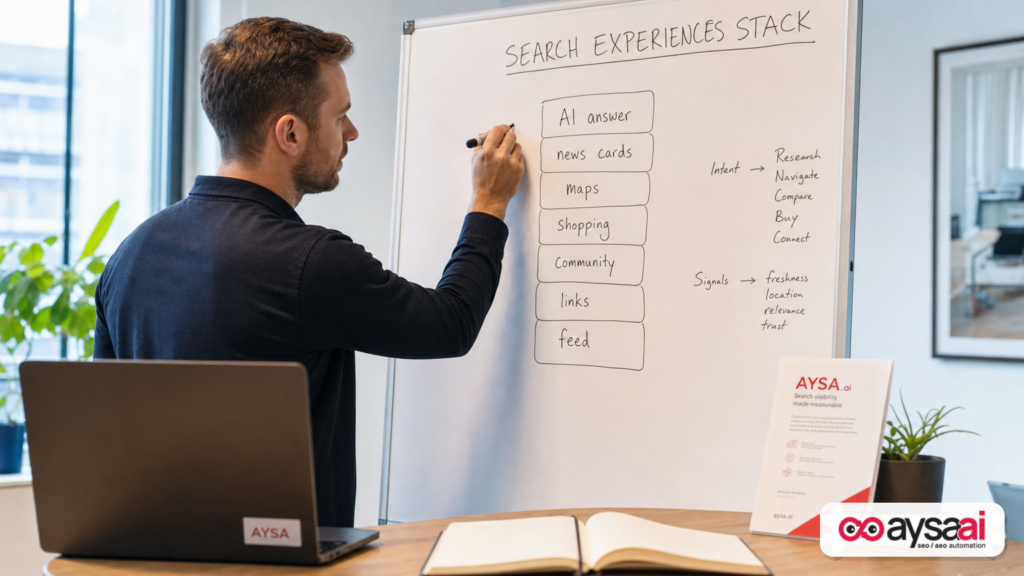
- Google is becoming modular: AI answers, classic links, Top Stories, forums, maps, shopping, and feed-driven Discover-style content can all coexist—often on the same query.
- AI Mode growth matters, but default replacement isn’t guaranteed: cost, user adoption, and monetization constraints slow down “flip-the-switch” scenarios.
- News and real-time content still hold ground: AI struggles with fast-moving accuracy and Attribution; SERPs often keep dedicated news modules.
- Discover-like feeds are under-discussed: they create “incidental search,” where people consume content before searching—changing how brands earn demand.
- Visibility beats rankings: the goal is being referenced, recommended, and chosen across AI, feeds, and classic results.
- Execution is now the bottleneck: you need Monitoring + controlled deployment, not just strategy docs. That’s where AYSA fits.
Key takeaways for SMEs and agencies
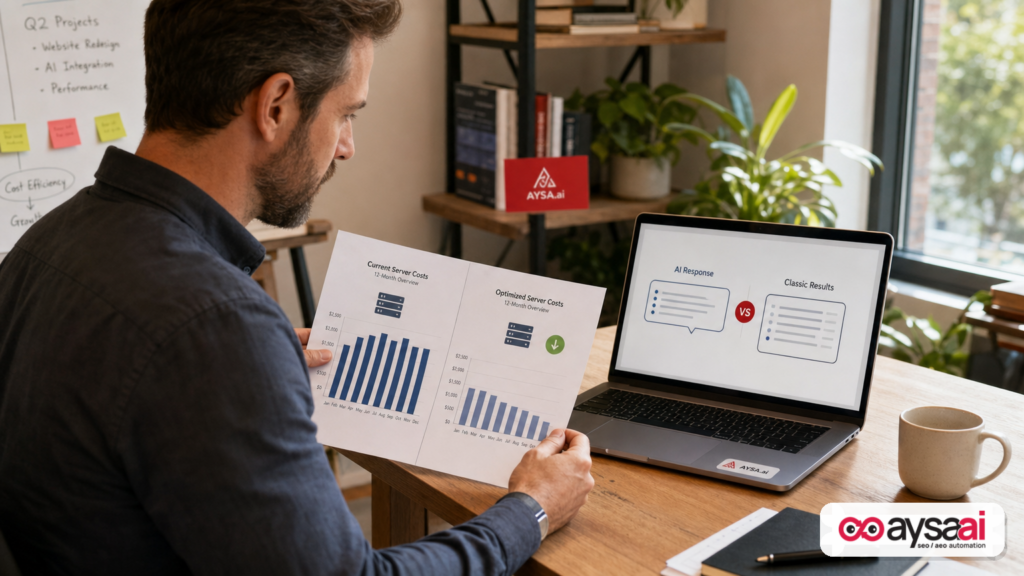
- Stop measuring success as “traffic only.” Tie SEO to outcomes you can control: qualified leads, calls, bookings, revenue, subscriptions, and assisted conversions.
- Build “Entity Clarity.” Make it easy for systems to understand who you are, what you do, where you operate, and why you’re credible.
- Prepare for SERP volatility. Expect shifts by query type—informational vs local vs commercial comparison—then design content and pages for each module.
- Operationalize change. Monitoring, change proposals, approvals, and deployments must happen continuously—not quarterly.
Table of contents

- What Changed: Google Became a Portfolio of Experiences
- Why Google’s Business Model Still Matters More Than Any Feature Launch
- Will AI Mode Become the Default?
- Why AI Mode Might (or Might Not) Become the Default
- Why News Holds Ground (and What That Teaches Every Business)
- Discover and the Rise of “Incidental Search”
- What the Future SERP Likely Looks Like (By Query Type)
- Stop Optimizing for Google Alone—Optimize for Visibility
- A Concrete SME Scenario: A Local Clinic Competing in an AI SERP
- What SMEs Should Monitor Weekly (Not Quarterly)
- What Agencies Must Rethink: From Deliverables to Outcomes
- Where AYSA Fits: Approved Execution for AI Search Visibility
- What to Do Next: A 30–60–90 Day Plan
- Sources and Further Reading
What Changed: Google Became a Portfolio of Experiences
For years, the SEO industry talked as if “the SERP” was a single thing: ten blue links plus a handful of features. That mental model is now outdated.
Today’s Google experience is best understood as a stack of products that can appear in different combinations:
- Classic results (still important, still lucrative)
- AI-powered summaries (AI Overviews and related elements)
- Conversational exploration (AI Mode)
- Local modules (maps, listings, reviews)
- Commerce modules (shopping units, product comparisons)
- Community content (forums, UGC, discussions)
- News modules (Top Stories and freshness-driven surfaces)
- Feed discovery (Discover-style content that shows up because of you—not your query)
The most important implication: your “SEO strategy” cannot be one universal playbook. Your strategy must be query-type aware and module aware.
In the SEJ analysis, one concept stood out as a signpost of what’s next: publishers and creators increasingly need profiles and broader identity signals to be surfaced in new discovery surfaces (including Discover). This aligns with a shift from “rank a page” to “be a known source.” That is entity-first marketing.
Why Google’s Business Model Still Matters More Than Any Feature Launch
Most future-of-search predictions fail for one simple reason: they ignore incentives. Google’s product decisions are constrained—and enabled—by the business model.
SEJ’s source article discusses Google’s financial performance and the durability of its search revenue while other business lines grow (subscriptions, cloud, YouTube). I won’t restate specific figures beyond what’s referenced there, because the editorial point is more important than the number: Search monetization is still enormous, and any major UX shift must preserve (or expand) that economic engine.
That changes how you should interpret AI Search moves:
- Some AI features will be rolled out cautiously until monetization is proven.
- Some query classes will remain “classic” longer because they monetize well or require less compute.
- Some experiences will be personalized, not universal, because personalization protects margins.
If you run a business, this is good news. It means the world won’t go “all AI answers tomorrow.” It will be uneven—and that creates room for a disciplined operator to win.
Will AI Mode Become the Default?
AI Mode is the most obvious candidate for “the future interface.” It’s conversational, feels helpful, and matches how people increasingly interact with assistants elsewhere.
SEJ references third-party usage trend data (shared by well-known industry analysts) suggesting AI Mode usage grew quickly quarter-over-quarter but remains a small share of overall events. Two truths can coexist:
- Growth rate can be high because the starting point is small.
- Total share can be low and still matter because the traffic it affects is often informational and top-of-funnel—historically the “free demand” engine for many sites.
Here’s the practical takeaway: you don’t need to bet your business on AI Mode becoming universal to justify preparing for it. If it captures even a modest slice of the queries you rely on, your lead flow and CAC can change.
Why AI Mode Might (or Might Not) Become the Default
It’s tempting to think Google will eventually force everyone into AI Mode. But “eventually” is doing a lot of work in that sentence.
SEJ’s source analysis highlights a key constraint: AI generation is computationally expensive relative to classic information retrieval. Whether the “30x” energy estimate cited in the industry is precisely right is less important than the direction: AI answers cost more to produce than returning a ranked list.
From a business operator’s lens, that implies:
- Not every query deserves an AI answer. Navigational searches (“login,” “phone number,” “brand + hours”) may stay classic or become SERP-direct experiences.
- Not every user cohort wants it. Adoption will vary by age, habit, and trust. People don’t adopt technology uniformly.
- Monetization must catch up. Google won’t trade a proven ad machine for an unproven one without a bridge (hybrid ads, subscriptions, or something new).
For SMEs, the strategic implication is to plan for a blended environment—not a single “AI takes over” endpoint.
Why News Holds Ground (and What That Teaches Every Business)
One of the more practical observations in the SEJ piece is that news modules tend to hold firm in many cases, with AI elements not always replacing Top Stories. The reason is straightforward: real-time information has different requirements—freshness, attribution, and the risk of summarization errors.
Even if you’re not a publisher, this is useful because it teaches a rule you can apply to your own content:
- AI eats “generic evergreen.” If your page is a rephrase of what everyone already says, it’s easy to summarize away.
- AI struggles with what’s uniquely yours. Original data, first-hand expertise, location-specific nuance, real inventory constraints, pricing realities, and operational policies remain harder to compress without losing value.
So if you sell services, don’t just publish “What is X?” Publish “X in our city/state, with our process, timelines, constraints, before/after expectations, and FAQs we actually hear.” That’s where differentiation lives.
Discover and the Rise of “Incidental Search”
If you only think about search as a query box, you miss what may be the highest-leverage distribution surface Google has: Discover-style feeds.
In the SEJ analysis, Discover is framed as a cohort-driven rollout mechanism—similar to social algorithms—where engagement from one group increases exposure to similar users. You don’t need to know the exact mechanics to understand the strategic effect: Google can create demand, not just capture it.
This changes the playbook for brands and SMEs:
- Winning isn’t only “ranking.” It’s being followed, surfaced, and re-surfaced in moments of idle attention.
- Entity signals matter more. Profiles, consistent identity, and recognizable authorship become competitive advantages.
- Engagement loops matter. Returning visitors, newsletter signups, and repeat consumption become not just business KPIs, but distribution inputs.
In practical terms: your content strategy should include at least some “feed-native” pieces—timely, opinionated, or story-driven—alongside your evergreen conversion pages. Not because you want vanity traffic, but because Discover can seed branded demand that later converts through local packs, shopping modules, or direct navigation.
What the Future SERP Likely Looks Like (By Query Type)
There isn’t one future SERP. There are many, depending on intent. Here’s a business-first breakdown you can use to prioritize work.
1) Navigational queries (brand, login, “near me” address lookups)
These are often the highest-intent queries, and they’re frequently resolved inside the SERP: knowledge panels, map packs, sitelinks, quick answers. AI may appear, but the more likely shift is fewer clicks to your homepage and more direct actions (calls, directions, bookings).
What to do: strengthen your local listings, keep business info accurate, ensure key pages load fast, and make your brand unambiguous across the web.
2) Informational queries (how-to, definitions, comparisons early in journey)
This is where AI summaries and conversational exploration can reduce clicks, especially when users just want a quick synthesis.
What to do: create content that provides something AI cannot safely compress: original examples, first-hand process detail, calculators/tools, updated policy nuance, or local/regulatory specifics. Use clear structure so AI can cite you when it does answer.
3) Commercial comparison queries (“best,” “top,” “vs,” “reviews”)
These are ripe for AI-led experiences because users want summarized tradeoffs. But monetization is also strong here, so Google will protect ad units and shopping modules.
What to do: build review-worthy pages: transparent comparisons, “who this is for,” limitations, pricing guidance, and proof assets. Also ensure product/service pages are richly structured and internally linked.
4) Local intent queries (services + city, urgent needs)
Maps and local packs remain dominant. AI might assist with choice, but local reputation data, proximity, and service relevance still drive outcomes.
What to do: prioritize Google Business Profile hygiene, consistent NAP data, service-area clarity, review strategy, and location pages that are not boilerplate.
5) News/freshness queries (events, public figures, fast-moving topics)
Top Stories and freshness-driven results remain important because speed and sourcing matter.
What to do: if you publish, invest in newsroom-quality workflows. If you’re a brand, publish rapid, authoritative updates when relevant (product recalls, policy updates, shipping disruptions, etc.)—and make them indexable and shareable.
Stop Optimizing for Google Alone—Optimize for Visibility
One line from the SEJ source resonates with how we see the market moving: “Search is broader than ever.” The idea is not that “Google doesn’t matter.” It’s that Google is no longer the only surface where people decide what to trust, and even within Google, classic rankings are only one part of the decision journey.
That’s why AEO (Answer Engine Optimization) and GEO (Generative Engine Optimization) aren’t just rebrands. When done seriously, they force you to answer a different question:
“What signals would cause an AI system—or a human—in a crowded SERP to choose us?”
Those signals include:
- Clear entity identity (who you are, what you do, where you operate)
- Consistency across properties (website, listings, social, profiles)
- Demonstrated expertise (specificity, process, credentials where relevant)
- Real proof (reviews, case studies, examples, original data)
- Technical accessibility (crawlable, fast, structured, internally coherent)
This is exactly the kind of work that benefits from an always-on system approach rather than a one-time audit.
If you want a deeper overview of visibility across AI search surfaces, start here: AI Search Visibility.
A Concrete SME Scenario: A Local Clinic Competing in an AI SERP
Let’s make this real.
Scenario: A mid-sized dental clinic in a metro area. Historically, they’ve relied on:
- Local pack visibility for “dentist near me”
- Blog posts for informational queries (“cost of Invisalign,” “tooth pain at night”)
- A handful of high-intent service pages (“emergency dentist,” “teeth whitening”)
What changes in an AI-fragmented SERP:
- Informational traffic declines because AI answers cover basics.
- Local pack becomes even more decisive because users want quick action.
- Brand trust matters more because AI surfaces “best options” and users validate with reviews.
What the clinic should do (practical, not theoretical):
- Turn “generic” blog posts into clinic-specific guides. Add real timelines, what to expect at the first appointment, insurance/payment notes, and “when to call us today” decision points.
- Strengthen location/service entity clarity. Unique location pages (not templated), clear service coverage, and consistent business info.
- Build proof assets. Before/after galleries where appropriate, practitioner bios, patient education videos, and review acquisition workflows (within policy).
- Fix technical and structural issues continuously. Broken internal links, thin pages, slow templates, missing structured data—these compound when SERPs get more competitive.
- Measure “zero-click outcomes.” Calls, direction requests, appointment forms, and assisted conversions—so you don’t panic when sessions fluctuate.
This is the difference between “SEO as publishing” and “SEO as a revenue system.”
What SMEs Should Monitor Weekly (Not Quarterly)
In a modular SERP world, your biggest enemy isn’t a competitor—it’s drift.
Drift happens when:
- Templates change and your internal linking degrades.
- New pages ship without proper metadata or indexability.
- Reviews trend downward and local visibility softens.
- Your best pages get cannibalized by new content.
- SERP features change and you don’t notice until leads drop.
That’s why monitoring is now a core competency, not a “nice to have.” AYSA is built around this reality: monitor, prepare changes, ask for approval, then execute the accepted changes—so you can move fast without breaking things.
Start with monitoring as a discipline: AYSA Monitoring.
Minimum monitoring checklist (SME-friendly):
- Indexing health: are your money pages indexed and stable?
- Template performance: did Core Web Vitals or speed regress after a theme/app update?
- Content decay: are formerly top pages slipping in impressions or engagement?
- Local signals: reviews volume/velocity, NAP consistency, location page changes.
- SERP mix shifts: are AI summaries showing up more on your core topics?
Even if you don’t have perfect data on AI click-through (the SEJ source notes concerns around reporting and click visibility), you can still track outcomes and leading indicators on your own property.
What Agencies Must Rethink: From Deliverables to Outcomes
Agencies are under pressure because AI surfaces compress the value of “content volume” and make rankings less stable as a single KPI. If you sell “X blog posts per month,” you will struggle.
What replaces it is a more operational, cross-surface model:
- Visibility management across AI answers, classic results, local modules, and feed discovery
- Entity building and proof assets (not just “keyword targeting”)
- Measurement redesign (pipeline and conversions, not sessions-only)
- Execution velocity with governance (fast changes without chaos)
This is where tooling and process matter. Most agencies don’t fail because they lack ideas; they fail because they can’t ship consistently across many clients without introducing risk.
That’s why we emphasize “approved execution.” You can see the broader tool approach here: AI SEO Tools.
Where AYSA Fits: Approved Execution for AI Search Visibility
AI search creates two immediate requirements:
- You need better inputs. Clear, structured, credible content and technical fundamentals that systems can interpret.
- You need faster iteration. Because the SERP mix and competitive landscape will keep changing.
AYSA’s model fits this moment because it’s designed around continuous operations, not one-off projects:
- Monitor site and visibility signals over time
- Prepare recommended changes (content, technical, structural)
- Ask for approval so business owners retain control
- Execute accepted changes so work actually ships
This matters because many teams are stuck in the worst middle ground: they know what to do (in theory), but they can’t implement quickly, or they’re afraid to touch the site. In 2026 search, that hesitation is expensive.
If you’re evaluating whether this model fits your organization, check pricing and operational scope here: AYSA Pricing.
And if you want ongoing viewpoints on AI search and execution, our editorial archive lives here: AYSA Blog.
What to Do Next: A 30–60–90 Day Plan
This is a practical roadmap you can run as an SME, or deploy as an agency across clients.
Days 1–30: Stabilize and instrument
- Define “visibility outcomes”: calls, leads, demo requests, bookings, revenue—choose 2–4 primary KPIs.
- Audit your money pages: are they unique, credible, and clearly aligned to intent?
- Fix technical blockers: indexability, speed regressions, broken internal linking, thin location pages.
- Set up monitoring so you’re alerted when drift begins (not after the quarter ends).
Days 31–60: Build entity clarity + proof
- Strengthen identity signals: consistent brand descriptions, authorship where appropriate, and cross-property coherence.
- Create proof assets: case studies, reviews strategy, original insights, operational transparency.
- Upgrade informational content: add first-hand experience, constraints, decision trees, and real FAQs.
Days 61–90: Expand coverage by query type
- Comparison content: publish “best for” and “vs” pages that reflect real-world tradeoffs, not generic lists.
- Local depth: improve location pages with unique content and local trust signals.
- Feed-aware publishing: test a small set of story-driven pieces designed to earn engagement and repeat exposure.
- Review performance monthly: keep what drives outcomes, cut what doesn’t.
What Can Go Wrong (and How to Avoid It)
AI search volatility creates predictable failure modes:
- Chasing every feature instead of strengthening fundamentals and proof.
- Publishing more generic content and expecting it to beat summarization.
- Over-optimizing for traffic and ignoring conversion outcomes that still grow.
- Moving too slowly because implementation is messy or risky.
The fix is operational discipline: measure outcomes, monitor drift, ship improvements continuously with approvals, and invest in differentiation (not volume).
AYSA perspective: the future is “managed visibility”
My point of view is simple: the future of SEO isn’t a trick for AI Mode. It’s a management function.
As Google becomes more personalized and more modular, the winners won’t be the teams that “figure out the algorithm” once. The winners will be the teams that:
- stay technically clean as sites evolve,
- produce uniquely valuable content that can’t be summarized into nothing,
- build trust signals that carry across modules, and
- execute continuously without breaking the business.
That’s the gap AYSA exists to close: turning strategy into approved, trackable execution—so you’re not just “ready for AI search,” you’re consistently visible in it.
What to do next (action list)
- Pick 10 revenue-driving queries and categorize them (navigational, informational, comparison, local).
- Review what Google shows today for each category (AI elements, maps, shopping, forums, news). Document the modules—not just rankings.
- Upgrade the 5 most important pages with differentiation: proof, process, specifics, and internal links.
- Set monitoring to detect indexation, speed, and template drift early.
- Redesign reporting around outcomes (leads, bookings, revenue) and assisted visibility—not sessions alone.
- Adopt approved execution so improvements ship weekly, not quarterly.
Sources and Further Reading
- Search Engine Journal: What The Future Of Google Looks Like
- Search Engine Journal: Latest News (research lead)
- Search Engine Journal: SEO (research lead)
- Search Engine Journal: Google Algorithm Updates (research lead)
AYSA internal resources:
- AI search visibility: what it is and how to operationalize it
- AYSA AI SEO tools (AEO/GEO execution support)
- Monitoring: detect drift and SERP-impacting changes early
- Pricing and operational scope
- AYSA blog
Note on claims and numbers: Where the source article discusses specific financials, adoption trends, and reporting limitations, this editorial treats them as directional context and avoids extending them into new numeric claims without primary documentation in the provided research context. If you need a fully footnoted, primary-source-only brief (e.g., SEC filings, regulator statements), we can produce that as a separate research memo.
Continue the AI search topic inside AYSA.
Use these pages to connect the article with AI SEO tools, AI visibility monitoring, AI Overviews and approved website execution.
Turn this topic into a website action plan.
Use these AYSA hubs to move from reading to technical fixes, AI visibility monitoring, research, glossary context and approval-first SEO execution.

