
People Are Prompting AI Like It’s Google — Until It Really Matters: The New Playbook for GEO Visibility
Most AI prompts still look like classic keyword searches. But the prompts that decide what gets recommended are increasingly packed with personal context—budget, location, health, preferences. That shift changes how brands earn visibility in AI answers, what to track, and why execution speed matters.

AI Search is changing faster than most teams can rewrite their playbooks. But the biggest shift isn’t that everyone suddenly became a “prompt engineer.” It’s that real people are using AI like a search box—until the moment they need a confident recommendation. Then they start adding personal context (budget, location, health constraints, preferences, life stage), and AI systems use that context to filter which brands get named.
This editorial is my take (Marius Dosinescu, AYSA.ai) on what that means for GEO (Generative Engine Optimization), AEO (Answer Engine Optimization), and the execution layer that most businesses still treat as an afterthought. I’ll pull from the survey-driven reporting published by Search Engine Land and connect it to a practical operating system you can run inside a real company—SME, ecommerce, local service, SaaS, or agency.
Concise summary
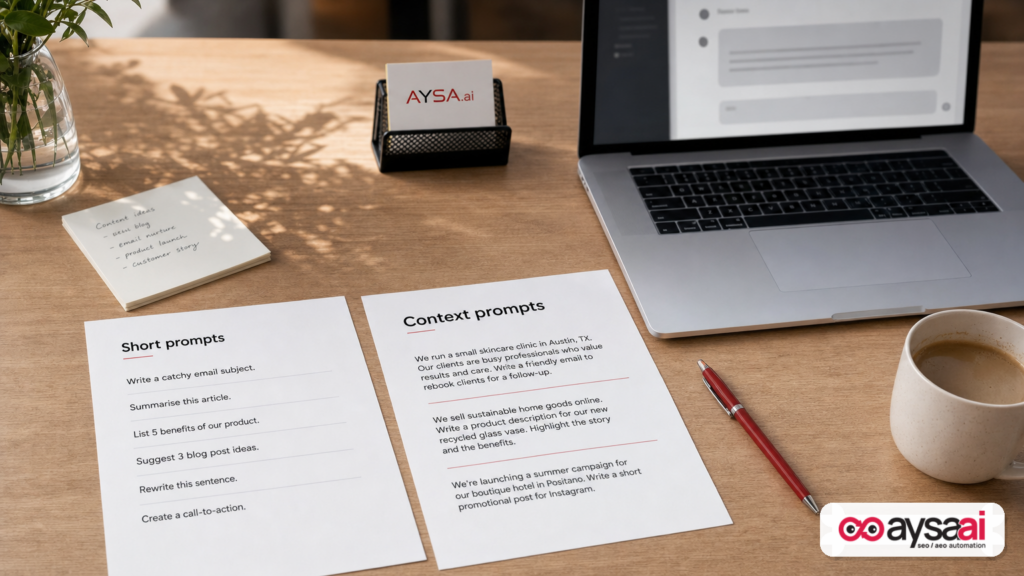
- Most AI prompts are still short and keyword-like—closer to Google queries than “prompt template” culture suggests.
- The prompts that drive decisions are increasingly context-rich (budget, location, health needs, personal preferences). That context reshapes recommendations and visibility.
- GEO isn’t replacing SEO; it’s adding new surfaces (AI answers, citations, shopping agents, local AI experiences) where brand selection happens.
- Tracking needs two modes: short retrieval-triggering prompts (SEO-like) and scenario prompts that approximate real user context.
- Execution speed matters because AI visibility shifts quickly as models retrieve, summarize, and cite changing sources—so fixes need to ship reliably, not just live in a backlog.
Key takeaways (what to remember when you close this tab)

- Stop optimizing for fantasy prompts. If your strategy assumes everyone writes 60-word prompts, you’ll overbuild the wrong content and under-measure the prompts that actually happen.
- Design content for context, not just keywords. People are telling AI their constraints directly. Your job is to be the best match when those constraints appear.
- Win citations, not just rankings. In AI answers, being cited (or clearly attributable) is the new “top of page” moment.
- Build an operating cadence. Monitor → prepare fixes → get approval → execute. Without execution, GEO is just a dashboard.
Table of contents

- What changed: AI prompts aren’t “prompt engineer” prompts
- Why GEO is becoming a board-level topic (even for SMEs)
- The “personal context” layer is the real disruption
- What this means for visibility: GEO is not “new SEO,” it’s a new surface area
- Retrieval, citations, and why short prompts still matter
- Synthetic prompts vs. real prompts: how to use both without fooling yourself
- What to track: the minimum viable AI visibility stack
- What content wins when users add budget, location, and constraints
- Local + AI: “near me” moved into LLMs—are you ready?
- A concrete SME scenario: a clinic that depends on “best” recommendations
- What agencies should rethink: deliver outcomes, not audits
- Where AYSA fits: approved execution for AI search visibility
- What to do next (action list)
- Sources and further reading
What changed: AI prompts aren’t “prompt engineer” prompts
One of the most useful things in the Search Engine Land piece is the simple reminder that average users behave like average users. They don’t write elaborate, structured prompts most of the time. They type the minimum they believe will get a decent answer.
That matters because a lot of GEO advice is built on a flawed mental model: that prompts are long, detailed, and neatly formatted. In reality, many AI searches still resemble traditional search queries—short, keyword-driven, and ambiguous. The article cites survey work showing a heavy skew toward brief prompts, plus scenario tasks where the “median” response is extremely short. In other words: people are still “searching,” just inside a chat box.
So what changed? Not that prompts became complex overnight. What changed is where the search happens (inside AI interfaces) and what happens when people care more (they provide context that classic search rarely captures).
Why GEO is becoming a board-level topic (even for SMEs)
For years, most small and mid-sized companies treated SEO as a channel and content as a lever. Now AI search is turning “recommendation” into a primary user experience—sometimes with fewer obvious clicks, fewer visible SERP blue links, and more summarized answers.
Search Engine Land has been covering how search behavior is shifting in parallel directions: more answers on the results page, more automation, and more non-human traffic patterns. Several of the linked pieces around this topic are a useful backdrop:
- Google zero-click searches hit 68% in early 2026: Study (visibility without a click is now a default outcome, not an edge case)
- Cloudflare: Bots now make up 57% of webpage requests (machine consumption of content is not theoretical)
- Schema.org now shows you how many sites are using each schema type (structured data adoption is becoming more measurable)
Put that together and you get a new CEO question:
“If customers ask AI who the best provider is, will it say our name—and can we influence that?”
That’s GEO in plain English. And for SMEs, it’s existential because AI answers can become the default shortlist. If your brand isn’t named, you’re not “ranked #8.” You’re invisible.
The “personal context” layer is the real disruption
The most important shift isn’t prompt length by itself. It’s the type of information users are embedding into prompts: budgets, locations, sizes, ages, job constraints, health concerns, taste, and identity signals.
In the Search Engine Land reporting, a meaningful portion of prompts included personal attributes and constraints. Conceptually, this is the “user embedding” layer: the AI system doesn’t just process a query; it processes a query plus a user profile that the user is actively enriching in conversation (and potentially via memory features, depending on the system and user settings).
Why this is disruptive for marketing:
- Traditional keyword research can’t see the real decision prompts. People don’t type “comfortable, stylish, under $120, wide feet, Gen X, don’t judge me” into Google—yet that’s the kind of composite need that drives a purchase.
- AI can filter brands using constraints you never knew were being applied. Budget, availability, shipping speed, sensitivity/allergies, accessibility needs—these can become silent ranking factors.
- The impression is higher quality. If your brand gets cited inside a context-rich prompt, it’s not a random visit; it’s a pre-qualified match.
My opinion: GEO is about “being the best match for a context,” not “being the best page for a keyword.” Keywords still matter. But context is where the margin is moving.
What this means for visibility: GEO is not “new SEO,” it’s a new surface area
Many teams are trying to rename the same work: “SEO but with AI.” That’s partly true, but it’s incomplete. GEO adds surfaces where selection happens differently:
- AI answers that summarize multiple sources (with or without citations)
- AI Overviews and AI Modes that blend classic ranking with answer synthesis
- Conversational refinement loops where the user narrows constraints interactively
- Shopping agents and assistant experiences that can take action, not just advise
Search Engine Land’s broader coverage points to the platform direction: assistants are becoming shopping and decision interfaces. See, for example:
- Amazon turns Alexa into a shopping agent — and an advertising platform
- OpenAI launches product feed ads in Ads Manager beta
Even if you never run ads in these environments, the strategic lesson is clear: distribution is shifting from “lists of pages” to “recommended options.”
Retrieval, citations, and why short prompts still matter
Here’s the trap: as soon as marketers hear “personal context,” they stop caring about head terms and short queries.
Don’t.
The Search Engine Land analysis makes a critical point: a big share of prompts still look like standard queries. And when AI systems use live web retrieval (or whatever the platform calls it), the experience can look like this:
- User enters a short query
- The system retrieves results from the web (often similar to a SERP)
- The model synthesizes an answer and may cite sources
In that mode, classic SEO fundamentals still matter: crawlability, indexation, strong pages that answer common questions, clear entity signals, and content that is actually cited by reputable sources.
And citations matter because the user may click. The source article references multiple research leads (Semrush, Conductor, others) indicating that AI referrals—while still a smaller share of overall sessions—can be disproportionately valuable. I won’t restate specific numbers beyond what Search Engine Land reported, but the directional insight is what businesses need: AI citations can still drive measurable traffic and conversions.
So the right mental model is:
Short prompts keep SEO relevant; context-rich prompts make GEO necessary.
Synthetic prompts vs. real prompts: how to use both without fooling yourself
Because context-rich prompts are messy and personalized, GEO teams often simulate them using synthetic personas. That’s not wrong—it’s often the only scalable way to test.
But synthetic prompts can become a self-fulfilling benchmark:
- You design a persona that matches your assumptions
- You run the prompt and get a result set
- You optimize to that result set
- You convince yourself you “won,” while real users ask differently
The source article recommends using synthetic prompts as a mapping exercise, not as ground truth. I agree, and I’d make it more operational:
Use synthetic prompts for coverage, not certainty
- Coverage: “Do we show up for the major persona constraints we claim to serve?”
- Not certainty: “We’re #2 in AI answers.” (AI answers can vary by user, context, and retrieval results.)
Use real business signals to ground the prompt library
You may not have access to “real prompts” at scale, but you do have real language:
- Customer emails and support tickets
- Sales call notes
- On-site search queries
- Google Search Console question queries (who/what/where/which/can/should)
- Reviews (what people praise/complain about is often the hidden constraint)
These signals are how you keep your testing honest. If your GEO tests never include “under $X,” “near me,” “safe for,” “works with,” “doesn’t cause,” “return policy,” or “insurance accepted,” you’re optimizing for a world that doesn’t exist.
What to track: the minimum viable AI visibility stack
Most teams want a single metric. “AI visibility score.” One number.
That’s comforting—and it’s also how you end up managing the wrong thing.
Based on the survey-driven prompt realities described by Search Engine Land, plus what we see in execution-heavy SEO work, I’d structure measurement as three layers:
Layer 1: Retrieval-triggering prompt set (short, SEO-like)
This is your “AI behaves like search” layer. Track prompts that look like:
- “best [category]”
- “[service] near me”
- “[product] under $X”
- “[category] for [condition/use case]”
Why: these are common, high-intent, and more likely to be supported by live retrieval and citations.
Layer 2: Persona constraint set (synthetic but realistic)
Build 10–30 prompts that represent the constraints you claim to serve. Example for a local physical therapy clinic:
- “I’m a runner training for a half marathon with knee pain, looking for a PT near [city] that accepts [insurance]. What should I look for?”
- “I’m 60+ with plantar fasciitis, want a clinic that offers shockwave therapy, under $X per session—recommend options.”
Why: you’re testing whether the AI system connects your brand with those constraints.
Layer 3: Outcome instrumentation (what happens after visibility)
Visibility is not the goal. Outcomes are. Track:
- AI referral traffic (where available)
- Assisted conversions (AI touches that lead to later direct/brand search)
- Lead quality (calls booked, consult requests, demo requests)
If you’re missing the analytics plumbing, fix that first. Search Engine Land has a practical piece on estimation and impact thinking that’s relevant to measurement discipline even if the topic is classic SEO fixes: How to estimate the traffic impact of SEO fixes.
What not to waste time tracking
- Single-word head terms with no intent signal
- Pure brand-only prompts (often answered from model memory/weights and can be less diagnostic)
- Vanity “rankings” that aren’t tied to a prompt family you can act on
In practice, your tracking should guide actions: which pages to build, update, consolidate, or technically fix.
What content wins when users add budget, location, and constraints
When a user provides constraints, AI systems can only recommend what they can justify. That’s the practical content opportunity: make your justification easy to retrieve.
Here’s the content pattern I see working across industries:
1) “Best for…” pages that don’t read like affiliate spam
The Search Engine Land data indicates “best” appears frequently in prompts. People still ask “best.” The difference is they now ask “best for me.”
Build “best for” content that is:
- Specific about tradeoffs
- Clear about who it’s for and not for
- Supported by real experience and evidence
On that last point, Search Engine Land also published a related editorial that’s worth reading alongside this one: AI can write SEO content, but it can’t replace real experience. In AI search, “experience” becomes the difference between being cited and being ignored.
2) Constraint-based FAQs (not generic FAQs)
Most FAQs are built around company convenience. Build them around customer constraints:
- Budget/payment: “Do you offer packages under $X?”
- Location/service area: “Do you serve [neighborhood]?”
- Eligibility: “Do you accept [insurance]?” “Is this safe during pregnancy?”
- Logistics: returns, shipping windows, appointment times
3) Comparisons and alternatives (controlled, honest, useful)
AI answers love comparative framing: “Option A vs Option B.” If you don’t provide reputable comparisons, the model will assemble them from whatever it retrieves.
Create comparison pages that help the user decide with integrity:
- “[Your solution] vs [Category alternative]”
- “[Approach] vs [Approach] for [use case]”
- “Alternatives to [category leader] for [constraint]”
This is not about “bashing competitors.” It’s about being a source that AI can cite when a user asks for tradeoffs.
4) Structured signals that reduce ambiguity
Schema isn’t a magic wand, but it’s a way to reduce ambiguity for machines. Search Engine Land highlighted Schema.org usage visibility as a developing angle: Schema.org now shows you how many sites are using each schema type.
If you’re an SME, you don’t need 40 schema types. But you do need consistent basics:
- Organization / LocalBusiness where applicable
- Product / Offer for ecommerce
- FAQPage when FAQs are real and visible
- Review/aggregate ratings only if compliant with policies and accurately represented
If you aren’t sure what’s safe or appropriate, don’t guess. Bad markup can create trust issues.
Local + AI: “near me” moved into LLMs—are you ready?
Local search has always been constraint-driven: distance, category, reputation, availability, price, and urgency. AI makes that explicit because users will state constraints in one sentence.
The Search Engine Land piece references research leads about the intersection of AI experiences and local intent. Even without restating every statistic, the strategic implication is enough: informational local queries and “help me choose” local queries are increasingly answered in AI surfaces.
For local businesses, the GEO fundamentals look like:
- Service-area clarity (neighborhoods, cities, travel radius)
- Offer clarity (what you do, what you don’t)
- Proof (licenses, credentials, awards, real reviews, case studies)
- Operational details (hours, booking process, emergency availability)
If your site hides these details behind “Call us” buttons, AI systems may not have enough to recommend you when the user asks for specifics.
A concrete SME scenario: a clinic that depends on “best” recommendations
Let’s make this real with a scenario that mirrors how people actually prompt.
The business
A two-location physical therapy clinic in a mid-sized U.S. metro. They rely on organic leads, referrals, and a small amount of paid search. Their differentiators are real: specialized therapists, sports rehab focus, and transparent pricing packages.
Old world (classic SEO)
- Rank for “physical therapy [city]”
- Rank for “sports physical therapy [city]”
- Publish blog posts about common injuries
New world (AI prompting behavior)
Users now ask:
- “best PT near me for runners”
- “I have knee pain from running, need a PT in [neighborhood] that takes [insurance], who do you recommend?”
- “I’m training for a marathon and can only do evenings, any clinics with late appointments?”
Notice what’s happening: the user is not searching for a page. They’re searching for a recommended provider under constraints.
What the clinic should do (practical)
- Build a “Running injury rehab” hub with clear scope, therapist credentials, treatment approach, and what conditions they treat.
- Create constraint-based FAQs: insurance accepted, typical pricing ranges, evening/weekend availability, what to expect in first visit.
- Publish “who it’s for” sections on service pages (runners, post-op, seniors, desk workers).
- Strengthen local entity signals: each location page with consistent NAP details, service areas, and appointment flows.
- Monitor AI answers for the high-intent prompt families above, then adjust content when the model repeatedly cites competitors.
They don’t need 300 blog posts. They need decision support content that aligns with how users ask for “best” in an AI interface.
What agencies should rethink: deliver outcomes, not audits
Agencies are going to feel this shift fast because clients will show up with screenshots of AI answers and ask, “Why aren’t we here?”
What changes for agencies:
Stop selling “SEO deliverables” as the product
An audit doesn’t change an AI answer. A backlog doesn’t change an AI answer. A roadmap doesn’t change an AI answer.
The product is: measurable visibility + shipped improvements.
Operate cross-functionally by default
GEO touches content, technical SEO, PR/authority, product feeds (for ecommerce), and local listings. If your agency is stuck in a single lane, your client will stall.
Reset reporting to include AI surfaces
If you’re still reporting only rankings and sessions, you’re missing the story. Start including:
- AI answer presence for defined prompt families
- Citations/mentions in AI answers (where measurable)
- AI referral traffic trends
- Conversion quality changes
Search Engine Land has also explored related concepts like “co-mentions” and the recommendation gap: What co-mentions reveal about the AI recommendation gap. That’s the direction agencies should be thinking: how your brand shows up in the broader web narrative, not just on your site.
Where AYSA fits: approved execution for AI search visibility
This is the part that most GEO conversations skip: execution.
Even if you know what to do—create constraint-based content, improve service pages, add structured data, strengthen local pages—the work still has to ship. And most SMEs and agencies lose momentum in the handoff between insight and implementation.
AYSA is designed as an execution system for modern search:
- Monitors visibility signals across search and AI surfaces (so you can see shifts early): AYSA Monitoring
- Prepares recommended changes (content, internal links, technical fixes) based on what it detects
- Asks for approval so humans stay in control (brand, compliance, legal, medical, finance—all the real-world constraints)
- Executes accepted changes on the website so the plan becomes reality
That “approved execution” model matters more in AI search because the environment is more volatile:
- AI interfaces change presentation
- Retrieval sources change
- Competitors update content
- User prompts evolve with new habits (including voice)
If you want the overview of the workflows and tools behind this, start here:
Important clarity: I’m not claiming AYSA can “force” an AI model to recommend you. No one can promise that. What AYSA can do is make sure your site is consistently prepared to be retrieved, understood, and cited—and that your team actually ships the improvements that align with real user prompts.
What to do next (action list)
If you’re an SME owner, marketing lead, or agency operator, here’s a practical sequence you can run over the next 30–60 days.
1) Build a prompt map from real customer language
- Pull 50–200 customer phrases from tickets, reviews, and sales calls.
- Extract constraints: budget, location, timeline, compatibility, health/safety, size/fit, policy concerns.
- Turn those into 20–40 prompt families (not individual prompts).
2) Define your “best” battleground
- List the top “best” questions in your category (best for X, best under Y, best near Z).
- Decide which 5–10 you must win.
- Write down what proof you have for each claim (experience, credentials, testing, outcomes).
3) Fix your recommendation assets
- Upgrade your main service/product pages to answer constraint questions directly.
- Build comparison and alternatives content where it’s appropriate and honest.
- Improve local landing pages with operational details users actually ask for.
4) Implement lightweight structured clarity
- Add the right schema types where applicable (don’t spam).
- Make sure key facts are present in visible HTML (not hidden in images or PDFs).
5) Start monitoring and ship improvements weekly
- Pick a monitoring tool/workflow for AI search visibility.
- Review results weekly, not quarterly.
- Ship 3–10 improvements per week (small is fine; consistency wins).
If you want an execution loop built for this, start with AYSA monitoring and AI visibility:
Sources and further reading
- Search Engine Land: How real people actually prompt AI — and what it means for GEO
- Search Engine Land: Google zero-click searches hit 68% in early 2026: Study
- Search Engine Land: Cloudflare: Bots now make up 57% of webpage requests
- Search Engine Land: Schema.org now shows you how many sites are using each schema type
- Search Engine Land: How to estimate the traffic impact of SEO fixes
- Search Engine Land: AI can write SEO content, but it can’t replace real experience
- Search Engine Land: What co-mentions reveal about the AI recommendation gap
- Search Engine Land: Amazon turns Alexa into a shopping agent — and an advertising platform
- Search Engine Land: OpenAI launches product feed ads in Ads Manager beta
AYSA resources:
Continue the AI search topic inside AYSA.
Use these pages to connect the article with AI SEO tools, AI visibility monitoring, AI Overviews and approved website execution.
Turn this topic into a website action plan.
Use these AYSA hubs to move from reading to technical fixes, AI visibility monitoring, research, glossary context and approval-first SEO execution.

