
AI Search Is Assigning “Jobs” To Your Brand Mentions: How To Win When Reddit, LinkedIn, And Publishers Don’t Count The Same Everywhere
BrightEdge research highlighted a shift: AI engines don’t just cite sources—they appear to assign them roles. That changes how brands should think about visibility across ChatGPT, Google AI Overviews, Reddit, LinkedIn, and traditional publishers. Here’s the practical playbook to adapt, measure, and execute—without guessing.

AI Search is forcing a hard reset on how we think about visibility. It’s no longer enough to ask, “Did we get cited?” The better question is: what job did the AI engine assign to that citation—authority, social proof, professional verification, comparison debate, or something else entirely?
That shift matters because the same platform (and sometimes the same page) can be interpreted differently depending on the engine and the query. BrightEdge research covered by Search Engine Journal points to a pattern: AI engines appear to “role assign” sources like Reddit and LinkedIn, treating them as different inputs depending on the context and the system generating the answer.
I’m writing this from the perspective of building and operating SEO and AI-search workflows for real businesses: busy teams, limited time, and a strong need for measurable outcomes. If AI search is going to reshape the funnel, then strategy can’t stop at theory. It has to become a repeatable operating system: monitor, decide, execute, and verify.
Concise summary
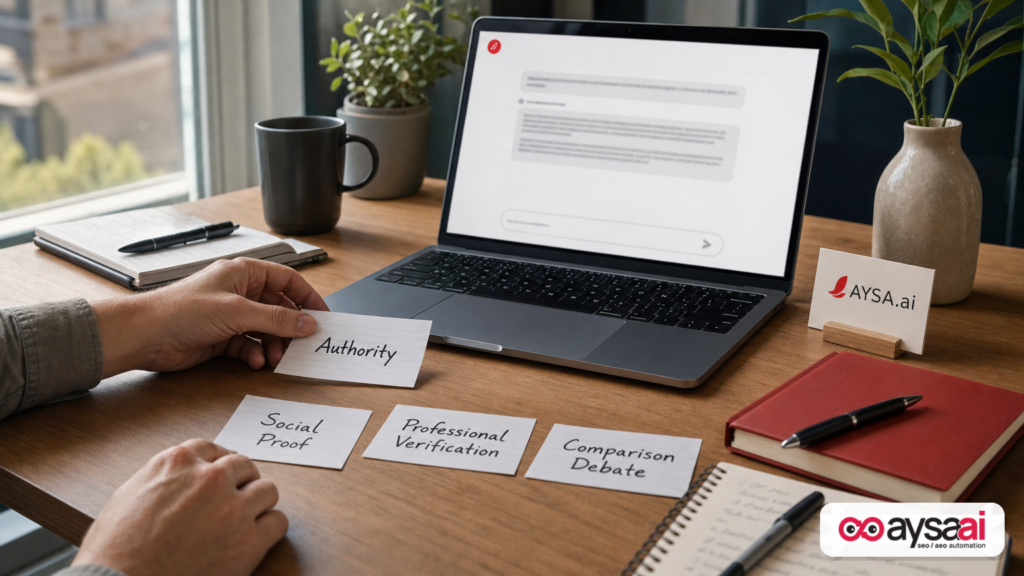
AI engines increasingly behave less like classic search rankings and more like editorial systems. They don’t just retrieve sources—they appear to classify sources and recruit them for specific roles inside answers. That’s why Reddit might function like “authority” in one engine and “community sentiment” in another, and why LinkedIn can show up as “professional verification.”
The practical implication: your AI visibility strategy must be platform- and intent-specific. You need to map which questions matter to your business, understand which sources each AI engine tends to use for those question types, and then engineer your inputs (website, content, PR, community participation, profiles) so your brand shows up in the right role.
Key takeaways (for busy operators)

- AI citations are contextual. Who appears next to you in an answer can signal what the engine “thinks” your source is good for.
- Different engines use the same platform differently. The same Reddit thread may read as authority in one engine and social chatter in another.
- Intent matters more than ever. “How-to,” “why,” “best,” “X vs. Y,” and “is this legit?” prompts can recruit different source types.
- Teams must stop measuring only rankings. You need Monitoring for AI answer visibility, citation context, and brand narratives across engines.
- Execution is the moat. The brands that win will be the ones that can safely ship site improvements and content updates every week—approved, auditable, and consistent.
Table of contents
- What Changed: From Ranking Pages To Recruiting Sources
- The New Problem: AI Search Doesn’t Treat “A Citation” As A Citation
- What BrightEdge’s Findings Really Signal (And Why I Think This Is Bigger Than Citations)
- Role Assignments By Intent: How-To, Explanation, Comparisons, Verification
- What Businesses Should Do Differently (SMEs, Ecommerce, Local, B2B)
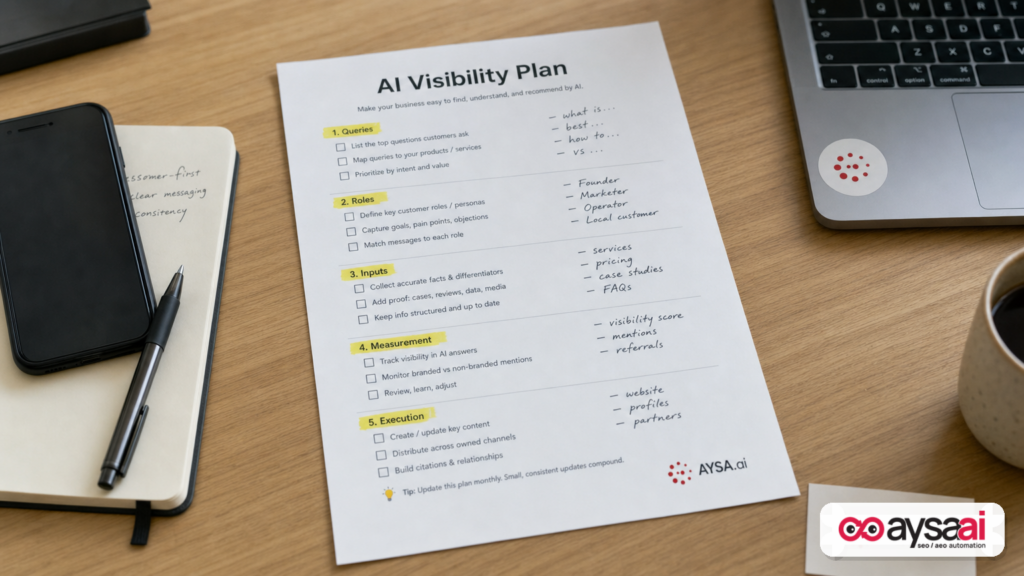
- A Practical Framework: Map Questions → Map Roles → Engineer Your Inputs
- A Concrete SME Scenario: A Local Clinic Trying To Win “Is This Treatment Legit?”
- What Can Go Wrong: The New Failure Modes In AI Visibility
- What To Monitor Weekly (Not Quarterly)
- What Agencies Need To Rethink (And What To Sell Instead)
- Where AYSA Fits: Monitoring + Approved Execution For AI Search Visibility
- What To Do Next: A 30-Day Action List
- Sources And Further Reading
What Changed: From Ranking Pages To Recruiting Sources
In classic SEO, we spent two decades learning a mostly stable set of rules:
- Search engines crawl and index pages.
- They evaluate relevance and authority signals.
- They rank pages for queries.
- Users click, you get traffic.
That model still exists. But AI-driven answer systems (including Google AI Overviews and systems like ChatGPT) change how value is distributed. In many queries, the user’s journey ends without a click. The “win” shifts from ranking to being recruited into the answer—and being recruited in the right way.
Here’s the subtle change that matters: AI engines don’t just pull “the top ten.” They synthesize. They select sources to support statements. And when they select, they appear to make judgments about what each source is for.
This is the editorial layer that traditional SEO rarely had to address explicitly. Yes, Google always had quality signals and classifications—but you were still competing for a slot on a results page. Now you’re competing to be cast in a role inside a narrative.
The New Problem: AI Search Doesn’t Treat “A Citation” As A Citation
BrightEdge’s research (as summarized by Search Engine Journal) points to a core issue: the same platform can land in different “citation neighborhoods” depending on the AI engine. In their analysis, Reddit sometimes shows up alongside medical and reference publishers in ChatGPT citations—and in other contexts, it clusters with social/video platforms in Google AI Overviews.
Even if you don’t memorize the percentages, the operational lesson is simple:
- A citation is not a citation.
- Context defines meaning.
- Meaning determines whether you influence the outcome.
In practice, this changes how you should interpret “we were cited.” If your brand appears in a thread that the engine uses as social proof, that can be helpful for trust—especially for consumer reassurance queries. But it’s not the same as being used as reference authority for definitions, safety, or professional best practices.
So we need a new mental model: AI visibility is role-based.
What BrightEdge’s Findings Really Signal (And Why I Think This Is Bigger Than Citations)
BrightEdge’s work is most valuable as a signal—not because it “proves” a single deterministic ranking algorithm, but because it illustrates a pattern consistent with how modern AI systems behave.
The pattern is this:
- AI engines appear to classify sources by type (community, professional network, editorial publisher, reference, video/social).
- They then use those types to assemble answers for different intents.
When you zoom out, this looks less like ten blue links and more like an editorial workflow:
- Need a definition or consensus? Pull from reference/editorial sources.
- Need lived experience or reassurance? Pull from community discussion.
- Need professional credibility? Pull from professional profiles and career-oriented sources.
- Need a debate between options? Pull from comparison threads and discussions.
It’s tempting to reduce this to “Reddit is good” or “LinkedIn is good.” That’s the wrong takeaway. The real takeaway is: AI engines are building answers using compositional logic. And your brand has to be present in the right components.
That also means you shouldn’t chase every platform equally. You should chase roles that align with your business outcomes.
Role Assignments By Intent: How-To, Explanation, Comparisons, Verification
BrightEdge’s analysis (via SEJ) highlights that different AI engines appear to use Reddit and LinkedIn more heavily for different query types. Let’s translate that into an intent-to-role playbook you can apply without needing to reverse-engineer any model.
1) How-to queries: “Tell me how to do the thing”
How-to intent often recruits procedural content: step-by-step instructions, checklists, do/don’t guidance, troubleshooting.
In traditional SEO, you’d build a how-to page, maybe a video, maybe a Featured snippet. In AI search, the system may still pull your official instructions—but it may also pull community-confirmed steps that validate what “actually works.”
Business implication: Your official documentation (website, help center, clinic FAQ, product manuals) needs to be clean, structured, and current. But you may also need real-world proof: users discussing outcomes, edge cases, and practical tips.
2) Explanation queries: “Why does this happen?”
Explanation intent is where AI systems often synthesize across sources. But they still need raw material: hypotheses, consensus views, and caveats.
Business implication: If you’re in a complex category (health, finance, compliance, B2B technical), publish “why” content that is sober, evidence-driven, and clearly scoped. Don’t just answer what; answer mechanism, context, and limitations.
This is also where E-E-A-T-like signals become practical: not as a buzzword, but as a way to make your content legible as “safe to use” in a synthesized answer. Google has long emphasized building helpful, people-first content; if you want the official framing, start with Google’s guidance on creating helpful content: Google Search Central: Creating helpful, reliable, people-first content.
3) Comparison queries: “X vs Y” and “best for…”
Comparison intent is where I expect role assignment to become even more visible. Comparison questions are inherently argumentative: there isn’t always a single “right answer,” just tradeoffs.
According to the SEJ summary of BrightEdge’s research, Google AI Overviews appears more likely than ChatGPT to recruit social sources for comparison-style prompts. That suggests a plausible mechanism: if users are already debating the tradeoffs in public, surfacing that debate can be a shortcut to representing “the market’s view.”
Business implication: If you sell a product or service where comparisons are common (SaaS, clinics, home services, ecommerce categories), you need assets that handle comparisons honestly:
- Comparison pages on your site (your product vs alternatives, or service options).
- Third-party reviews and discussions where users mention your differentiators accurately.
- Clear positioning statements that your team repeats consistently everywhere.
4) Verification queries: “Is this legit?” “Can they do this?”
Verification intent is where reputational gravity concentrates. Users ask:
- Is this provider qualified?
- Is this product safe?
- Is this company real?
- Is this too good to be true?
In the BrightEdge findings (as described by SEJ), LinkedIn tends to appear for professional capability questions, while Reddit appears more for consumer reassurance and experience-based validation.
Business implication: You need two layers of proof:
- Professional proof: leadership bios, credential pages, speaking, certifications, case studies, accurate professional profiles.
- Consumer proof: authentic reviews, community mentions, “what to expect” content, transparent policies.
For many SMEs, this is the fastest path to better AI outcomes: verification queries drive conversions.
What Businesses Should Do Differently (SMEs, Ecommerce, Local, B2B)
Let’s move from concept to operations. If AI engines are assigning roles, the winning strategy is not “post more content.” It’s to build a diversified set of inputs—each engineered for a job.
SMEs (general): stop chasing one platform
SMEs often over-index on the channel that’s easiest to manage. Historically that was the website + Google rankings. Then it became social. Now it’s “AI Optimization.”
But if the role-assignment hypothesis holds, single-channel strategies are fragile. A better SME approach:
- Build a strong primary authority hub (your website).
- Build a professional validation layer (bios, profiles, credentials, partnerships).
- Build a community sentiment layer (participation, customer education, real discussions).
- Build a publisher/reference layer when possible (PR, citations, mentions).
Ecommerce: you need “real use” proof, not just category pages
Ecommerce already learned that product pages alone don’t answer the real questions: sizing, durability, setup difficulty, compatibility, returns, “is it worth it.”
If AI engines recruit community sources for reassurance and comparisons, ecommerce brands should prioritize:
- Structured product FAQs (shipping, fit, compatibility, care).
- Long-form “how to choose” guides.
- User-generated Q&A and reviews (on-site and off-site where appropriate).
- Transparent policy pages and trust signals.
Google has detailed documentation on structured data (including product and review markup) which helps systems interpret pages. Start here: Google Search Central: Understand structured data.
Local businesses: your “locations” narrative must be consistent across the web
Local businesses have an extra challenge: AI answers often compress location-specific nuance. If you have multiple locations, the AI can blend attributes, reviews, or services incorrectly.
Your job is to reduce ambiguity:
- Unique, accurate location pages (services, hours, photos, policies).
- Consistent NAP and business details across platforms.
- Clear “what to expect” content for first-time visitors.
- Reputation management that addresses recurring concerns.
B2B: LinkedIn is not “social,” it’s the verification layer
In B2B, LinkedIn often functions as a public resume + credibility ledger. If AI engines use it for capability checks, then:
- Your leadership profiles need to match your positioning.
- Your company page should be accurate and specific (not generic slogans).
- Your employees should be aligned on how they describe what you do.
This is not about “posting more.” It’s about reducing contradictions and increasing the density of consistent claims the AI can safely repeat.
A Practical Framework: Map Questions → Map Roles → Engineer Your Inputs
Here’s the framework I recommend if you want an actionable plan you can run monthly, then refine weekly.
Step 1: Build a “money question” list (20–50 queries)
Forget keywords for a moment. Collect questions that:
- Precede a purchase decision
- Signal high intent
- Trigger fear/uncertainty (“is it safe,” “is it worth it,” “can they,” “what are the side effects”)
- Trigger comparisons (“X vs Y,” “best for,” “alternatives”)
If you’re an SME, you can pull these from:
- Your sales calls
- Customer support tickets
- On-site search
- FAQs your staff answers repeatedly
Step 2: Label each question by intent type
Create 5 intent buckets:
- Definition: what is X?
- How-to: how do I do X?
- Explanation: why does X happen?
- Comparison: X vs Y / best X for Y
- Verification: is X legit / can Y do Z?
This is enough structure to drive decisions without overcomplicating.
Step 3: Decide what role you need to win for each intent
For each question, ask: if an AI engine is building an answer, what role would most influence the user?
- Authority role: “this is the correct factual framing”
- Professional verification role: “these people are qualified to say this”
- Social proof role: “people like me have tried this and here’s what happened”
- Comparison debate role: “here are the real tradeoffs”
Not every business needs all roles equally. A local clinic might care most about verification + reassurance. A SaaS tool might care about comparisons + how-to implementation.
Step 4: Engineer your inputs by role (website + off-site)
Now the work becomes clear.
Authority inputs (your website)
- Clear service/product pages with definitions, claims, and limitations
- Evidence pages (methodology, safety, sourcing, compliance)
- Editorial content with expert review and clear authorship
- Structured data where appropriate
Professional verification inputs (profiles + credentials)
- Leadership and staff bio pages with credentials
- Consistent professional profiles (e.g., LinkedIn) aligned with what you do
- Clear company identity pages (about, contact, policies)
Social proof inputs (community + reputation)
- Reviews and Q&A
- Participation in relevant communities (without spam)
- Customer stories that sound like real people, not brochures
Comparison debate inputs (positioning + alternatives)
- Comparison pages that address tradeoffs honestly
- “Who is this for / not for” content
- Implementation guides that reduce risk and set expectations
Step 5: Measure visibility the new way
Instead of only tracking classic rankings, you want to track:
- Whether your brand appears in AI answers for your money questions
- What is said about you (narrative accuracy)
- What sources the engine uses around you (citation neighborhood)
- What role your mentions appear to play
This is where monitoring becomes central, not optional.
A Concrete SME Scenario: A Local Clinic Trying To Win “Is This Treatment Legit?”
Let’s make this real with a scenario that resembles hundreds of businesses I’ve seen: a small regional clinic offering a specialized service (could be dermatology, physiotherapy, dental implants, or a wellness program). They’re great at delivery, but online perception is messy.
The problem: Prospective patients ask AI systems questions like:
- “Is [treatment] safe?”
- “Does [treatment] actually work?”
- “What are side effects of [treatment]?”
- “[treatment] vs [alternative]”
- “How much does [treatment] cost in [city]?”
In classic SEO, you’d write articles and try to rank. In AI search, you need to win roles:
Role 1: Authority (medical framing)
The clinic needs pages that clearly describe:
- Who it’s for / not for
- Risks and disclaimers
- What “results” actually mean and timelines
- How it compares to alternatives (with appropriate caution)
These pages should be clean, updated, and authored/reviewed appropriately. Even if AI cites third-party references, your site becomes a reliable anchor for specifics like pricing ranges, eligibility, and what your clinic actually does.
Role 2: Professional verification (credibility)
The clinic needs to make credentials unmissable:
- Physician/provider bios (licensure, training, associations)
- Clear contact details and location legitimacy
- Transparent policies
And yes—professional profiles matter here because they can reinforce the “capability check” role that BrightEdge suggests systems may assign to networks like LinkedIn in certain contexts.
Role 3: Social proof (reassurance)
Patients want to know what it feels like, what recovery is like, and whether the clinic is trustworthy.
This is where reviews, patient education, and community discussion can matter—especially if AI engines recruit “lived experience” sources for reassurance questions.
Execution reality
Most clinics won’t do all of this manually in a clean loop. They’ll publish one blog post, update a page once a year, and wonder why outcomes are inconsistent.
That’s why an operating system matters: monitor the questions, ship page improvements, verify how AI answers change.
What Can Go Wrong: The New Failure Modes In AI Visibility
Role-based AI search introduces new ways to lose—some of them subtle.
1) You show up, but in the wrong role
Being present in a community thread can be great, but if your goal is to be treated as the authoritative source for safety guidance, “social chatter” placement may not move the needle. Worse, it can introduce misinterpretations that the AI repeats.
2) Your brand narrative becomes inconsistent across platforms
If your website says one thing, your profiles imply another, and community discussion claims a third, the AI has to reconcile contradictions. Often it will average them or hedge—which is terrible for conversion.
3) You optimize for citations and forget conversion
Teams can become addicted to screenshots: “Look, we’re cited!” But if the AI summary still discourages purchase (“mixed reviews,” “not suitable for…,” “alternatives may be better”), you didn’t win.
4) You outsource too much to generative content
Flooding your site with generic AI-written pages is a fast way to create sameness and erode trust. Helpful content still requires real experience, specificity, and editorial accountability. (Google’s “helpful content” guidance remains a relevant north star: Search Central documentation.)
5) You don’t operationalize execution
AI search changes quickly. If your team can’t ship improvements weekly, you’ll always be behind. Strategy without execution becomes a quarterly slide deck.
What To Monitor Weekly (Not Quarterly)
If you only track organic traffic and rankings, you’ll miss the shift until revenue feels it.
Here’s what I recommend monitoring on a weekly cadence:
- AI answer presence for your money questions (do you appear?)
- Narrative accuracy (is the AI describing you correctly?)
- Citation context (who appears next to you and what that signals)
- Brand sentiment signals (recurring concerns and objections)
- On-site health (broken pages, thin sections, outdated claims)
AYSA is built for this kind of loop: monitoring that detects what’s happening, paired with recommendations you can approve and execute safely.
What Agencies Need To Rethink (And What To Sell Instead)
If you run an agency, this shift is both threat and opportunity.
The threat: one-size-fits-all SEO deliverables
“Four blog posts a month” or “ten backlinks” won’t map cleanly to role-based AI visibility. You may produce activity without changing the roles your brand can occupy in AI answers.
The opportunity: role-based visibility programs
Agencies can productize a better offer:
- Query-to-role mapping workshops
- AI narrative audits (what engines say about the brand)
- Role-specific asset creation (comparison pages, verification hubs, how-to libraries)
- Community + professional presence alignment
- Continuous monitoring and approved execution
The differentiator won’t be “we know AI.” It will be: we can execute changes reliably and prove outcomes.
Where AYSA Fits: Monitoring + Approved Execution For AI Search Visibility
At AYSA.ai, we treat AI search visibility as an execution problem, not just a research problem.
Here’s how AYSA fits naturally into the role-based world BrightEdge is hinting at:
1) Monitor what AI engines say and cite
AI answers shift. Your inputs change. Competitors push content. AYSA helps you stay current with ongoing monitoring workflows: AYSA Monitoring.
2) Prepare improvements that match the role you’re trying to win
If you need to win verification queries, AYSA can help identify gaps in bios, policies, location details, and trust content. If you need to win how-to queries, AYSA can help structure and improve instructional pages.
See the broader view of AI visibility workflows here: AI Search Visibility.
3) Ask for approval before changes go live
Many business owners want speed—but not surprises. AYSA’s model is designed around approved execution: we prepare recommended website changes, you review, you approve, and then changes are implemented. This keeps control with the operator while still shipping consistently.
4) Execute accepted changes and close the loop
Most teams die in the gap between “we should update this page” and “it’s live and verified.” AYSA is built to close that gap.
If you want to explore the toolkit side, start here: AI SEO Tools. If you want to understand packaging and fit, pricing is here: AYSA Pricing. For ongoing guidance and playbooks, visit the AYSA blog: AYSA Blog.
What To Do Next: A 30-Day Action List
This is the execution plan I’d run if I owned an SME and wanted to be materially better positioned for AI search within 30 days.
Week 1: Inventory and prioritize
- List 20–50 “money questions.”
- Label each by intent (definition/how-to/explanation/comparison/verification).
- Pick the top 10 that drive the most revenue or risk.
Week 2: Fix your authority hub (website)
- Update the top 10 relevant pages for clarity, scope, and freshness.
- Add missing FAQ sections that answer verification and comparison objections.
- Ensure authorship, contact info, and policies are easy to find.
- Review structured data opportunities using Google’s documentation: structured data intro.
Week 3: Build verification and consistency
- Align leadership/staff bios on-site with public profiles.
- Make sure “about” and “contact” pages are complete and consistent.
- Document your positioning in one paragraph and reuse it everywhere.
Week 4: Engineer social proof and comparison assets
- Create one honest comparison page (or “alternatives” page) that states tradeoffs.
- Publish one “what to expect” page that reduces uncertainty.
- Start a lightweight community participation plan (answer questions where your customers already are; don’t spam).
Ongoing: Monitor, approve, execute
- Set a weekly review of AI answer presence and narrative accuracy.
- Ship at least 1–3 approved site improvements per week.
- Track which improvements correlate with better AI visibility for your money questions.
If you want an execution system rather than another spreadsheet, start with AYSA monitoring and visibility workflows: AI Search Visibility and Monitoring.
Sources And Further Reading
- Search Engine Journal: Research Suggests AI Engines Assign Ranking Roles To Sources (coverage of BrightEdge research; primary context for this editorial)
- Google Search Central: Creating helpful, reliable, people-first content
- Google Search Central: Understand structured data
Note on sourcing: The SEJ article references BrightEdge’s research and links to it (“Same Users, Same Jobs, Different Doors: How Organic and AI Search Cover the Same Job Universe”). That BrightEdge URL was not provided in the extracted links we received for this assignment, so I’m not linking it directly here to avoid guessing. If you share the direct BrightEdge link, we can add it as a primary source in this section.
Published by Marius Dosinescu / AYSA.ai. This editorial is designed to be practical: it explains what changed, why it matters, what to do next, and how to build an execution loop that survives AI search volatility.
Continue the AI search topic inside AYSA.
Use these pages to connect the article with AI SEO tools, AI visibility monitoring, AI Overviews and approved website execution.
Turn this topic into a website action plan.
Use these AYSA hubs to move from reading to technical fixes, AI visibility monitoring, research, glossary context and approval-first SEO execution.

