Stop Auditing AI Visibility Like It’s Just Crawlability: Relationship Integrity Is the New Search Moat
AI systems can now find your content. The harder problem is whether they can correctly understand how your business works across brands, locations, products, and markets. Here’s how to audit (and fix) relationship integrity so AI answers don’t drift into confident wrongness—and how AYSA operationalizes the changes safely.

AI Search has a visibility problem—but it’s not the one most teams are auditing.
Yes, your content must be discoverable and accessible to crawlers and AI systems. But once it’s found, the higher-stakes question becomes: will machines understand your business correctly—across your brands, locations, products, services, eligibility rules, and market differences?
That’s where relationship integrity becomes the real moat. If your Structured data (and your site’s internal “truth”) describes pages but not the business, AI can still confidently produce answers that are inconsistent, out-of-date, or contextually wrong.
This editorial is inspired by (but does not reproduce) Bill Hunt’s discussion of the “Integrity Graph” as a missing layer in AI visibility audits, published at Search Engine Journal. I’m expanding the idea into a practical, operator-focused playbook for SMEs, agencies, and multi-location or multi-market teams—and showing how AYSA fits as an execution system, not just a reporting layer.
Concise summary

- Discoverability is table stakes. AI systems can crawl your content, but still misunderstand how your business operates.
- Entity markup isn’t enough. You need accurate, explicit relationships: ownership, availability, eligibility, market rules, product families, and location/service mapping.
- Page validators can mislead. Many tools score individual pages and miss graph-level integrity across your whole site.
- The risk is “confident wrongness.” AI blends facts across locations or markets, recommends unavailable services, or misattributes brands to legal entities.
- AYSA’s value is operational. Monitor relationship drift, prepare fixes, ask for approval, execute changes, then verify—without chaos in your CMS.
Key takeaways (what changed, why it matters)
- Search is shifting from pages to systems. Search engines and AI assistants increasingly synthesize, recommend, and take actions—making relationships and context essential.
- More “access layers” are emerging. People are talking about AI crawlers, agent standards, and new auditing frameworks. Those matter, but they don’t fix semantic integrity by themselves.
- Relationships determine understanding. If your site doesn’t explicitly model relationships, machines will infer them—and inference is where mistakes happen.
Table of contents

- The problem with most AI visibility audits: they stop at “can it be found?”
- Describing a page vs describing a business (why AI cares)
- The validator trap: why page-level tests miss graph-level truth
- Why Google’s direction signals relationships are the battleground
- The “Integrity Graph” idea: from entity identification to contextual truth
- How AI gets your business wrong (realistic failure modes)
- A concrete SME scenario: a multi-location clinic with services that vary by state
- A practical Integrity Audit framework (what to review and how)
- Implementation patterns that scale (without rewriting your whole site)
- Governance: keeping relationships true as your business changes
- How AYSA operationalizes relationship integrity (without breaking your site)
- What to do next (action list)
- Sources and further reading
The problem with most AI visibility audits: they stop at “can it be found?”
AI visibility audits are becoming popular because they feel like the next version of a Technical SEO crawl audit: if an AI system can’t access your content, it can’t cite it, summarize it, or use it to answer questions.
That logic is correct—and it’s why projects like Common Crawl have sparked conversations about AI discoverability. Common Crawl is an open web crawl dataset used widely in research and often discussed in the context of training data and AI visibility (even when a specific model’s training mix isn’t public). The core idea is still useful: machines can only use what they can find.
But here’s the practical operator problem: visibility is necessary, not sufficient.
In 2026, many businesses won’t lose the AI search game because their content is blocked. They’ll lose because:
- their facts are inconsistent across pages,
- their relationships are implied rather than explicit,
- their “truth” varies by location/market but isn’t modeled that way,
- and AI systems guess incorrectly—with high confidence.
In classic SEO, “misunderstanding” might reduce rankings. In AI search, misunderstanding can turn into something worse: incorrect answers that look authoritative and get repeated across channels.
Describing a page vs describing a business (why AI cares)
Most schema and structured data efforts still behave like a rich-results checklist:
- Does the page have
Organizationmarkup? - Does the product page have a price field?
- Does the Location page have an address?
That work has value. But it’s fundamentally page-centric.
AI assistants aren’t page-centric. They’re context-centric. They aim to answer questions like:
- “Which of these services are available near me?”
- “Is this product compatible with what I already own?”
- “Which policy applies in my state/country?”
- “Is this brand part of the same company as that brand?”
Those answers require a machine to understand relationships that may not be spelled out in any single URL.
Put differently: you can mark up a checking account page, a mortgage page, and a branch page perfectly—and still leave the machine unable to reliably answer:
- Which branches offer which services?
- Which products are restricted by jurisdiction?
- Which brand name is used in which market?
This is exactly why Bill Hunt’s “Integrity Graph” framing matters: entity identification isn’t the finish line—relationship integrity is.
The validator trap: why page-level tests miss graph-level truth
Structured data validators (including tools built for search features) generally test a single page at a time. They’re great at answering: “Is this markup syntactically valid and complete for this type?”
They’re not designed to answer: “Does the entire site express a coherent, consistent business model?”
In fact, some best-practice implementations can look “incomplete” in page validators because modern schema often uses graph references and shared entities via @id. That can be the right approach for entity reconciliation, but it can confuse simplistic audits that expect every fact repeated on every page.
The deeper problem isn’t the tooling—it’s the mental model. If your audit ends when every page passes validation, you may still be missing the question AI cares about: can I reliably connect and constrain facts across contexts?
Why Google’s direction signals relationships are the battleground
When Google invests in mechanisms that capture relationships—feeds, attributes, compatibility, variants, and other structured context—it’s a signal that even sophisticated systems hit limits when inferring relationships from raw content.
In the SEJ piece, one example discussed is Google Merchant Center’s move toward richer attributes that help systems understand product context in more conversational ways. That lines up with a broader pattern: Google is continuously refining how it consumes structured signals and context so it can produce better answers and recommendations.
Even without claiming any proprietary insight into Google’s roadmap, you can observe a consistent direction across public-facing initiatives and documentation: more emphasis on entities, attributes, and relationships.
This should change how businesses allocate effort. The next wave of advantage will come less from “more content” and more from higher-integrity meaning.
The “Integrity Graph” idea: from entity identification to contextual truth
An Entity Graph helps machines know what something is: a business, a location, a product, a service.
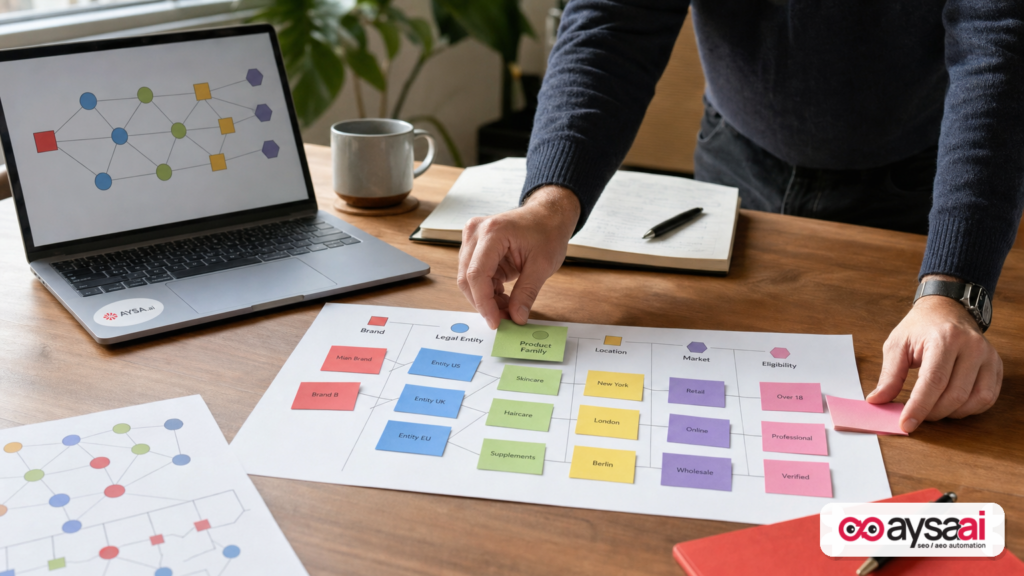
An Integrity Graph helps machines know which facts are true in which context. That includes relationship rules like:
- Ownership: which legal entity owns a brand (and whether that varies by country).
- Availability: which services are offered at which locations.
- Eligibility: which audiences qualify for which offers (membership, age, region, professional status).
- Jurisdiction: which regulations, terms, fees, or disclosures apply in which markets.
- Product families and variants: what belongs together, what’s a successor, what’s compatible.
- Global vs local truth: which statements are universally true vs market-specific.
This is not just an enterprise problem. SMEs have “context” too—often more than they realize:
- a local service business with different service areas and pricing zones,
- a clinic with state-by-state restrictions,
- an ecommerce shop with country-specific product compliance,
- a franchise with corporate brand rules but local operator differences.
If you don’t encode those constraints, AI will compress your business into a simpler story—and that simplification is where errors are born.
How AI gets your business wrong (realistic failure modes)
Let’s make this concrete. Here are common “relationship integrity” failures I see across real websites (and that any SME or agency can recognize):
Failure mode #1: AI merges two similar-but-not-identical offerings
You have two services that sound similar (e.g., “emergency dental,” “urgent dental,” “after-hours dental”), offered at different locations. Your site has separate pages, but the relationship is not explicit. AI summarizes them as one universal offering across all locations.
Outcome: users arrive expecting a service you don’t provide at that location, harming trust and conversions.
Failure mode #2: A brand/legal entity mismatch creates credibility issues
A holding company owns several brands. The website mentions both, but doesn’t clearly encode ownership relationships. AI answers “Who owns X?” incorrectly, or attributes policies from one brand to another.
Outcome: reputational risk and potential compliance confusion (especially in regulated industries).
Failure mode #3: Market rules leak across borders
Your EU site contains GDPR-specific language and region-specific product restrictions. Your US site does not. AI blends them and presents the strictest version as universal—or worse, presents the loosest version to regulated audiences.
Outcome: compliance and customer expectation risk.
Failure mode #4: Product variants become “the product”
You have variants by size, model year, region, or compatibility. AI sees a popular variant and treats it as the canonical product.
Outcome: returns, support tickets, and customer dissatisfaction.
Failure mode #5: Location knowledge decays silently
Locations open, close, rebrand, or change services. The site updates some pages but not others; structured data and internal links drift. AI snapshots an old state and repeats it.
Outcome: wasted spend, calls to wrong offices, negative reviews.
A concrete SME scenario: a multi-location clinic with services that vary by state
Imagine a growing clinic brand with five locations across two states. The brand runs paid search, ranks well organically, and has location pages and service pages.
But in State A, the clinic offers a specific procedure; in State B, it does not. Maybe it’s licensing. Maybe it’s staffing. Maybe it’s a local partnership limitation.
Here’s what typically happens on real sites:
- The service page is written as if the service is universal (“We offer X”).
- The location pages list “Services,” but the list is incomplete or inconsistent.
- Structured data exists, but it describes each page in isolation (an address here, a service there), without explicit constraints that tie availability to a location or jurisdiction.
Now a user asks an AI assistant: “Does [Clinic Brand] offer X near me?” The assistant may confidently answer “Yes,” citing a service page, even though the nearest location can’t provide it.
This isn’t a theoretical edge case—it’s normal web publishing behavior colliding with AI synthesis.
What fixes it? Not more blog posts. Not “AI content.” It’s relationship integrity: explicit, machine-readable mapping of which services are offered at which locations, plus clear copy and Internal linking that reinforce the same truth.
A practical Integrity Audit framework (what to review and how)
If you want to operationalize the Integrity Graph concept, you need an audit that looks less like a schema checklist and more like a business truth test.
Here’s a practical framework you can run as an SME, an in-house team, or an agency.
Layer 1: Discoverability and access (baseline)
Before anything else, confirm AI systems and crawlers can reach key pages. That includes standard technical SEO hygiene: crawlability, indexing signals, and consistent internal linking. Common Crawl-inspired thinking is useful here: if the content can’t be fetched, it can’t be used.
If you need a visibility baseline and monitoring, start with a system built for AI search visibility tracking—see AYSA AI Search Visibility and AYSA Monitoring.
Layer 2: Entity clarity (who/what are you?)
Confirm your site clearly defines:
- your business name(s),
- your brand(s) vs parent company,
- your locations (if relevant),
- your key products and services.
For many SMEs, this means cleaning up inconsistent naming (LLC vs brand name), outdated “About” copy, and mismatched citations across your own site.
Layer 3: Relationship integrity (how does the business actually work?)
This is the missing layer. Create an explicit map of:
- Brand ↔ legal entity (ownership and responsibility)
- Location ↔ services (availability by branch/clinic/store)
- Product ↔ variants (what changes by region/model/year)
- Product family ↔ alternatives (what competes or substitutes)
- Market ↔ policy/disclosure/terms (what’s true where)
Then test a set of real-world questions that customers ask—especially the ones that require context:
- “Do you offer X at location Y?”
- “Is product A compatible with B?”
- “Does this warranty apply in my country?”
- “Is this brand the same as that brand?”
If a human has to stitch together multiple pages to answer correctly, assume a machine will sometimes stitch it together incorrectly unless you model it explicitly.
Layer 4: Drift and change management (keeping it true)
Integrity is not a one-time project. Businesses change weekly:
- new SKUs, discontinued SKUs, seasonal offerings,
- new locations, hours changes, staffing changes,
- policy updates, regulated disclosures, market-specific terms.
The question isn’t “Can we model relationships once?” It’s “Can we prevent drift?”
This is where monitoring and controlled execution becomes the difference between a nice diagram and durable advantage. AYSA is built for this: monitor, prepare changes, request approval, then execute accepted updates safely. (More in the AYSA section below.)
Implementation patterns that scale (without rewriting your whole site)
You don’t need to build a massive internal knowledge graph platform to benefit from relationship integrity. Most SMEs and mid-market teams can get 80% of the value by tightening a few implementation patterns.
Pattern 1: Canonical “truth” pages for core entities
Create (or designate) authoritative pages for:
- the primary brand,
- each location,
- each core service line,
- each key product family.
Then ensure internal links and structured references consistently point back to those canonical entities.
Pattern 2: Location-service matrices (even if they start as content)
If services vary by location, publish it clearly. A simple “Services at this location” block on each location page (kept consistent) will often outperform a fancy sitewide claim.
Then align structured data and internal linking to reflect the same mapping.
Pattern 3: Market-specific constraints (don’t bury them in PDFs)
Many companies hide critical context inside PDFs, footers, or legal pages. AI systems may extract the wrong takeaway or ignore constraints.
Where possible:
- surface constraints near the relevant product/service description,
- use clear, scannable language,
- avoid ambiguous “may vary” statements when you can be explicit.
Pattern 4: Consistent naming and IDs across templates
Even before you go deep on schema architecture, fix basic consistency:
- Same service names everywhere (avoid “Urgent Care” vs “Immediate Care” unless truly different).
- Same location naming conventions.
- Same brand references (including punctuation, Inc/LLC, and abbreviations).
AI models and retrieval systems are sensitive to small inconsistencies that humans ignore.
Pattern 5: Structured data as a graph, not a checklist
If you’re using schema markup, use it to express relationships, not just page types. The goal is not “more schema.” The goal is “more coherent truth.”
Practical note: because validators often score page-by-page, graph-based approaches can look messy if your audit tool expects every property inline. Don’t let the tool drive the architecture; let the business truth drive it.
Governance: keeping relationships true as your business changes
Relationship integrity fails for one reason more than any other: no one owns it.
Marketing owns content. Ops owns locations. Product owns SKUs. Legal owns policy. Support owns FAQs. The website becomes a patchwork of partial truths.
AI search punishes that patchwork because it synthesizes across the whole web. The fix is governance:
- Define an owner for each relationship class (e.g., location-service mapping owned by Ops).
- Define update triggers (e.g., new location = update location schema + service matrix + internal links).
- Define an approval workflow for high-risk updates (pricing, eligibility, regulated claims).
- Monitor drift (unexpected template edits, removed blocks, inconsistent fields).
In my experience, most SMEs don’t fail because they can’t do the work—they fail because they can’t keep the work correct after month two.
How AYSA operationalizes relationship integrity (without breaking your site)
This is where I’ll be direct: audits don’t create advantage. Execution does.
AYSA is designed to be an approved execution system for SEO/AEO/GEO—not a passive reporting dashboard.
Here’s how AYSA fits the Integrity Graph problem in practice:
1) Monitor what matters (and catch drift early)
Relationship integrity problems often start as small, routine edits:
- a location page template loses a “Services offered” block,
- a new product launches without being connected to a family page,
- a rebrand updates the header but not structured references,
- two service pages diverge in terminology.
With AYSA Monitoring, teams can track changes and surface issues that impact AI understanding—not just rankings.
2) Prepare fixes as concrete, reviewable changes
Most businesses don’t need “AI magic.” They need specific proposed edits:
- update internal linking patterns,
- normalize service naming,
- add structured relationship references,
- create or update canonical entity pages,
- clarify market constraints in copy.
AYSA prepares changes in a way a human can review—especially important for regulated or high-liability categories.
3) Ask for approval (keep humans in control)
Relationship integrity touches business truth. That means it shouldn’t be auto-deployed blindly.
AYSA’s model is: prepare → ask for approval → execute accepted changes. That keeps the organization responsible for claims and constraints—while still moving fast.
4) Execute accepted updates safely
The hardest part for SMEs and agencies is not knowing what to do—it’s getting it implemented without breaking templates, battling stakeholder approvals, or letting tickets rot in a backlog.
AYSA’s purpose is to close that gap: make high-leverage integrity fixes real on the site.
5) Verify impact across AI search visibility
Finally, you want to see whether AI systems are representing you more accurately over time.
AYSA’s AI Search Visibility capabilities are designed for that: measuring and monitoring how your brand and offerings appear in AI-driven experiences, so integrity improvements don’t stay theoretical.
If you’re evaluating tooling, you can also review AYSA’s AI SEO tools and practical packaging on pricing. For more operator-level guidance, see the AYSA blog.
What to do next (action list)
If you’re an SME owner, marketing lead, or agency, here’s a practical sequence you can execute this month.
1) Pick 10 “context questions” customers ask
- “Do you offer X at location Y?”
- “Is X available in my state/country?”
- “Which version fits my model/year?”
- “Are these brands the same company?”
These questions are your Integrity Graph acceptance tests.
2) Map the minimum relationships needed to answer them correctly
- Location ↔ service
- Market ↔ policy
- Product ↔ variant
- Brand ↔ legal entity
3) Audit your site for “implied truth” and contradictions
- Pages that claim universal availability without exceptions
- Location pages missing service lists
- FAQs that conflict with product/service pages
- Old pages still indexed that describe retired offerings
4) Fix the highest-risk integrity issues first
Prioritize where errors cause:
- lost leads (wrong service expectations),
- compliance exposure (wrong disclosures),
- high return/support costs (wrong variant/compatibility info),
- reputation damage (ownership/policy confusion).
5) Put monitoring + approval-based execution in place
Do not treat this as a one-time sprint. Treat it like keeping your store hours correct: continuous.
If you want an operational system for it, start with:
- Monitoring to catch drift,
- AI search visibility to track representation,
- Tools to prepare fixes, and an approval workflow to deploy them safely.
Sources and further reading
- Bill Hunt, Search Engine Journal: The Integrity Graph: The Missing Layer In Your AI Visibility Audit
- Search Engine Journal SEO section (research lead): SEJ SEO
- Search Engine Journal Enterprise SEO section (research lead): SEJ Enterprise SEO
- Search Engine Journal International Search section (research lead): SEJ International Search
- Search Engine Journal Google Algorithm Updates hub (research lead): Google Algorithm Updates
Note: The SEJ article references additional concepts (e.g., agent readiness mechanisms like llms.txt and emerging agent protocols). This editorial intentionally avoids claiming adoption statistics or vendor-specific outcomes beyond what was provided in the source context.
Continue the AI search topic inside AYSA.
Use these pages to connect the article with AI SEO tools, AI visibility monitoring, AI Overviews and approved website execution.
Turn this topic into a website action plan.
Use these AYSA hubs to move from reading to technical fixes, AI visibility monitoring, research, glossary context and approval-first SEO execution.