
AI Search Loves Listicles: What Citation Patterns Really Mean for SEO and AEO
A Search Engine Land report on 25,000 cited URLs shows listicles are heavily cited by AI search. Here is what that really means for SEO, AEO and SMEs.
Executive summary: A recent Search Engine Land analysis based on Wix Studio’s AI Search Lab data found that listicles appear heavily in AI search citations. Across 75,000 AI answers and more than 1 million citations, listicles accounted for 21.9% of cited URLs, followed by articles at 16.7% and product pages at 13.7%. The quick takeaway would be: “write more lists.” That is also the dangerous takeaway.
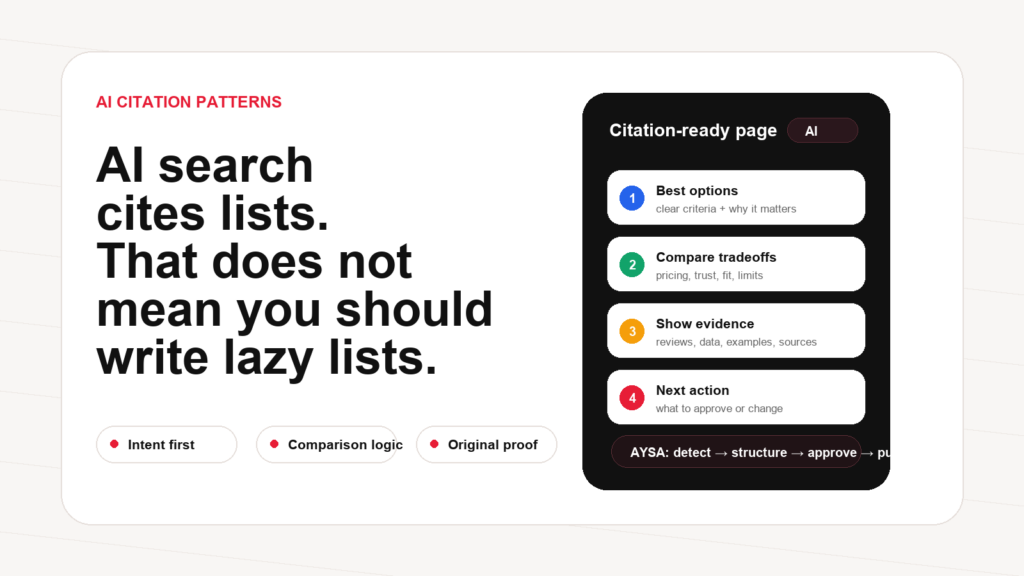
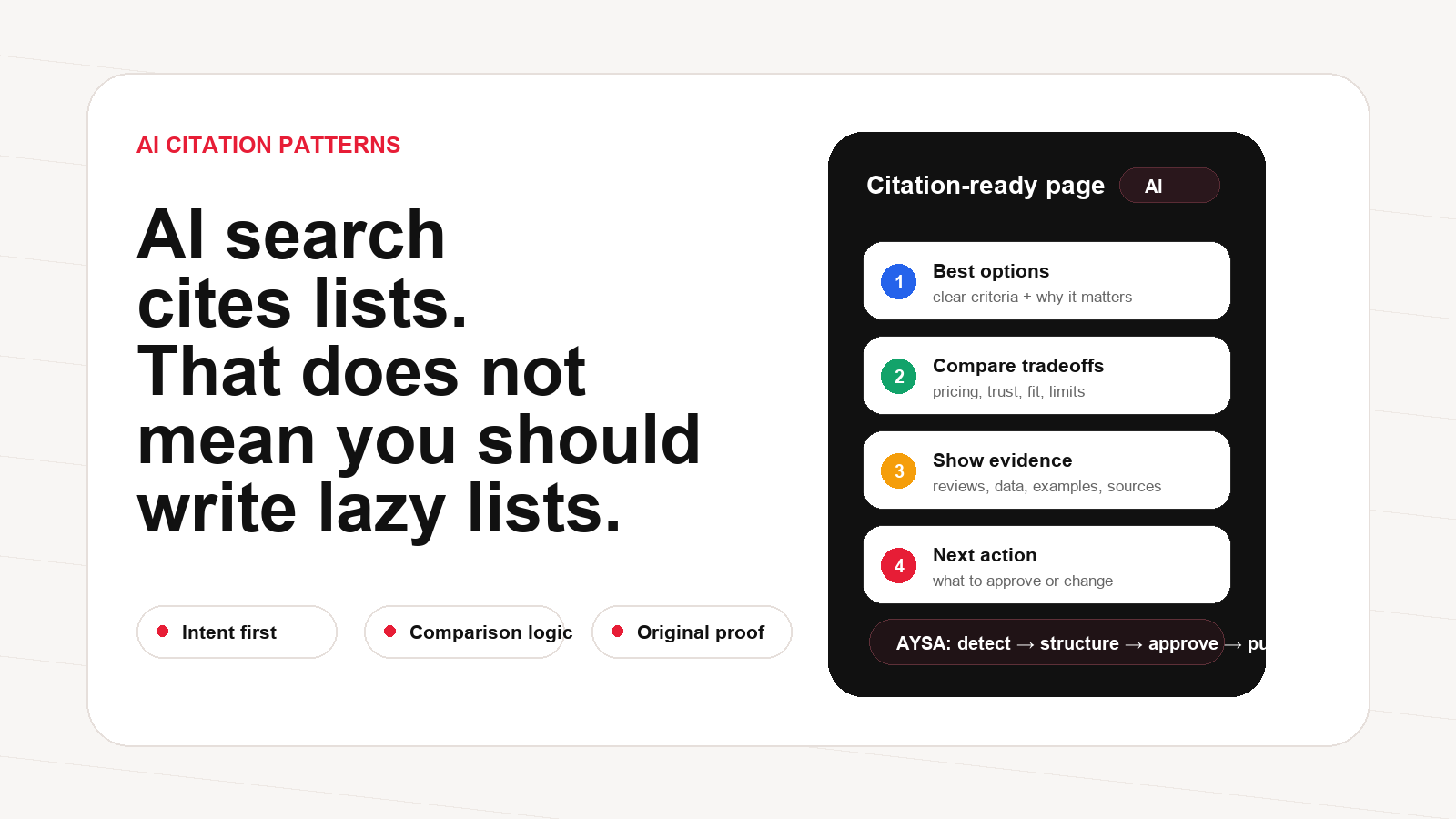
AI search does not reward weak listicles because they are listicles. It tends to cite pages that are easy to extract, compare, summarize and use as supporting evidence. A strong listicle has clear criteria, structured entities, original insight, comparison logic, useful examples and a reason to trust it. A lazy listicle is just content noise. The AYSA view is simple: if AI search is becoming more citation-driven, SMEs need a workflow that turns topics into useful, structured, approval-ready pages, not another pile of generic list posts.
What the data says
Search Engine Land reported on a Wix Studio AI Search Lab analysis of 75,000 AI-generated answers and more than 1 million citation links. The study looked at 25,000 unique cited URLs and classified the formats most often cited by AI systems. The headline result is easy to remember: listicles represented 21.9% of citations, articles 16.7%, and product pages 13.7%.
There is a reason this matters. For years, SEO teams optimized primarily for rankings and snippets. AI search adds another layer: citations. If an AI answer uses your page as supporting evidence, your brand can appear even when the user does not browse the traditional search results in the same way. Citation visibility is not the same as ranking, but it is increasingly part of search visibility.
The study also found that the query itself matters more than the industry or AI model. In other words, the format AI cites is heavily influenced by what the user is trying to do. A “best” query naturally invites lists and comparisons. A “how to” query may invite guides. A “what is” query may invite definitions. A product query may invite product pages, review pages and category pages.
This is the first important correction: AI search does not love listicles in the abstract. It often cites listicles when the query expects comparison, options, recommendations, rankings or curated choices.
Why AI systems cite lists
A strong listicle is easy for machines to parse because it has a predictable structure. It gives the AI system discrete entities, attributes, criteria and short explanations. If a page is titled “Best SEO Automation tools for small businesses,” and each entry includes what the tool does, who it is for, pricing notes, limitations and use cases, the model can extract usable fragments.
That matters because AI answers are often synthesizing across multiple sources. The system needs content that can be compressed into a useful response. A messy page with long paragraphs, unclear headings and vague claims is harder to use. A page with consistent sections, specific criteria and evidence is easier to cite.
Good listicles also match human decision behavior. People often want options. They want to compare. They want to know “which one should I choose?” AI systems mirror that behavior because many AI search prompts are phrased as recommendation tasks:
- best accounting software for a Romanian SME;
- top pediatric clinics in Bucharest with online booking;
- best parking near Otopeni airport for early flights;
- best SEO content tools for non-specialists;
- recommended ecommerce platforms for a small florist.
Those queries are not asking for a dictionary definition. They ask for structured judgment. A useful listicle provides judgment in a format both humans and AI systems can reuse.
Weak listicle
Ten generic options, no criteria, no proof, no tradeoffs, no clear recommendation and no update discipline.
AI-citable listicle
Clear criteria, entity details, comparison logic, sources, examples, limitations and next-step guidance.
The bad takeaway: “just write more listicles”
The worst possible response to this data is to flood the web with low-quality list posts. That would repeat the mistake that damaged a lot of SEO content over the last decade: chasing a format instead of satisfying a user need.
A lazy listicle is easy to recognize. It has a headline like “10 Best Tools,” but every entry sounds the same. It offers no real criteria. It copies public descriptions. It does not explain why one option fits a specific situation. It has no author perspective, no market context, no examples, no limitations and no update process. It exists because someone saw a Keyword opportunity, not because the page helps a user decide.
AI systems may still cite some weak pages, especially when the web has no better source. But that is not a durable strategy. Google’s guidance on helpful content is clear that pages should be created for people, demonstrate experience, provide substantial value and avoid content made primarily to attract search visits. AI search does not remove that standard. It raises the stakes because vague pages are easier to ignore when a system can compare many sources quickly.
The right lesson is not “publish lists.” The right lesson is “structure decision content in a way that is useful, verifiable and easy to extract.”
What a good AI-citable listicle looks like
A good listicle is not a content shortcut. It is a decision asset. It should help the user compare options and understand why the recommendation makes sense.
For AI search and AEO, a strong listicle usually includes:
- A clear scope: who the list is for, what market it covers and what it excludes.
- Selection criteria: the rules used to include or rank options.
- Consistent structure: each item should have similar fields so users and machines can compare.
- Entity Clarity: names, categories, locations, product types, use cases and business types should be explicit.
- Evidence: official sources, reviews, public data, experience, screenshots, examples or observed use cases.
- Tradeoffs: who each option is best for and who should avoid it.
- Freshness: the page should be updated when prices, features, availability or market conditions change.
- Internal links: the list should connect to deeper guides, glossary terms, category pages and product/service pages.
- Next action: the user should know what to do after reading.
The best listicles also avoid pretending every option is equally good. Real editorial judgment is valuable. If a page does not make choices, it is not helping the user decide. It is only arranging names on a page.
Examples for SMEs: where listicles can be genuinely useful
Small and medium businesses can use list-style content very effectively, but only when the format matches real customer questions.
A private clinic could create a page like “Best pediatric clinic options in Bucharest: what parents should compare before booking.” The useful version would not simply list competitors. It would explain criteria: emergency versus routine care, online booking, doctor specialties, reviews, parking, price transparency and follow-up communication. If the clinic is included, it should be honest about the cases it fits best.
A florist could create “Best flowers for a corporate event: options by budget, season and venue.” That page can compare roses, orchids, lilies, preserved arrangements and mixed bouquets based on durability, visual impact, logistics and budget. It can link to product categories and delivery information.
An airport parking business could create “Best parking options near Otopeni airport for early morning flights.” A useful page would compare distance, shuttle frequency, security, pricing, reservation rules, luggage convenience and customer reviews.
An ecommerce store could create “Best product categories for first-time buyers,” “Best alternatives to a discontinued product,” or “Best gifts under 100 euros for specific occasions.” These pages help users and AI systems understand how products map to situations.
A B2B SaaS company could create “Best SEO automation tools for non-specialists” or “Best AI visibility monitoring tools for SMEs,” but the page should include real evaluation criteria: execution ability, approval workflows, data sources, integrations, reporting, content generation, technical SEO, Authority Building and pricing transparency.
In every case, the listicle is not the goal. The goal is to help a real person or AI assistant make a better choice.
How to measure citation readiness
AI citation measurement is still developing, and no single tool gives the full truth. But businesses can start with practical indicators.
1. Prompt visibility tests. Test realistic queries in AI search systems and answer engines. Do not test only your brand. Test category, comparison, local, problem and purchase-intent prompts.
2. Citation tracking. Track whether your pages are cited, mentioned or used as supporting sources. This is still imperfect, but directional monitoring is better than guessing.
3. Content format audit. Identify pages that should have comparison structure but currently read like generic articles. These are often strong candidates for improvement.
4. Entity and schema checks. Make sure the page clearly names entities, products, services, locations and criteria. Add structured data where it matches visible content.
5. Internal link coverage. If a listicle mentions topics, products, categories or services, link to the relevant deeper pages. AI retrieval benefits from connected content, and users benefit too.
6. Freshness checks. A listicle about tools, clinics, software, prices or products can become outdated quickly. Track when it needs review.
7. Business outcomes. Citation visibility is useful, but it is not the final goal. Track leads, calls, bookings, sales, assisted conversions and qualified traffic.
The AYSA view: turn listicle insight into approved execution
The AYSA view is that this research confirms a larger pattern: AI search rewards content that is structured, useful, specific and easy to use as evidence. But most SMEs do not need another report telling them to “create better content.” They need the work prepared and executed.
AYSA can help by identifying where a website lacks comparison-ready content, where existing pages are too generic, where internal links are weak, where schema is missing, where AI visibility gaps exist and where the business has enough authority to create a useful decision asset.
The workflow matters. AYSA should not blindly publish listicles. It should prepare the page structure, explain why it matters, suggest criteria, connect relevant glossary and product/service pages, ask for approval and execute accepted changes inside the website workflow.
In my opinion, the next phase of SEO will reward companies that can create decision infrastructure. Not just blog posts. Not just product pages. Not just category pages. Decision infrastructure: content that helps humans and AI systems compare, understand and act.
Listicles can be part of that infrastructure, but only when they are honest, useful and maintained.
AI search rewards structured decision content.
If your website has topics worth comparing, AYSA can help turn them into approval-ready pages.
AYSA monitors SEO, AEO and AI visibility signals, prepares useful content structures, asks for approval and executes accepted changes inside your website workflow.
Sources and further reading
This article was inspired by Search Engine Land’s report, “AI search loves listicles: What 25,000 URLs reveal about citations”, which summarizes Wix Studio AI Search Lab research on AI search citations. It was cross-checked with Google’s guidance on creating helpful, reliable, people-first content and Google’s AI features and your website guide. The AYSA sections are our editorial and product perspective. We do not claim guaranteed rankings, guaranteed AI citations or guaranteed AI Overview inclusion.
Continue the AI search topic inside AYSA.
Use these pages to connect the article with AI SEO tools, AI visibility monitoring, AI Overviews and approved website execution.
Turn this topic into a website action plan.
Use these AYSA hubs to move from reading to technical fixes, AI visibility monitoring, research, glossary context and approval-first SEO execution.

