
AI Visibility Monitoring vs Execution: Why Dashboards Are Not Enough
AI visibility monitoring can show where a brand appears in AI answers, but growth starts when insights become approved execution. Here is the operating model businesses need.
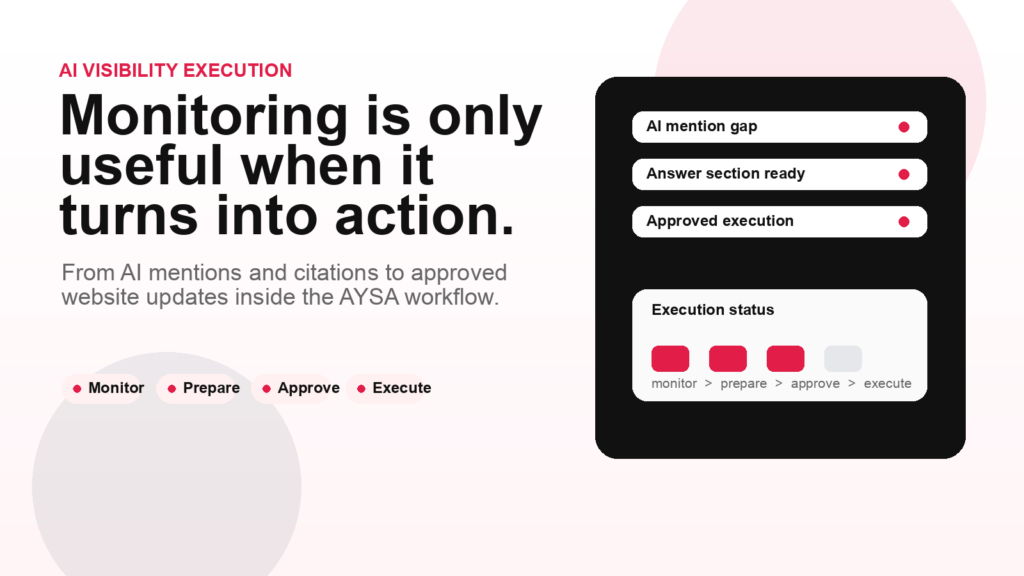
AI visibility monitoring is becoming a serious category because search is no longer limited to the classic list of blue links. Brands now want to know whether they appear in AI Overviews, ChatGPT, Perplexity, Gemini, Copilot and other answer engines. They want to know who gets cited, what competitors are mentioned, what sources are used, and whether their website is understandable enough to be included in synthesized answers.
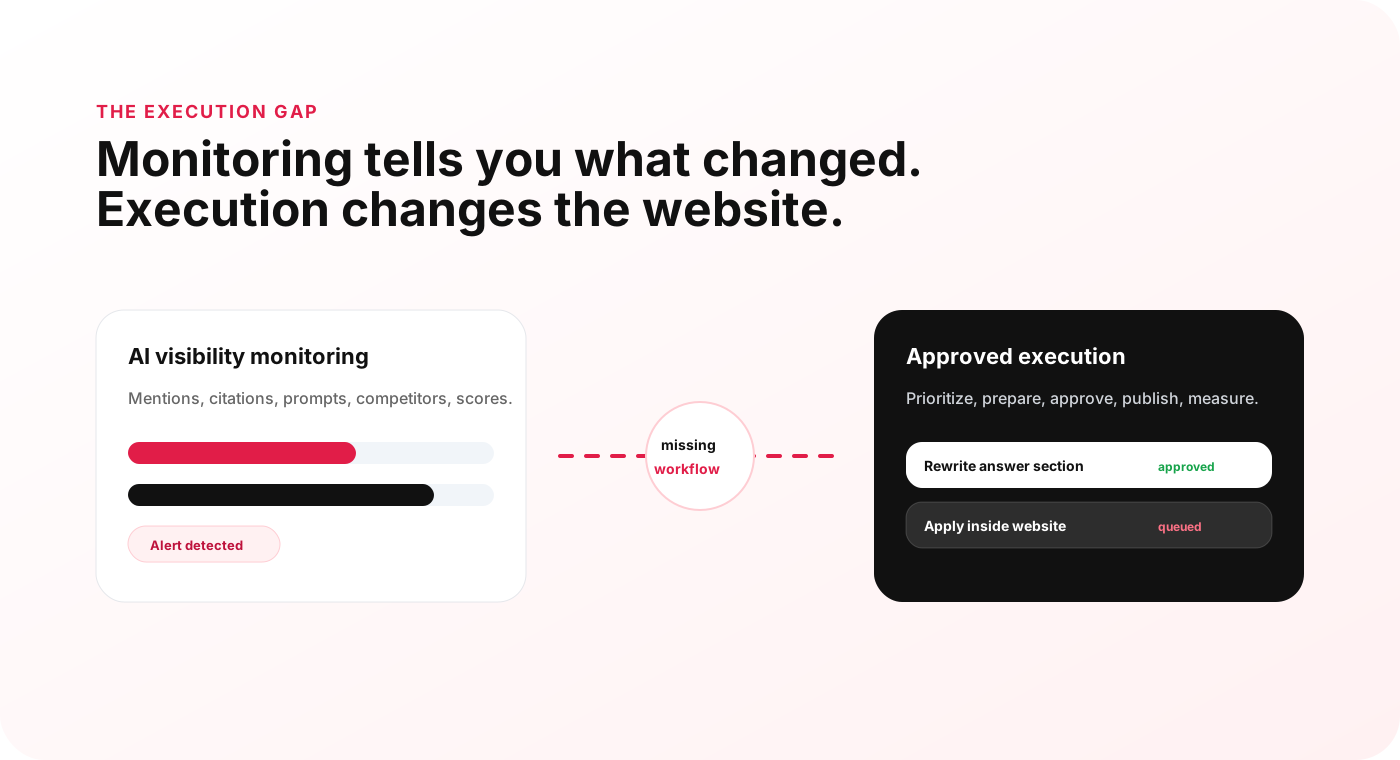
That Monitoring layer matters. But it is not enough. A dashboard can show that competitors are cited more often. It can show that your brand is missing from AI answers. It can show that a topic has weak coverage or that an Answer engine prefers third-party sources. But a dashboard does not rewrite the page, improve the entity signals, fix the internal links, update schema, build supporting content, strengthen authority or publish approved changes. That is the difference between AI visibility monitoring and AI visibility execution.
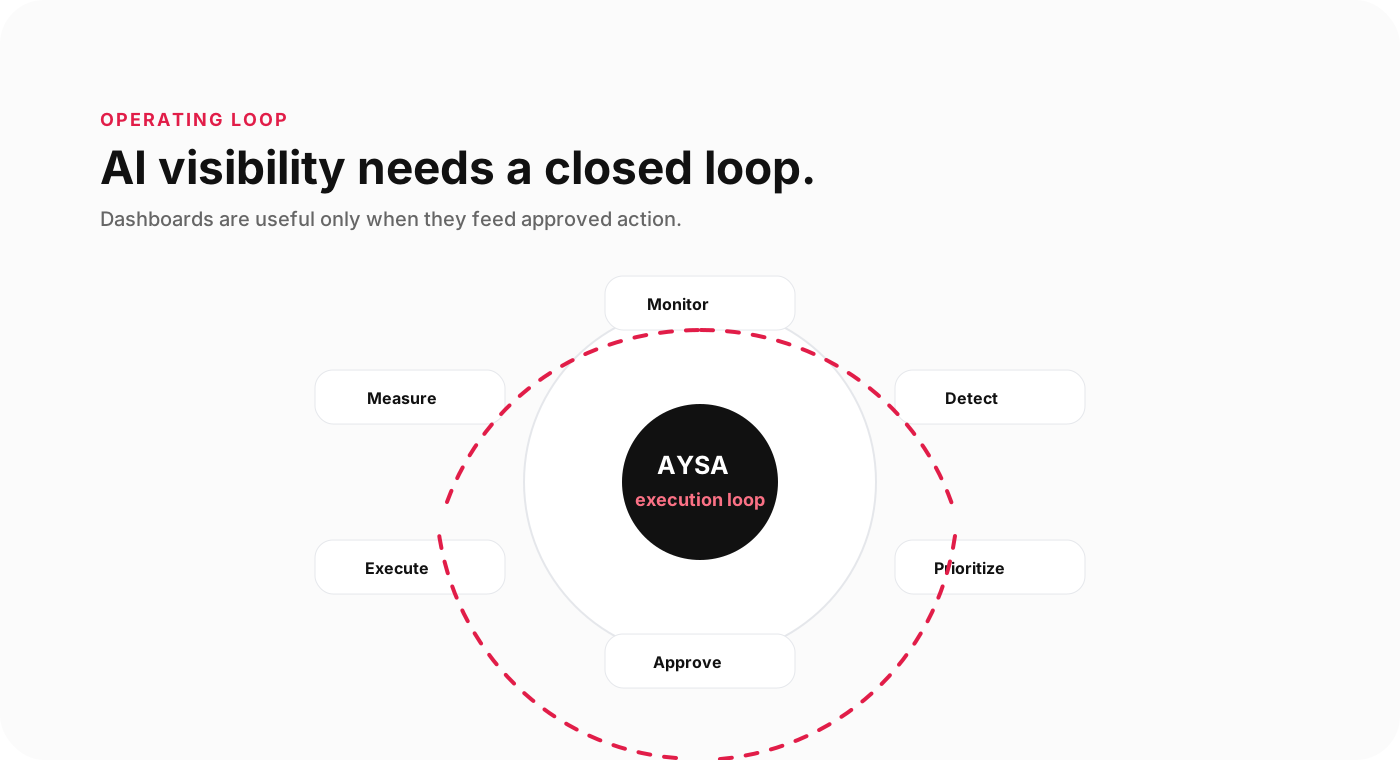
The Writesonic article on AI visibility monitoring versus execution is useful because it names an important tension in the market: businesses do not only need to observe AI Search. They need to act on what they learn. AYSA’s point of view goes even further: the winner will not be the company with the prettiest AI visibility report. The winner will be the company that turns visibility signals into a repeatable operating system: monitor, detect, prioritize, approve, execute and measure again.
What is AI visibility monitoring?
AI visibility monitoring is the process of tracking how a brand, website, product, service, person or topic appears across AI-assisted search experiences and answer engines. Depending on the platform, this can include prompts, generated answers, citations, source URLs, competitor mentions, answer sentiment, category coverage, country differences, model differences and topic gaps.
In classic SEO, visibility was often measured through rankings, impressions, clicks, click-through rate, Organic traffic, Share of Voice and conversions. In AI search, visibility can be more fragmented. A brand might be mentioned in an answer without receiving a click. A competitor might be cited as a source even when your website ranks well in traditional search. A publisher article might be used as evidence while your own service page is ignored. A model might summarize a category without naming any provider at all.
That is why monitoring is useful. It helps answer questions like:
- Does the brand appear when customers ask answer-style questions?
- Which competitors are mentioned more often?
- Which third-party sources are being cited?
- Do AI systems understand what the business does?
- Are important products, services, locations or use cases missing?
- Are AI answers accurate, incomplete or outdated?
- Are there topics where the business has content but no AI visibility?
These questions are strategically important. But they are diagnostic. They tell you what may be happening. They do not, by themselves, improve the website.
What is AI visibility execution?
AI visibility execution is the work that happens after monitoring. It is the process of turning AI visibility gaps into approved changes that improve the website, content, structure, authority and measurement system.
Execution may include:
- Rewriting pages so they answer important questions more clearly.
- Adding concise answer sections for AEO and AI search readiness.
- Improving topical coverage around important commercial themes.
- Strengthening internal links between related pages.
- Adding or correcting structured data where it matches visible content.
- Clarifying product, service, pricing, location, author and company information.
- Creating supporting articles, glossary pages or comparison pages.
- Improving crawlability, indexability and technical quality.
- Building authority through credible mentions and publisher opportunities.
- Updating Google Business Profile and local proof where relevant.
- Tracking the next cycle to see whether the action improved visibility.
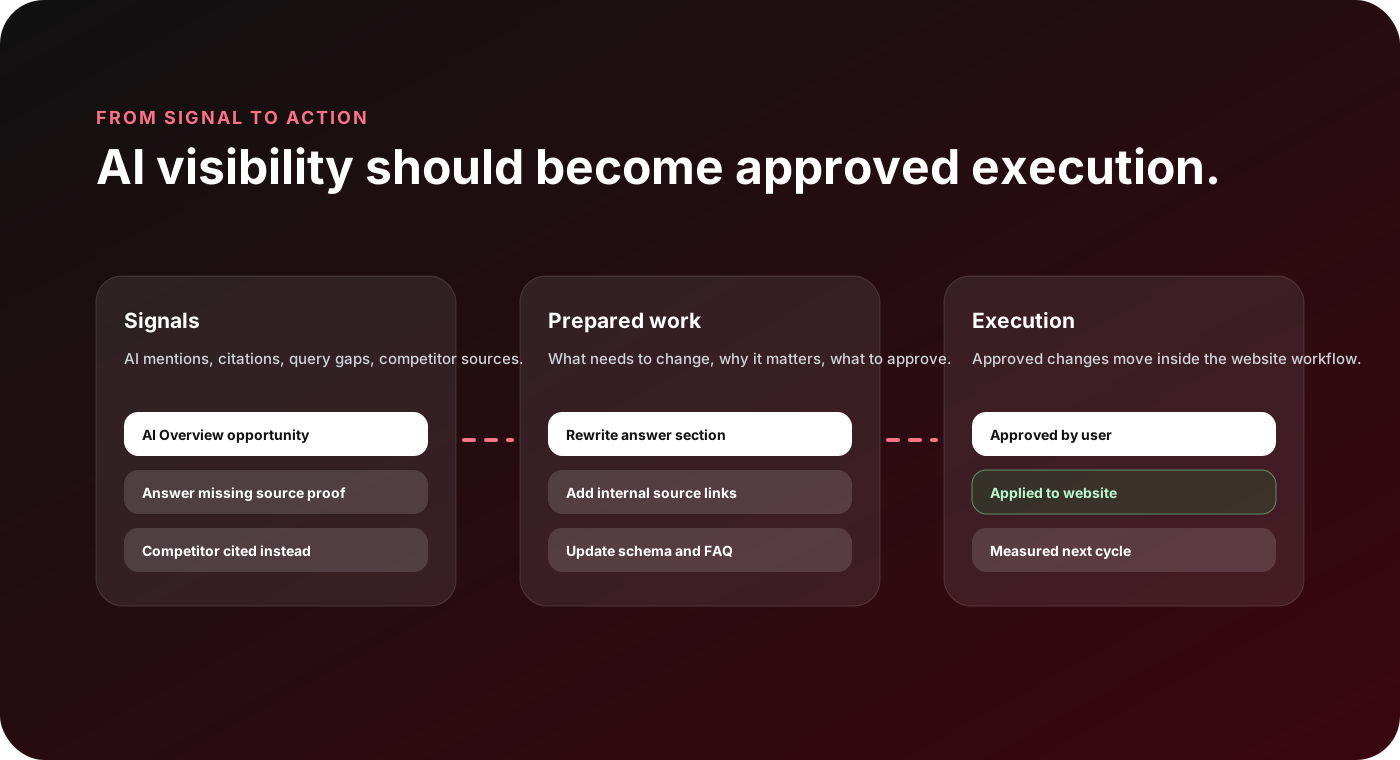
Execution is harder than monitoring because it requires judgment, prioritization, approval and implementation. It touches the website. It affects public content. It may involve compliance, brand voice, technical risk and business tradeoffs. That is why AYSA treats AI visibility as an approval-first workflow. The agent can prepare the work, explain the reason, ask for approval and execute accepted changes inside the website workflow.
Why dashboards are not enough
Dashboards are useful when they help a team make decisions. They become a problem when they create the illusion of progress. A business can monitor AI visibility every week and still not become more visible if nobody improves the website, content or authority signals.
This is not new. Classic SEO has had the same problem for years. Tools found crawl errors, missing titles, keyword gaps, broken links, slow pages and content opportunities. Reports were created. Screenshots were shared. Meetings happened. Then implementation stalled because nobody owned execution. AI visibility can easily repeat that pattern.
The AI search version of the problem looks like this:
- The dashboard says a competitor is cited more often.
- The team exports the report.
- Someone asks why the competitor is cited.
- Someone else says the website needs more authoritative content.
- A task is created.
- The task waits for copy, approval, developer help or CMS access.
- Nothing changes for weeks.
That workflow is too slow for AI search. The market is moving toward continuous monitoring and continuous improvement. AI visibility is not a quarterly research project. It is an operating rhythm.
How AI search changes visibility measurement
Google’s documentation for AI features says website owners do not need special markup or tags to be eligible for AI experiences; the same fundamentals apply: make content crawlable, indexable, helpful and eligible to appear in Google Search. That is a critical point. AI search does not replace SEO fundamentals. It increases the importance of clarity and usefulness.
OpenAI has also published documentation around search and crawler user agents. ChatGPT search and product discovery create another discovery surface where websites need to be accessible, understandable and useful. Bing, Google and other search systems continue to rely on crawling, indexing, content quality, links, structured information and user usefulness in different ways.
What changes is the output format. A classic search result often gives a title, URL and snippet. An AI answer may synthesize information, cite sources, mention brands, compare options or answer a question without producing a traditional ranking list. This means visibility is no longer only “position three for a keyword.” It may also be:
- Was the brand mentioned in the answer?
- Was the website cited as a source?
- Was a competitor selected instead?
- Did the answer understand the product correctly?
- Did the answer recommend the category but not the brand?
- Did the AI system use a third-party publisher instead of the company’s own website?
- Did the answer expose missing content, unclear pricing or weak proof?
Monitoring helps capture these signals. Execution determines whether the signals improve over time.
The three levels of AI visibility maturity
Most businesses will pass through three levels of maturity.
Level 1: no AI visibility awareness
The business still measures only rankings and traffic. It may have no idea whether AI systems understand the brand, cite the website or recommend competitors. This level is risky because customers may already be discovering information through AI-assisted experiences.
Level 2: monitoring without execution
The business starts tracking AI visibility. It sees mentions, citations, competitors and prompts. This is better, but the workflow is still incomplete if insights do not become approved content, technical, authority or website actions.
Level 3: monitoring plus approved execution
The business treats AI visibility as an operating system. Monitoring finds the gaps. The agent prepares work. The user approves important changes. The system executes accepted updates and records the action history. This is the level AYSA is built for.
What should be monitored?
AI visibility monitoring should not be random prompt checking. A useful monitoring system starts with business-relevant questions. What does the company need to be known for? Which products, services, locations, use cases and pain points matter commercially? Which competitors appear in the same buying journey?
Useful monitoring categories include:
- Brand mentions: whether the business is named in relevant AI answers.
- Source citations: whether the website or trusted third-party sources are cited.
- Competitor presence: which alternatives appear more often.
- Topic coverage: whether key services and use cases are represented.
- Answer accuracy: whether AI answers describe the business correctly.
- Entity clarity: whether the brand, founder, products, locations and ecosystem are understandable.
- Content gaps: missing pages or weak explanations that reduce answer readiness.
- Authority gaps: missing external proof, citations, reviews, media or publisher references.
- Technical eligibility: crawlability, indexability, performance, structured data and internal linking.
But every monitored signal should have a possible action. If a metric cannot influence what the business does next, it may be interesting but not operational.
What should be executed?
Execution should start with the highest-confidence opportunities. Not every missing AI mention requires a new page. Not every citation gap requires link building. Not every competitor mention means the competitor is better. The job is to interpret the signal and prepare the right action.
Here are examples of monitoring signals and execution responses:
| Monitoring signal | Likely issue | Execution response |
|---|---|---|
| Competitors are cited, but your brand is missing | Weak authority or unclear entity signals | Improve company/entity pages, add proof, strengthen topical coverage and authority references |
| AI answer mentions the category but not your product | Product page is not clear enough or lacks comparison/use-case content | Rewrite product sections, add direct answers, comparison content and internal links |
| Your website ranks, but is not cited | Page may be useful for SEO but weak as a source | Add clearer structure, facts, examples, author/company proof and source-worthy sections |
| AI answer uses outdated information | Old content, weak freshness or external sources with stale data | Update visible content, schema where appropriate, profile information and supporting pages |
| Local competitor appears more often | Reviews, local proof, GBP details or service-area clarity may be stronger | Improve local pages, review workflows, Google Business Profile and local authority |
Where AYSA fits
AYSA is built for the execution side of this problem. Monitoring matters, but the core product idea is that SEO, AEO, GEO and AI visibility should not end in a report. AYSA learns the business context, monitors opportunities, prepares actions, asks for approval and executes accepted changes inside the website workflow.
In practice, that means AYSA can help with AI visibility work such as:
- Finding pages that receive impressions but do not answer the query clearly enough.
- Detecting topics where the business lacks authority-building coverage.
- Preparing answer-ready sections and FAQs based on real search intent.
- Improving internal links between related glossary, guide and commercial pages.
- Suggesting schema improvements that match visible content.
- Flagging technical issues that limit crawlability or indexability.
- Preparing authority-building opportunities for approval.
- Turning accepted recommendations into website execution.
The important distinction is approval. AYSA is not blind autopilot. It is autonomous preparation and execution after approval. The user should not have to manually live inside dashboards, but the user should remain in control of important public-facing changes.
The wrong way to approach AI visibility
The wrong approach is to chase every AI surface as a separate tactic. A business does not need a random “ChatGPT page,” a random “AI Overview page” and a random “GEO checklist” disconnected from its website strategy. That creates more content noise.
The wrong approach is also to assume that AI visibility can be bought with a single tool. Monitoring tools can help. Content tools can help. Technical tools can help. But the business still needs a coherent execution system.
AI visibility work becomes weak when it is:
- Based on random prompts instead of business-relevant journeys.
- Disconnected from Search Console, analytics and website performance.
- Focused on mentions without improving the underlying content.
- Measured without a plan for execution.
- Handled as a one-time campaign instead of a continuous workflow.
- Done without approval controls for public-facing changes.
The right way to approach AI visibility
The right approach starts with SEO fundamentals and extends them into AI search. Make the website crawlable. Make important pages indexable. Make the business easy to understand. Make content useful. Make answers clear. Add proof. Build authority. Monitor outcomes. Then repeat.
A strong AI visibility operating system includes:
- Business context: products, services, audience, locations, competitors, tone and goals.
- Search data: Search Console, analytics, rankings, queries and existing performance.
- AI monitoring: prompts, mentions, citations, competitors and answer accuracy.
- Content execution: answer-ready sections, guides, comparisons, glossary and use-case pages.
- Technical execution: crawlability, indexability, performance, schema and internal links.
- Authority execution: reviews, publisher mentions, backlinks, citations and ecosystem proof.
- Approval workflow: the user reviews important changes before publication.
- Measurement: visibility, traffic, conversions, citations and action history.
This is where the future of SEO is heading. Less manual interpretation. More approved action. Less dashboard fatigue. More organic growth.
Practical checklist: from AI visibility monitoring to execution
If you already use an AI visibility monitoring tool, do not stop at the report. Use this checklist to convert findings into action.
- Group prompts by business intent. Separate informational, commercial, local, comparison and support journeys.
- Identify missing or weak mentions. Look for places where competitors appear and your brand does not.
- Check cited sources. Are they your pages, publishers, directories, reviews, forums or competitor websites?
- Map each gap to a page. Decide whether an existing page should be improved or a new page is justified.
- Prepare the work. Write the answer section, content update, FAQ, internal link, schema recommendation or technical fix.
- Review risk. Check brand tone, compliance, claims, medical/legal sensitivity and technical impact.
- Approve and execute. Publish accepted changes through the website workflow.
- Measure the next cycle. Track whether visibility, rankings, citations, clicks or conversions improve.
Why AI visibility is not a replacement for classic SEO
One of the biggest mistakes in the current market is treating AI visibility as if it replaces SEO. It does not. AI visibility depends heavily on the same foundation that made websites discoverable before AI answers became mainstream: crawl access, indexability, page quality, useful content, internal linking, authority, structured information and a clear relationship between query intent and page purpose.
If a website blocks crawlers, hides important information behind scripts, publishes thin pages, has weak internal links, duplicates the same content across many URLs or fails to explain the business clearly, AI visibility monitoring will mostly document the symptoms. It will not solve the underlying problem.
This is why execution needs to connect AI search with the full SEO stack. A visibility gap in ChatGPT, AI Overviews or another answer system may actually be caused by a traditional SEO problem:
- The important page is not indexable.
- The content is too vague to be used as a source.
- The page lacks examples, definitions, pricing, process details or proof.
- The site has no supporting cluster around the topic.
- The brand entity is unclear across the website and external sources.
- Competitors have stronger reviews, mentions, links or publisher coverage.
- The website has technical issues that reduce crawl efficiency or trust.
In other words, AI visibility is not a separate magic layer. It is a new way to observe whether search systems understand and trust the business. The execution response still happens through content, technical SEO, authority, internal linking, local proof and continuous improvement.
What makes a page more useful as an AI source?
There is no single checklist that guarantees citation in an AI answer. But pages that are clear, useful and source-worthy tend to share practical traits. They answer the main question directly. They explain context. They define terms. They show examples. They include real business details. They connect to related pages. They avoid exaggerated claims. They make authorship, company identity or product ownership understandable where it matters.
For a commercial website, this may mean adding information that many businesses hide or leave vague: who the product is for, what it does, what it does not do, what approval means, what platforms are supported, how pricing works, what happens after setup, what risks exist, what evidence supports the claim and what a customer should expect next.
For a local business, it may mean making locations, services, opening hours, service areas, reviews, appointment process, parking, accessibility, staff expertise and real customer questions easier to understand. For an ecommerce site, it may mean improving category content, product attributes, comparison pages, delivery information, return policies, availability, reviews and buying guides.
AI systems do not need marketing fog. They need extractable, accurate, well-structured information. Humans need the same thing. That is why the best AI visibility execution work often looks like excellent SEO and excellent user experience at the same time.
Why approval matters more in the AI search era
Execution speed matters, but uncontrolled automation is risky. AI visibility actions can affect public claims, medical or financial statements, pricing, legal language, product positioning and brand tone. A system that automatically publishes every recommendation can create a new class of problems: inaccurate claims, duplicated pages, thin content, compliance issues or content that sounds generic.
Approval-first execution solves this tension. The agent can do the heavy work: monitor signals, analyze patterns, prepare changes, explain why they matter and estimate impact. The human can review important public-facing actions before they go live. Once approved, the system can execute without manual copy-paste.
This is the operating model AYSA is built around. Businesses should not have to choose between slow manual SEO and reckless autopilot. The better model is autonomous preparation, human approval and automated execution after approval.
FAQ
What is AI visibility monitoring?
AI visibility monitoring tracks how a brand, website or topic appears in AI-assisted search experiences, including mentions, citations, competitors, prompt coverage and answer accuracy.
What is AI visibility execution?
AI visibility execution is the process of turning monitoring insights into approved website improvements such as content updates, technical fixes, internal links, structured data, authority actions and measurement workflows.
Can AI visibility tools guarantee AI Overview inclusion?
No. No responsible tool can guarantee inclusion in Google AI Overviews, ChatGPT answers or answer engines. The goal is to improve eligibility, clarity, usefulness, authority and monitoring.
Is AI visibility separate from SEO?
No. AI visibility extends SEO. Crawlability, indexability, helpful content, page quality, internal links, authority and technical health still matter. AI search adds new surfaces and new measurement needs.
How does AYSA help?
AYSA monitors SEO and AI visibility signals, prepares approval-ready actions and executes accepted changes inside the website workflow. It is designed for businesses that want execution, not only reports.
The AYSA point of view
AI visibility monitoring is a valuable starting point, but the market will move quickly from observation to execution. Businesses do not need another dashboard that tells them they are behind. They need a system that prepares the work, explains the tradeoff, asks for approval and gets accepted changes live.
That is the practical difference between an AI visibility report and an AI visibility operating system. The first shows the gap. The second closes it.
Sources and further reading
- Writesonic: AI Visibility Monitoring vs Execution
- Google Search Central: AI features and your website
- Google Search Central: Creating helpful, reliable, people-first content
- Search Engine Land: How ChatGPT search ranks products and merchants
- OpenAI Platform Docs: Bots and crawler user agents
- Bing Webmaster Guidelines
Continue the AI search topic inside AYSA.
Use these pages to connect the article with AI SEO tools, AI visibility monitoring, AI Overviews and approved website execution.
Turn this topic into a website action plan.
Use these AYSA hubs to move from reading to technical fixes, AI visibility monitoring, research, glossary context and approval-first SEO execution.

