Publishers Are Blocking AI Crawlers By Default: What It Changes For Search, Content, And Your Growth Strategy
Reuters and Time are now blocking AI bots by default and only allowing approved crawlers via allowlists. That shift isn’t just a publisher-vs-AI fight—it changes how discovery, citations, and traffic will work in AI search. Here’s what it means for SMEs, agencies, and the next era of SEO/AEO/GEO—plus a practical action plan you can execute.

Publishers have spent the last year playing defense against AI scraping with the same toolset the web has relied on for decades: robots rules and blocklists. That era is ending. Reuters and Time have reportedly moved to a default-deny posture—blocking AI bots by default and allowing only approved crawlers through allowlists—joining other major publishers experimenting with the same approach.
This is not just a media-industry storyline. It’s a structural change to how information flows into AI systems and, downstream, how customers discover brands. If the web becomes “permissioned” for AI Crawling, the winners won’t be decided by who publishes the most content. They’ll be decided by who is allowed to be ingested, cited, and surfaced—plus who can still earn discovery through alternative inputs (Structured data, first-party feeds, partnerships, APIs, and direct audience).
I’m writing this from the perspective of building AYSA.ai: an execution system for SEO/AEO/GEO where the difference between strategy and results is whether changes actually get implemented—safely, consistently, and with approvals. In a default-deny world, execution details (robots rules, headers, CDN/WAF settings, bot policies, and content packaging) stop being “Technical SEO chores” and become business development levers.
Concise Summary

- What changed: Large publishers are shifting from blocklists (deny known bots) to allowlists (allow only approved bots), making access a negotiation rather than an assumption.
- Why it matters: AI discovery depends on what models and AI Search tools can crawl, index, and cite. Reduced access reshapes what sources show up in AI answers.
- What businesses should do: Build “AI-ready” visibility inputs you control (structured data, on-site Entity Clarity, citations, feeds, partnerships), monitor bot activity, and align content strategy to new distribution realities.
- Where AYSA fits: AYSA monitors changes, prepares fixes and optimizations, requests approval, and executes accepted website changes—exactly what’s needed when technical policies and visibility inputs require continuous iteration.
Table of Contents
- What Changed: From “Robots.txt Requests” To “Default-Deny” Enforcement
- Why This Is Happening Now (And Why It’s Accelerating)
- Why Robots.txt Blocklists Weren’t Enough (And Why That’s Not A Small Detail)
- How Publishers Decide Which Bots To Allow
- How Blocking Changes AI Search: Discovery, Citations, And Traffic
- A Concrete SME Scenario: The Clinic, The Ecommerce Store, And The “Invisible In AI Answers” Problem
- What Agencies Must Rethink: From Rankings To Distribution Engineering
- The Technical Reality: Where Default-Deny Usually Gets Enforced
- What Can Go Wrong (And The Risk Of “Accidental Invisibility”)
- Action Plan: How To Prepare For A More Permissioned Web
- Where AYSA.ai Fits: Monitoring + Approved Execution For AI Search Readiness
- What To Do Next
- Sources And Further Reading
What Changed: From “Robots.txt Requests” To “Default-Deny” Enforcement

According to reporting summarized by Search Engine Journal, Reuters and Time are now blocking AI bots by default and allowing only approved crawlers via allowlists, a pattern also seen at other publishers over the past year. The key strategic move is not “blocking one bot.” It’s changing the default posture.
Historically, the web’s crawler relationship worked like this:
- Default-allow: Bots can crawl unless you explicitly tell them not to (usually via robots rules).
- Default-deny: Bots cannot crawl unless you explicitly allow them (via allowlists or other enforcement).
This matters because default-allow scales with the number of bots you know exist. Default-deny scales with the number of bots you trust.
That reversal is the real story. It turns “crawling” into an explicit permissioned relationship and makes the value exchange visible: What do we get if we let you in?
Why This Is Happening Now (And Why It’s Accelerating)
Three forces are converging:
1) AI shifted the economics of scraping
Traditional search crawling had a clear implicit bargain: search engines crawl, index, and send traffic back. Publishers might dislike parts of the arrangement, but the loop was legible—crawl → index → click → ads/subscriptions.
AI training and AI answers complicate the loop. If a user gets a synthesized answer without clicking through, the “send traffic back” component weakens. That creates a rational incentive for publishers to put up friction and demand licensing or other compensation.
2) Bot volume and bot fragmentation are exploding
In the SEJ summary, a publisher example indicates an allowlist approach massively expanded the number of blocked user agents compared to a traditional blocklist approach. Even without relying on exact numbers for your own situation, the operational takeaway is clear: new user agents appear constantly, and many don’t behave like well-known search crawlers.
If you’re a small business, this might sound distant. It’s not. Bot traffic hits your hosting costs, can degrade performance, and can create analytics noise that hides real customer behavior.
3) The industry is moving toward standards and coalitions
Publishers don’t just want to block. They want leverage. SEJ’s summary mentions the SPUR Coalition building shared standards for licensing and content use. Whether any single standard “wins” is less important than the direction: publishers coordinating and normalizing permissioned access.
Once permissioned access becomes normal for major sources, AI vendors can’t treat the open web as an unlimited buffet. They need deals, exemptions, or alternative data pipelines.
Why Robots.txt Blocklists Weren’t Enough (And Why That’s Not A Small Detail)
Robots rules were built for a cooperative ecosystem. They are advisory in practice: they work when crawlers choose to comply.
SEJ’s summary, referencing Digiday and a Tollbit report, highlights that a meaningful share of AI bot scrapes reportedly did not comply with explicit robots permissions. You don’t need to debate the exact percentage to accept the operational truth: non-compliant crawling exists, and the incentive to ignore advisory rules increases when the data is valuable.
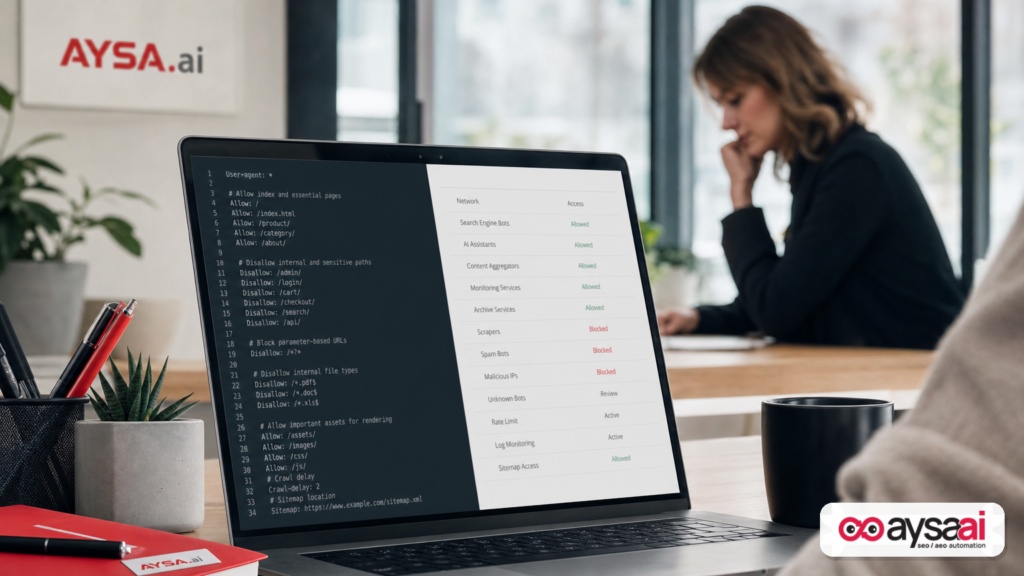
This is why default-deny is attractive to publishers. It moves enforcement to systems where “choosing to comply” is not an option—CDNs, WAFs, rate limits, authentication, and IP reputation systems.
Business translation: robots rules are like a “Please don’t enter” sign. Default-deny is a locked door.
How Publishers Decide Which Bots To Allow
In the SEJ summary of the Reuters approach, approval is tied to a “fair value exchange.” The idea is not complicated: if crawling creates value extraction, access should require value return.
From the summary, the value can come in several forms:
- Licensing: payment or contractual permission for content usage.
- Traffic return: referrals that meaningfully benefit the publisher.
- Operational support: behaviors that don’t overload infrastructure.
- Monetization support: preserving the publisher’s ability to monetize content (rather than replacing it).
Notice what’s missing: “We’ll just take it because we can.” That is the posture shift.
Also notice what’s implied: different bots will be treated differently. A bot that behaves like a classic search crawler and sends referrals may be approved. A bot that primarily collects content for training or answer generation may be denied unless it comes with licensing terms.
How Blocking Changes AI Search: Discovery, Citations, And Traffic
Let’s separate what we know from what we should infer carefully.
What we can say confidently
- If a system cannot crawl or access content, it’s harder for that content to become part of that system’s outputs.
- Allowlisting creates an explicit gate: some AI tools will have access, others won’t.
- As more large sources gate access, AI companies will rely more on licensed sources, partnerships, or alternative accessible sources.
What likely changes in the real world
1) Citations become more political and contractual. In AI answers, citations are not only an “algorithmic” decision; they can become the side effect of which sources are accessible and licensed.
2) The open-web advantage shifts to what remains open. If premium publishers close the door, the systems still need somewhere to pull from. That can elevate other sources—niche experts, vendor documentation, community forums, government sites, open-access knowledge bases, and SMEs who publish exceptionally clear, structured information.
3) Your brand may be summarized without your latest content. If a model or AI search tool can’t access updated pages, it may rely on older cached knowledge, third-party mentions, or incomplete profiles. This is a recipe for “almost correct” answers—wrong hours, outdated product terms, incorrect eligibility rules, etc.
4) SEO becomes broader than Google SERPs. The SEJ page itself links to other SEJ coverage around AI Overviews and the shift from search to discovery. You don’t need to accept every hot take to see the direction: customers are increasingly getting answers in interfaces that don’t behave like 10 blue links.
That’s where AEO (Answer Engine Optimization) and GEO (Generative Engine Optimization) move from buzzwords to budgeting decisions.
A Concrete SME Scenario: The Clinic, The Ecommerce Store, And The “Invisible In AI Answers” Problem
Let’s make this tangible with two realistic SME examples.
Scenario A: A local clinic
A dental clinic has always relied on two things:
- Local SEO basics (Google Business Profile, reviews, consistent NAP citations)
- A handful of service pages that rank for “emergency dentist” and “teeth whitening”
Now patients start asking AI tools: “What’s the best emergency dentist near me open after 6pm?”
If AI answers pull from sources the system can access and trust—and if certain publisher sources are no longer accessible—then the AI might rely more on:
- Directory data
- Old third-party blog posts
- Outdated hours on a scraped profile
- Review snippets without context
The clinic didn’t “lose rankings.” It lost control of its inputs. The fix isn’t only content. It’s making sure the clinic’s primary source of truth is machine-readable and consistent across the web.
Scenario B: An ecommerce store
An ecommerce brand sells specialty running gear. The SEO playbook used to be:
- Publish content targeting product comparisons
- Earn links from reviewers
- Win category rankings
In AI search, the purchase journey can compress: “best stability shoes for overpronation under $150” becomes a synthesized shortlist. If AI crawlers can’t access certain review sites, the AI may overweight sources it can access—manufacturer pages, marketplace listings, forums, and whatever is licensed.
The ecommerce brand’s response should include:
- Structured product data
- Clear comparative content on-site (not fluff)
- Independent mentions in accessible, reputable places
- A monitoring system for how the brand is represented in AI answers
This is not “do more content.” It’s “package your truth so machines can reliably reuse it—ethically and accurately.”
What Agencies Must Rethink: From Rankings To Distribution Engineering
Agencies are about to face an uncomfortable question from clients:
“If customers get answers without clicking, what exactly are we buying from you?”
Default-deny crawling makes that question sharper because it changes the inventory of what AI systems can see. Agencies will need to broaden deliverables from “rankings and traffic” into a more resilient set of outcomes:
- Entity clarity: who you are, what you sell, where you operate, and what you’re known for—expressed consistently.
- Machine-readable truth: structured data, clean information architecture, canonical discipline, and feed readiness.
- Distribution diversification: not only Google, but also citations, partner pages, industry associations, directories, and platforms that remain accessible and reputable.
- Measurement upgrades: monitoring brand presence in AI surfaces (where possible) and tying it back to leads, calls, and sales rather than vanity impressions.
Most importantly, agencies must upgrade execution. In a permissioned web, small configuration mistakes can be catastrophic (blocking the wrong bot, breaking rendering, disallowing key paths). If your agency strategy depends on a dev queue that moves once a month, you’re exposed.
The Technical Reality: Where Default-Deny Usually Gets Enforced
When people hear “blocking bots,” they often think only of robots rules. But default-deny setups typically involve a layered stack. Without claiming any specific publisher’s exact architecture, here are common enforcement layers businesses should understand:
1) Robots rules (advisory layer)
Still important because compliant crawlers respect it, and because it communicates intent. But it’s not enforcement by itself.
2) CDN / WAF bot management (enforcement layer)
Where you can block by user agent patterns, IP ranges, reputation scores, rate limits, geography, and behavioral signals. This is where “locked door” happens.
3) Server-side rate limiting and caching policy
Protects origin infrastructure from spikes, including bot spikes.
4) Authentication, paywalls, and tokened access
Hard gating that requires a credentialed relationship—often aligned with licensing.
SME translation: you don’t need to become a security engineer, but you do need to treat bot policy as a business policy with technical consequences.
What Can Go Wrong (And The Risk Of “Accidental Invisibility”)
Whenever the market changes, the biggest risks aren’t always the obvious ones. For many businesses, the danger isn’t “AI stole our content.” It’s “we unintentionally disappeared.”
Common failure modes
- Blocking legitimate search crawlers by mistake: Over-aggressive bot rules can reduce traditional search visibility and referrals.
- Breaking rendering for crawlers: JavaScript-heavy sites sometimes require careful handling so key content is accessible and indexable.
- Inconsistent canonical and duplication signals: AI systems and search engines struggle when multiple URLs claim to be the same page but differ slightly.
- Over-reliance on one channel: If your discovery depends on a single “gatekeeper” and the gatekeeper’s inputs shift, your pipeline becomes fragile.
- Wrong incentives in content strategy: Publishing “SEO content” that isn’t actually useful is already failing; AI answers make it fail faster.
The operational theme: you need monitoring and change control. Not one-time audits.
Action Plan: How To Prepare For A More Permissioned Web
Here’s a practical plan you can run whether you’re an SME, an in-house team, or an agency. The goal is not to “outsmart AI crawlers.” The goal is to stay discoverable, accurate, and competitive as access models shift.
Step 1: Define your “AI visibility inputs” (what machines should learn from)
Make a list of the sources you control and the sources you influence:
- Your website (core pages, FAQs, policies, documentation)
- Structured data (where relevant)
- First-party feeds or catalogs (for ecommerce)
- Business listings and citations (for local)
- Partner pages and association listings
If you’re unsure where to start, use a framework like “entity + offerings + proof + policies”: clearly define who you are, what you offer, evidence you’re credible, and the rules (pricing, shipping, returns, service area, availability).
Step 2: Audit your crawl controls (robots rules, headers, and edge policies)
Even if you don’t plan to block anything, you should understand what’s currently happening:
- Do you have robots rules that accidentally block important sections?
- Are there conflicting directives between robots rules and meta robots tags?
- Are you using a CDN/WAF with bot rules that could block legitimate crawlers?
This is where a system approach matters. It’s easy to “set and forget” something that later becomes a growth ceiling.
Step 3: Build content that’s citation-friendly, not just keyword-friendly
In AI answers, content tends to be reused when it’s:
- Specific and structured (clear headings, definitions, lists, steps)
- Consistent (no contradictions across pages)
- Verifiable (policies, specs, references, transparent authorship)
- Updated (freshness matters most for time-sensitive info)
For SMEs, the high ROI move is often building a small set of “truth pages” that remove ambiguity: pricing explainer, service area, compatibility charts, eligibility requirements, safety notes, and a well-maintained FAQ.
Step 4: Strengthen off-site corroboration
If premium publishers block broad crawling, AI systems may lean more on whatever reputable sources remain accessible. That makes third-party corroboration more valuable:
- Industry directories and associations
- Supplier/manufacturer partner lists
- Local chamber/municipal listings (for local businesses)
- Transparent review ecosystems
This isn’t old-school link spam. It’s building a consistent footprint of facts that different systems can cross-check.
Step 5: Monitor how your brand is represented in AI and search
You can’t manage what you don’t monitor. Track:
- Critical commercial queries (the questions that lead to revenue)
- Whether your site is being cited or referenced (where visible)
- Changes in branded search behavior and lead sources
- Bot traffic patterns and performance impacts
Monitoring should lead to execution—not dashboards that no one acts on.
Step 6: Create a governance process for changes
Default-deny is a governance story. Even if you never adopt allowlisting, the market is moving toward explicit policies. You need a lightweight but real process:
- Who can change robots rules?
- Who can change CDN/WAF bot rules?
- What’s the approval path?
- How do you roll back safely?
For SMEs, the right answer is often “we need a system that prepares changes and asks for approval,” not “we need to hire three more people.”
Where AYSA.ai Fits: Monitoring + Approved Execution For AI Search Readiness
At AYSA.ai, we think the next era of search rewards businesses that can execute continuously, not businesses that write the longest strategy deck.
Here’s how AYSA fits this shift—without magic claims:
- Monitoring: Keep watch on the signals that matter (technical health, visibility inputs, and changes that can affect discoverability). See: AYSA Monitoring.
- Preparation: Identify and prepare website changes that improve search and AI readiness (structured improvements, clarity, technical fixes).
- Approved execution: AYSA asks for approval before changes go live, then executes accepted updates—reducing the “strategy-to-implementation gap.”
- AI search visibility focus: The goal is not only rankings; it’s being present and accurate where people actually discover brands. See: AI Search Visibility.
If you want the practical toolset perspective, start here: AYSA AI SEO Tools. If you’re evaluating fit and cost for an SME or agency, see: Pricing. And for more implementation-heavy editorials, browse: AYSA Blog.
The big idea: as crawling becomes negotiated, the businesses that win will treat technical controls and information packaging as core revenue infrastructure. AYSA is built to operationalize that—monitor, propose, approve, execute—without waiting for quarterly rebuilds.
What To Do Next
- Inventory your truth sources: List the pages and datasets that should define your business in AI answers (services, pricing rules, locations, policies, product specs).
- Audit your access controls: Review robots rules, meta robots, and any CDN/WAF bot settings so you don’t block what you need.
- Upgrade to citation-ready content: Build a small library of pages that answer high-intent questions with clarity and structure.
- Improve corroboration: Strengthen reputable third-party references (associations, partners, directories) that validate your facts.
- Set monitoring + execution cadence: Weekly monitoring, monthly improvements, and immediate response for critical issues.
- Operationalize it: Use a system like AYSA to prepare changes, get approvals, and execute continuously: Monitoring + AI search visibility.
Sources And Further Reading
- Search Engine Journal: More News Sites Default To Blocking AI Crawlers (primary source for this editorial’s news context)
- Search Engine Journal: Latest News (ongoing coverage context)
- Search Engine Journal: SEO coverage (broader SEO context referenced in the source page navigation)
- AYSA.ai: AI Search Visibility
- AYSA.ai: AI SEO Tools
- AYSA.ai: Monitoring
- AYSA.ai: Pricing
- AYSA.ai: Blog
Note: The SEJ source references reporting by Digiday and mentions other organizations and documents (e.g., crawler documentation and UK conduct requirements). Those primary documents are not included in the supplied research context, so I’ve intentionally avoided making claims that would require direct verification beyond the SEJ summary.
Continue the AI search topic inside AYSA.
Use these pages to connect the article with AI SEO tools, AI visibility monitoring, AI Overviews and approved website execution.
Turn this topic into a website action plan.
Use these AYSA hubs to move from reading to technical fixes, AI visibility monitoring, research, glossary context and approval-first SEO execution.