AI Overviews Are Now Showing Up on Brand Searches: What That Means for Your Reputation, Revenue, and SEO Execution
AI Overviews are increasingly appearing on brand-name searches, changing how customers learn about you before they ever click. Here’s what’s happening, what can go wrong, what to monitor, and how to build an execution system that improves your odds of being cited and chosen.

Brand search used to be the safest corner of SEO. Someone typed your company name, Google showed your homepage, maybe your social profiles, and you could predict the story customers would see.
That era is fading. As Search Engine Journal reported, third-party tracking suggests Google’s AI Overviews are now appearing on a large share of brand-name searches, including many household-name brands. The exact percentages vary by dataset and methodology—but the direction is clear: the “AI summary layer” is increasingly sitting on top of the results page for queries that used to be dominated by the brand itself.
From my perspective at AYSA.ai, this isn’t just an SEO story. It’s a reputation, conversion, and operational execution story. The core risk is simple: even if you rank #1 for your brand, customers may form their first impression from an AI-generated answer that cites sources you don’t control.
This editorial is designed for founders, marketers, and agency leads who need a practical plan: what changed, why it matters, what to monitor, what to fix on your site and across your brand ecosystem, and how to create a repeatable system that turns “AI Overview anxiety” into measurable action.
Concise summary
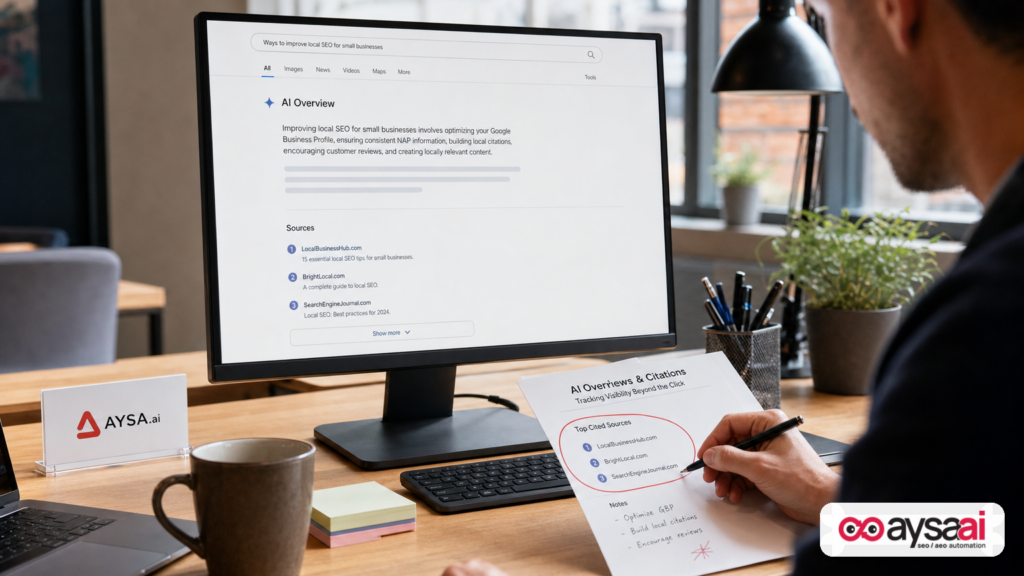
- AI Overviews are increasingly present on brand-name searches, often near the top of the page, based on third-party tracking shared by Ahrefs and others (via SEJ).
- Brand SERPs are no longer fully brand-controlled: AI summaries can cite Wikipedia, YouTube, LinkedIn, finance portals, marketplaces, and other sources—sometimes more prominently than your own site.
- The immediate job is operational: monitor what the AI says about your brand, which sources it cites, and whether it links to you. Then systematically improve the inputs the model pulls from.
- Search Console and GA4 help—but have blind spots. Google’s branded query filtering and AI performance reporting are useful but don’t answer every “why did this change?” question.
- Winning here is execution: accurate brand facts, strong entity signals, clean Site architecture, and content that answers questions clearly. AYSA helps by Monitoring, preparing changes, requesting approval, and executing accepted updates.
Table of contents
- What changed: AI Overviews are increasingly present on brand-name searches
- Why this is happening now (and why it’s not just “another SERP feature”)
- The new risk: external sources can shape your brand story
- What the tracking data suggests—and what it does not prove
- How this changes customer behavior (even if your rankings don’t move)
- What to monitor weekly (minimum viable brand-AIO monitoring)
- Fix the inputs: the “brand answer surface area” checklist
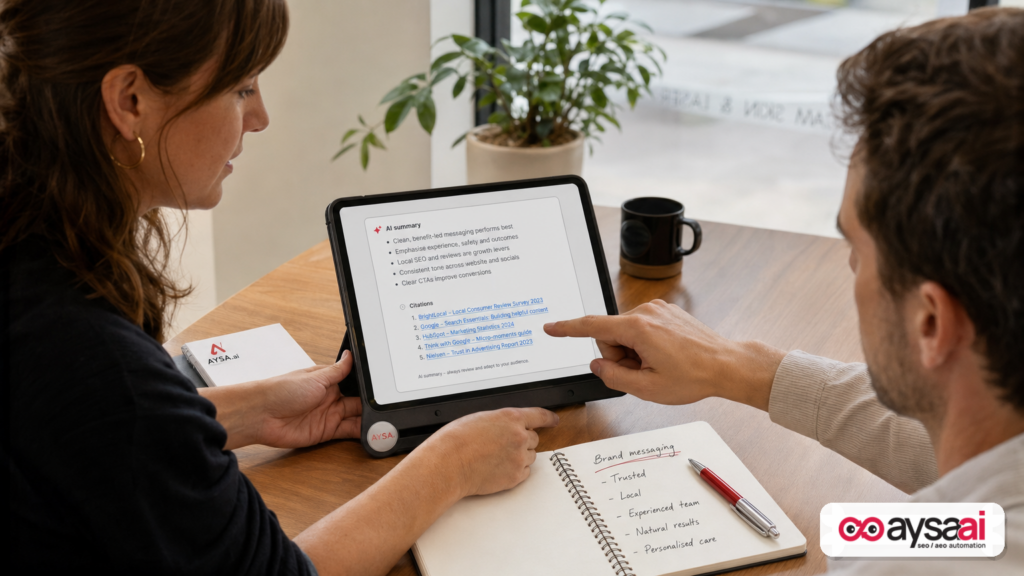
- Content that gets cited: clarity, corroboration, and quotable blocks
- Technical foundations that influence AI summaries (without magic thinking)
- Measurement: what Search Console and GA4 can (and can’t) tell you
- A concrete SME scenario: a clinic that loses calls without losing rank
- What agencies should rethink: reporting, deliverables, and governance
- Where AYSA fits: from monitoring to approved execution
- What to do next
- Sources and further reading
What changed: AI Overviews are increasingly present on brand-name searches
Historically, brand-name queries were among the most stable in search. Even when Google tested new layouts, a brand SERP (search results page) generally behaved like a navigational query: “I want that company.”
But AI Overviews change the “first thing seen” dynamic. Instead of a list of links, users increasingly see an AI-generated summary card that attempts to answer “who is this brand?” or “what does this company do?” before the user Clicks anything.
According to the reporting summarized by Search Engine Journal, Ahrefs tracked exact brand-name searches for a panel of global brands over time and saw AI Overviews expand from a small minority to a majority by late September 2026. Other trackers (DemandSphere and independent scraping shared by Chris Long) reported similarly high prevalence for branded terms, though their sampling methods differed.
Even if you assume every dataset is imperfect (it is), the practical takeaway holds: your brand query is increasingly an AI-mediated experience.
Why this is happening now (and why it’s not just “another SERP feature”)
Every era of SEO has had a “SERP displacement” event—something that changes what users see before they click:
- Featured snippets and People Also Ask expanded Google’s answer-first interface.
- Local packs and maps changed service discovery and lead flow.
- Shopping units compressed ecommerce clicks.
AI Overviews are different for two reasons:
- They synthesize language. Instead of choosing a single source, Google generates a narrative. Narrative is powerful—and dangerous when it’s wrong, outdated, or missing nuance.
- They formalize citations. The answer may cite several sources. That creates a new competition: not only “rank #1,” but “be among the sources the AI uses to describe the brand.”
In other words, the job is shifting from classic SEO (rankings) toward a mix of AEO (Answer Engine Optimization) and GEO (Generative Engine Optimization): influence the generated answer and the citations that underpin it.
If you’re an SME, you don’t need to memorize the acronyms. You need a system that ensures your brand facts are consistent, your best pages are understandable, and your most authoritative profiles are accurate.
The new risk: external sources can shape your brand story
One line from the SEJ write-up captures the emotional reality brand teams are now feeling: the idea that external sources can control the narrative of your brand directly in the search results.
Let’s translate that into business outcomes:
- Reputation risk: The AI summary may repeat outdated controversies, misstate your founding date, mischaracterize your pricing model, or incorrectly describe your services.
- Conversion risk: If the summary answers the question in a way that reduces intent (“They’re expensive,” “They’re enterprise only,” “They’re headquartered in X”), users may never click.
- Compliance risk: Regulated industries (health, finance, legal) can’t afford wrong claims being amplified—even if you didn’t write them.
- Competitive positioning risk: Even if direct competitor mentions are rare, category framing matters. If the AI positions you as “like X,” it can pull you into comparisons you didn’t choose.
In the SEJ summary of the Ahrefs panel, the most frequently cited external domains included Wikipedia, YouTube, and LinkedIn—platforms where some assets may be brand-controlled, but many are not. That is the new playing field: your website is necessary, but it is not sufficient.
What the tracking data suggests—and what it does not prove
It’s tempting to read a single headline number and declare “brand SEO is dead” or “AI Overviews are everywhere.” That’s not responsible.
Here’s what the SEJ reporting (based on Ahrefs plus other trackers) does suggest:
- AI Overviews are appearing on a growing share of branded queries, including exact brand names.
- When present, they often appear near the top of the page (high visibility), though “position” definitions vary by dataset.
- Citations frequently come from major reference and platform domains, not just brand websites.
Here’s what it does not prove (and what you should be skeptical about):
- Click impact: Presence doesn’t automatically equal lost clicks. Some users will still click; others may click more because the AI summary builds trust.
- Causality: If your branded clicks change, you can’t automatically blame AI Overviews without deeper analysis.
- Ownership of citations: A citation from YouTube or LinkedIn might be your official channel—or someone else’s content. Aggregate domain counts can’t tell that story.
- User-level frequency: Vendor crawls are snapshots of results pages, not a direct measurement of how often real users saw that exact layout.
The right posture is: assume branded AI summaries will be common enough to matter, and treat measurement as a diagnostic process—not a single KPI.
How this changes customer behavior (even if your rankings don’t move)
If you’ve ever looked at a heatmap of a SERP, you know the top of the page is everything. AI Overviews move the “trust-building” moment above the fold.
For brand queries, user intent often falls into four buckets:
- Navigational: “Take me to the website.”
- Validation: “Are they legit? What do they do? Are they a fit for me?”
- Comparison: “How do they compare to alternatives?”
- Support: “How do I contact them? return policy? login?”
AI Overviews disproportionately affect the middle two buckets (validation and comparison) by summarizing who you are before the click. That changes the funnel:
- Fewer exploratory clicks (users decide faster without visiting your site).
- Higher-quality clicks (users who do click are pre-qualified).
- Different landing pages (if the AI cites a third-party page or a subpage, that may become the “first touch”).
This is why brand SEO is now tightly coupled with brand communications. You’re not just optimizing a page; you’re optimizing what the market believes is true about you.
What to monitor weekly (minimum viable brand-AIO monitoring)
Most SMEs and even many mid-market brands don’t need an enterprise-level SERP observatory. They need a simple, repeatable monitoring cadence.
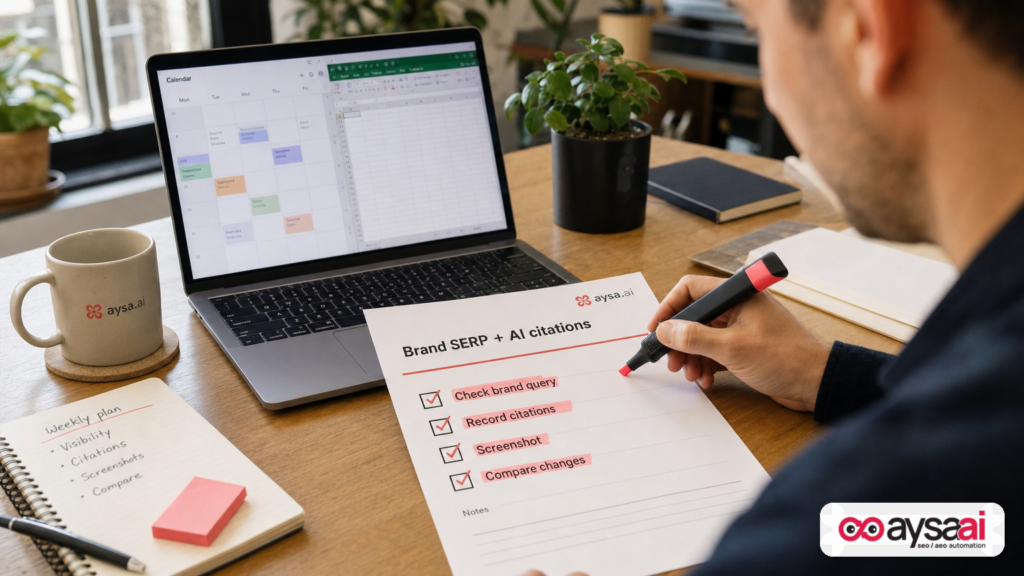
The weekly brand-AIO checklist (30–60 minutes)
- Search your exact brand name (and common misspellings) in a consistent environment. Use a logged-out browser profile if possible.
- Record whether an AI Overview appears and where it sits visually (top of page vs lower).
- Capture a dated screenshot of the overview and the citations area.
- List the citations (domains + specific URLs, if visible).
- Grade accuracy: mark statements as correct, incomplete, outdated, or wrong.
- Identify “fix targets” (which cited pages should be updated, replaced, or counterbalanced).
- Log changes week over week (what changed in wording, what sources appeared/disappeared).
Do the same for:
- Brand + “pricing”
- Brand + “reviews”
- Brand + your flagship service/product
- Brand + “contact” / “support”
This is also where AYSA’s Monitoring approach fits naturally: you can’t manage what you don’t consistently observe. The operational goal is to turn SERP volatility into a queue of approved actions.
Fix the inputs: the “brand answer surface area” checklist
When an AI Overview summarizes your brand, it’s rarely “reading your homepage like a human.” It’s synthesizing signals from multiple places. So you need to expand your mindset from “optimize the site” to “optimize the brand answer surface area.”
Here’s the checklist I use to structure that work.
1) Your website’s brand facts must be explicit
Many sites bury key facts in marketing language. AI systems prefer clear, corroboratable statements. Ensure these are easy to find (and consistent across pages):
- What you do (in one plain-English sentence).
- Where you operate (countries, states, cities—don’t assume it’s obvious).
- How you make money (subscription, one-time purchase, service packages—be clear where appropriate).
- How to contact you (multiple contact paths if relevant).
- Customer support routes (help center, phone, email, chat).
Make sure your About page is not a brand poem. It should be a factual anchor.
2) Clean up the platforms that AI Overviews commonly cite
SEJ’s summary of the Ahrefs panel highlighted citations from Wikipedia, YouTube, and LinkedIn, among others. You can’t always control these domains—but you can often control your presence on them.
- YouTube: Ensure the channel description, about links, and pinned videos reflect your current positioning.
- LinkedIn: Update company page categories, descriptions, and website URL; ensure executive bios match reality.
- Wikipedia / knowledge references: You may not be able to directly edit, and you should follow community guidelines. The broader strategy is to ensure reputable third-party sources exist that reflect accurate information. (If you don’t have those sources, start with PR and authority building—ethically.)
Important nuance: “being cited” is not only about your website. It’s about your most credible public footprints.
3) Audit third-party pages that rank for your brand
Search your brand and identify which third-party pages consistently appear:
- Directories and review sites
- Partner pages
- Old press releases or outdated announcements
- Marketplaces or reseller listings
Your goal is not to erase the internet. It’s to reduce the probability that the AI summary pulls from the worst or most outdated source.
Content that gets cited: clarity, corroboration, and quotable blocks
In classic SEO, we often wrote content to rank. In AI search, we also write content to be used—as a cited input into an answer.
That changes how you should structure key pages.
Write like a reference, not a brochure
For core brand pages (home, about, product/service pages), add concise “reference-style” blocks:
- Definition block: “AYSA.ai is a platform that helps businesses monitor AI search visibility and execute approved SEO updates.” (Adjust to your brand.)
- Capabilities bullets: concrete, verifiable items.
- “Who it’s for”: SMEs, agencies, ecommerce, etc.
- “What we don’t do”: a surprisingly effective clarity tool (e.g., “We don’t replace your brand voice; we propose changes for approval.”)
AI systems (and humans) reward clarity.
Use FAQs to control interpretation—without keyword spam
FAQ sections aren’t about gaming. They’re about preventing misinterpretation:
- “Do you operate in X location?”
- “Do you accept insurance / returns / refunds?”
- “What’s included in the plan?”
- “How long does onboarding take?”
If these answers exist only in support tickets or sales calls, AI summaries will fill the gap with whatever sources they can find.
Corroboration beats cleverness
AI citations tend to favor sources that corroborate each other. If your About page claims one thing and your LinkedIn page claims another, you’re increasing ambiguity.
Operationally, the work becomes: align your brand facts across the web, and ensure your site is the canonical source for the most important statements.
Technical foundations that influence AI summaries (without magic thinking)
Let’s keep this grounded: you can’t “schema markup” your way into a perfect AI Overview. But technical SEO still matters because it influences crawling, comprehension, and trust.
1) Make sure the pages you want cited are crawlable and stable
- Clean indexation: avoid accidentally noindexing key brand pages.
- Consistent canonical tags: don’t create multiple competing versions of your About page.
- Fast, reliable rendering: content hidden behind heavy scripts can be harder to process.
2) Use structured data where it genuinely matches your content
Structured data is not a direct “AI Overview switch,” but it can help search systems understand entities and attributes. Use it honestly and consistently. (Because the supplied research context doesn’t include specific Google documentation links, I won’t cite implementation rules here—check Google’s official structured data documentation directly.)
3) Entity consistency across properties
Make sure your brand name is consistent (same capitalization, punctuation), and that your site clearly references official profiles. This reduces fragmentation: fewer “almost-the-same” entities competing in the machine’s view.
4) Internal linking as “importance signaling”
If your About page is buried, or your pricing page is inaccessible from primary navigation, you’re telling both users and systems that it’s not important. Make your key truth pages easy to reach.
Measurement: what Search Console and GA4 can (and can’t) tell you
Measurement is where teams get frustrated because AI search adds complexity. SEJ’s piece surfaced several useful but imperfect tools.
Google Search Console branded query filtering
SEJ referenced Google’s branded queries filter (announced in late 2025 and expanded availability later), which can help agencies and brand teams isolate performance for branded queries. That’s useful for trend monitoring, but it has limitations:
- You don’t fully control what Google classifies as “branded.”
- Changes in branded clicks don’t automatically tell you whether AI Overviews caused the change.
Still, you should use it as a weekly baseline: branded impressions, branded clicks, CTR, and average position.
Search Console’s generative AI performance reporting
SEJ also noted Google’s Search Console reporting around generative AI visibility (AI Overviews / AI Mode). The key practical point: it can show whether your site links appeared in those AI experiences, but it may not include the query-level detail you want for brand-by-brand diagnosis.
So treat it as a directional signal: are you appearing as a cited source at all, and which pages are being pulled in?
GA4 attribution: don’t expect a neat “AI Overview” channel
SEJ’s write-up pointed out a reality many marketers are discovering: GA4 often buckets AI-driven visits under Organic Search or other broad categories. If you’re trying to isolate brand-AI effects, you’ll need a more careful approach:
- Compare periods with and without AI Overviews observed on the brand SERP (via your screenshot log).
- Watch changes in branded CTR in Search Console, not just sessions in GA4.
- Monitor assisted conversions and direct traffic patterns, but avoid over-attributing.
The uncomfortable truth: for many SMEs, the best measurement system is still triangulation—Search Console trends + SERP observations + lead/sales outcomes.
A concrete SME scenario: a clinic that loses calls without losing rank
Consider a multi-location dental clinic (a realistic SME). They rank #1 for their brand name. Their homepage looks great. They assume brand search is “handled.”
Then AI Overviews appear for their exact name. The summary pulls from:
- An outdated directory listing with old hours
- A third-party insurance page that incorrectly implies they don’t accept certain plans
- A review site excerpt highlighting a complaint from years ago
Nothing “SEO obvious” changes. Rankings are stable. But front-desk staff notices fewer calls from new patients who say, “Google said you don’t take my insurance.”
This is the new reality: the AI summary can pre-answer the objections that sales teams used to address—sometimes incorrectly.
A practical response plan would be:
- Start weekly brand SERP screenshots and citation logging.
- Update the clinic site: a clearly written insurance FAQ, updated hours, a “New Patients” page with plain-language policies.
- Clean up third-party listings where possible (directories, partner sites).
- Strengthen owned platforms: ensure the clinic’s official YouTube/LinkedIn (if used) and other profiles align with the site.
- Track branded CTR, appointment form starts, and call volume week over week.
This isn’t glamorous. It’s reputation operations.
What agencies should rethink: reporting, deliverables, and governance
If you run an agency, AI Overviews on brand searches change what clients will ask you for:
- “Why is Google saying this about us?”
- “Why are they citing Wikipedia instead of our About page?”
- “Are we losing branded clicks?”
Classic rank tracking won’t answer those questions. Agencies need new deliverables:
1) The “Brand SERP + AI narrative” report
At minimum, include:
- Screenshots of the brand query weekly or biweekly
- A list of citations observed
- Accuracy notes (what changed)
- A prioritized action queue
2) Governance: who approves brand-truth changes?
AI search forces cross-functional work. Updating “brand facts” often touches legal, compliance, PR, and leadership. Agencies that win will be the ones that build a clean approval workflow instead of pushing random edits via email threads.
This is exactly why we built AYSA’s “prepared changes + approval + execution” model: modern SEO is not just ideation. It’s controlled implementation.
3) Scope expansion: beyond the website
Clients will expect help with:
- Profile consistency
- FAQ and policy pages
- Authority building and credible references (earned media, partner mentions)
Not because those are “new services,” but because AI Overviews make those surfaces visible to customers earlier.
Where AYSA fits: from monitoring to approved execution (without adding chaos)
The market is overloaded with AI SEO tools that generate ideas. The bottleneck for SMEs is rarely “ideas.” It’s execution capacity and execution governance.
Here’s the system I believe brands need now:
- Monitor what AI search is showing about you (visibility + citations + narrative changes).
- Prepare website changes that improve clarity, corroboration, and discoverability.
- Ask for approval so brand/legal/leadership stays in control.
- Execute the accepted changes consistently and safely.
That’s how AYSA is designed to operate.
- Start with AI search visibility to understand where you stand as AI surfaces grow.
- Use Monitoring to keep a continuous record of what’s changing.
- Deploy execution with governance—so improvements happen without the “who changed what?” chaos.
- If you’re evaluating tooling, review Pricing and the broader set of AI SEO tools.
And if you want more operational playbooks, we’ll keep publishing them on the AYSA blog.
What to do next
If you do nothing else after reading this, do these steps in order.
Action list (practical and time-boxed)
- Run the brand SERP check today: search your exact brand name and capture a screenshot. If an AI Overview appears, copy its citations into a doc.
- Create a weekly log: one row per week, include “AIO present?”, “top citations,” “accuracy notes,” and “actions taken.”
- Fix your About page: add a plain-English definition, key facts, and a short FAQ. Remove ambiguity.
- Audit your top 10 third-party brand results: identify what’s outdated or wrong, and where you can request updates.
- Align your owned platforms: ensure your LinkedIn and YouTube (if applicable) match your site’s current positioning and URLs.
- Watch branded CTR and leads: use Search Console branded filtering trends and your actual lead volume (calls/forms/demos) to detect business impact.
- Build an execution workflow: decide who approves brand-truth changes, how quickly, and how changes get implemented.
Sources and further reading
- Search Engine Journal: AI Overviews Have Spread To Most Big-Brand Searches
- SEJ category: AI Search
- SEJ category: SEO
- SEJ: SEO News
- SEJ: Technical SEO
- SEJ: Ask An SEO
Related AYSA resources
Bottom line: brand search is no longer “set it and forget it.” AI Overviews are turning branded SERPs into a summarized reputation layer. If you treat it like an operations problem—monitor, fix inputs, execute with approval—you can reduce risk and earn more of the citations and clicks that matter.
Continue the AI search topic inside AYSA.
Use these pages to connect the article with AI SEO tools, AI visibility monitoring, AI Overviews and approved website execution.
Turn this topic into a website action plan.
Use these AYSA hubs to move from reading to technical fixes, AI visibility monitoring, research, glossary context and approval-first SEO execution.