
The New SEO Reality: Spam Updates, Crawl Timelines, and “People-First” Trust Signals (What SMEs Should Do Now)
Google’s latest spam update is finished, but the real story is what it reveals: ranking “labels” can mislead, crawl/index timelines are measured in months, and fake author profiles are now explicitly called deception. Here’s a practical playbook for SMEs and agencies—plus how AYSA helps you monitor, prepare changes, get approval, and execute safely.

Search used to feel like a dashboard: rankings up, rankings down, make a change, see a result. In 2026, that mental model is the fastest way to make bad decisions.
This week’s developments from Search Engine Journal’s SEO Pulse are a reminder that modern SEO is less about “winning a single SERP” and more about building a system: a system that can survive spam updates, tolerate multi-month crawl/index cycles, report performance across many markets cleanly, and prove credibility when Google’s own guidance calls deception out explicitly.
I’m writing this as Marius Dosinescu at AYSA.ai with a strong point of view: most businesses don’t lose to competitors because they lack ideas. They lose because they don’t execute consistently—and they don’t verify what the labels in their reports actually mean.
Concise summary
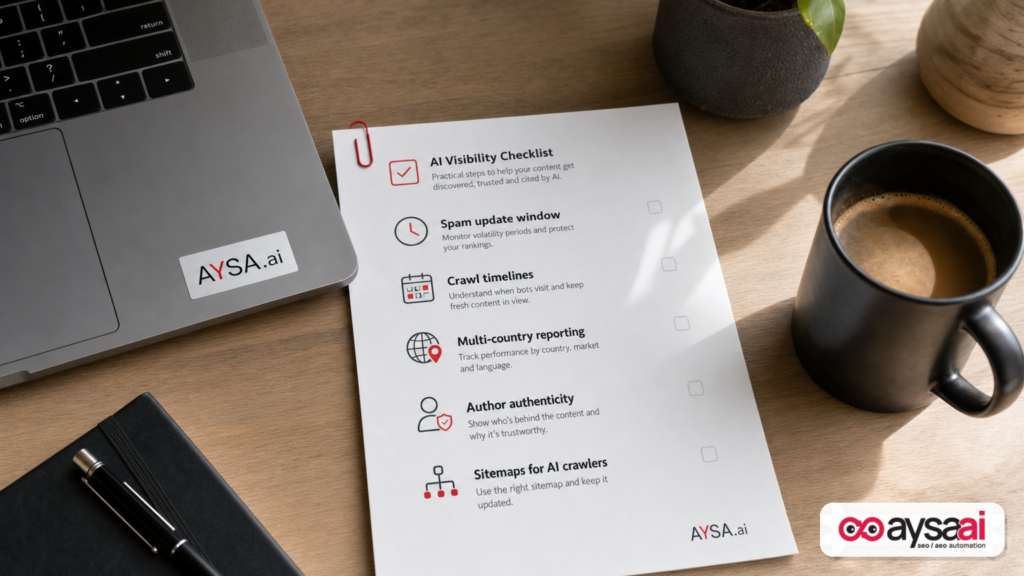
Google wrapped a September spam update rollout after nearly two weeks, but some rank trackers showed movement that searchers didn’t—highlighting measurement limits. New shared timing ranges (from a conference recap) frame site moves and core update recovery in months, not days. Search Console can now combine multiple countries in Performance reports, improving multi-market reporting. And Google’s people-first guidance now explicitly warns against fake author profiles as deception. The playbook: measure with Search Console first, plan SEO changes on multi-month horizons, standardize discovery assets like sitemaps/RSS, and treat authorship as a governance problem—not a design flourish.
Key takeaways (read this first)
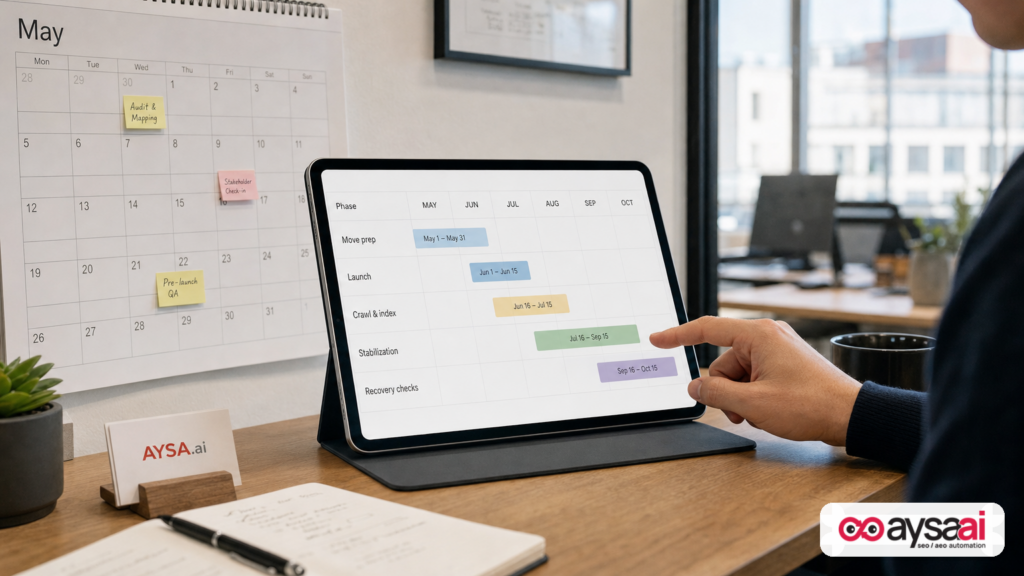
- Stop treating rank trackers as ground truth during active updates. If the SERP data Google returns to automated tools is incomplete, your charts can lie even when your traffic doesn’t.
- Expect crawl, Indexing, and recovery to take months. Not because you did it wrong—because search systems reprocess changes on their own schedules.
- Search Console reporting just got easier for multi-market teams. Combined country filters mean fewer spreadsheet gymnastics and cleaner executive reporting.
- Authorship is now explicitly a quality signal. Fake names, AI headshots presented as real people, and fabricated credentials are described as deception—something you don’t want in your risk profile.
- Assume AI crawlers don’t have a console. Use standard sitemap naming and make discovery obvious (Robots.txt entries, RSS feeds where sensible).
Table of contents

- Context: the theme is “reading past the label”
- Google’s spam update finished: what that changes for analysis
- Rank trackers vs. Search Console: what to trust (and when)
- Crawl, indexing, and recovery can take months—plan like it
- Site moves: why “still moving” is a real thing at 90 days
- Search Console multi-country filters: better reporting, better decisions
- People-first now explicitly calls out fake author profiles
- A practical authorship and credibility playbook for SMEs
- Sitemaps, RSS, and AI crawlers: assume there’s no console
- “Couldn’t fetch” doesn’t always mean “broken”
- Concrete SME scenario: an ecommerce brand hits turbulence
- What agencies should rethink: reporting, expectations, execution
- Where AYSA fits: monitoring → prep → approval → execution
- What to do next (action list)
- Sources and further reading
Context: the theme is “reading past the label”
The source story framed the week with a useful theme: labels can mislead. That’s not a philosophical point; it’s an operational one.
Here are the “labels” that hurt businesses when taken at face value:
- “Spam update” as a label that implies you should only worry if you’re doing spam. In reality, broad anti-spam systems can ripple into legitimate sites with thin sections, aggressive templating, or questionable Attribution.
- “Typical” timelines as a label that comforts stakeholders but can also hide complexity: Site architecture, internal links, crawl demand, and quality signals all change the clock.
- “Couldn’t fetch” as a label that sounds like an error in your sitemap file, even when it can be about demand, load, or prioritization.
- Country metrics as a label that used to force you into two-at-a-time comparisons; now those totals can represent groups—powerful, but also easier to misread if your markets aren’t comparable.
- Bylines and author pages as a label for credibility; now Google’s own guidance underscores that fabricated profiles are deception, not marketing.
The only way to win in that environment is to build a workflow that treats every label as a hypothesis, not a conclusion.
Google’s spam update finished: what that changes for analysis
Per Google’s Search Status updates as reported by Search Engine Journal, the September spam update began Sept. 24 and completed Oct. 8—just under two weeks. The business takeaway isn’t just “it’s done.” It’s this:
- You now have a defined comparison window. You can segment “before,” “during,” and “after” periods and let Search Console data finish populating.
- “During rollout” data is often noisy. Systems update; data centers can differ; Crawling and reprocessing do not happen uniformly.
- Decision timing matters. Cutting budgets, rewriting entire sites, or changing URL structures in the middle of volatility is how you turn a temporary problem into a permanent one.
Google maintains public communications channels for search incidents and updates. When you’re doing analysis, use those official timestamps as your anchor, not a Twitter thread, not a Slack rumor, and not a single rank-tracker chart. If your team needs a broader context of algorithm communications over time, Search Engine Journal also keeps a running Google algorithm history page that can help frame patterns (useful for narrative, not for causal proof).
Rank trackers vs. Search Console: what to trust (and when)
One of the most actionable points in the Pulse recap was that industry rank trackers can observe “sudden ranking changes” that users don’t see—attributed (by a third party) to incomplete or inaccurate data returned by Google to automated tools during the period.
I can’t verify the mechanics beyond what’s described in the source, so treat the explanation as a plausible model, not gospel. But the strategic conclusion is solid and verifiable from first principles:
- Rank trackers are samples. They query at scale, in patterns, from specific locations, using automation.
- Search Console is first-party performance data. It’s what Google says your site received in impressions and clicks on Google Search.
- Different questions, different tools. Trackers are good for directional monitoring and competitor context; Search Console is better for business impact and diagnosing query/page shifts.
So what should you do the next time your tracker screams but your business feels normal?
A simple verification ladder
- Check Search Console clicks and impressions first (not average position). If clicks and impressions are stable, your revenue risk is lower than the chart implies.
- Segment by page type: product pages, blog posts, location pages, category pages. “Site-wide drop” is often “one template dropped.”
- Segment by query intent: branded vs non-branded, informational vs transactional. Spam systems often touch thin informational pages first.
- Validate with manual spot checks for a small set of money queries. Not to cherry-pick, but to confirm whether “real SERPs” match your sampled tool.
- Wait for the rollout window to close before major structural changes—unless you find a clear technical error or policy problem you can prove.
If you want to operationalize this, it’s exactly the kind of routine you can embed in a monitoring workflow. At AYSA, we approach volatility as a trigger for verification and controlled execution—not panic. Start with AYSA Monitoring to detect changes, then prepare fixes, request approval, and execute changes systematically.
Crawl, indexing, and recovery can take months—plan like it
A key item in the Pulse was an attendee recap of Google’s Gary Illyes sharing timing ranges for crawling, indexing, site moves, and core update recovery. The recap described “typical” site moves as one to three months, with slow cases six months to over a year. It also described core update recovery as three to six months typical, and six months to a year slowest.
Important caveat (also noted in the source): “typical” wasn’t defined with sample size, timeframe, or methodology. Treat these as ranges to manage expectations, not promises and not SLAs.
Even with that uncertainty, the business lesson is extremely clear:
- SEO is not a real-time system. Publishing is real-time. Search reflection is not.
- “We fixed it” and “Google recognized it” are different milestones.
- If you budget and forecast like changes land in a week, you will overreact.
Why does it take so long?
Without inventing internals, we can describe the external reality: Google must discover URLs, crawl them, process content, reconcile canonical and duplication signals, understand internal linking, associate queries with pages, and integrate all of that with quality and spam systems. If you also changed templates, navigation, URL structure, or content, you’ve multiplied the scope.
The more your site looks like “work” to a crawler (infinite filters, duplicated pages, parameter chaos, inconsistent canonicals, slow servers), the longer stabilization can take.
The planning change: treat SEO like a supply chain
SMEs often plan SEO like it’s social: publish today, results tomorrow. Instead, plan it like a supply chain:
- Input: content and technical changes shipped.
- Processing: crawl and index cycles.
- Distribution: rankings and impressions across markets and devices.
- Feedback loop: Search Console performance and conversion data.
AYSA’s value here is the operational layer: make the workflow visible, measurable, and controlled. That’s the difference between “we changed a bunch of things” and “we executed a sequence of approved changes with check-ins.” See AYSA AI Search Visibility for how we think about performance in a world that’s moving toward AEO/GEO alongside classic SEO.
Site moves: why “still moving” is a real thing at 90 days
Site moves (domain changes, platform migrations, URL restructures, HTTPS shifts, subdomain changes) are where expectations go to die.
At day 7, everyone asks, “Are we done?” At day 30, someone wants to roll back. At day 90, leadership assumes the agency messed up or the dev team missed a redirect.
The timing ranges cited in the Pulse recap—again, not strict—help explain why the “are we done?” question often has an uncomfortable answer: you might be in the normal range and still feel pain.
What can go wrong (in plain English)
- Redirects are correct, but internal links aren’t. You’re forcing Google to take the long way to the new URLs.
- Canonicals conflict with redirects. You tell Google “this is the main page,” then redirect elsewhere, creating ambiguity.
- Navigation changes starve key pages. Your best money pages lose internal link equity.
- Faceted navigation explodes URL count. Crawl budget gets wasted on near-duplicates.
- Performance regressions slow crawling. If pages time out or are heavy, crawlers back off.
How to communicate timelines without losing trust
If you’re an owner or a CMO, you don’t want excuses—you want a plan. A mature plan uses milestones:
- Milestone 1: Redirect coverage verified (top pages + templates).
- Milestone 2: New URLs discovered in Search Console.
- Milestone 3: Index coverage stabilizes (not necessarily grows).
- Milestone 4: Query-to-page mapping stabilizes (less cannibalization).
- Milestone 5: Traffic and revenue stabilize or improve.
That’s an execution problem, not a theory problem. AYSA is built for that: monitor the signals, prepare the changes, ask for approval, then execute what’s accepted. Explore how that works at AYSA AI SEO Tools.
Search Console multi-country filters: better reporting, better decisions
Google updated Search Console’s Performance report filters so you can select multiple countries (and multiple devices) and see combined data. That’s a tactical UI change with real strategic impact if you manage multiple markets.
Why? Because teams rarely operate by “country as a reporting unit.” They operate by:
- Sales regions (e.g., Nordics, DACH, Benelux)
- Language markets (e.g., Spanish-speaking LATAM)
- Operational clusters (where a single team owns several countries)
When reporting forces two-at-a-time comparisons, you either:
- waste time exporting and pivoting, or
- simplify the story until it’s wrong.
What this unlocks for SMEs
- Cleaner executive reporting. One number for “EU organic search” is often more decision-friendly than 12 separate charts.
- Better prioritization. If a cluster is rising, you can invest in the right language, product set, and shipping/fulfillment messaging.
- Faster anomaly detection. A sudden drop in one cluster becomes visible without waiting for someone to compare five dashboards.
To make this sustainable, tie Search Console reporting to operational monitoring. That’s the role of systems like AYSA: turn reporting changes into “we noticed, we diagnosed, we prepared fixes, we shipped them.” If you’re new to our approach, start with Monitoring and browse examples on the AYSA Blog.
People-first now explicitly calls out fake author profiles
This is the part most businesses will underestimate until it’s painful.
Google’s “helpful, reliable, people-first” guidance now includes an explicit warning against fabricated creator profiles—AI headshots, made-up names, and false credentials used to create the impression content was written by human experts. The Pulse recap notes that Google describes deception as a “signal of a low-quality page.”
Even if you’re not trying to deceive, it’s easy to drift into risky patterns:
- A marketing team uses AI to generate author photos because “we don’t have headshots.”
- A founder assigns a generic byline to 200 articles to look credible.
- An agency creates persona authors to scale content output.
- A clinic lists “Dr. X” as an author for SEO, but Dr. X never reviewed the content.
These are governance failures. And governance is now SEO.
Why this matters beyond rankings
- Brand risk: If a customer notices fabricated credentials, trust can crater instantly.
- Legal/compliance risk: In regulated spaces (health, finance), false expertise claims can create serious liability.
- Conversion risk: Even if you rank, users may bounce when credibility cues feel fake.
The correct move isn’t “remove all author info.” It’s to make author information accurate, reviewable, and consistent with your editorial process.
A practical authorship and credibility playbook for SMEs
Let’s make this concrete. Here’s a “minimum viable credibility” framework that an SME can adopt without turning into a newsroom.
1) Decide what authorship means for your business
Pick one model and be honest about it:
- Single-author founder model: The founder writes or heavily edits. Great for expertise; limited scale.
- Team byline model: “The [Brand] Team” with an editorial policy page explaining the process.
- Contributor model: Named contributors with bios, disclosure, and review workflows.
2) Build an “About the author” standard that doesn’t lie
- Use real names for real people.
- Use real photos (or use no photo). If you don’t have headshots, do a simple team photo day. It’s cheaper than cleaning up a trust mess.
- List credentials only if verifiable.
- Use “Reviewed by” or “Fact-checked by” only if true.
3) Publish an editorial process page
This is underused. A short page that states:
- How content is created (including AI assistance, if used)
- How it’s reviewed
- How often it’s updated
- How readers can report errors
It’s not about impressing Google with words. It’s about aligning your site’s trust cues with reality.
4) Audit existing bylines at scale
Most companies have legacy content. Your goal is to find mismatches:
- Authors that don’t exist
- Headshots that look AI-generated or inconsistent
- Bios with inflated credentials
- Medical/legal/financial content with no review stated
This is where execution systems matter. Audits that end as spreadsheets don’t change outcomes. In AYSA, the ideal workflow is: monitor and inventory templates → prepare recommended changes page-by-page → request approval → execute updates consistently.
If you want to see how we approach automation without losing control, review AYSA Pricing to understand the product tiers that support monitoring and execution.
Sitemaps, RSS, and AI crawlers: assume there’s no console
The Pulse recap also highlighted comments attributed to Google’s John Mueller on Search Off the Record: AI training crawlers often don’t provide a way to submit a sitemap. The practical suggestion: use a default name like sitemap.xml or provide an RSS feed, making it easier for crawlers to find content naturally.
We should be careful here: “AI crawlers” is a broad bucket—different operators behave differently, and policies vary. But the principle is durable:
- Discovery should not depend on special submission flows.
- Standard conventions reduce friction.
What to do (without overcomplicating it)
- Use a standard sitemap location where feasible (commonly /sitemap.xml or sitemap index files in predictable locations).
- Reference your sitemap in robots.txt so automated systems can find it without a console.
- Consider an RSS/Atom feed if you publish frequently (blog, news, new products, listings).
These are small technical choices that pay compounding dividends—especially as discovery expands beyond classic Googlebot into a mixed ecosystem of crawlers and agents.
“Couldn’t fetch” doesn’t always mean “broken”
The Pulse recap notes two causes for valid sitemaps showing “Couldn’t fetch” in Search Console: host load and crawl demand, the latter often based on perceived site quality. It also references that Search Console help documentation lists low crawl demand as a reason a sitemap can’t be fetched.
The practical point: if your sitemap is valid, “couldn’t fetch” can be about prioritization, not syntax.
A troubleshooting sequence that saves time
- Confirm the sitemap URL returns a 200 status reliably and quickly.
- Check server performance during Google access times (if you have logs). Timeouts and rate limiting can look like fetch failures.
- Inspect whether you’re publishing massive low-value URL sets (facets, parameters, internal search results). If your sitemap is full of weak pages, demand will be low.
- Improve internal linking to the URLs that matter. Sitemaps are hints; internal links express importance.
Again, this is where an execution system matters: once you identify the cause (host load vs low-value URLs vs internal linking), you need to ship changes reliably. AYSA is designed to monitor the symptom, propose fixes, and execute only after approval—reducing the risk of “fixing” the wrong thing.
Concrete SME scenario: an ecommerce brand hits turbulence
Let’s ground this in a situation a real operator might face.
The business
A mid-sized ecommerce store sells specialty home goods. They ship to the U.S., Canada, and the UK. Their revenue depends on a mix of branded demand and high-intent category keywords (“ceramic baking dish set,” “linen table runner,” etc.). They also publish buying guides.
What happens
- Late September, their rank tracker shows a sharp drop in visibility across thousands of keywords.
- The CEO sees the chart and asks, “Did we get hit by a spam update?”
- The paid team proposes increasing ad spend immediately to “cover the loss.”
- The content team proposes rewriting 200 articles “to be safe.”
What a disciplined team does instead
- Open Search Console. Check clicks and impressions for the Sept. 24–Oct. 8 window compared to the prior period.
- Segment by country. With multi-country filters, they view U.S.+Canada combined (North America) and UK separately to see if this is localized or global.
- Check page groups. Are product pages stable while blog guides drop? That often signals “content quality” issues rather than store-wide trust.
- Audit authorship on guides. They discover many guides use AI-generated headshots for fictional personas created by an old agency. That’s now explicitly risky per Google’s guidance.
- Fix credibility signals first. Replace fictional personas with a truthful editorial byline model, add an editorial policy page, and update the highest-traffic guides.
- Wait for stabilization. They keep monitoring rather than rewriting everything at once.
Where AYSA fits in this scenario
- Monitor: Detect visibility and traffic anomalies early (Monitoring).
- Prepare: Generate a prioritized change set: fix author pages, update templates, improve internal links to best categories.
- Approve: The CEO/marketing lead approves the high-impact changes first (no risky broad edits).
- Execute: Implement accepted changes consistently across the site.
This is the difference between reactive SEO and operational SEO.
What agencies should rethink: reporting, expectations, execution
If you run an agency or you’re the in-house lead working with one, these updates should change your client management immediately.
1) Replace “ranking reports” with “decision reports”
Rankings are not decisions; they are signals. A better weekly executive report includes:
- Search Console clicks/impressions (by page group and intent)
- Top winners/losers with hypotheses (not certainty)
- What changed on the site (release notes)
- What Google changed (update windows)
- Actions taken and actions queued for approval
2) Sell timelines in months, not weeks
Use the ranges discussed in industry coverage as expectation-setting, while being transparent that they are ranges and not guaranteed. The point is not to excuse slow outcomes; it’s to stop clients from forcing chaotic rework cycles that sabotage recovery.
3) Treat authorship as a compliance surface
Many agencies outsourced content production to commodity pipelines. That’s increasingly dangerous if those pipelines generate fake personas. Your content ops needs guardrails: real contributors, truthful bios, and a documented process.
4) Operationalize execution
The hardest part of SEO isn’t ideas—it’s shipping. Agencies that win will:
- connect monitoring to tickets,
- connect tickets to approvals,
- connect approvals to changes in production,
- and keep a release log so analysis is possible later.
This is the philosophy behind AYSA: we’re not another dashboard. We’re an execution system for SEO/AEO/GEO that monitors, prepares, asks for approval, and then executes accepted website changes.
Where AYSA fits: monitoring → prep → approval → execution
Let’s connect the dots between this week’s changes and what a modern SEO operating system must do.
Spam updates: you need verification, not panic
- AYSA Monitoring detects anomalies and surfaces them as issues to investigate, not instant conclusions.
- Teams can prioritize fixes that are provable (technical errors, deceptive bylines, thin templates) rather than rewriting everything.
Crawl/index timelines: you need patient, trackable execution
- Multi-month timelines require release logs, staged rollouts, and checkpoints.
- AYSA’s approach supports controlled change management: prepare changes, approve, execute, then measure.
Multi-country reporting: you need smarter market groupings
- Search Console now supports combined country totals, which aligns with how businesses manage regions.
- AYSA’s focus on visibility makes it easier to translate regional data into action items: content localization, internal linking adjustments, and template fixes.
Fake author warnings: you need governance
- AYSA can help teams inventory and standardize author templates and bio pages, then roll out approved corrections sitewide.
- Most importantly: the “approved execution” step prevents accidental deception. Humans decide the truth; the system enforces consistency.
If you want to understand how this fits your stack, start with AYSA AI SEO Tools and AI Search Visibility, then browse implementation thinking on our blog.
What to do next (action list)
If you’re a founder, marketer, or agency lead, here’s a practical next-step list you can execute this month.
1) Build an “update window” habit
- When Google confirms a rollout window, annotate it in your reporting.
- Compare Search Console “before/during/after” rather than reacting mid-rollout.
2) Create page-type segments in Search Console
- At minimum: homepage, category/collection pages, product/service pages, blog/resources, location pages.
- Measure clicks/impressions by segment weekly.
3) Use multi-country filtering to match how you operate
- Define regional clusters (e.g., North America, UK+IE, DACH).
- Report cluster performance, then drill into countries only when needed.
4) Run an authorship risk audit
- List all authors and author pages.
- Flag AI-looking headshots, unverifiable credentials, and fictional personas.
- Decide a truthful byline model and implement consistently.
5) Make discovery assets boring and standard
- Ensure a standard sitemap location and robots.txt reference.
- Consider an RSS feed if you publish frequently.
6) Treat “Couldn’t fetch” as a prioritization clue
- Check host load and performance.
- Reduce low-value URLs and strengthen internal linking to key pages.
7) Move from “ideas” to “approved execution”
- Choose a workflow where monitoring triggers a change proposal.
- Require approval for sitewide edits and high-risk technical changes.
- Keep a release log so your next analysis is grounded in reality.
To operationalize this with less manual work, use AYSA as the system layer: monitor, prepare changes, ask for approval, then execute.
Sources and further reading
- Search Engine Journal – Google Ends Spam Update, Shares Crawl Timing Ranges – SEO Pulse
- Search Engine Journal – Google Algorithm History (context reference)
- Search Engine Journal – SEO coverage (ongoing updates)
- Search Engine Journal – Technical SEO (supporting context)
Note: The Pulse recap references additional primary sources (e.g., Google Search Status Dashboard, Search Console documentation, Search Off the Record podcast). They’re mentioned in the source coverage but not provided directly in the supplied research context here, so I’m not linking them as verified primary citations in this draft. If you’d like, we can update this section with direct official URLs once they’re supplied.
Continue the AI search topic inside AYSA.
Use these pages to connect the article with AI SEO tools, AI visibility monitoring, AI Overviews and approved website execution.
Turn this topic into a website action plan.
Use these AYSA hubs to move from reading to technical fixes, AI visibility monitoring, research, glossary context and approval-first SEO execution.