
Keywords aren’t dead, but keyword control is shrinking: a practical Google Ads plan for 2026
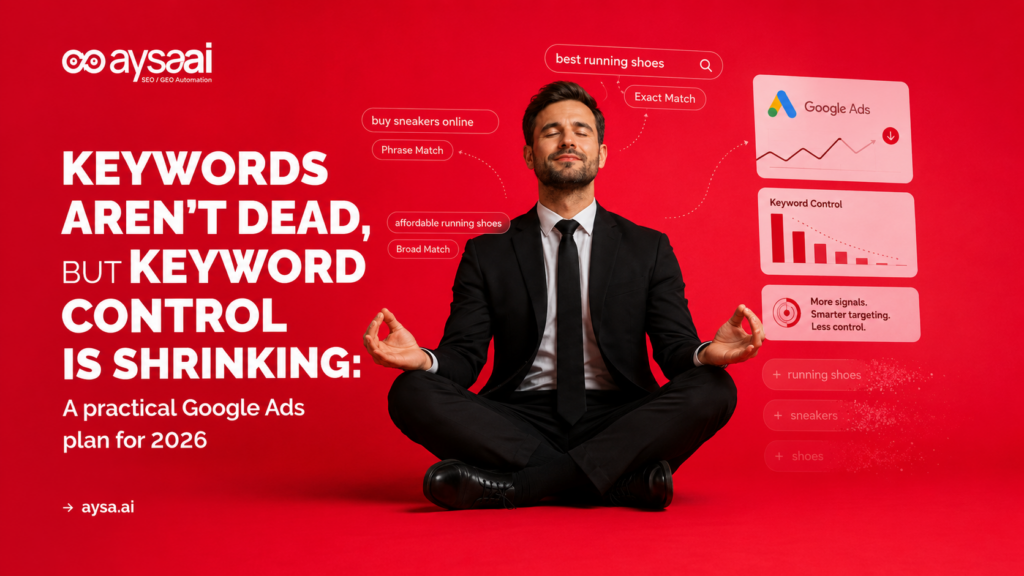
Keywords aren’t dead, but keyword control is shrinking: a practical Google Ads plan for 2026
TL;DR
Google Ads has steadily moved from “precise Keyword control” to “intent + automation,” where match behavior is more flexible and bidding is increasingly optimized by machine learning. That doesn’t mean keywords disappear. It means keywords are now one input in a larger system. If you want profit in 2026, the winning strategy is not “a bigger keyword list.” It’s:
- define conversions that reflect profit (not vanity leads),
- separate exploration from efficiency in your account structure,
- run negative keywords as an operational discipline,
- upgrade landing pages so they convert and are clearly relevant,
- build measurement that can explain changes quickly and survive product shifts.
Sources: SEJ (topic signal), Google Ads documentation on close variants and Smart Bidding, and Google’s AI Max for Search campaigns announcement.
Table of contents
- Why people say “keywords are becoming obsolete”
- What Google actually documents (no guessing)
- What changes in practice for business owners
- A practical 2026 plan (10 steps, in order)
- Guardrails: negatives, budgets, diagnostics
- Landing pages that win in an intent-first system
- Measurement that prevents self-deception
- How AYSA executes this (workflow + verification)
- FAQ
- Checklist
- Sources
- About the author
Why people say “keywords are becoming obsolete”
SEJ highlights a narrative that many advertisers feel: query-to-keyword matching is less deterministic than it used to be. That perception comes from three observable product directions.
1) Matching is not strictly literal
Google Ads documents “close variants,” meaning match types can include variations that have the same or similar intent. In other words: even when you choose exact match, you should not assume “literal only.” (See Google’s close variants documentation.)
2) Optimization shifts from inputs to outcomes
Smart Bidding is explicitly designed to optimize toward conversions or conversion value, using signals and auction-time modeling. That means the system’s behavior depends heavily on the conversion signal you feed it. If you feed it “cheap but low-quality leads,” it will find more of the same. (See Google’s Smart Bidding documentation.)
3) Product direction keeps expanding automation
Google’s AI Max for Search campaigns is another indicator that Search campaigns are moving toward more AI-driven expansion and optimization. We don’t need to exaggerate the details—only recognize the direction: more automation, more “intent-based” behavior. (See Google’s AI Max announcement.)
Taken together, the practical conclusion is simple: your job is less “pick perfect keywords” and more “build a system that makes automation profitable.”
What Google actually documents (no guessing)
To stay “no hallucinations,” here’s what we can anchor in official docs.
Close variants exist
Google explains that close variants allow matching to include variations that are close in meaning or form. The point isn’t the taxonomy. The point is operational: keyword control is not binary. You need guardrails. (Google Ads Help: close variants.)
Smart Bidding uses machine learning to optimize outcomes
Smart Bidding is described as a set of automated bid strategies that optimize for conversions or conversion value in each auction. Operationally:
- your conversion definition becomes your “north star,”
- your signal quality becomes your competitive advantage. (Google Ads Help: Smart Bidding.)
AI Max is positioned as an AI capability set for Search campaigns
Whatever your stance on AI Max, the existence of the product tells you where the platform is going: more AI-driven expansion and optimization on Search. (Google blog: AI Max for Search campaigns.)
What changes in practice for business owners
When matching becomes more flexible and bidding becomes more automated, five things become more important than ever:
1) Negative keywords become a weekly habit
Without negative discipline, flexible matching produces waste. The fix isn’t rage. It’s a process: review search terms, add negatives, update shared lists.
2) Conversion definitions become your core product decision
Most accounts lose money because they optimize for the wrong thing:
- “lead submitted” instead of “qualified lead,”
- “add-to-cart” instead of “purchase,”
- “Call click” instead of “booked appointment.”
3) Landing pages determine whether automation helps or hurts
Automation amplifies what’s already true:
- if landing pages convert and qualify, automation scales profit,
- if landing pages are vague and leaky, automation scales waste.
4) Account structure becomes risk management
Structure is how you control:
- where exploration happens,
- how much budget exploration can consume,
- how quickly you can diagnose changes.
5) Measurement must explain “why,” not just “what”
If you can’t explain why performance changed, you can’t fix it. You need a simple diagnostics pack.
A practical 2026 plan (10 steps, in order)
This plan works for most SMBs and lean teams. It’s not fancy. It’s durable.
Step 1: choose a profit-aligned primary conversion
Pick one conversion that correlates with profit:
- purchase,
- booked call,
- qualified lead.
If you can’t import quality signals yet, at least define them in CRM and report them separately.
Step 2: clean up tracking and deduplication
Before changing match/bidding, ensure:
- conversions aren’t duplicated,
- micro actions aren’t treated like macro outcomes,
- Attribution windows are consistent,
- tagging changes are documented.
Step 3: separate efficiency from exploration
Create two operational zones:
- Efficiency: must be profitable and predictable.
- Exploration: allowed to be messy, but bounded.
Exploration gets capped budgets and stricter query reviews. This is how you stay safe while learning.
Step 4: implement negative keywords as a process
Set a cadence:
- weekly search term review (especially exploration),
- monthly shared list review.
Build shared lists by intent:
- “free,” “jobs,” “template,” “PDF,” “DIY” (depending on your offer),
- location exclusions (if irrelevant),
- competitor/brand exclusions (where appropriate).
Step 5: upgrade signal quality (lead quality or value)
For ecommerce: use real revenue/value.
For lead-gen: define “qualified” and move toward offline conversion imports.
Step 6: stabilize creative and landing pages before judging changes
Don’t change five variables at once (ads, Landing page, conversions, bidding, budgets) and then claim a causal story. Make sequential changes and keep a changelog.
Step 7: build a minimal diagnostics pack
You need five simple views you can trust:
- daily cost/conv/value by campaign,
- search terms categorized (exploration),
- device + GEO split,
- landing page Conversion Rate,
- lead quality distribution (if available).
Step 8: optimize structure, not just bids
Use structure to make diagnosis easy:
- separate brand vs non-brand,
- separate offers,
- separate intents,
- isolate experiments.
Step 9: set risk limits (“guardrails”)
Examples:
- exploration capped at 10–20% of budget,
- negative lists enforced,
- location exclusions,
- “pause rules” for extreme CPA spikes.
Step 10: document changes (changelog)
Write down:
- what changed,
- when,
- why,
- what you observed.
Changelogs turn “opinions” into learning.
Deep research (practical): what “control” means in 2026
If you feel like “Google is spending my budget on nonsense,” you’re not alone. But the fix is rarely “rewrite the keyword list.” The fix is to redefine control.
Old control (keyword-first)
Old control was mostly about:
- keyword list completeness,
- match type choices,
- ad group segmentation.
It assumed query matching is predictable and bidding is mostly manual.
New control (signal + guardrail control)
New control is about:
- signals: what conversions you define and import,
- guardrails: where you allow exploration and how you bound it,
- diagnostics: how quickly you can explain what changed,
- iteration speed: how consistently you ship improvements.
That’s why the “keywords are dead” framing is misleading. Keywords still matter—but they’re no longer the single primary lever.
The uncomfortable truth: automation amplifies your inputs
If your conversion is wrong, automation scales the wrong outcome faster than a human ever could. If your landing page is leaky, automation floods it with traffic you can’t convert. If your negative discipline is absent, automation finds the cheapest Clicks—which often correlate with irrelevance.
So if you want one strategic takeaway for 2026, it’s this:
- Fix your inputs and guardrails first. Only then scale.
Account structure templates (minimum viable)
There is no “perfect” structure. But there are structures that reduce risk and increase clarity.
Template A: SMB lead-gen (simple)
- Campaign 1: Brand (efficiency, stable budget)
- Campaign 2: Non-brand core (efficiency, controlled queries)
- Campaign 3: Exploration (flexible matching allowed, budget cap, weekly search terms review)
Why it works: exploration cannot quietly eat the whole account.
Template B: Ecommerce (simple but robust)
- Campaign 1: Brand
- Campaign 2: Core categories (efficiency)
- Campaign 3: Promotions (short windows, isolated learning)
- Campaign 4: Exploration (budget cap + strict negatives)
Why it works: promotions don’t “contaminate” learning in core campaigns.
Template C: Agency / larger account
Separate by offer line or margin tiers:
- high-margin offers in one container,
- low-margin/high-volume offers in another,
- exploration isolated per offer line.
Why it works: you stop cross-subsidizing waste with profitable segments.
The weekly rhythm that actually produces profit
Most accounts don’t lose money because they lack strategy. They lose money because nobody runs the boring weekly rituals.
Weekly (30–60 minutes)
1) Review search terms (exploration first)
2) Add negatives (shared list + campaign-level)
3) Check landing page conversion rate (if it dropped, fix landing page, not keywords)
4) Check device/geo distribution changes
5) Write 2–3 lines in the changelog (what changed, what you saw)
Monthly (60–120 minutes)
1) Conversion audit (noise vs revenue-driving)
2) Lead quality review (CPL vs CPQL)
3) Offer messaging review (are you attracting the right buyers?)
4) Rebalance budgets between efficiency and exploration
This rhythm is how “small teams” outperform bigger teams: consistent execution beats sporadic heroics.
Lead quality playbook (the upgrade that makes Smart Bidding work for you)
If you run lead-gen, “lead submitted” is rarely a good optimization target. Here’s a minimal playbook:
1) In CRM, define three stages: unqualified, qualified, customer.
2) Choose a time window for qualification (7–14 days).
3) Export qualified outcomes back (offline conversions) when possible.
4) Report three KPIs:
- CPL (all leads),
- CPQL (qualified leads),
- CAC (customers), when you can.
Even if you can’t import offline conversions immediately, start with internal reporting. The biggest win is decision quality: you stop celebrating lead volume while profit falls.
Guardrails: negatives, budgets, diagnostics
Guardrails are what make automation safe.
Negative keywords: 3 layers
- global shared list (obvious irrelevance),
- intent-based lists (DIY/free/job seekers),
- campaign-specific exclusions (offer-level refinements).
Budgets: contain exploration
If everything runs in one campaign, you have no containment. Create containers:
- efficiency containers for stability,
- exploration containers for learning.
Diagnostics: questions you ask when performance drops
1) Did tracking/conversions change?
2) Did query mix change (exploration leaking)?
3) Did landing page conversion rate drop?
4) Did budget/structure change cause a learning reset?
If you can answer these fast, you have control.
Landing pages that win in an intent-first system
Landing pages are not “where traffic goes.” They’re where relevance, trust, and conversion are proven.
1) Clarity in 5 seconds
State:
- what you offer,
- for whom,
- the next step.
2) Proof and risk reduction
Add:
- case studies or examples,
- terms and constraints,
- policies (refund/return where applicable),
- transparent pricing where possible.
3) Qualification (lead-gen)
If you accept every lead, the system optimizes for volume. Add:
- qualifying questions,
- scheduling (booked call),
- separate conversion actions for micro vs macro.
4) Agent-friendly structure (bonus)
Clear headings and scannable content helps both people and systems understand relevance.
Measurement that prevents self-deception
Bad measurement is the most expensive bug in Ads.
1) Don’t mix volume KPIs with value KPIs
Lead volume can rise while quality collapses. Track:
- CPL (all leads),
- CPQL (qualified leads),
- CAC (customers), where feasible.
2) Store history; don’t depend on UI forever
Google’s reporting retention changes are a reminder: build your own archive for decision-grade history.
3) Use multiple time windows
Always report:
- short window (7–14 days),
- medium window (28–56 days),
- and seasonal comparisons when meaningful.
Common failure patterns (and how to fix them)
If you want to diagnose most underperforming accounts quickly, look for these patterns.
Pattern 1: “We optimize for the easiest conversion”
Symptoms:
- high lead volume,
- low close rate,
- rising CPA or wasted sales time.
Fix:
- redefine the primary conversion,
- add qualification to forms,
- move toward offline conversion imports or at least internal CPQL reporting.
Pattern 2: “Exploration and efficiency are mixed”
Symptoms:
- unstable results,
- sudden query mix shifts,
- hard-to-explain performance changes.
Fix:
- isolate exploration into its own campaigns,
- cap budgets,
- enforce weekly query reviews.
Pattern 3: “Landing pages are treated as an afterthought”
Symptoms:
- rising CPCs without conversion lift,
- inconsistent quality,
- poor post-click experience.
Fix:
- make landing page changes part of the optimization plan,
- add proof, clarity, and faster “next step,”
- track page-level conversion rates.
Pattern 4: “No changelog, no learning”
Symptoms:
- debates replace analysis,
- repeated mistakes,
- “it worked once” mythology.
Fix:
- write down every meaningful change and observation.
Stakeholder messaging: how to explain the shift without drama
When stakeholders believe “keywords control everything,” they may interpret automation as loss of control. Here’s a healthier framing:
- We still use keywords, but we manage performance through signals and guardrails.
- We control where exploration happens and how much budget it can consume.
- We optimize toward profit-aligned outcomes (qualified leads / purchases), not vanity metrics.
- We maintain a diagnostics pack so we can explain changes quickly.
This reduces panic and keeps decision-making grounded.
How AYSA executes this (workflow + verification)
AYSA’s advantage is not “secret settings.” It’s execution discipline:
1) audit structure + tracking,
2) define profit-aligned conversions,
3) isolate exploration with guardrails,
4) ship weekly improvements (ads + landing pages + measurement),
5) verify outcomes, not just activity.
That’s how you win when keyword control becomes less deterministic.
Execution snapshot (animated)
Agent workflow
Approval-first agent flow
User Request
The user describes the SEO task in plain language.
Agent Analysis
AYSA reviews website context, signals and opportunities.
Recommendations
The agent prepares clear actions with context.
Approval
Important changes wait for human approval.
WordPress Publish
Approved work moves into website execution.
A simple 30/60/90-day rollout
If you want a concrete implementation timeline:
Days 1–30 (stabilize inputs):
- fix conversion tracking and deduplication,
- define the primary conversion and quality tiers,
- split exploration vs efficiency campaigns,
- create the diagnostics pack.
Days 31–60 (improve post-click):
- rebuild 1–3 landing pages with clarity + proof,
- tighten qualification (for lead-gen),
- improve internal links and offer pages so relevance is obvious.
Days 61–90 (scale what works):
- increase budgets gradually for efficiency containers,
- keep exploration capped but continuous,
- run a monthly review: what changed, what improved, what to stop.
This rhythm ensures automation works for you instead of against you.
FAQ
“Does exact match still matter?”
Yes, but treat it as a risk-reduction tool—not a guarantee of literal matching. Close variants still exist. (See Google’s close variants doc.)
“Is broad match always wasteful?”
Not necessarily. Broad can work when:
- conversion signals are high quality,
- exploration is contained,
- negatives are maintained weekly,
- landing pages convert and qualify.
“Why did costs increase if the system is smarter?”
Because the system optimizes the signal you provide. If the signal is misaligned with profit, it scales the wrong thing. “Smarter” doesn’t mean “psychic.” It means “better at optimizing the defined objective.”
“What’s the fastest way to stop waste this week?”
Do three things in order:
1) Pull search terms for your exploration traffic and add obvious negatives.
2) Check landing page conversion rate and fix the largest leak (clarity, form friction, broken tracking).
3) Reduce exploration budget temporarily until your guardrails are in place.
This is boring, but it works because it attacks waste at the source: irrelevance and weak post-click conversion.
“Do we need more tools?”
Most of the time, no. You need a repeatable process:
- a weekly search term review,
- a changelog,
- a minimal diagnostics pack,
- and a clear definition of “good conversion.”
Tools can help, but they don’t replace discipline.
Checklist
- Primary conversion reflects profit, not vanity?
- Tracking is clean and documented?
- Exploration is isolated and budget-capped?
- Weekly negative keyword discipline exists?
- Landing pages have clarity + proof + qualification?
- Minimal diagnostics pack exists?
- You keep a changelog and make sequential changes?
If you want a single sentence to align the team: control in 2026 is not “perfect matching.” Control is “bounded learning + verified outcomes.”
One last reminder: don’t change everything at once. If you change conversions, bidding strategy, landing page, and targeting in the same week, you won’t learn anything—and you’ll be stuck with opinions. Make one meaningful change, observe it with the diagnostics pack, log the outcome, then move to the next change. That’s how you get compounding performance, not random spikes.
Sources
- SEJ (topic signal): https://www.searchenginejournal.com/i-helped-build-googles-keyword-system-heres-why-its-becoming-obsolete/572362/
- Google Ads Help: About close variants: https://support.google.com/google-ads/answer/9342105
- Google Ads Help: About Smart Bidding: https://support.google.com/google-ads/answer/7065882
- Google: Introducing AI Max for Search campaigns: https://blog.google/products/ads-commerce/google-ai-max-for-search-campaigns/
About the author
Marius Dosinescu is the founder of AYSA.ai, an approval-first SEO/AEO/AI Search execution platform focused on practical growth systems for business owners and marketers.
More: https://aysa.ai/ • Blog: https://aysa.ai/blog/
If you’re running Ads without a weekly operating rhythm, AYSA’s approach helps turn “ideas” into shipping: define the signal, set guardrails, improve post-click, and verify outcomes. That’s how you stay profitable as the platform becomes more automated.
And it’s how you build durable control without fighting the product direction.
In 2026.
Continue the AI search topic inside AYSA.
Use these pages to connect the article with AI SEO tools, AI visibility monitoring, AI Overviews and approved website execution.