
Google’s Holiday Search Updates Signal a Bigger Shift: From “Find Answers” to “Get It Done” (and What SMEs Should Do Now)
Google’s latest holiday-focused Search features—live camera help, visual product decomposition, AI-assisted booking, and ticket monitoring—show Search moving from information to execution. Here’s what changed, why it matters for SMEs, and a practical action plan (with AYSA) to win visibility in AI-driven journeys.
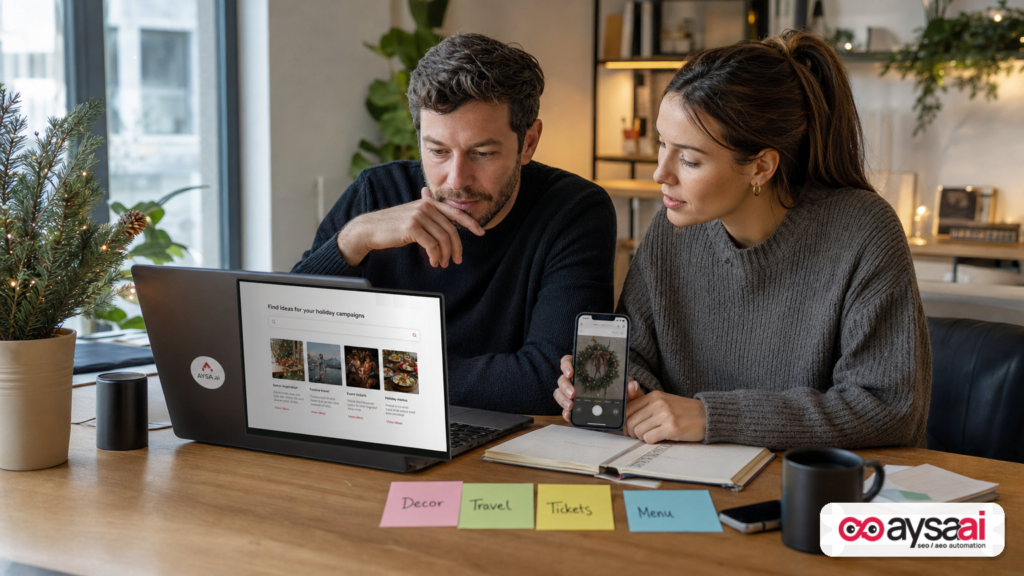
Google just published a holiday-focused update that, on the surface, looks like a set of seasonal convenience features: real-time cooking help through your camera, visual shopping and decor matching, AI-assisted booking for hotels and dining, and ticket Monitoring for sold-out events.
But from an operator’s perspective—especially if you run a small or mid-sized business—this isn’t just “nice UX.” It’s a clear signal of where Search is going next: less finding, more finishing. Search is steadily turning into an execution layer that helps people complete tasks end-to-end, often without the old, predictable sequence of ten blue links.
That shift matters because it changes what users expect, how Google chooses what to show, and which businesses get pulled into (or excluded from) these new, AI-assisted journeys.
I’m writing this as Marius Dosinescu from AYSA.ai. My point of view is simple: if Search is becoming a task completion product, then “ranking” alone is no longer the job. The job is eligibility (being selected by AI-driven experiences), clarity (making your policies and offers unambiguous), and execution (shipping site improvements continuously, not quarterly).
Primary source: Google Search Blog, “4 ways Search can help with your holiday plans”.
Concise summary
- Google’s holiday Search updates emphasize camera-first help (Search Live), visual decomposition (Lens), AI-assisted booking (AI Mode), and monitoring/alerts for tickets.
- These aren’t isolated features—they illustrate a broader shift: Search is moving from information retrieval to task completion.
- For SMEs, this raises the bar on data quality, content structure, policy clarity, local accuracy, inventory availability, and conversion hygiene.
- SEO in 2026 becomes more operational: AEO/GEO requires proactive monitoring and fast, Approved Execution of site changes.
- AYSA fits here as an execution system: monitoring → prepares recommended changes → asks for approval → publishes accepted changes (without SEO projects stalling out).
Key takeaways (for busy operators)

- Expect more “zero-to-one-click” journeys. If AI Mode can compare options, guide decisions, and trigger bookings, your site must be eligible and frictionless when the click happens—or you’ll be bypassed.
- Camera-first discovery will keep growing. Lens-like behavior means the web is increasingly queried with images. Your product photos, structured product data, and local availability matter more than ever.
- “Answers” are becoming “actions.” Content that only informs may lose ground to content that enables: clear pricing, availability, policies, booking steps, and the next best action.
- Monitoring beats guessing. You need systems that notice when Search behavior changes, your pages drop out of visibility, or your information becomes inconsistent.
- Execution is the moat. Most SMEs will understand the trend; few will ship the fixes. That’s where durable advantage lives.
Table of contents
- What Google actually changed (and what it signals)
- Context: Search is turning into an assistant, not a directory
- The new customer journey: Search becomes the front door to transactions
- What this means for SEO in 2026: AEO/GEO is now operational, not theoretical
- Breaking down the four features: business implications and failure modes
- A concrete SME scenario: Boutique hotel + restaurant + events week
- What SMEs should monitor weekly (not annually)
- What can go wrong: brand, compliance, and conversion risks
- What agencies should rethink
- Where AYSA fits: monitored, approved, executed improvements
- 90-day action plan (practical checklist)
- What to do next
- Sources and further reading
What Google actually changed (and what it signals)
In Google’s holiday post (source), the updates are framed around four seasonal use cases:
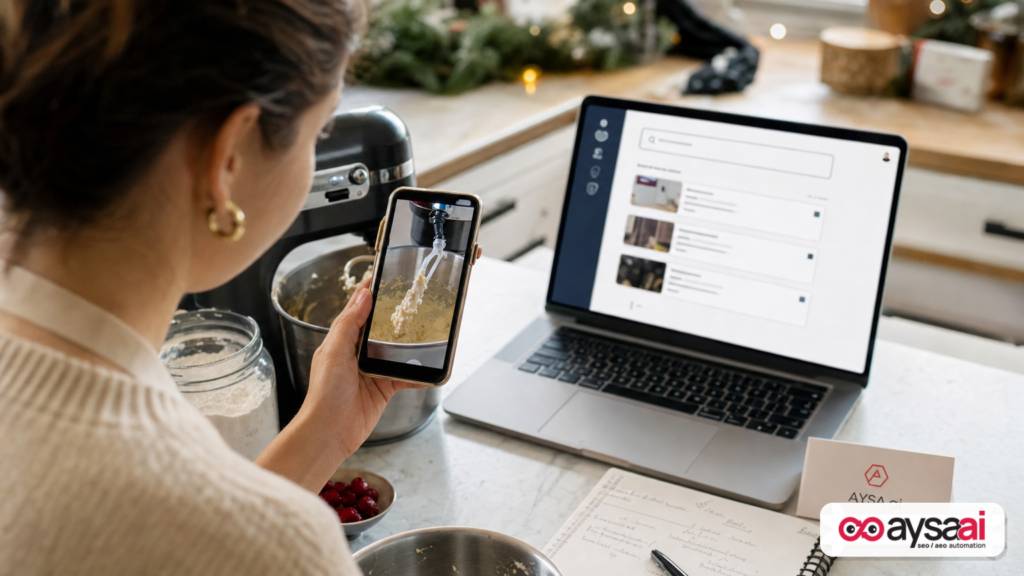
- Real-time help via camera (Search Live): point your phone at a cooking problem and ask what to do.
- Visual shopping and decor recreation (Lens in Search): take a photo/screenshot of a tablescape and ask Search to identify pieces and show shopping options.
- AI-assisted travel and dining bookings (AI Mode): describe your preferences, compare options, and in some cases complete reservations inside the experience.
- Ticket discovery plus monitoring: find tickets across partners, and set monitoring tasks to get notified about drops, releases, or price changes.
If you zoom out, the signal is bigger than the features:
- Search is becoming multimodal (text + image + live video).
- Search is becoming agentic (it doesn’t just answer; it helps you complete tasks).
- Search is becoming more stateful (monitoring tasks and notifications that persist over time).
For businesses, this changes the competition. You’re not just competing for a ranking position. You’re competing for inclusion in an AI-led shortlist, a recommendation set, or an action flow that may reduce the number of sites a user visits.
Context: Search is turning into an assistant, not a directory
The traditional web journey looked like this:
- User searches
- Clicks a few results
- Compares tabs
- Makes a decision
- Completes the transaction on a site
Google’s direction increasingly compresses those steps:
- User describes the goal (or shows it with a camera)
- AI Mode / Search experience compares and filters
- User completes the action (booking, reservation, purchase intent) with fewer hops
We don’t need to speculate about “AI agents replacing the web” to take this seriously. The practical effect is already visible: the decision-making happens earlier, often before a click. That changes what “SEO success” means.
Instead of optimizing only for “get the click,” you need to optimize for:
- Be understood by AI systems (clear entities, attributes, policies).
- Be trusted in comparison contexts (consistent reputation signals and content quality).
- Be selectable for a specific intent (availability, location, constraints, preferences).
- Be easy to complete (fast, accurate landing pages, frictionless checkout/booking).
This is the operational definition of AEO/GEO (Answer Engine Optimization / Generative Engine Optimization): not a buzzword, but a measurable requirement for being included when AI is the interface.
The new customer journey: Search becomes the front door to transactions
Let’s translate the holiday features into “how customers behave.”
1) The camera becomes the query
When Search Live and Lens are the starting point, the user often doesn’t know the right keywords. They know what they’re seeing: a broken sauce, a decor style, a jacket, a chair, a centerpiece.
For product businesses, this implies:
- Visual similarity and attribute matching become more important.
- Your product imagery and product feed hygiene matter.
- “Explainers” need to be structured so an AI system can extract the fix quickly.
2) AI shortlists replace tab-hoarding
AI Mode’s promise is a curated comparison experience: amenities, reviews, photos, availability, and a path to booking. That means fewer random clicks and more “pre-qualified” clicks. The downside: if you’re not in the shortlist, you may not even be considered.
3) Monitoring features reduce impulse advantage
Ticket monitoring is a small but important behavioral change: users stop repeatedly checking websites and outsource the monitoring to Search. The brand that wins is the brand that is discoverable when availability changes—and whose info is reliably structured so the system can detect those changes.
What this means for SEO in 2026: AEO/GEO is now operational, not theoretical
Classic SEO frameworks still matter (crawlability, indexation, relevance, authority). But the center of gravity shifts toward structured clarity and task completion readiness.
Here’s the mindset shift I want SMEs to make:
- Old mindset: “We need to rank #1 for ‘best holiday decor’.”
- New mindset: “When someone shows a photo of a tablescape and asks to recreate it, can Search confidently identify our products, show availability, and land the user on a page that converts?”
In AI-led experiences, ambiguity kills inclusion. And ambiguity is everywhere on SME sites:
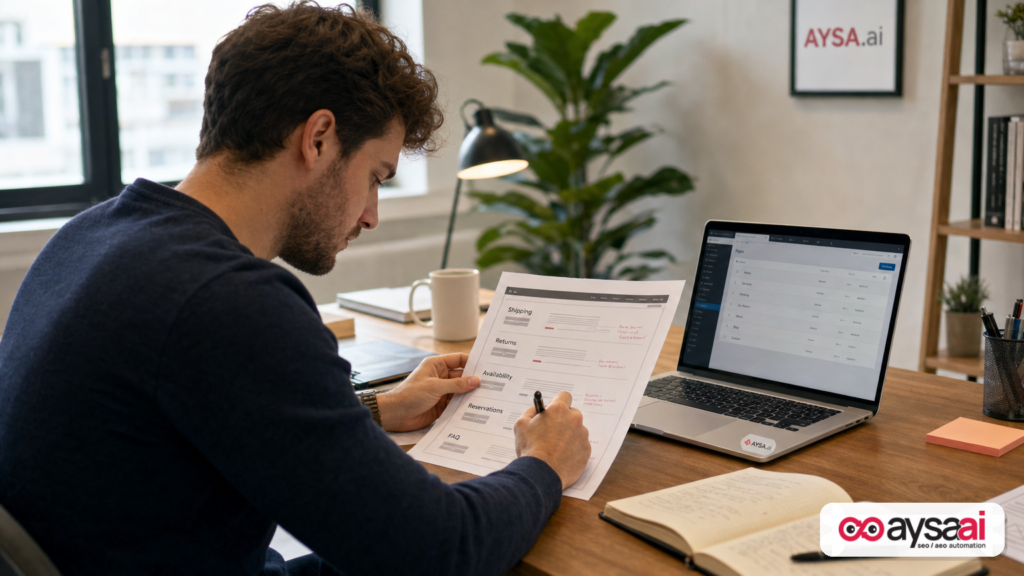
- Shipping cutoffs buried in PDFs
- Returns policies written like legal disclaimers
- Out-of-date holiday hours
- Service areas not clearly defined
- Inventory not synced or not reflected on landing pages
- Reservation links that break on mobile
If you want AI systems to recommend you, you must reduce the “guesswork” in your business information.
AYSA’s perspective: AEO/GEO becomes achievable for SMEs only when it’s treated like operations—monitored continuously, updated quickly, and executed with approvals. That’s why we built tools like Monitoring and an execution loop that prepares changes, requests approval, and implements what you accept.
Breaking down the four features: business implications and failure modes
Google’s four holiday examples are consumer-centric. Let’s convert them into business-centric implications you can act on.
Feature #1: Search Live (real-time camera help)
What it is (from Google’s description): Users can tap a Live icon in the Google app, point their camera at a problem, ask a question by voice, and get instructions with links to explore further (source).
Why it matters for businesses: This is “help in the moment,” where speed and clarity matter more than long-form content. In many categories—food, DIY, beauty, home repair—users don’t want a 2,500-word blog post; they want the next correct step.
What can go wrong for SMEs:
- Your content exists, but it’s not structured for quick extraction (no steps, no clear headings, too much fluff).
- Your content is accurate but not specific (missing temperatures, times, ratios, warnings).
- Your “help” content conflicts across pages (one page says one thing, another contradicts).
What to do:
- Create “in-the-moment” troubleshooting pages with clear step-by-step formatting.
- Add crisp FAQs and “if/then” branching logic (e.g., “If ganache is grainy… If it’s split…”).
- Make sure pages load fast and are readable on mobile.
AYSA angle: Use AI search visibility thinking: can an AI system quote your steps confidently? Then operationalize updates via AI SEO tools and monitoring so the “help” pages stay accurate over time.
Feature #2: Lens in Search (recreate decor by identifying elements)
What it is: Users take a photo or upload a screenshot, then ask Search to find the pieces to recreate a scene; Search breaks the scene into elements and shows shoppable links and local in-stock options (per Google’s post: source).
Why it matters: This is a direct threat to generic “gift guide” content and a major opportunity for merchants who have strong product catalogs. The query becomes “this vibe” rather than “this SKU.”
What can go wrong:
- Product photos are inconsistent (bad lighting, cluttered backgrounds, low resolution).
- Attributes are missing or wrong (color, material, dimensions, pattern).
- Category pages are thin and don’t help AI systems understand the assortment.
- Local availability is unclear, especially for multi-location retailers.
What to do:
- Standardize imagery: consistent background, multiple angles, scale references where relevant.
- Enrich product titles and descriptions with true attributes customers use visually (shape, finish, style, era, pattern).
- Build “shop the look” landing pages that group complementary items (and keep them updated).
AYSA angle: This is where execution can compound. Monitoring can flag when category pages drift, products go out of stock, or internal linking breaks. AYSA can prepare and propose updates, and you approve what gets published—so your catalog stays AI-ready without constant manual fire drills. See Monitoring and AI SEO tools.
Feature #3: AI Mode booking for hotels (and dining reservations in some markets)
What it is: Users describe destination, dates, and preferences; they receive a visual list of options to compare; they can click out to book with partners—and for select properties in the U.S. in English, they may see “Continue on Google” and complete the hotel reservation in AI Mode using Google Pay (as described by Google: source).
Google also describes dining reservations via AI Mode in select markets and languages (same source).
Why it matters: AI-driven booking is a funnel compressor. Customers can go from intent to reservation without the traditional wandering through multiple sites. That’s good for consumers—and for businesses that are eligible and represented accurately. It’s rough for businesses with messy data or slow, confusing booking paths.
What can go wrong:
- Rate parity and offer confusion: users see conflicting pricing or unclear inclusions.
- Outdated amenities/room descriptions: AI comparison surfaces your weaknesses.
- Inconsistent business info across the web: address, hours, phone, or policies mismatch.
- Landing pages that don’t match AI Mode’s promise: the click arrives ready to book, but your page is a maze.
What to do (hotels, restaurants, experiences):
- Audit the top booking intents: parking, breakfast, cancellation, pet policy, fees, accessibility.
- Make those policies explicit and scannable on your site (not hidden in a footer PDF).
- Improve “decision pages” (room types, packages, menus) so users can commit quickly.
AYSA angle: This is visibility plus conversion. Use AI search visibility principles, then close the loop by implementing the improvements with approved execution. If you need to align stakeholders, AYSA’s “propose → approve → publish” model is designed for exactly this operational reality.
Feature #4: Tickets + monitoring for sold-out shows
What it is: Users can find and compare event tickets across partners, and if a performance is sold out (or not on sale yet) they can set a tracking task to get notified when tickets drop or prices change (per Google: source).
Why it matters: Monitoring features reduce the advantage of “who checks fastest” and increase the advantage of “who is best integrated and most accurately represented.” For venues, promoters, and local event businesses, it increases the importance of timely updates and consistent availability signals.
What can go wrong:
- Inconsistent event metadata across platforms (dates, venues, times).
- Confusing ticketing paths: users bounce because the final step feels risky or unclear.
- Local SEO neglect: the event exists, but the venue’s knowledge panel info is wrong.
What to do:
- Create canonical event pages with clear details, policies, and “what to expect.”
- Keep venue and organizer information consistent everywhere you control.
- Optimize for trust: refund policies, accessibility, parking, entry rules—make them explicit.
AYSA angle: Monitoring is your friend. Not just rankings—monitor business info drift and high-impact page changes. This is where an always-on system matters more than a once-a-year “SEO audit.” See AYSA Monitoring.
A concrete SME scenario: Boutique hotel + restaurant + events week
Here’s a realistic scenario I’ve seen in different forms across markets:
Business: a 25-room boutique hotel with a small restaurant, located near a downtown theater district. Q4 includes weekend travelers, company parties, and tourists looking for events.
Old world: The marketing plan is “rank for ‘boutique hotel near [city]’ and run a few ads.” The site has a room page, a dining page, and a blog post from two years ago titled “Top holiday events.”
New world (the one Google is steering toward):
- A traveler uses AI Mode and asks for “a boutique hotel with a cozy vibe, walkable to theaters, and good late-night food.”
- They compare amenities and reviews in a shortlist.
- They try to book quickly—maybe even within the Search experience depending on availability and partnerships.
- They also look for a show. If it’s sold out, they set monitoring.
- They try to reserve dinner before the show, choosing the easiest path.
Now ask: where does this break for an SME?
- The hotel site buries its parking fee and cancellation window; users abandon.
- The restaurant menu PDF is outdated and unreadable on mobile.
- “Holiday hours” aren’t posted clearly, so users don’t trust the reservation.
- Room photos are inconsistent; AI comparisons make the property look weaker than it is.
- The event page is stale, so the hotel misses “things to do” visibility.
What winning looks like: clear policies, structured pages, up-to-date content, fast mobile experience, and fewer steps to book. Not “more blog posts.” Better operational content.
This is precisely where an execution system helps. The difference between “we should fix that” and “it’s fixed this week” is the difference between benefiting from AI Mode and being invisible inside it.
What SMEs should monitor weekly (not annually)
Most businesses still treat SEO like a quarterly project. AI-driven search behavior punishes that cadence.
Here’s what I’d monitor weekly during peak season (and monthly the rest of the year):
1) Offer clarity and drift
- Shipping cutoffs
- Holiday hours
- Returns and exchange windows
- Cancellation policies
- Fees (resort fees, service fees, parking)
These are the first things AI comparisons surface—and the first things customers distrust when unclear.
2) Availability signals
- In-stock vs out-of-stock accuracy
- Bookable inventory accuracy (rooms, tables, appointments)
- Event dates and ticket availability accuracy
3) Top landing page conversion health
- Page speed on mobile
- Broken forms or booking widgets
- Confusing CTA hierarchy
- Mismatch between snippet promise and on-page reality
4) Entity consistency
- Business name, address, phone
- Hours (including special hours)
- Service areas
- Key category descriptors
Even though Google’s post is about Search features, not local listings, entity consistency is the bedrock for being recommended confidently.
5) Content that answers “last-mile” questions
- “Can I get this by Friday?”
- “Will this fit in my space?”
- “Is there parking?”
- “Is it kid-friendly?”
- “What if I need to reschedule?”
These are the questions AI Mode will try to answer. If you don’t answer them clearly, someone else will.
AYSA’s practical approach is to make monitoring continuous and improvements shippable: start with monitoring, then apply changes with approvals so owners stay in control.
What can go wrong: brand, compliance, and conversion risks
Whenever Search gets more “assistant-like,” businesses face a new kind of risk: being summarized, compared, or recommended in contexts you don’t fully control.
Here are the risks I’d plan for without overreacting.
Risk #1: Misinterpretation of policies or offers
If your cancellation policy is written ambiguously, it can be interpreted differently across pages or partners. AI systems try to simplify. Simplification plus ambiguity can become misinformation.
Mitigation: create one canonical, plain-English policy section, keep it consistent, and link to it from all key pages.
Risk #2: Inconsistent data across your ecosystem
Hotels, restaurants, and events often rely on third-party systems. If your own site says one thing and a partner feed says another, the user will trust neither.
Mitigation: run a recurring “truth audit” on the handful of facts that matter most to conversions.
Risk #3: Funnel compression reduces your storytelling time
If AI Mode pre-qualifies the decision, you may get fewer chances to persuade. That makes brand positioning and clarity more important, not less.
Mitigation: put your differentiators on the first screen of key pages: why you, what’s included, what’s unique, and what’s easy.
Risk #4: Over-dependence on one discovery channel
As Search becomes more capable, it’s tempting to rely on it. Don’t. You still want owned channels: email, loyalty, direct bookings, repeat customers.
Mitigation: use AI Search for demand capture, but keep building demand generation and retention.
What agencies should rethink
If you run an agency, the holiday Search update is a warning label: the old SEO retainer model—deliver reports, recommend changes, hope someone implements—will underperform.
Agencies need to shift from “advice” to “outcomes.” That requires:
- Faster shipping cycles (weekly, not monthly)
- Clear ownership of implementation
- Monitoring systems that detect changes and regressions quickly
- Content operations that update key pages, not just publish new posts
It’s also where modern tooling matters. In many client accounts, the limiting factor isn’t that the strategy is unknown—it’s that nothing gets shipped because approvals, access, and capacity are messy.
AYSA’s model (monitor → propose → approve → execute) is built to reduce that friction for both in-house teams and agencies. If you want to see how we frame it, start with AYSA AI SEO tools and our pricing for planning.
Where AYSA fits: monitored, approved, executed improvements
Let’s be blunt: most businesses lose in AI Search for a boring reason. They don’t execute consistently.
Here’s the operational loop that wins:
- Monitor what matters: key pages, policy sections, inventory/availability pages, high-intent queries, and visibility shifts. (See AYSA Monitoring.)
- Prepare changes: rewrite unclear sections, add missing FAQs, improve internal linking, update metadata, fix thin pages.
- Request approval: owners and teams keep control; nothing “mysteriously changes” on the site.
- Execute accepted changes quickly: publish improvements before peak demand passes.
This is what we mean by AYSA as an execution system for SEO/AEO/GEO. We’re not just measuring; we’re helping you ship the work—safely, with approvals.
If you want the conceptual overview first, read AI search visibility. If you want the tools, start at AI SEO tools. If you want implementation rhythm, see Monitoring. For ongoing education, our blog is where we publish operator-level playbooks.
90-day action plan (practical checklist)
This is designed for SMEs that want measurable improvements without “boiling the ocean.”
Days 1–7: Fix the trust breakers
- Audit your top 10 revenue pages (products, categories, services, booking pages).
- Make shipping, returns, cancellations, and fees explicit and scannable.
- Update holiday hours and special schedules.
- Remove or rewrite anything that feels like “legalese first, customer second.”
Days 8–30: Structure your content for AI answers
- Create or upgrade FAQ blocks on money pages (not only blog posts).
- Add step-by-step sections for troubleshooting and “how-to choose” guidance.
- Improve internal linking so “policy truth” pages are easy to find and consistent.
- Ensure pages answer last-mile intent questions (timelines, constraints, suitability).
Days 31–60: Upgrade your visual and catalog readiness
- Standardize product imagery where possible; prioritize best-sellers.
- Enrich product attributes in titles/descriptions (materials, dimensions, finishes).
- Create “shop the look” and “complete the set” collections (merchants).
- Refresh photo libraries for rooms/menus/amenities (hospitality).
Days 61–90: Build a monitoring and execution cadence
- Decide what you’ll monitor: top pages, policies, booking funnels, and visibility.
- Set a weekly “ship list” meeting: what gets updated, what gets approved.
- Document owners: who approves content, who approves dev changes.
- Implement a loop that reduces time-to-fix.
AYSA was built for this cadence: monitor, propose, approve, execute. Start with Monitoring and scale from there.
What to do next
- Read the source update to understand the consumer UX Google is pushing: Google Search Blog: holiday prep Search features.
- Pick one journey you care about most (buy, book, reserve, visit, schedule) and audit it end-to-end on mobile.
- Rewrite one policy section this week into plain English and link it from your top pages.
- Create one “in-the-moment” help page (troubleshooting, sizing, compatibility, appointment prep) with step-by-step formatting.
- Set up ongoing monitoring so you notice drift before customers do: AYSA Monitoring.
- Operationalize approvals so changes ship, not stall. If you want a system for that, explore AYSA AI SEO tools and pricing.
Sources and further reading
- Google Search Blog (primary): 4 ways Search can help with your holiday plans
- Google DeepMind blog (context lead from source page): Google DeepMind Blog
- Google Research blog (context lead from source page): Google Research Blog
- Google Developers Blog (context lead from source page): Google Developers Blog
- Google Cloud Blog (context lead from source page): Google Cloud Blog
- Google Ads & Commerce blog (context lead from source page): blog.google: Ads Commerce
- Waze blog (context lead from source page): blog.google: Waze
- Google Security blog (context lead from source page): Google Security / Cloud Security blog
Note: Google’s post includes availability caveats for some AI Mode booking features (e.g., select properties, specific markets/languages). If you’re outside those regions, you should still treat this as a directional product signal: task completion is the goal, and the UX will likely expand over time.
Continue the AI search topic inside AYSA.
Use these pages to connect the article with AI SEO tools, AI visibility monitoring, AI Overviews and approved website execution.
Turn this topic into a website action plan.
Use these AYSA hubs to move from reading to technical fixes, AI visibility monitoring, research, glossary context and approval-first SEO execution.