
How AEO, GEO and AI Search Actually Work in 2026
A practical AYSA analysis of why AEO and GEO are not magic tricks, but SEO, entity clarity, retrieval, citations and approved execution working together.
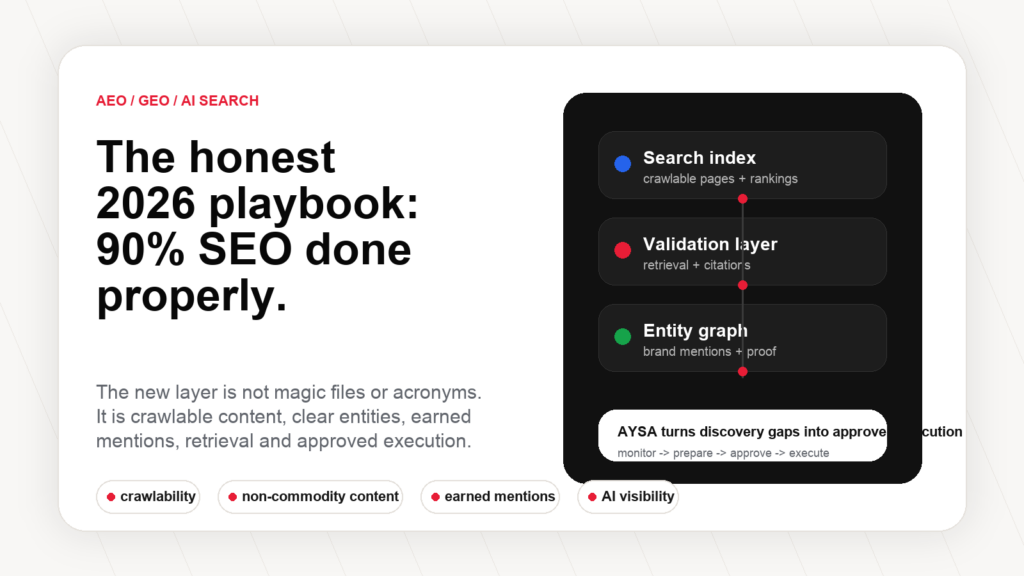
Executive summary: AEO, GEO and AI Search Optimization are often sold as if they are completely new disciplines. The useful truth is more grounded: most of the work is still excellent SEO, but executed for a search environment where answers are generated, sources are retrieved, entities matter, and users ask longer, more specific questions.
A recent LinkedIn article by Jake Ward framed the debate sharply: much of “AI visibility” comes from ranking, retrieval and mentions, not from a secret shortcut. I agree with the direction, with one important addition: for SMEs, the competitive advantage is not knowing the acronym. It is having a system that turns the work into approved Website Execution.
Why this debate matters
AEO, GEO, LLMO, AI visibility, Answer Engine Optimization, Generative Engine Optimization: the naming race has become louder than the work. That creates a problem for business owners. When every new acronym sounds urgent, it becomes harder to understand what actually needs to be done.
The useful question is simple: when a user asks an AI-assisted search system for an answer, what information can that system find, trust, retrieve, compare and cite? If your website is unclear, thin, technically blocked, weakly connected or not mentioned anywhere credible, it is unlikely to become the preferred source in generated answers.
This is why the “AEO/GEO is mostly SEO” argument is valuable. It brings the conversation back to fundamentals: crawlability, indexability, content usefulness, entity clarity, internal links, external validation and continuous improvement. But it is not the whole story. AI search changes query behavior, answer composition, source selection and the way users continue the journey after the first answer.
What AI search retrieves before it answers
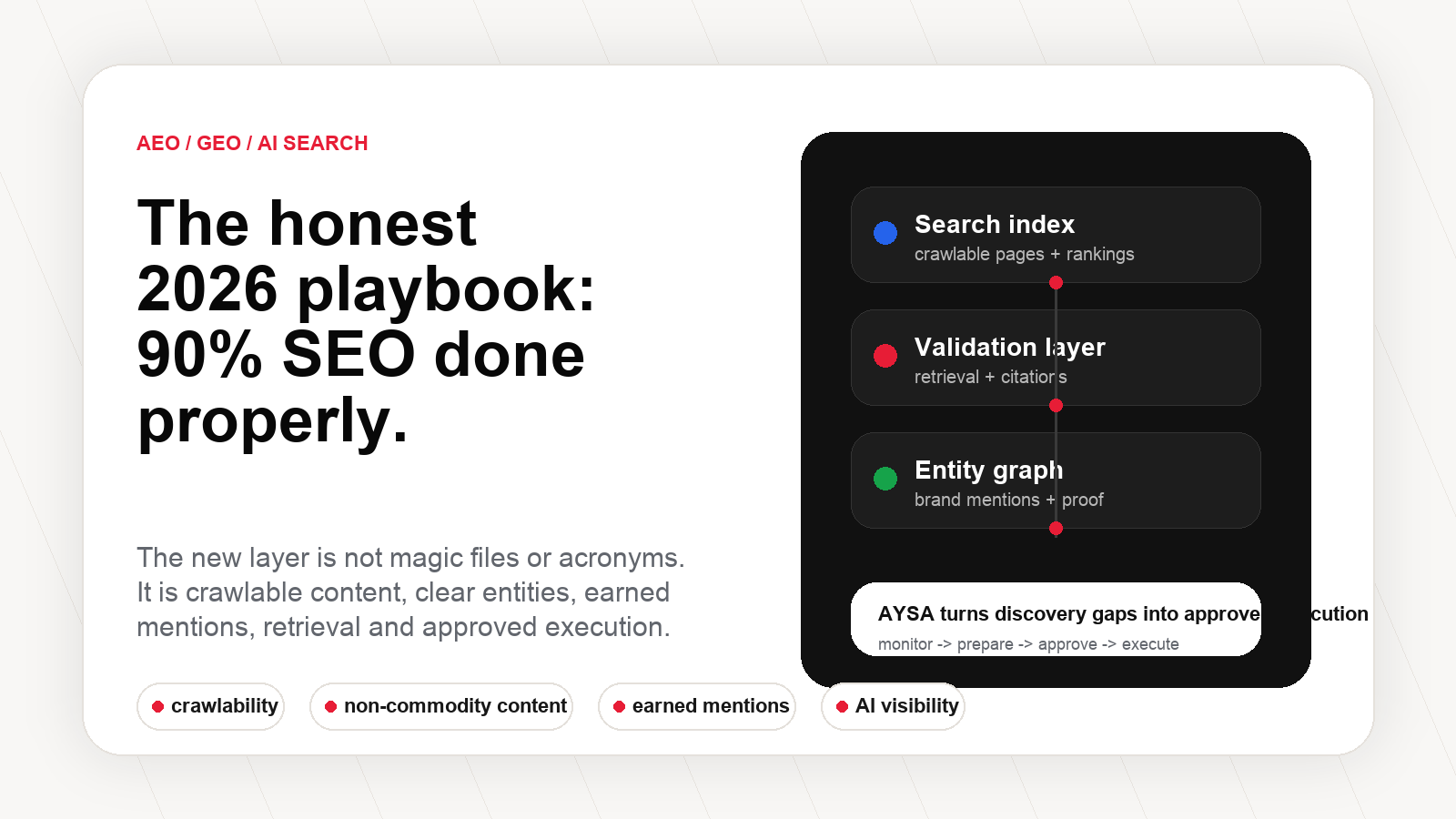
AI-assisted search systems do not answer from vibes. They need source material. Depending on the system and the query, that material may come from a search index, a shopping graph, local data, product feeds, web pages, documents, reviews, forum discussions, publisher pages, citations, structured data or other available sources.
Google’s own AI optimization guidance is not exotic. It tells site owners to make content accessible, useful, original, people-first and technically crawlable. Google’s Search Central documentation still emphasizes the same base concepts: allow crawling, make pages indexable, use helpful content, and ensure structured data matches visible content.
That matters because many “AI SEO” conversations skip the plumbing. A page cannot become a useful source if it cannot be crawled. A business cannot be understood if its entity signals are inconsistent. A product cannot be recommended well if pricing, availability, category context, specifications and reviews are unclear. A local clinic cannot be compared properly if the website does not clearly explain services, location, booking, doctors, trust signals and patient decision criteria.
AI search makes weak information more visible. If the business has vague pages, copied category descriptions, missing FAQs, poor internal links and no credible external mentions, a generated answer has little reason to use it.
SEO is still the base layer
The first layer of AEO and GEO is still technical SEO. Search systems need to access the page, understand it, follow links and process the content. Robots directives, noindex tags, canonical rules, sitemap quality, status codes, redirects, page speed, mobile usability, JavaScript rendering and internal linking still matter.
The second layer is content. Not generic content, but useful content. A page should answer the user’s actual decision. A page about “best pediatric clinic in Bucharest” should help a parent compare options, understand when emergency care matters, evaluate doctors, parking, appointment availability, reviews and trust signals. A page about “technical SEO audit” should explain the checks, risks, examples, prioritization and what happens after the issues are found.
The third layer is semantic structure. Headings, definitions, lists, comparison tables, clear examples and related internal links help both humans and machines understand the page. This does not mean stuffing schema or adding fake FAQ sections. It means making the page easier to extract, cite and reason over.
The fourth layer is authority. AI systems may retrieve web pages, but source preference is influenced by credibility. Brand mentions, publisher references, expert authorship, reviews, citations, backlinks, product mentions, forum discussion and local prominence can all become part of the broader validation layer.
What is actually new in AEO and GEO
If most of the base is SEO, what is new? The new part is the journey.
Classic search often began with a short query. AI-assisted search increasingly begins with a task: “compare these options,” “what should I choose,” “what are the risks,” “which provider fits my situation,” or “what am I missing?” That means content must serve a richer intent model. One page has to answer the direct question, connect to related questions, expose proof and guide the next step.
The new part is also retrieval diversity. AI search may use more than a single website page. It can combine brand pages, third-party articles, reviews, local listings, product data, social discussion and publisher references. For AI visibility, your website matters, but your footprint matters too.
Finally, the new part is monitoring. Traditional rank tracking is not enough. Brands need to know whether they are mentioned in AI answers, whether they are cited, what competitors appear, what sources influence answers, what topics are missing and where the business is misunderstood. That is not a one-time audit. It is an operating system.
Bad AEO/GEO advice
- Create random glossary pages without editorial quality.
- Add fake FAQs only for markup.
- Chase every new acronym without fixing the website.
- Assume prompts can replace crawlability and authority.
Useful AEO/GEO work
- Make important pages crawlable, clear and complete.
- Answer real user tasks with examples and proof.
- Strengthen entities, internal links and topic coverage.
- Earn and monitor credible mentions across the web.
Why mentions matter more than SEOs want to admit
In classic SEO, links have always mattered. In AI search, mentions may matter in more visible ways. A brand that is referenced by credible third-party sources, appears in relevant comparisons, receives reviews, is discussed in context and has consistent entity signals gives retrieval systems more material to work with.
This does not mean spammy link buying. It means authority building in the real sense: earning or approving placements where the context is relevant, the page is crawlable, the mention is useful, and the brand is connected to the right category. For SMEs, this is often the missing layer. They may have a decent website but no external proof that helps search systems understand why they should be included.
That is one reason AYSA is integrated with Adverlink. Authority building should not be a chaotic spreadsheet of emails, negotiations and manual follow-ups. The business should be able to review publisher opportunities, understand the context and approve authority actions before money is spent or work is executed.
The practical SME playbook for 2026
If you run a business and you are not an SEO specialist, the playbook should be simple:
- Fix the technical foundation: crawlability, indexability, redirects, canonical rules, sitemap quality and page speed.
- Rewrite important pages around decisions, not keywords.
- Add clear definitions, comparison points, FAQs and examples where they help the user.
- Build topic clusters so related pages support each other semantically.
- Connect service, product, local, pricing, proof and help pages with internal links.
- Strengthen entity signals: brand, founder, locations, products, services, industries and partners.
- Monitor Search Console, AI visibility, brand mentions and competitor appearances.
- Build authority through relevant mentions and approved publisher opportunities.
- Turn every recommendation into an approved action, not another report.
The last item is where many SEO programs fail. The website owner receives a list of issues. Someone needs to prioritize them. Someone needs to write, edit, approve, publish, redirect, link, monitor and update. In AI search, the pace is faster. Manual SEO execution becomes the bottleneck.
Where AYSA fits
AYSA is built for this exact operating model. It does not treat AEO and GEO as magic labels. It treats them as work: monitor the website, detect opportunities, prepare the action, explain the impact, ask for approval and execute accepted changes inside the website workflow.
For example, AYSA can help identify pages that rank but do not answer the query well, missing topic coverage, weak internal links, unclear service details, FAQ opportunities, schema opportunities, technical crawl issues, authority-building opportunities and AI visibility gaps. Then it prepares the work for approval instead of leaving the user with a dashboard.
That is the difference between a tool that reports and an execution agent. In my opinion, the next advantage in SEO, AEO and GEO will not belong to the company that knows the newest acronym. It will belong to the company that can improve the website faster, safer and more consistently than competitors.
Sources and further reading
Tired of AEO/GEO advice that never becomes execution?
Try AYSA, the SEO execution agent built for the AI Search era.
AYSA monitors SEO, AEO and AI visibility signals, prepares useful website actions, asks for approval and executes accepted changes so business owners do not have to become full-time SEO specialists.
Continue the AI search topic inside AYSA.
Use these pages to connect the article with AI SEO tools, AI visibility monitoring, AI Overviews and approved website execution.
Turn this topic into a website action plan.
Use these AYSA hubs to move from reading to technical fixes, AI visibility monitoring, research, glossary context and approval-first SEO execution.

