
Reasoning Lift and AI Search: Why ChatGPT Thinking Longer Changes SEO Visibility
Growth Memo’s reasoning lift analysis shows that when ChatGPT thinks longer, it fans out more queries and cites a broader web. Here is what that means for SEO, AEO, AI visibility and AYSA-style execution.
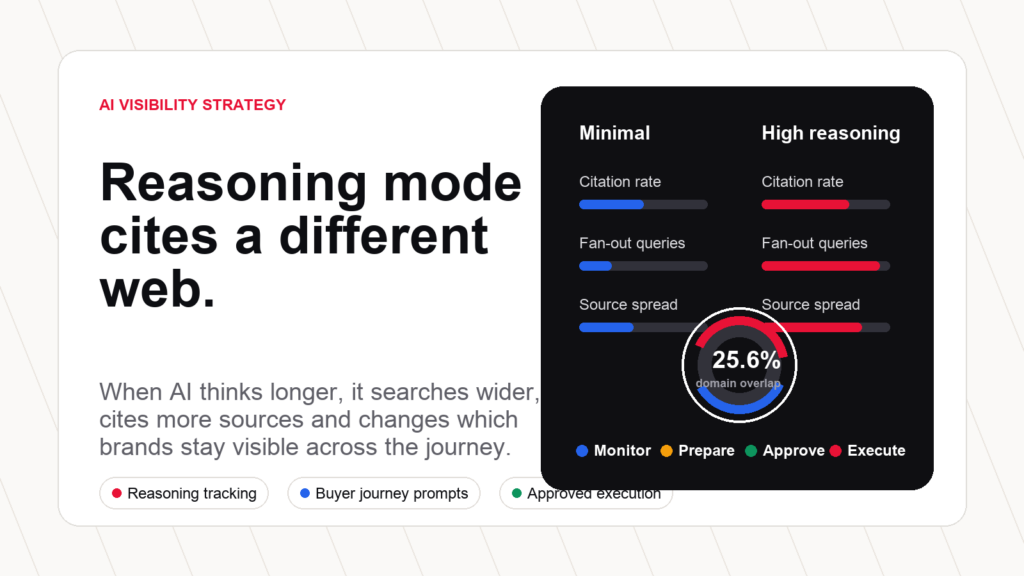
Summary: Kevin Indig’s Growth Memo analysis of “reasoning lift” points to a practical AI Search problem: the same prompt can produce a different set of cited sources when ChatGPT spends more time reasoning. Extended thinking does not just make a longer answer. It appears to widen query fan-out, pull from more domains, and change which brands become visible.
For SEO teams, agencies, business owners and SMEs, this matters because AI visibility is not a single ranking position. It is a moving surface made of prompts, follow-up questions, citations, source overlap, topical coverage and execution quality. In my opinion, this is exactly where SEO needs to move away from report-only workflows and toward Approved Execution systems.
What happened: reasoning mode changes the web an AI system sees
Growth Memo published a useful analysis called “Reasoning Lift: What Happens To AI Search When ChatGPT Thinks Longer”. The article compares thousands of ChatGPT responses in a default mode versus an extended-thinking mode and looks at how citations, domains and query fan-out change.
The central idea is simple and important: when the model spends more effort reasoning, the answer is not only more verbose. The retrieval behavior appears to change. The system searches more broadly, cites more sources and may choose a different set of documents. That means a business can be visible in one version of an AI answer and absent in another version of what feels like the same search journey.
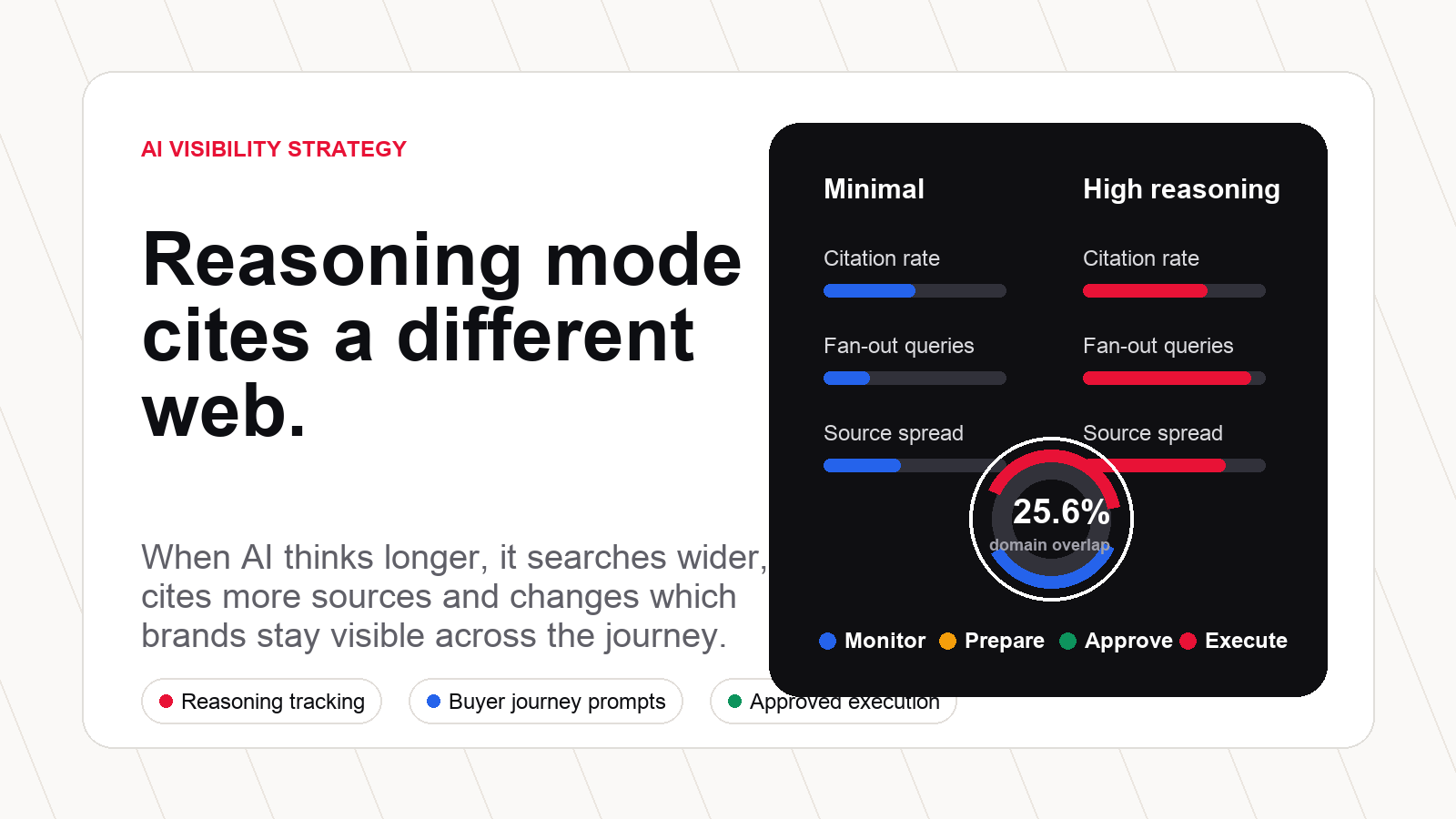
The Growth Memo article reports that extended thinking selected about 2.33 times more sources than the default experience, with average sources rising from 3.2 to 7.6 per response. It also reports a much larger jump in query fan-out: from 1,478 unique queries in the default dataset to 6,582 unique queries in extended thinking.
Those numbers should not be treated as a universal law. AI search systems change quickly. The dataset, prompt set, model version, interface and Retrieval Layer all matter. But the direction is very plausible: deeper reasoning can mean a broader search path, more intermediate questions and more chances for content to be included or excluded.
Why this matters for SEO, AEO and AI visibility
Classic SEO trained everyone to think in keywords, rankings and landing pages. That still matters. Google still crawls, indexes, ranks and evaluates pages. Search Console data is still one of the best sources of truth for how real people discover your site. But AI-assisted search adds a new layer: the system may decompose a broad question into several smaller information needs before generating an answer.
For example, a traditional SEO query might be “best pediatric clinic Bucharest.” An AI-style query could become a longer task: “I need a pediatric clinic in Bucharest for a toddler with recurring fever, preferably private, good reviews, easy parking and online booking. What should I compare?” That one request contains location, service type, audience, urgency, trust criteria, logistics and decision support.
If a website only has a generic service page, it may rank for a classic keyword but fail to support the richer AI answer. If another clinic has clear pages about pediatric consultations, online booking, parking, insurance, emergency guidance, doctor credentials, reviews and parent-friendly instructions, it gives the AI system more usable material.
This is the shift: AI visibility is not just “do we rank?” It is also “can the system understand us, trust us, cite us and use our content in a multi-step answer?”
Google’s own AI features guidance keeps the foundation practical: make content helpful, unique, satisfying, crawlable and indexable; make sure important resources are accessible; use Structured data that matches visible content; and avoid blocking Google from accessing pages and assets. In other words, AI search does not remove SEO fundamentals. It raises the cost of weak execution.
Query fan-out means one user question can become many invisible searches
Query fan-out is one of the most important concepts in AI search. Instead of handling a prompt as one literal keyword, the system can generate a set of related subqueries or research steps. It may look for definitions, comparisons, examples, prices, reviews, authority sources, official documentation and recent updates before writing the final answer.
That creates a new measurement problem. A business may not see the full fan-out in a standard rank tracker. The user asked one question, but the AI system may have evaluated ten or twenty information needs behind the scenes. Some of those needs look like classic SEO. Others look like entity verification, review extraction, source attribution, local context, product data, authority checking or topical coverage.
Growth Memo’s reported jump from roughly 1.5 unique queries per original query to about 6.6 unique queries per original query is a strong signal. Again, we should not over-generalize the exact numbers. But the direction is obvious: deeper reasoning increases the surface area on which a brand can win or lose visibility.
This changes how content should be planned. A page written only to repeat the main keyword is not enough. The page needs to answer the questions that support the decision. For a SaaS page, that may include workflow, integrations, pricing, use cases, limitations, comparisons and examples. For a local business, it may include location, opening hours, booking process, service area, reviews, parking, guarantees, staff credentials and common customer concerns.
For ecommerce, the fan-out can be even more aggressive. A single product question can trigger checks for product attributes, availability, price, delivery, return policy, brand trust, category alternatives, reviews, images, structured data and merchant feed quality. If those signals are scattered, missing or inconsistent, the business becomes harder to retrieve.
Classic rank tracking
- Keyword
- Position
- URL
- Clicks
AI visibility tracking
- Prompt families
- Source overlap
- Citation diversity
- Missing context
- Approved actions
Source overlap is the uncomfortable metric nobody can ignore
One of the most interesting parts of the Growth Memo article is the domain overlap number. The article reports 25.6% domain overlap between the default and extended-thinking citation sets. That means many domains that appeared in one mode did not appear in the other.
For marketers, this is a warning. You cannot look at one AI answer and assume you know your AI visibility. You might be visible in a short response, invisible in a deeper response, visible for comparison prompts, absent from recommendation prompts, cited for definitions, ignored for commercial decisions or mentioned in one geography but not another.
That is why “AI rank tracking” cannot simply copy the old rank-tracker model. It needs to measure clusters of prompts, intent variations, source overlap, citation frequency and the business context behind the answer.
In my opinion, the right question is no longer “what position are we?” The better question is: “Across the buying journey, which questions can AI systems answer with our website as a useful, trustworthy source?”
This also explains why content quality has to become more practical. A vague article about “SEO tips” is not enough. A useful article explains the problem, gives examples, cites sources, shows trade-offs, includes definitions, links to related concepts, and makes the next action clear. AI systems need extractable evidence. Users need useful answers. Google needs crawlable and indexable pages. Those requirements are converging.
Reasoning models make generic content less defensible
OpenAI’s documentation explains that reasoning models are designed for tasks that benefit from deliberate reasoning and that developers can control reasoning effort in supported models. In practical terms, the more effort a system spends on a task, the more likely it is to evaluate context, constraints and trade-offs instead of returning the first plausible answer.
That has SEO consequences. Thin content can survive shallow matching for a while. It is much harder to survive when the system has enough time and context to compare sources, resolve ambiguity and look for stronger evidence. The more reasoning a system applies, the more it can reward pages that are specific, structured and genuinely helpful.
This does not mean every page has to become a giant essay. It means every page needs a job. A service page should help a buyer understand the service. A category page should help a shopper compare options. A glossary page should define the term accurately and connect it to related concepts. A guide should show how to decide, not only what to memorize.
For SMEs, the risk is that content production becomes overwhelming. You cannot manually rewrite every page, build every internal link, monitor every AI prompt, check every technical issue and keep up with every Google update while running the business. That is the reason execution systems matter.
What SMEs should do now
Most small and medium businesses do not need to start by chasing every new AI search acronym. They need a durable operating model. The foundation is still boring in the best possible way: crawlable pages, fast templates, clear services, strong internal links, real examples, consistent entity information, structured data that matches visible content and useful answers to actual customer questions.
The difference is the rhythm. In the old model, a business might run an SEO audit once or twice a year, receive a spreadsheet, and then slowly implement part of it. In the AI search era, that is too slow. Query patterns, SERP layouts, AI features, competitor content and citation behavior can change continuously.
A practical SME workflow should look like this:
- Monitor classic search demand, Search Console data, important pages and AI visibility prompts.
- Identify pages that receive impressions but do not satisfy the user intent well enough.
- Map prompt families and customer questions, not just head keywords.
- Improve entity clarity: who you are, what you sell, where you operate, what makes you credible.
- Strengthen pages with examples, criteria, FAQs, structured content and internal links.
- Review technical blockers: indexability, canonicals, redirects, sitemaps, page speed and rendering.
- Approve meaningful changes before they go live.
- Track what changed and whether visibility improves over time.
That workflow is not glamorous. But it is how businesses become easier to understand, cite and recommend.
Where AYSA fits: from reasoning visibility to approved execution
AYSA is built around a simple belief: SEO should not stop at research. It should move toward approved execution. The reasoning-lift idea makes that even more important. If AI systems search wider and cite different sources depending on how they reason, then businesses need a system that continuously improves the website, not a static report that becomes outdated.
AYSA can help connect the dots between classic SEO, AEO, GEO and AI visibility. It can monitor signals, prepare actions, explain what matters, ask for approval and execute accepted changes inside the website workflow. That includes research, on-page improvements, technical fixes, internal linking, content planning, authority building and monitoring.
The human stays in control. AYSA should not publish blindly. But the business owner should not have to copy-paste recommendations from ten tools into WordPress either. The value is in the operating loop: monitor, prepare, approve, execute, learn, repeat.
Reasoning lift also changes how we think about content strategy. It is not enough to ask, “do we have an article about this keyword?” The better question is, “can our website support the reasoning path a buyer or AI system needs to make a good recommendation?”
That means a website needs topical coverage, trustworthy detail, structured information and continuous maintenance. For non-SEO users, AYSA’s role is to translate that complexity into clear approval-ready actions.
My take: AI visibility will reward execution discipline
The biggest mistake marketers can make is treating AI search as a trick. There will be many shortcuts sold under new names. Some will promise instant citations, guaranteed AI Overview inclusion or magical prompt hacks. I do not believe that is where durable value will come from.
AI search rewards systems that are easy to crawl, easy to understand, easy to verify and useful enough to cite. That is not a gimmick. It is SEO discipline with a broader retrieval surface.
The Growth Memo data is valuable because it shows how unstable “one answer” can be. If extended thinking cites a broader and different web, then AI visibility is probabilistic. You do not optimize for one screenshot. You optimize for coverage, clarity, trust and execution across many possible reasoning paths.
For business owners, the conclusion is simple: do not panic, but do not ignore it. Your website has to become a better source. Your content has to answer real questions. Your technical SEO has to stop wasting crawl. Your internal links have to make relationships obvious. Your brand entity has to be consistent. Your authority signals have to be earned and controlled. And your workflow has to move faster than the old audit-and-wait model.
Sources and further reading
Less SEO work. More organic growth.
Turn AI visibility research into approved website execution.
AYSA helps SMEs monitor SEO, AEO and AI search visibility, prepare useful website improvements, ask for approval and execute accepted changes inside the website workflow.
Continue the AI search topic inside AYSA.
Use these pages to connect the article with AI SEO tools, AI visibility monitoring, AI Overviews and approved website execution.
Turn this topic into a website action plan.
Use these AYSA hubs to move from reading to technical fixes, AI visibility monitoring, research, glossary context and approval-first SEO execution.

