Google Search Profiles: Why This “Creator Layer” Changes Authority, Clicks, and How SMEs Should Respond
Google is rolling out Search profiles: shareable pages that let publishers and creators centralize their presence and be followed from Search and Discover. Here’s what changed, why it matters for trust and distribution, and what SMEs and agencies should do next—plus how AYSA turns the strategy into approved, executed site changes.

By Marius Dosinescu (AYSA.ai)
Google just introduced Search profiles—a dedicated, shareable space meant to help publishers and creators “shape their presence” on Search and make it easier for audiences to follow their work across the web. The announcement is framed as a creator/publisher feature, but the strategic implication is bigger: Google is building a more explicit identity layer on top of the open web.
That matters for everyone who depends on Search—SMEs, agencies, ecommerce brands, local service businesses, SaaS companies—because identity features change how visibility works. When Search makes it easier to follow a source and see their latest content, the competitive unit shifts from “a page ranks” to “a source is trusted, recognized, and easy to engage with.”
This editorial breaks down what changed, why Google is doing it, what it will likely change about click dynamics and Authority Building, what can go wrong operationally, and what to do next. I’ll also show where AYSA fits: monitor, prepare, ask for approval, and execute accepted website changes so you can respond to shifts like this with speed and discipline—not chaos.
Concise summary

- Search profiles are shareable profile pages accessible through a Knowledge Panel, Discover, or direct URL, designed to centralize a publisher/creator’s content and links across platforms.
- They introduce a clearer “follow the source” mechanic in the Search ecosystem (not just “visit the page”).
- This reinforces a trend: entity-first search and source credibility matter as much as (or more than) individual Keyword targeting.
- SMEs should treat this as a prompt to improve brand and author identity, site trust signals, and content hygiene—so they’re eligible for richer presence as Google expands the feature.
- Execution is the bottleneck. Strategy without implementation loses. AYSA is built for that: monitoring + AI search visibility + proposed changes + approval + implementation.
Key takeaways (the business version)
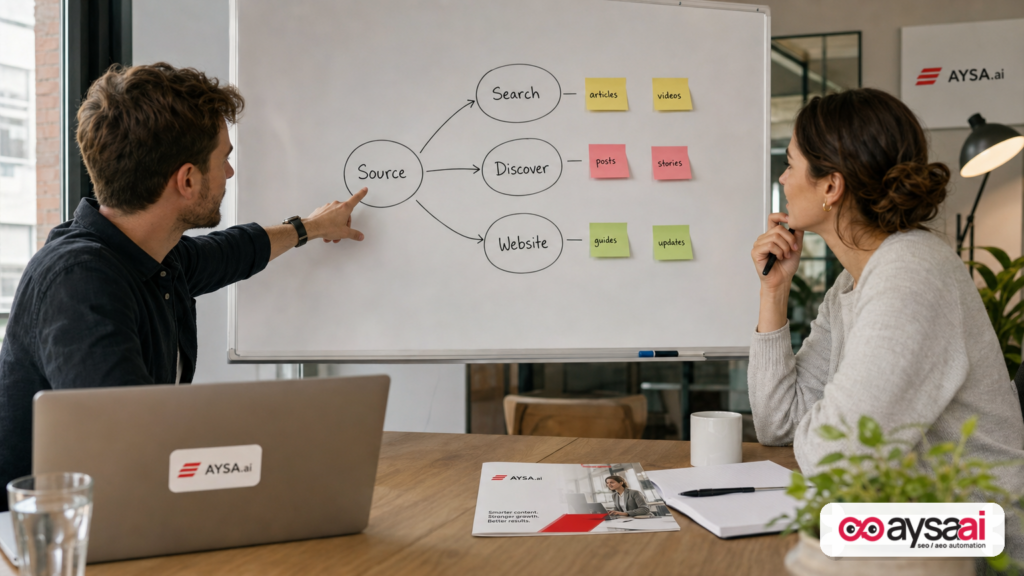
- Google is making “source” more navigable. If people can follow a source from its profile, distribution becomes more relationship-driven.
- Your website is still the trust anchor. Even if Google surfaces more profile-centric experiences, your site remains the canonical record you control (About, Contact, policies, credentials, author pages).
- Consistency is now a growth lever. Naming, bios, avatars, social links, and ownership signals matter more when Search packages your identity into a shareable object.
- Creators and publishers are the first wave; brands are in the blast radius. If you’re an SME, you compete with creator-led media all the time—this feature lowers friction for users to stick with those sources.
- Act now even if you can’t claim a profile. Improve entity signals, Structured data, Internal linking, and Content Freshness so you’re ready when eligibility broadens.
Table of contents
- What Google launched: Search profiles in plain English
- Context: the long shift from pages to entities and sources
- Why Google did this: Search is becoming identity- and source-centric
- How Search profiles connect to knowledge panels, Discover, and URLs
- The practical SEO reality: profiles won’t replace websites, but they will change click dynamics
- Who benefits (and who gets squeezed)
- What can go wrong: operational and reputation risks
- A concrete SME scenario: a local clinic competing with a creator-led brand
- What agencies should rethink: reporting, strategy, and execution
- Action plan: how to prepare your business for identity-first Search
- Where AYSA fits: from monitoring to approved execution
- What to do next
- Sources and further reading
What Google launched: Search profiles in plain English
Google’s announcement introduces Search profiles as a new, dedicated space for publishers and creators to shape how they appear on Search. In Google’s own framing, a profile is:
- Dedicated and shareable (a single place people can view and share).
- Cross-platform (it can surface a mix of articles, videos, and social posts).
- Followable (people can follow sources from the profile, increasing the odds that content shows up in Google Discover).
- Accessible from multiple entry points (knowledge panels, Discover, direct URL).
Google also notes that eligible publishers/creators can customize key identity elements—avatar, bio, website, and social/video platforms—and that claiming a profile may trigger a knowledge panel for eligible entities. If you already have a knowledge panel, it may be enhanced with the updated avatar, latest content, and a direct profile link. The initial rollout is US-only, with intentions to expand and add capabilities over time.
Primary source: Google Search Blog announcement.
Let’s translate this into business terms: Google is productizing “source identity”. Instead of the user assembling a picture of who you are from scattered signals (site, social, video, mentions), Google wants a single object in Search that represents “you” and can be followed.
Context: the long shift from pages to entities and sources
If you’ve been doing SEO for a decade, this won’t feel out of nowhere. Search has been moving toward entities (people, brands, organizations) for years. Knowledge panels, brand SERPs, and attribution features are all part of a trend: Google doesn’t just index pages; it tries to understand who is behind them and whether that source is credible.
Search profiles are essentially a new layer that makes that “who” more usable for humans. It’s not only that Google understands the entity; Google is now offering a front door to it.
From an editorial standpoint, I see three macro forces behind this move:
- User behavior is multi-platform by default. People discover a creator on video, verify on Search, then subscribe on social. Google wants to keep that loop inside Google surfaces as much as possible.
- Trust and authenticity are harder than ever. People need quick ways to verify: “Is this the real person/brand? What’s their latest? Where else do they publish?”
- Distribution is now relationship-driven. Following a source is a stronger signal than clicking a one-off result. Profiles formalize that.
None of this requires hype about the future of SEO. It’s a practical continuation of something business owners already experience: sometimes you don’t win because you wrote the “best” blog post—you win because you’re recognized as the most credible source in that niche.
Why Google did this: Search is becoming identity- and source-centric
Google’s stated intent is straightforward: help audiences find accurate, up-to-date information about sources and help creators/publishers highlight their work. That’s important language. “Accurate” and “up-to-date” are not only content quality terms—they’re also source governance terms.
Here’s the deeper business rationale I see:
1) Search wants fewer dead ends and more “known good” navigation
When a user searches a name, a brand, or a publication, they’re often not looking for a single page. They’re looking for the official home, the latest posts, the social handle that’s actually real, and maybe a way to subscribe. Profiles make that path shorter.
2) Discover is a distribution engine—and following matters
Google explicitly connects profiles to following and Discover visibility. That tells you something: Google wants more durable user-source relationships. Discover is not traditional query-based Search; it’s a feed. Feeds thrive on subscriptions, affinities, and preference signals. Profiles help generate those signals.
3) Identity is a safety feature, not just a marketing feature
From a platform perspective, identity reduces ambiguity. For users, it reduces the chance of confusing a real creator with an impersonator or a scraped content mirror. For Google, it can improve content attribution and reduce spammy “who even is this?” results. Profiles are a UX mechanism that aligns with those goals.
4) The web is fragmenting; Google is rebuilding a map
Publishers don’t just publish on their domain anymore. They publish on video platforms, social networks, newsletters, podcasts—sometimes with more reach than their own site. Search profiles are a way for Google to assemble those fragments into a coherent object users can navigate.
How Search profiles connect to knowledge panels, Discover, and URLs
Google’s announcement lists three access points:
- Knowledge panels (the information box in Search for notable entities), via mobile.
- Discover (tap the creator/publisher name to reach the profile).
- Direct URL (a shareable link to the profile).
That matters because it tells us what Google considers the profile to be: not an isolated feature, but a connective tissue between classic Search (knowledge panels) and feed-based discovery (Discover).
Two operational implications for businesses:
Knowledge panels are now more consequential
Historically, many SMEs treated knowledge panels as something that “happens if you’re famous.” But Google is signaling that profiles can be intertwined with panels: claiming a profile may trigger a panel for eligible publishers/creators, and existing panels may be enhanced.
For businesses, the lesson is not “go chase a knowledge panel at all costs.” It’s: entity consistency and legitimacy signals increasingly unlock product surfaces. If you’re sloppy with identity signals, you’ll miss out when Google expands these experiences beyond large creators.
Discover becomes a stronger reason to invest in brand voice and repeatable content
If following from a profile increases the likelihood that people see content on Discover, you have a new incentive to publish content that earns ongoing attention, not just one-time clicks.
AYSA readers: this is exactly where AI search visibility strategies need to be paired with a publishing cadence and on-site execution, or the upside stays theoretical.
The practical SEO reality: profiles won’t replace websites, but they will change click dynamics
Let’s address the fear that always shows up with new Search features: “Is Google trying to keep users from clicking websites?”
Google’s announcement doesn’t say that. It says profiles help users find accurate info about sources and follow them, and help creators/publishers highlight content across platforms. That can coexist with website clicks. But it will change how clicks are earned.
The shift: from “best page” to “best source”
Traditional SEO taught businesses to win by targeting keywords and building pages. That still matters. But profile-centric experiences reward:
- Recognizable source identity (consistent name, avatar, bio, official links)
- Content breadth (articles + videos + social posts, not just blog pages)
- Freshness (latest content visible at the source level)
- User affinity (following signals that feed into Discover)
That’s not a replacement for SEO—it’s a different layer of it. And it’s one that most SMEs are underprepared for because they outsourced “brand presence” to random social posting and never centralized identity.
Why your website still matters (maybe more than before)
Even if Google packages your identity nicely, your site remains the place where you can:
- Set canonical information (legal name, address, contact, credentials, policies)
- Publish deep content with full context (not platform-limited snippets)
- Control conversion (forms, checkout, bookings, trials)
- Build structured “aboutness” (service pages, author pages, editorial policies)
In an identity-first world, the website becomes the verification anchor. If a profile sends users to a site that looks thin, inconsistent, or untrustworthy, you lose the trust moment you just earned.
Expect more “brand SERP” optimization work
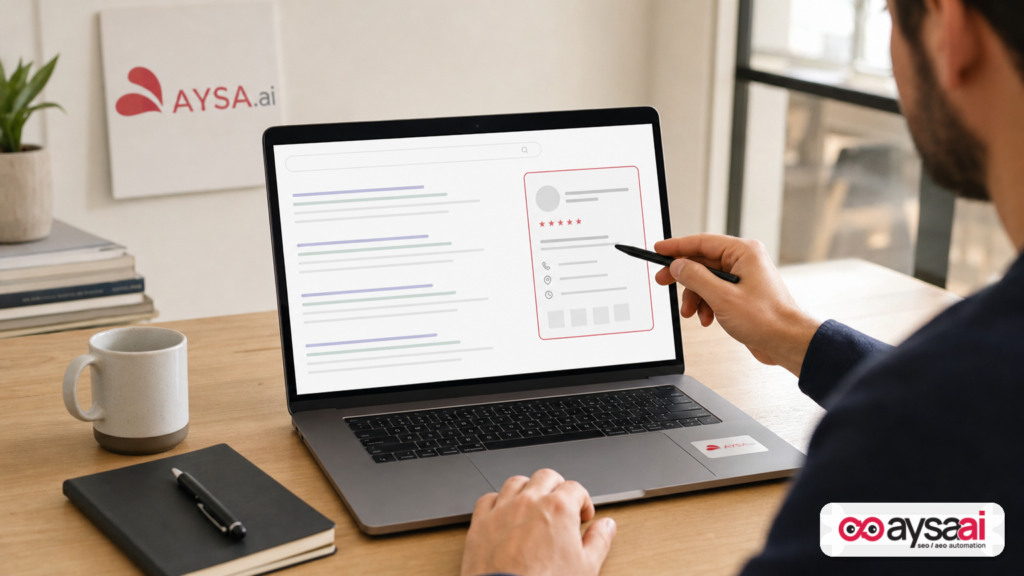
When a profile exists, brand searches become more interactive. The “right-hand area” (or panel area) and the source object itself become a major conversion surface—even if the conversion is “follow” rather than “buy.”
That means SMEs and agencies will spend more time on:
- Brand/creator naming consistency
- Official link hygiene
- Keeping “latest content” truly latest
- Making sure the owned site is the clean canonical source
Who benefits (and who gets squeezed)
Google says initial eligibility is for publishers and creators with a sizable following on at least one major social or video platform. So the first beneficiaries are obvious: people and organizations that already have distribution.
But the second-order effects will impact a much wider group.
Beneficiaries
- Creator-led brands (founders who are the brand). Their identity becomes a navigable asset.
- Publishers with multi-format content (text + video + social). A profile that aggregates formats reduces friction.
- Brands with disciplined content operations (consistent voice, consistent publishing, consistent profiles).
- Experts in sensitive niches where users need to assess credibility fast (health, finance, legal). Not because Google promises “rank boosts,” but because users will rely on identity cues more heavily.
Squeezed players
- Thin affiliate sites or anonymous niche sites that never built a real source identity.
- SMEs with fragmented presence (different names on different platforms, outdated bios, broken links).
- Agencies selling “SEO” as only rankings without helping clients build a credible entity and content system.
The uncomfortable truth: if Google makes it easier to follow trusted sources, attention concentrates. That’s great for quality sources. It’s rough for businesses that have been invisible behind generic content.
What can go wrong: operational and reputation risks
Any time a platform formalizes identity, you get a new class of failure modes. Some are technical; most are operational.
1) Inconsistent identity signals (the silent killer)
If your business name varies across your website, social profiles, directory listings, and your actual legal entity, you create ambiguity. Profiles make ambiguity more visible.
Fix: standardize naming (brand name, founder name), logo/avatar usage, and “official links” across your website and all platforms. Ensure your site’s About and Contact pages match reality.
2) Outdated bios and stale “latest content”
Profiles emphasize freshness. If your “latest” content is 18 months old, the profile experience can backfire: it highlights inactivity.
Fix: build a realistic publishing cadence. It can be monthly. It just has to be consistent and aligned with customer questions.
3) Over-optimizing for the profile while neglecting conversion
It’s tempting to treat a profile like the new homepage. But you don’t control the profile product. You control your site. If you forget that, you’ll end up with followers but no pipeline.
Fix: treat the profile as top-of-funnel. Ensure on-site journeys are crisp: clear services, proof, testimonials (where appropriate), pricing signals, booking/buying paths, and fast pages.
4) Reputation mismatch across platforms
Profiles centralize. That means your best and worst assets sit closer together. If your YouTube has momentum but your site looks neglected, users notice. If your website is credible but your social profile is chaotic, users notice.
Fix: audit your “front door assets” quarterly: website homepage, About page, primary social profiles, and your most visible content channels.
5) Eligibility confusion and wasted effort
Google is starting with creators/publishers who have sizable followings and launching in the US first. Many businesses won’t have access immediately. That creates a trap: people waste time chasing access instead of strengthening fundamentals.
Fix: focus on identity hygiene and content quality now. If and when profiles expand, you’ll be ready. If they don’t, you still improved your brand SERP and conversion trust.
A concrete SME scenario: a local clinic competing with a creator-led brand
Let’s make this real with a scenario that doesn’t require SEO jargon.
Business: A local physical therapy clinic in Austin.
Competitor: A fast-growing creator-led wellness brand (large Instagram/YouTube presence) that sells digital programs and has a blog.
Before Search profiles:
- The clinic relies on local search, referrals, and occasional blog traffic.
- The creator brand wins “informational” searches because they have lots of content and strong social proof.
- A user sees random pages; attribution is fuzzy.
After Search profiles (as this pattern expands):
- The creator brand can offer a clean, followable identity object: “Here’s who we are, here’s our latest, follow us.”
- Users can move from Search → profile → follow → Discover feed, staying in their ecosystem.
- The clinic still needs bookings, not follows. But the clinic now competes in a world where users are trained to trust sources that look unified and active.
What should the clinic do?
Step 1: Make the clinic an entity people recognize
- Create or improve a strong About page: who the clinicians are, credentials, philosophy, what conditions you treat.
- Add author pages for clinicians who write educational content (even short pieces). Tie articles to real people.
- Ensure name/branding consistency across the site and social platforms.
Step 2: Publish content that matches the clinic’s business model
- Not generic “what is back pain” posts. Instead: “what to expect from an evaluation,” “how we treat runners,” “insurance vs cash pay,” “recovery timelines,” “red flags that mean see a doctor.”
- Short videos can be repurposed as on-site FAQs and social posts.
Step 3: Turn trust into action
- Clear booking CTA, response-time promise, and location specifics.
- Policies that reduce anxiety (what to bring, what happens first visit).
This is the core message: Search profiles may launch for “creators,” but they raise expectations for everyone. Users increasingly expect sources to be real, current, and cohesive.
What agencies should rethink: reporting, strategy, and execution
If you run an agency, you’re probably thinking: “How do I sell and report on this?”
Here’s my take: agencies that keep reporting “rankings went up/down” will look increasingly out of touch. Profiles reinforce that visibility is distributed across multiple surfaces—Search, panels, Discover, and entity experiences.
What changes in strategy
- Brand SERP work becomes a standard deliverable. Not reputation management theater—real identity consistency and canonical signals.
- Content operations matter more than content volume. You need repeatable production, formatting, and updating.
- On-site trust assets become part of SEO. About, Contact, author identity, editorial standards, and clear customer pathways.
What changes in reporting
Without inventing new metrics, agencies can still report honestly by shifting to:
- Branded search health: are users finding correct, consistent identity and official links?
- Content freshness and coverage: are we answering the real customer questions comprehensively?
- Search surface readiness: structured data, internal linking, author pages, and indexation quality.
- Business outcomes: leads, bookings, revenue, not vanity.
Most agencies fail here for one reason: execution lag. The recommendations sit in docs. Clients don’t implement. Momentum dies.
This is precisely why we built AYSA as an execution system: propose changes, route for approval, then implement accepted changes—cleanly and consistently. See: AI SEO Tools and AYSA Monitoring.
Action plan: how to prepare your business for identity-first Search
You may not be eligible to claim a Search profile today. You might not be in the US. That’s fine. The preparation work is still valuable because it strengthens your entity and trust signals everywhere.
Here’s an actionable plan that an SME can execute without turning into an SEO nerd.
1) Audit your “official identity” in one hour
- What is your exact brand name? Is it consistent across the website header, footer, About page, and social profiles?
- Do you have one “official” homepage URL you always use?
- Is your avatar/logo consistent?
- Do your social links on the website point to the right profiles (and vice versa)?
Outcome: a short list of mismatches to fix first. Identity consistency is compounding value.
2) Build or fix your About + Contact pages (yes, this is SEO now)
These pages aren’t “fluff.” In identity-first Search, they are your credibility backbone.
- About page: who you are, what you do, why you’re qualified, where you operate, and what makes you different.
- Contact page: real contact methods, service area, hours, and clear next steps.
If you publish content, add a short statement about editorial quality (even just: “written by X, reviewed quarterly”). Don’t fake credentials. Just be transparent.
3) Create “source pages” that map to reality
If you’re a publisher/creator, you need a home on your site that mirrors your identity:
- Author pages for writers and experts (with bios, credentials, and links)
- A clean newsroom/blog hub that surfaces latest content
- A video hub if you publish video
If you’re an SME and the “creator” is the founder, treat the founder as a primary source entity. That can be a competitive edge.
4) Tighten your internal linking so Google (and users) can follow the story
Profiles emphasize “latest content,” but your site still needs to express structure: pillar pages, categories, related articles, and clear navigation.
For example, an ecommerce store selling running shoes should not have 50 disconnected blog posts. It should have:
- A “Shoe Finder” guide as a hub
- Supporting articles (trail vs road, sizing, injury prevention)
- Links from those articles to relevant categories/products
5) Refresh content you already have before creating more
Profiles and panels can highlight “latest.” But Search also rewards content that stays accurate. Update old posts with:
- Current recommendations
- Better structure (headings, summaries, FAQs)
- Clear authorship
- Improved internal links
AYSA is designed to help here by continuously scanning and recommending improvements as part of monitoring, then moving into approved execution.
6) Treat social/video as distribution—then bring authority back to your site
Search profiles highlight cross-platform content. That means your off-site content can feed your Search presence. But the goal for most SMEs is still: bookings, sales, pipeline.
So use platforms for reach, but ensure each platform points back to:
- Canonical service/product pages
- Lead magnets or booking pages
- Foundational guides that build trust
7) Set a simple, sustainable publishing system
Most SMEs fail because they either publish nothing or try to publish like a media company for two weeks and burn out.
Pick one:
- 1 high-quality piece per month that answers a high-intent question
- 2 short videos per month repurposed into on-site FAQs
- Quarterly updates to core evergreen pages
The point is repeatability. Profiles reward sources that look alive and consistent.
Where AYSA fits: from monitoring to approved execution
Most businesses don’t lose at SEO because they don’t know what to do. They lose because the work doesn’t ship.
Search profiles are a perfect example. The “strategy” is obvious:
- Centralize identity
- Publish consistently
- Keep information accurate
- Make your site the canonical trust anchor
But implementing that touches many moving parts: templates, About pages, author pages, internal links, schema/structured data, content refreshes, and cross-platform link hygiene. This is where AYSA is built to operate as an execution engine:
- Monitor: track your site’s search readiness and detect issues/opportunities continuously. See AYSA Monitoring.
- Prepare: generate prioritized recommendations for changes that improve visibility and clarity across AI search and classic search. See AI Search Visibility.
- Ask for approval: you stay in control. Nothing “auto-edits” your business-critical pages without your sign-off.
- Execute accepted changes: implementation happens cleanly—so improvements don’t sit in a spreadsheet.
That “approved execution” model is the difference between reading about Search changes and actually benefiting from them.
If you want to evaluate AYSA for your team (SME or agency), start here:
What to do next
Use this as a practical checklist. No jargon, no drama.
- Do an identity consistency audit (website name/logo/bio + social links) and fix mismatches.
- Upgrade About + Contact pages so they clearly communicate legitimacy and next steps.
- Add authorship and source structure (author pages, editorial ownership, clear content hubs).
- Refresh 5–10 important pages (services/products + best content) for accuracy and clarity.
- Build a lightweight publishing cadence you can sustain for 6 months.
- Monitor continuously so you see issues before they become traffic losses: AYSA Monitoring.
- Move from recommendations to execution using a system that requires approval but removes implementation drag: AYSA AI Search Visibility.
Search profiles are launching in the US first and for creators/publishers with sizable followings. But the strategic message is universal: Search is making sources more central. If you’re an SME, you need to look like a real, consistent, trustworthy source—because that’s increasingly how users decide who deserves attention.
Sources and further reading
- Google Search Blog: “A new profile to help publishers and creators highlight their work on Search”
- Google Security blog (useful background context on trust/safety topics from Google)
- Google Research blog (for broader context on how Google thinks about information systems)
- Google DeepMind blog (for broader AI ecosystem context)
- Google Developers blog (for technical ecosystem updates that often impact web operators)
- Google Cloud blog (not Search-specific, but relevant for teams building content/data infrastructure)
Note: This editorial is based on Google’s announcement and broader observed patterns in Search behavior. Google has not published (in the provided source context) detailed eligibility thresholds, ranking impacts, or performance metrics for Search profiles; where specifics are not verified, this article focuses on operational implications and risk-aware strategy.
Continue the AI search topic inside AYSA.
Use these pages to connect the article with AI SEO tools, AI visibility monitoring, AI Overviews and approved website execution.
Turn this topic into a website action plan.
Use these AYSA hubs to move from reading to technical fixes, AI visibility monitoring, research, glossary context and approval-first SEO execution.