Google Discover “Search Profiles” Are a Wake-Up Call: Build Followable Brands, Not Just Rankable Pages
Google is rolling out Search profiles inside Discover—enhanced publisher landing pages that let people follow a source and see its latest articles, videos, and social posts. For SMEs and agencies, this is more than a shiny new feature: it signals a shift from keyword traffic to audience relationships and from “ranking” to “being selected” in feed-based search experiences.

Google is rolling out a new feature inside Google Discover: Search profiles—enhanced landing pages for publishers and creators that let people follow a source and browse its latest articles, videos, and social posts in one place.
If you’re a publisher, this sounds like a distribution upgrade. If you’re an SME, ecommerce brand, local business, SaaS company, or agency, it’s something bigger: Google is making “the source” more important than “the page.”
And that’s the direction search has been moving for a while—toward feeds, reading sessions, AI answers, and selection mechanisms where the winner isn’t always the best-optimized URL. The winner is the brand Google can understand, trust, and confidently surface repeatedly.
In this editorial, I’ll break down what Search profiles are, why they matter even if you don’t qualify today, and what to do next—especially if you feel like Organic traffic is getting harder, slower, and less predictable.
Concise summary (what changed and what to do)

- What changed: Google is introducing Search profiles within Google Discover—a followable profile-style landing page for eligible publishers/creators that aggregates recent content across platforms.
- Why it matters: It accelerates a shift from keywords → audiences and one-off Clicks → repeat exposure. It also elevates identity/entity signals (Knowledge graph-style understanding) as a practical growth lever.
- What businesses should do: Treat your brand like a source: align identity across platforms, strengthen entity signals on your site, create a “follow-worthy” content cadence, and measure visibility beyond clicks.
- Where AYSA fits: This is exactly the kind of shift that punishes “strategy without execution.” AYSA monitors your visibility, prepares site changes, asks for approval, then executes the accepted work—so you can move faster without breaking things. See: Monitoring, AI search visibility, and AI SEO tools.
Table of contents
- What Google launched: “Search profiles” inside Discover (and what they’re really for)
- Eligibility and rollout: what we know (and what we don’t)
- Why this matters now: Search is becoming a feed, not a list of links
- Search profiles as a “relationship layer” on top of search
- Who benefits (and who gets squeezed) when following becomes the CTA
- The hidden requirement: identity and entity signals (Knowledge Panels, consistency, trust)
- Operational implications: how Discover changes content ops for SMEs and publishers
- Stop grading SEO like it’s 2019: visibility metrics that still matter
- A concrete SME scenario: the clinic that lost clicks—but gained patients
- What agencies should rethink: deliver “approved execution,” not just audits
- An execution-first playbook for SMEs (and what agencies should change)
- The AYSA perspective: execution, governance, and compounding brand signals
- What to do next (checklist)
- Sources and further reading
What Google launched: “Search profiles” inside Discover (and what they’re really for)
According to Search Engine Land, Google is rolling out Search profiles in the U.S. for publishers within Google Discover. The feature functions like an enhanced publisher landing page: a header image, a follow button, and a consolidated view of recent content—articles, videos, and social posts—in one place.
Source: Search Engine Land: Google introduces Search profiles within Google Discover.
Google’s public positioning (as described in the source) is straightforward: it’s a central place for sources to showcase content across platforms and make it easier for people to follow them—leading to more repeated exposure in Discover.
My take: Search profiles are not just a publisher feature. They’re another step in Google’s broader move from “index the web” to “curate sources.” When Google builds product surfaces that encourage following, it’s nudging users toward ongoing relationships—because relationships are sticky, measurable, and monetizable in ways that one-off organic clicks are not.
This is also a subtle admission: users don’t want to sift through ten blue links for everything. Sometimes they want a trusted stream of updates from sources they recognize. That’s Discover’s DNA, and Search profiles reinforce it.
What you should notice about the design (even if you haven’t seen it)
- The unit of value becomes the source (publisher/creator), not the individual URL.
- Following is the new micro-conversion—a “soft subscription” inside Google’s ecosystem.
- Cross-platform aggregation matters: articles + video + social in one view. That’s not accidental; it’s Google acknowledging that content lives across formats and channels.
Eligibility and rollout: what we know (and what we don’t)
Per Search Engine Land’s reporting, Search profiles are rolling out first in the U.S. and initially to publishers/creators with a “sizable following” on at least one major social or video platform. The article referenced minimum follower/subscriber thresholds (e.g., TikTok, YouTube, Instagram, X) as part of eligibility.
Two practical implications for most SMEs:
- You may not qualify today—and you might never want to. But the product direction still affects you because it shows where Google is investing attention.
- Google is using off-Google signals (social/platform audiences) as a proxy for “real-world prominence.” Whether we like it or not, that’s a hint about how Google decides which sources deserve enhanced surfaces.
What we don’t know (and shouldn’t guess): how quickly this expands, whether thresholds change, how profiles impact Discover distribution, and how much control sources will truly get long-term.
Why this matters now: Search is becoming a feed, not a list of links
If you run a business website, you’ve felt the trend: even when rankings hold, clicks can soften. Users are spending more time “reading” directly in search experiences, comparing summaries, and bouncing between surfaces that aren’t classic SERPs.
Search Engine Land framed this broader change across multiple articles in its recent coverage, including topics like AI Overviews turning search into “reading sessions,” AI performance reporting in Search Console, and tracking AI visibility when Attribution falls short. Those headlines align with a single reality: Google is redesigning the journey.
Relevant context links from the same publication (as research leads):
- What to do now that AI Overviews turned search into reading sessions
- Google Search Console AI performance reports and controls to block your content in AI responses
- 4 ways to track AI search visibility when attribution falls short
- Why so much SEO work no longer drives growth
Search profiles in Discover fit into this exact pattern. Discover is essentially a personalized feed. If Google can make that feed more “source-centric,” it increases retention inside Google’s app, increases repeat engagement, and creates new ad and subscription-like dynamics.
A simple mental model for non-SEO operators
Old model:
- User has a question → searches → clicks a page → leaves Google.
New model (increasingly common):
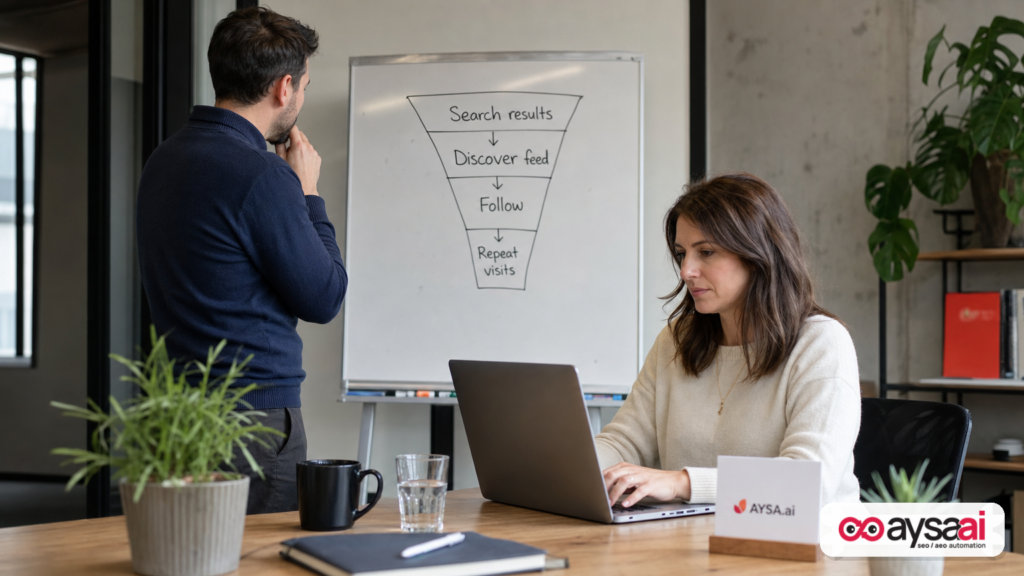
- User has a question → gets an overview/summary → scrolls related sources → follows a source → continues consuming in-feed.
In that new model, you don’t “win” by ranking for one Keyword. You win by becoming a source Google keeps resurfacing.
Search profiles as a “relationship layer” on top of search
Let’s call this what it is: a relationship feature. A follow button inside Google’s ecosystem is a mechanism for:
- Preference signaling: users tell Google what they want more of.
- Distribution certainty: creators/publishers get a chance at repeat impressions without relying solely on fresh queries.
- Brand reinforcement: repeated exposure makes a name familiar. Familiar names get clicked more—on Google and elsewhere.
This is why I say Search profiles matter even if you’re a plumber, a boutique hotel, a niche ecommerce store, or a B2B SaaS company. You’re not competing only on “best page for keyword X.” You’re competing for mental availability—being the brand that comes to mind, and the source Google can confidently attach to a topic.
A shift in what you optimize
Traditional SEO asks:
- Is this page relevant?
- Is it authoritative?
- Is it technically accessible?
Discover + Search profiles add:
- Is this source follow-worthy?
- Is the source identity consistent across the web?
- Can Google verify this source is “real” and reputable?
- Does the source publish with a cadence and format mix that fits a feed?
Who benefits (and who gets squeezed) when following becomes the CTA
Search profiles could be great for:
- Publishers who already produce frequent updates and want a centralized presence.
- Creators who span multiple platforms and need Google to connect the dots.
- Brands with a point of view (not just product pages)—think experts, analysts, educators, and operators with strong content programs.
But it can squeeze:
- Thin affiliate sites and generic content farms—if Google leans harder on identifiable sources.
- Small brands that only “exist” on their website with no consistent identity footprint elsewhere.
- Businesses that publish sporadically and can’t maintain topical momentum.
This isn’t “good” or “bad.” It’s a product direction. Your job is to adapt your distribution and measurement so your marketing isn’t fragile.
The hidden requirement: identity and entity signals (Knowledge Panels, consistency, trust)
The source report notes that claiming a Search profile may trigger the creation of a Knowledge Panel for eligible publishers/creators, and that existing Knowledge Panels may be enhanced with updated elements and a direct profile link.
This is the part business owners should pay attention to: entity infrastructure.
When Google can represent you as an entity (a known “thing” in its systems), it can:
- Resolve ambiguity (you vs. similarly named businesses)
- Connect your site to your social/video presence
- Confidently display rich experiences (profiles, panels, carousels, cards)
Even without Search profiles, this is aligned with how Google has discussed organizing information via entities and the Knowledge Graph for years. If you want official background, Google’s longstanding framing of the Knowledge Graph is a useful reference point: Google Search Central: Introduction to structured data.
Entity consistency: what it looks like in practice
For SMEs, “entity optimization” isn’t mystical. It’s mostly consistency + clarity:
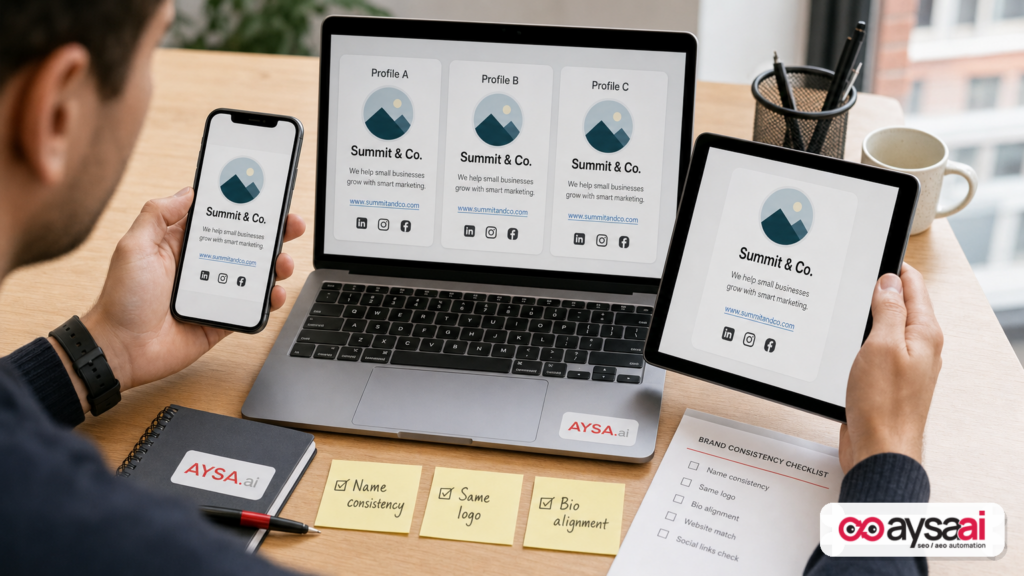
- Use the same business name everywhere (site, profiles, directories, social)
- Use a consistent logo/avatar
- Have a real About page with leadership, address (if relevant), contact methods
- Use clear author attribution for editorial content (where appropriate)
- Interlink your official profiles from your site
- Make it easy for Google to understand what you do, who you serve, and where you operate
This is also where technical and content SEO intersect. If your site has inconsistent brand naming, unclear ownership, or missing “who we are” context, it’s harder for systems—human and AI—to trust you.
Operational implications: how Discover changes content ops for SMEs and publishers
Discover is not classic query-driven search. You don’t “rank” for a keyword the same way. You earn distribution through relevance, engagement signals, topical alignment, and freshness (among other factors that Google doesn’t fully disclose).
That means your operation changes:
- Cadence matters: a feed wants steady updates.
- Packaging matters: titles and featured images become decision points.
- Format mix matters: text-only is often weaker than a blended approach (articles + short videos + visuals).
- Topical focus matters: you want Google to associate you with a tight cluster of themes you can own.
And yes: your website still matters. It’s your canonical home. It’s where you control conversion, compliance, retention, and first-party data. But you must treat the website as part of a broader presence—not the only presence.
The cost of random content
Many SMEs publish content in bursts:
- “We need traffic; let’s blog.”
- They publish 12 posts in 2 months.
- Then nothing for a year.
In a Discover-and-follow world, that pattern builds no relationship. If you want repeat exposure, you need a repeatable production system—even if it’s lightweight.
Stop grading SEO like it’s 2019: visibility metrics that still matter
If Search profiles and other Google surfaces reduce click dependency, the KPI conversation has to mature. Not because “traffic doesn’t matter,” but because traffic is increasingly downstream of visibility and trust.
Here are metrics that still matter, especially for SMEs:
- Branded search demand: are more people searching your name + category?
- Discover visibility: are your pages getting discovered by people who weren’t searching for you?
- Share of high-intent queries: are you present when the customer is ready to buy?
- Conversion rate from returning users: repeat exposure should improve conversion quality.
- Assisted conversions: visibility can influence later direct visits and branded queries.
Search Engine Land has also been highlighting the need to track AI search visibility when classic attribution fails. That’s the right mindset: build reporting that reflects reality, not nostalgia. See: 4 ways to track AI search visibility when attribution falls short.
What not to do
- Don’t panic and declare “SEO is dead.” That’s usually an excuse for not doing the hard work.
- Don’t chase vanity “AI share of voice” screenshots with no connection to pipeline. (Even the industry is calling out shallow metrics—see the related Search Engine Land context: The problem with AI share of voice and 3 metrics that matter more.)
- Don’t bet your business on one surface (SEO, Discover, ads, TikTok). Diversification is not optional anymore.
A concrete SME scenario: the clinic that lost clicks—but gained patients
Let’s make this real with a scenario that mirrors what many SMEs are experiencing.
Business: a local dermatology clinic with two locations.
Old strategy: publish SEO articles like “What causes acne?” and “Best sunscreen for oily skin,” expecting steady Google traffic and appointment bookings.
What changes:
- More search experiences become “reading sessions”—users get a quick overview, then browse sources.
- Discover surfaces more health/skin content, especially from identifiable sources.
- The clinic’s traffic from informational posts softens. The owner panics.
What the clinic does next (the adapt-and-win path):
- They strengthen identity signals on-site: physician bios, credentials, a clear About page, consistent NAP (name/address/phone), and tightly interlinked service pages.
- They repackage content for “source trust”: every article shows the medical reviewer, last-updated date, and points to the clinic’s actual treatment pages.
- They publish with cadence: one high-quality article per week and two short “myth vs fact” updates repurposed across platforms.
- They measure beyond clicks: branded search increases, returning visitors rise, and consultations improve—even if top-of-funnel clicks are volatile.
This is the new game: become the source people (and systems) trust, not just a page that happens to rank.
What agencies should rethink: deliver “approved execution,” not just audits
Search profiles reinforce a painful truth for agencies: strategy is cheap; implementation is rare.
In a more volatile search environment—AI features, Discover feeds, source-centric surfaces—the winners are the teams that can:
- Detect changes early (monitoring)
- Translate them into a prioritized plan (analysis)
- Ship improvements safely (execution)
- Do it repeatedly (process)
Audit decks don’t ship. Roadmaps don’t rank. Jira tickets that never get implemented don’t build brand authority.
This is why AYSA’s model matters: monitors → prepares → asks for approval → executes. It’s not “set and forget.” It’s governance plus speed—especially important when you need to adapt content structure, internal linking, schema, on-page clarity, and brand identity signals without breaking production websites.
If you’re an agency, this is also a margin opportunity: productize execution, not just recommendations.
An execution-first playbook for SMEs (and what agencies should change)
Below is a practical playbook designed for resource-constrained teams. You don’t need to do everything. You need to do the right things, in the right order, and keep doing them.
1) Treat your brand as a “source” (even if you’re not a publisher)
- Decide what you want to be known for (3–5 topics max).
- Create a simple editorial stance: what do you believe that customers find useful?
- Publish consistently enough to be remembered.
If your content reads like it was written by a committee to satisfy keywords, you won’t be follow-worthy. Make it useful, opinionated where appropriate, and grounded in your real operations.
2) Fix identity basics on your website (the “entity hygiene” checklist)
Minimum viable “entity hygiene” for most SMEs:
- A clear About page (who you are, what you do, where you operate)
- Consistent business name and logo across the site
- Clear contact information and trust elements (policies, customer support, returns if ecommerce)
- Author/reviewer attribution for educational content (where relevant)
- Internal links that connect educational content → service/product pages
AYSA can help operationalize this via ongoing monitoring and executed fixes after approval: AYSA Monitoring.
3) Build a “Discover-friendly” packaging system
Even if you never see a Search profile, your packaging affects CTR and engagement in many surfaces.
- Titles: clear, specific, benefit-led; avoid clickbait that doesn’t deliver.
- Featured images: high-quality, consistent style; avoid text-heavy thumbnails.
- Freshness signals: update important pieces; show what changed.
- Content blocks: use scannable sections, FAQs, and clear next steps.
If you’re serious about discoverability, your design system becomes part of SEO.
4) Publish across formats—but anchor to your site
Search profiles aggregate across platforms. That’s a hint: Google wants to connect the dots.
- Turn one strong article into: a short video, a social post, a newsletter segment.
- Always link back to a canonical page on your site where conversion happens.
This isn’t about chasing every channel. It’s about creating multiple “verification points” for your brand and expertise.
5) Monitor what SEO tools miss: server logs and bot behavior
As Google evolves, technical visibility matters: how bots crawl, what they skip, how frequently key templates get revisited.
Search Engine Land recently highlighted why server logs reveal what SEO tools miss. That’s a good reminder that crawl reality is not always what your SaaS dashboard suggests: What server logs reveal that SEO tools miss.
You don’t need to become a log analyst—but you do need someone (or a system) to catch technical drift before it becomes a revenue problem.
6) Prepare for AI-mediated discovery: AEO/GEO fundamentals
Whether we call it AEO (answer engine optimization) or GEO (generative engine optimization), the operational need is similar: make your content easy to interpret, attribute, and trust.
- Write in a way that’s quotable and verifiable.
- Make claims you can support on your own site.
- Use clear structure (definitions, steps, pros/cons, comparisons).
- Maintain a consistent brand voice and expertise footprint.
If you want a practical starting point for tracking and improving AI-era visibility, AYSA keeps resources here: AI Search Visibility and AI SEO Tools.
7) Align stakeholders: visibility first, conversion second, attribution last
This is a hard conversation, but necessary.
- Visibility (impressions, inclusion, presence) is increasingly upstream of clicks.
- Conversion remains the business goal.
- Attribution will get messier, not cleaner.
So your reporting needs to show leading indicators (visibility, branded demand) and lagging indicators (leads, revenue). Otherwise you’ll cut the exact work that creates the next quarter’s growth.
The AYSA perspective: execution, governance, and compounding brand signals
Search profiles inside Discover are a reminder that the “SEO checklist” era is over. The new requirement is ongoing adaptation.
At AYSA, we treat modern organic growth as an execution system:
- Monitor: detect changes in visibility and performance early (including AI-era surfaces where possible).
- Prepare: generate prioritized recommendations and concrete changes (not just advice).
- Approval: you stay in control—nothing ships without review.
- Execute: accepted changes get implemented so you actually move forward.
This matters because most businesses don’t lose to competitors on “knowing.” They lose on “doing.”
If you want to explore whether AYSA fits your stage and budget, start with:
- Pricing (so you can evaluate without a sales maze)
- Blog (to see how we think about execution and AI-era SEO)
- Monitoring (because you can’t optimize what you don’t observe)
What to do next (checklist)
Use this as a practical next-steps list for the next 2–4 weeks.
In the next 7 days
- Audit your “identity footprint”: business name, logo, About page, contact info, and official social links on your site.
- Pick 3–5 topics you want to be known for. Remove the rest from your content priorities.
- Identify your top 10 pages that represent your expertise or revenue. Ensure each has clear next steps and internal links.
In the next 30 days
- Create a lightweight publishing cadence you can sustain (even 1x/week is fine if consistent).
- Standardize content packaging: titles, images, author/reviewer blocks, last updated.
- Repurpose one piece of content into at least two formats (short video + post) and link back to your site.
- Start tracking visibility KPIs beyond clicks (branded demand, returning users, assisted conversions).
In the next quarter
- Build a “source-quality” library: 10–30 pieces that are truly better than what’s ranking today.
- Improve technical crawl efficiency (consider server log reviews if you have scale or frequent publishing).
- Systematize execution—either with an internal owner, an agency that ships, or an execution platform like AYSA.
Sources and further reading
- Search Engine Land: Google introduces Search profiles within Google Discover
- Search Engine Land: What to do now that AI Overviews turned search into reading sessions
- Search Engine Land: Google Search Console AI performance reports and controls to block your content in AI responses
- Search Engine Land: 4 ways to track AI search visibility when attribution falls short
- Search Engine Land: What server logs reveal that SEO tools miss
- Google Search Central: Introduction to structured data
Note: Some details about Search profiles (eligibility thresholds, rollout pace, and measurable impact on Discover distribution) may evolve. Where official Google documentation is not included in the provided research context, I’ve treated forward-looking claims as analysis rather than certainty.
Continue the AI search topic inside AYSA.
Use these pages to connect the article with AI SEO tools, AI visibility monitoring, AI Overviews and approved website execution.
Turn this topic into a website action plan.
Use these AYSA hubs to move from reading to technical fixes, AI visibility monitoring, research, glossary context and approval-first SEO execution.