The UK Just Forced an “Opt-Out” Button for AI Search: What It Means for Publishers, SMEs, and Everyone Fighting for Visibility
The UK’s CMA is requiring Google to let sites opt out of AI search features and to improve attribution. This is more than a policy tweak—it’s the beginning of an operational shift in how businesses should manage content rights, traffic risk, and AI-era visibility.

AI Search is no longer a “feature.” It’s becoming the interface between customers and the web. And that means the rules of the visibility game are shifting from rankings and blue links to something more fundamental: whether your content is used at all, how it’s attributed, and what control you have over the outputs built on top of it.
That’s why the UK’s Competition and Markets Authority (CMA) decision to require new controls for publishers—specifically the ability to opt out of AI search features and improve Attribution—matters far beyond the UK. It’s a regulatory acknowledgment of something publishers, ecommerce brands, local businesses, and agencies have been feeling for months: AI answers change the economics of the open web.
This editorial is written from my perspective as Marius Dosinescu at AYSA.ai. I’ll explain what the UK changed, why it matters to SMEs (not just publishers), what can break operationally if you ignore it, and what an execution system should look like in an AI-search world—especially when the stakes include both traffic and rights.
Concise summary
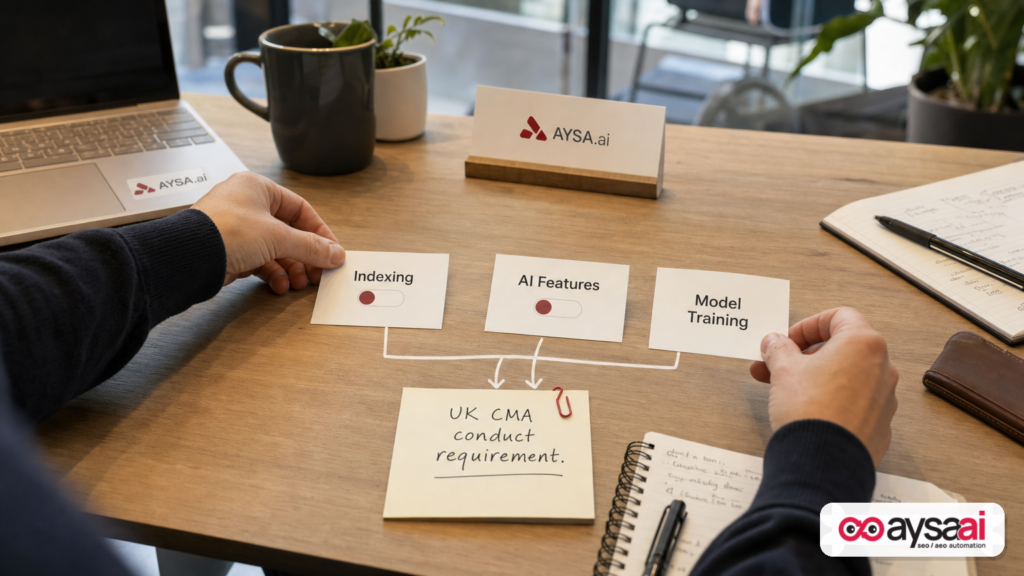
- The UK CMA has imposed a new conduct requirement on Google Search tied to Google’s strategic market status, requiring publisher controls over AI search feature usage, controls for AI model training, and clearer attribution in AI results. Source: Search Engine Journal.
- If implemented as described, it could reduce the current “all-or-nothing” tradeoff where blocking AI extraction can also harm normal search snippets.
- Even if your business is not a publisher, the same mechanics affect you: your pages may be used to answer queries without a click, and attribution quality will influence whether you’re discovered or commoditized.
- Businesses should prepare with: (1) Monitoring AI visibility, (2) attribution audits, (3) content and schema hygiene, (4) a policy stance on AI usage, and (5) a controlled execution workflow.
- AYSA’s role: monitoring what AI says and cites, recommending changes, asking for approval, and executing accepted website changes—so AI-era SEO/AEO/GEO is operational, not speculative.
Key takeaways (for busy operators)

- Opt-out controls create leverage. If publishers can selectively restrict AI feature usage without sacrificing normal indexing, bargaining power shifts—even if only modestly at first.
- Attribution becomes a competitive surface. In AI results, “being #1” matters less than “being cited clearly” with a link users trust and can act on.
- AI search is not just a Google issue. The same operational discipline you build for Google will help across AI assistants and AI-first discovery experiences.
- Execution is the new moat. The winners won’t be the brands with the most opinions—they’ll be the ones who monitor, decide, and ship improvements consistently.
Table of contents

- What the UK CMA Actually Changed (And What It Didn’t)
- Why This Is Happening Now: AI Search Is Rewriting the Value Exchange
- The Hidden Tradeoff Publishers Have Been Living With: “Nosnippet” Or Nothing
- What “Opt Out of AI Features” Might Mean Operationally (Without Assuming Implementation)
- Attribution Isn’t Cosmetic—It’s the New Distribution Layer
- Why SMEs Should Care Even If They Don’t Publish News
- SME Scenario: A Local Clinic, A Competitive Market, And A Sudden Drop In Calls
- What Agencies and In-House Teams Need to Rethink
- What to Monitor Weekly: AI Visibility, Citations, and Demand Capture
- A Practical Action Plan (30/60/90 Days)
- How AYSA Helps: Monitor → Recommend → Get Approval → Execute (No Guesswork)
- What Can Go Wrong: Risk, Compliance, and Unintended Consequences
- What to do next
- Sources and further reading
What the UK CMA Actually Changed (And What It Didn’t)
Based on reporting from Search Engine Journal, the UK CMA has imposed a new conduct requirement on Google Search under the UK’s digital markets framework. The key elements that matter operationally are:
- Publisher control to opt out of AI search features (examples given include AI Overviews and AI Mode).
- Publisher control to opt out of AI model training using their content (the CMA described this as a “world first” in the source reporting).
- Clearer attribution with links in AI-generated results, so users can better understand and trust what they’re seeing and where it came from.
There are also timeline and oversight details: requirements come into effect after a period (the source reports six months for most requirements and nine months for page-level controls), plus ongoing compliance reporting to the CMA.
What this is not:
- It is not a declaration that Google “broke the law” (the source notes the designation is not a finding of competition law violation).
- It is not yet a published technical spec you can implement today. The source explicitly states Google has not said how opt-out will work (robots.txt, Search Console, etc.).
- It is not a global standard—yet. It applies to the UK regime as described. But operationally, the trend is bigger than geography.
As an operator, this is the important mental shift: regulators are forcing the separation of “indexing” from “AI usage.” Historically, those concepts have been tightly coupled in practice. If they become separable, content owners gain a new control surface—and search platforms gain a new compliance surface.
Why This Is Happening Now: AI Search Is Rewriting the Value Exchange
For two decades, the implicit deal of search looked like this:
- You publish useful content.
- Google indexes it and ranks it.
- Users click through to your site.
- You monetize via ads, subscriptions, leads, sales, or brand lift.
AI search features (and AI-first interfaces more broadly) don’t just rank pages. They compose answers. That can reduce the need to click, or shift clicks toward a smaller number of citations. When the interface becomes the destination, the “value exchange” gets blurry:
- Who owns the customer relationship when the answer is delivered on the search results page?
- What does “traffic” mean if the user never visits the source?
- What is a fair bargain for content usage when the output is derivative and distributed at scale?
You don’t need to be a media company to feel this. If you’re a local service business, AI answers can absorb informational intent before the user reaches your booking page. If you’re ecommerce, AI summaries can compress product research into a single blob of “recommended options.” If you’re SaaS, AI can turn your detailed guides into a synthesized checklist that never mentions your product.
So the UK CMA’s move is not random. It’s a reaction to a structural shift: AI features move value away from the open web’s long tail and toward the interface owner. The conduct requirement is an attempt—imperfect, but meaningful—to reintroduce control, clarity, and bargaining leverage.
The Hidden Tradeoff Publishers Have Been Living With: “Nosnippet” Or Nothing
The source article highlights a painful reality: one common way to keep content out of AI Overviews has been using directives like nosnippet, but that can also remove standard search snippets—hurting normal search performance and click-through rate.
For non-SEO readers, here’s the plain-English version:
- A “snippet” is the short preview text Google shows under a result.
- Many publishers and businesses rely on that snippet to win the click.
- Some controls that restrict snippet usage can be too blunt—like turning off the lights to save electricity. Yes, you reduce consumption, but you also can’t see.
If the CMA requirement results in a clean separation—“don’t use my content in AI Overviews, but you can still index and show normal snippets”—that’s a big operational unlock. It turns a binary decision into a configurable strategy.
But caution: we should not assume implementation details that haven’t been announced. What matters today is preparing your internal decision-making and monitoring so you can act quickly when the controls become real.
What “Opt Out of AI Features” Might Mean Operationally (Without Assuming Implementation)
The SEJ reporting notes Google hasn’t specified whether controls will be via robots.txt, Search Console, or another method. We can’t invent the spec. But we can prepare for the operational reality: you may soon have multiple levels of permissions.
1) Indexing permission
This is the classic SEO layer: can the crawler fetch, render, and index the page?
2) Snippet/preview permission
This determines how your content is displayed in traditional results (titles, descriptions, rich results). This is where the historical “tradeoff” has lived.
3) AI feature permission
This is the new battleground: can your content be used in AI-generated summaries or answer modules?
4) Model training permission
Separate from search display: can your content be used to train AI models? This can affect future outputs even if your page isn’t cited at query time.
If you’re a business owner, the key is not memorizing directives. The key is designing a policy that matches your business model:
- If you sell services, you may want AI answers to cite you for trust and conversion.
- If you sell information (subscriptions, research), you may want to restrict AI usage more aggressively.
- If you’re a hybrid (e.g., ecommerce with educational content), you may want different rules by section: guides vs. category pages vs. product pages.
That implies your site architecture and CMS governance matter more than ever. When controls are page-level, you’ll want clean templates, clear content types, and consistent metadata—so you’re not managing permissions one URL at a time like it’s 2007.
Attribution Isn’t Cosmetic—It’s the New Distribution Layer
The CMA requirement includes clearer attribution with links in AI-generated results. This matters for three reasons.
1) Trust
If users can’t see sources, they treat the AI answer as “the truth,” and you lose the chance to build credibility. Links are not perfect, but they are the basic mechanism of web trust.
2) Click economics
In AI interfaces, the click is no longer the default. It’s a choice. The quality, clarity, and placement of citations will strongly influence whether a user visits your site—or just stops at the summary.
3) Brand positioning
Attribution is a ranking layer. If the AI answer cites Reddit but not your official documentation, you’re not just losing traffic—you’re losing narrative control. (The SEJ page context includes an adjacent headline about AI citing Reddit; we can’t rely on that as proof of universal behavior, but it reflects the broader industry conversation around what sources get elevated.)
From an operator standpoint, the question becomes: Are you building content that is cite-worthy and easy to attribute? That means clarity, structure, and consistency—plus technical elements that help machines understand what’s what.
Why SMEs Should Care Even If They Don’t Publish News
There’s a temptation to treat this as a “publisher problem.” That’s a mistake.
SMEs have two big exposures in AI search:
Exposure #1: Demand capture gets compressed
AI search can compress the top and middle of the funnel. Instead of “read 5 articles, compare options, then decide,” the user asks one question and gets a synthesized action plan.
If your business relies on informational content to earn trust before conversion—think clinics, legal services, home services, B2B SaaS—this compression can reduce the number of touchpoints you get with a customer.
Exposure #2: Facts about your business can be wrong or inconsistent
When AI summarizes, it may pull from multiple sources: your site, directories, third-party reviews, outdated pages, or scraped copies. If your brand data is inconsistent, the AI output can be inconsistent too—hours, pricing ranges, service areas, product compatibility, policies, and so on.
This is where AI search visibility becomes practical, not theoretical. It’s not just “do we rank?” It’s “what is the machine saying, and is it accurate, attributable, and conversion-friendly?”
SME Scenario: A Local Clinic, A Competitive Market, And A Sudden Drop In Calls
Let’s make this real with a scenario that mirrors what many SMEs experience, without relying on invented metrics.
Business: A local clinic in the UK (or serving UK search users), offering a few high-intent services in a competitive metro area.
What changes: A patient searches “best treatment for X” or “how to choose a clinic for Y.” AI Overviews (or similar AI features) summarize the answer, list a few factors, and cite a handful of sources. The patient gets most of what they need without clicking. If the clinic is cited at all, the link is small or buried, or the citation goes to a third-party directory instead of the clinic’s own page.
What the clinic feels:
- Fewer phone calls for “research” queries.
- More “bottom of funnel” calls—but only from people who already decided.
- More confusion at the front desk: patients referencing AI statements that don’t match clinic policies.
What a good response looks like:
- Monitor what AI outputs say for the clinic’s head terms and common questions.
- Audit attribution: when the clinic is cited, which page? Is it the best landing page for conversion? If not, fix internal linking and information architecture.
- Harden facts: ensure consistent service descriptions, pricing policy language (if applicable), hours, and location info across the site and key citations.
- Create “citation-ready” pages: short, structured, definitive pages that are easy for AI to quote and for users to trust.
Notice what’s missing: panic. The goal isn’t to “fight AI.” The goal is to adapt your visibility strategy to the new interface while protecting your business model.
What Agencies and In-House Teams Need to Rethink
Agencies and in-house teams are often optimized for a world where:
- You do a quarterly technical audit.
- You publish content on a calendar.
- You report on rankings, sessions, and conversions.
AI search pressures all three.
1) Reporting must evolve beyond rankings
Rankings still matter, but they’re no longer the full story. You need to track:
- Which queries trigger AI features
- Whether your brand is cited
- Which URL is cited
- How the AI frames your business (positioning)
- Whether the link is prominent enough to win a click
This is why a monitoring layer matters. AYSA is built around the idea that you can’t manage what you can’t see. Start at aysa.ai/monitoring.
2) Content strategy must be “answer + action,” not “traffic + ads”
AI can summarize “answer” content. What it cannot fully replace is action content—pages that help users complete a task, trust a provider, compare options with nuance, or transact.
In practice, that means investing more in:
- Clear service/product pages
- FAQs that match real buyer questions
- Policy pages written for humans (and structured for machines)
- Proof pages: case studies, clinical protocols (where applicable), standards, guarantees—anything that builds trust
3) Governance matters: who can ship changes, and how fast?
If the UK introduces page-level controls, someone has to implement them without breaking indexing, snippets, or analytics. This is where many teams fail: they have strategy, but no safe execution engine.
That’s why AYSA is positioned as an execution system, not just a set of recommendations: we monitor, propose changes, ask for approval, and then execute the accepted changes. Learn more at AI SEO Tools.
What to Monitor Weekly: AI Visibility, Citations, and Demand Capture
Until the exact opt-out mechanisms are known, your best competitive advantage is tight feedback loops. Here’s a practical monitoring model SMEs and agencies can actually run.
1) AI feature presence for your query set
Create a list of queries that represent your business:
- Money terms (service + city, product category + brand)
- Problem terms (“how to,” “best,” “compare,” “cost,” “near me”)
- Brand terms (your name + reviews, hours, pricing)
Track which of these queries trigger AI features and how frequently (even simple spot checks are better than guessing).
2) Citation tracking
When AI answers appear, track:
- Are you cited?
- Is the cited URL the one you want?
- Is the citation a strong proof page or a weak blog post?
If the wrong page is being cited, that’s often solvable with internal linking, consolidation, and clearer page intent. This is where an execution workflow beats a slide deck.
3) Attribution clarity (human test)
Have someone on your team answer a simple question: “Could I click to verify this claim?” If the interface makes sources unclear, you’re dealing with a distribution bottleneck you don’t control—but you can still improve your chance of being the cited source by making your pages more definitive.
4) Conversion diagnostics
AI can change where users convert. You may see fewer informational visits but higher-intent visits. Watch:
- Lead form submissions
- Calls
- Bookings
- Product add-to-cart and checkout starts
This is where analytics discipline matters. Even if you don’t change anything else, you need to know if the mix of traffic is shifting.
A Practical Action Plan (30/60/90 Days)
Most businesses don’t need a “big bang” AI search project. They need an operational plan that reduces downside and increases citation/attribution upside.
First 30 days: establish visibility and governance
- Define your AI query set (20–100 queries depending on business size).
- Inventory your key pages: service pages, product pages, pricing/policies, location pages, top guides.
- Set an approval workflow for changes that affect indexing/snippets/structured data. “Anyone can change robots directives” is not a strategy.
- Start monitoring AI visibility and citations. AYSA can do this as a system layer: AI search visibility and monitoring.
Days 31–60: build citation-ready assets
- Rewrite or consolidate thin pages so each important topic has one clear canonical source.
- Improve “definition density”: make key claims easy to quote (short paragraphs, clear headings, direct statements).
- Strengthen internal linking so AI systems and users land on the best action page, not an old blog post.
- Update high-risk facts (hours, service area, policies) and ensure consistency sitewide.
Days 61–90: prepare for opt-out controls and attribution audits
- Draft an AI usage policy by content type: what you want used in AI features vs. what you might restrict.
- Plan page-level segmentation in your CMS: categories, templates, or rules that could map to future controls.
- Run an attribution audit: for your top intents, which sources are cited, and why?
- Implement changes safely using an approved execution model, not ad-hoc edits.
If you want a system approach rather than a one-off project, explore AYSA’s model and options at AYSA Pricing, and browse additional guidance on AYSA Blog.
How AYSA Helps: Monitor → Recommend → Get Approval → Execute (No Guesswork)
AI search introduces new volatility, but the solution is not endless theorizing. It’s disciplined operations.
AYSA is designed as an approved execution system for SEO/AEO/GEO:
- Monitor what AI search experiences are showing about your brand and category (visibility, citations, positioning). See Monitoring.
- Prepare prioritized recommendations (technical, content, information architecture) that improve how machines interpret and cite you. Explore capabilities at AI SEO tools.
- Ask for approval before changes go live—so you can manage risk, compliance, and stakeholder alignment.
- Execute accepted changes on the website—closing the loop from insight to impact.
This matters because AI-era optimization often involves changes that are deceptively small but high impact: template updates, internal linking adjustments, consolidation of duplicate pages, schema refinements, and content clarity improvements. These aren’t “strategy deck” problems. They’re execution problems.
For businesses that want to be discovered in AI answers rather than erased by them, the primary skill is not predicting the future—it’s shipping improvements safely and consistently.
What Can Go Wrong: Risk, Compliance, and Unintended Consequences
Any time new controls are introduced, two types of mistakes happen: overreaction and misconfiguration.
1) Overreaction: blanket opt-outs that damage growth
It’s tempting to say “no AI usage, period.” For some publishers with subscription models, that might be rational. For many SMEs, it can be self-defeating. If AI becomes a dominant discovery interface, opting out entirely could reduce brand discovery—especially for new customers.
Better approach: segment by business model and page type. Protect what must be protected, but keep discovery surfaces open where they drive revenue.
2) Misconfiguration: breaking indexing while trying to control AI usage
If the implementation uses directives similar to existing indexing controls, mistakes can cause:
- Deindexation
- Loss of rich results
- Snippet suppression
- Analytics blind spots
This is why you need an approval-based workflow. The “fix” can be worse than the problem.
3) Attribution theater: being cited but not benefiting
Even if AI answers link to your site, you may not benefit if:
- The link points to an irrelevant page
- The cited page doesn’t convert
- The AI frames you as a commodity provider instead of a differentiated brand
This is where AEO/GEO work becomes brand strategy as much as technical SEO: you’re optimizing for how you’re described, not just where you appear.
4) Country-by-country fragmentation
The UK requirement described in the SEJ reporting is UK-specific. If other jurisdictions adopt different rules, international businesses could face fragmented controls and compliance overhead.
Practical mitigation: design your site governance so it can support region-specific rules without turning into manual chaos. Clean templates, consistent content types, and well-documented ownership of changes.
What to do next
- Pick 25 high-intent queries and manually review how AI features (if present) treat your brand: cited/not cited, correct/incorrect, which URLs.
- Identify your “citation targets”: the 10–20 pages you most want AI systems to cite (often not your blog homepage).
- Fix factual consistency across those pages (and across your site), especially anything customers ask about on calls.
- Strengthen internal linking so the best action page is easy to reach from every relevant piece of content.
- Set up a controlled execution workflow so future opt-out controls (when revealed) are implemented safely.
- Adopt a monitoring system rather than ad-hoc checks. Start with AYSA AI search visibility and AYSA monitoring.
Sources and further reading
- Search Engine Journal: Google Must Let Websites Opt Out Of AI Search Features In UK (primary source for this editorial’s news context)
- Search Engine Journal: Latest News (context on ongoing search/AI developments; not an official source)
- Search Engine Journal: SEO (additional industry context; not an official source)
- AYSA: AI Search Visibility
- AYSA: AI SEO Tools
- AYSA: Monitoring
- AYSA: Pricing
- AYSA: Blog
Note on primary documentation: The provided research context did not include direct links to official CMA publications or Google documentation describing the new opt-out mechanics. Where implementation details are unknown, this article treats them as open questions and focuses on operational preparation rather than speculative technical instructions.
Continue the AI search topic inside AYSA.
Use these pages to connect the article with AI SEO tools, AI visibility monitoring, AI Overviews and approved website execution.
Turn this topic into a website action plan.
Use these AYSA hubs to move from reading to technical fixes, AI visibility monitoring, research, glossary context and approval-first SEO execution.