
SEO Didn’t Stop Working. The Work That Wins Just Moved Up the Stack (Authority, Distribution, and AI Visibility)
Keyword research, on-page optimization, and technical fixes are still required—but they’re no longer sufficient for growth. In 2026, organic performance is increasingly decided by authority signals, distribution, brand visibility, and how AI systems perceive and cite your expertise. Here’s a practical playbook for SMEs and teams adapting to AI Overviews, zero-click behavior, and fragmented attribution—with an execution-first path using AYSA’s monitoring + approved changes model.

SEO didn’t stop working. What changed is which work creates lift and which work just keeps you “in the game.” In 2026, Keyword research, on-page optimization, and technical cleanups are still required—but they behave like table stakes. The compounding growth now comes from authority signals, distribution, and brand visibility, including how AI systems interpret your brand and decide what to cite.
This editorial is written from my perspective as Marius Dosinescu at AYSA.ai: an execution-first view of what’s happening to organic search, why so many teams feel busier than ever but grow slower, and how to rebuild your SEO program for an AI-shaped SERP without chasing shiny objects.
Concise summary
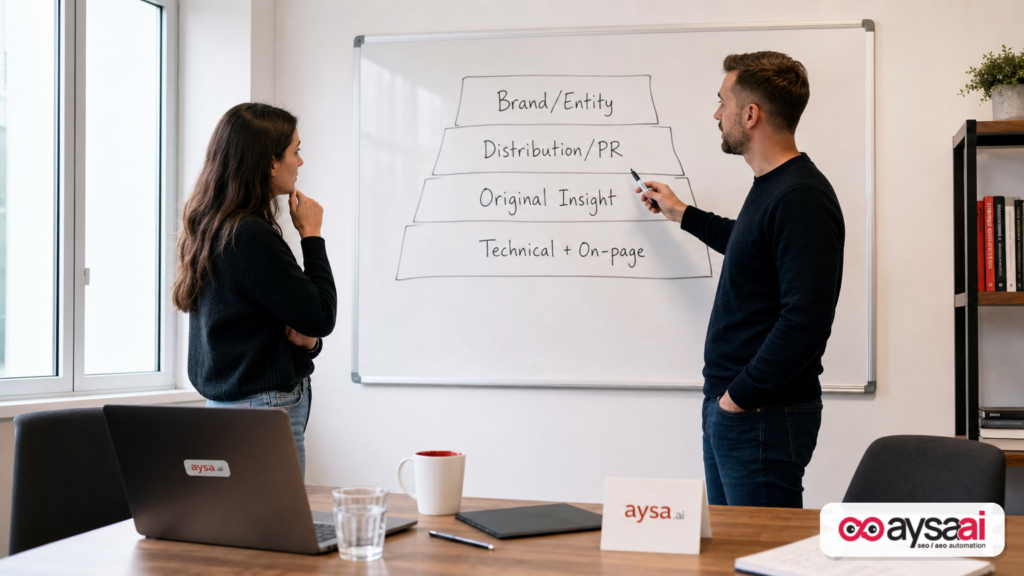
Traditional SEO tasks still matter, but they’re increasingly the “floor.” Growth increasingly comes from building a recognized brand/entity, publishing genuinely original insight, distributing that work deliberately, and measuring visibility even when Clicks disappear. The winners combine strategy with disciplined execution—changing pages safely, consistently, and fast. AYSA fits here as a Monitoring + preparation + approved execution system: it watches what changed, proposes what to fix, asks for approval, then executes accepted updates.
Key takeaways (for busy operators)
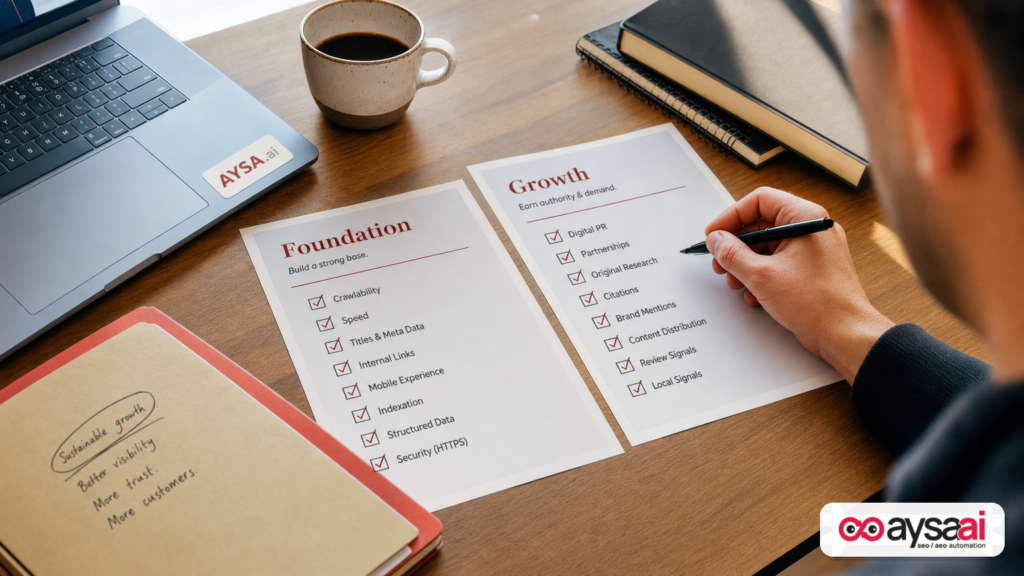
- Fundamentals are necessary, not differentiating. If your SEO plan is mostly on-page tweaks and content production, you’ll likely plateau.
- Authority and distribution now gate performance. “Great content” rarely earns attention by itself—someone must put it in front of people and publications that matter.
- AI changes the unit of success. You may be “winning” by being cited in AI responses even when clicks fall—so measurement must expand beyond classic rank-and-click dashboards.
- Entity coherence matters. If your brand, people, products, and claims aren’t consistent across the web, AI systems will form incomplete (or wrong) opinions about you.
- Execution speed with governance is a moat. The teams that monitor continuously and ship approved improvements weekly will outpace teams that plan quarterly.
Table of contents

- What actually changed (and why it’s not “SEO is dead”)
- Why teams feel busy but don’t grow
- What stopped mattering (mostly) and what became table stakes
- The new organic stack: foundation vs. growth levers
- Authority and entity building: the silent ranking factor you can’t spreadsheet
- Original insight: the only defensible content advantage left
- Distribution: “publish and pray” is over
- AI visibility: AEO/GEO is not a channel, it’s an outcome
- Measurement when clicks disappear: what to watch instead
- Why server logs and crawl reality matter more than tool exports
- A concrete SME scenario: the local clinic that “did SEO” but stopped growing
- What agencies should rethink (pricing, retainers, deliverables)
- Where AYSA.ai fits: monitoring + preparation + approved execution
- A practical 90-day action plan
- What to do next
- Sources and further reading
What actually changed (and why it’s not “SEO is dead”)
The internet didn’t stop needing search. People still need answers, providers, products, comparisons, and reassurance. What changed is how search results deliver those answers and how users complete tasks.
Over the last few years, we’ve watched search evolve from “ten blue links” into a stack of answer surfaces: Rich results, maps, shopping modules, “People Also Ask,” featured snippets, and now AI-generated answers. The user experience is increasingly designed to resolve intent inside the search product whenever possible. Search Engine Land summarized this shift well: Keyword research and on-page work still matter, but authority, distribution, and brand visibility now drive more organic growth (Search Engine Land).
Here’s the practical implication: the bar for “good enough to rank” fell (because content is cheaper to produce), while the bar for “trusted enough to be cited and recommended” rose. That’s why so much classic SEO activity feels less effective. It doesn’t mean it’s wrong—it means it’s no longer scarce.
Why teams feel busy but don’t grow
In-house teams and agencies tell the same story:
- They publish more pages than ever.
- They fix more “SEO issues” than ever.
- They run more reports than ever.
- And the growth curve flattens anyway.
This is usually not because they forgot how to do SEO. It’s because the bulk of their effort is spent on work that reduces risk (good!) but rarely creates new demand capture (growth).
Think of it like going to the gym:
- Technical SEO and on-page cleanup is stretching and mobility work. You need it, and skipping it increases injury risk.
- Authority, distribution, and original insight is progressive overload. That’s what changes the body.
If your week is 80% “mobility,” you’ll feel productive. But you won’t get stronger.
What stopped mattering (mostly) and what became table stakes
Let’s be direct about a few deliverables that used to justify big retainers and now often underperform. This mirrors themes discussed in Search Engine Land’s analysis (source)—but I’m going to frame them in plain business terms.
1) Keyword research as a deliverable (vs. a thinking process)
Keyword research still matters as a way to understand:
- Customer language
- Use cases and objections
- Category structure
- How competitors position themselves
But the “deliverable” version—spreadsheets with volume estimates and difficulty scores—has degraded in value for three reasons:
- Behavior changed: users start (and finish) research in more places than Google.
- The SERP changed: many informational queries are satisfied without a click (especially when AI summaries appear).
- The content market changed: “keyword coverage” is easy to replicate, so it’s a weak differentiator.
Use keyword research to inform strategy, not to justify invoices.
2) High-volume content production as a growth engine
Publishing a lot can still work in certain models (publishers with unique distribution, marketplaces with UGC, highly differentiated brands). But for most SMEs, “more posts” has become an expensive treadmill because:
- Average content quality is rising (cheaply), so sameness is punished.
- AI answer surfaces can capture informational intent before a user reaches your page.
- Even when you rank, clicks may not scale the way they used to.
When content is abundant, credibility becomes the choke point.
3) On-page optimization as “the strategy”
Titles, headers, internal links, schema, and copy improvements still matter. Not doing them is like leaving money on the table. But doing them without authority-building is like polishing a storefront on a street with no foot traffic.
On-page is the admission ticket. It’s not the show.
The new organic stack: foundation vs. growth levers
To make this operational, I like splitting organic work into two layers:
Layer 1: Foundation (you must have it)
- Indexability and crawlability (sitemaps, robots rules, canonicals)
- Information architecture and internal linking
- Basic performance and UX hygiene
- Unique, helpful content on the page
- Clean metadata and structured data where relevant
This layer is where most “SEO programs” spend their lives—because it’s measurable, familiar, and easy to scope. It’s also where many teams should use automation carefully, because it’s repetitive and continuous.
Layer 2: Growth levers (this is where compounding happens)
- Entity and brand coherence across the web
- Original research / proprietary insight that others cite
- Distribution (PR, partnerships, communities, newsletters, founder channels)
- AI visibility optimization (earning mentions/citations, not just rankings)
- Analytical depth (triangulating what’s driving revenue, not just sessions)
If you want a single sentence: SEO growth is increasingly the result of reputation.
Authority and entity building: the silent ranking factor you can’t spreadsheet
“Authority” gets thrown around like a mystical score. Don’t treat it that way. Treat authority as a set of consistent signals that answer the question: Should a user (or an AI system) trust this source about this topic?
Search systems have been moving toward entity-based understanding for years, and AI search accelerates it: models prefer stable, widely referenced entities (brands, people, organizations, products) because entities reduce ambiguity.
Practically, entity and brand building includes:
- Consistency: your name, description, leadership bios, and positioning match across your site and third-party profiles.
- Coverage: there are credible third-party mentions (not just your own blog).
- Context: your expertise is demonstrated with specifics (processes, outcomes, examples), not generic claims.
- Associations: you are linked to known concepts and peers (industry terms, standards, communities, conferences, partnerships).
This isn’t “link building” in the old sense of chasing placements. It’s brand footprint engineering—and many organizations have nobody accountable for it.
If you’re an SME, your advantage is that you can make this coherent quickly. If you’re an enterprise, your advantage is that you can create repeated proof at scale—if you break silos between SEO, PR, and leadership visibility.
A practical authority checklist (non-SEO friendly)
If you want to self-audit without overthinking it, ask:
- When someone searches my brand, do they immediately understand what we do?
- Do our founders/leaders have credible profiles that match what our site says?
- Are we mentioned on reputable sites in our industry (associations, partners, podcasts, local press, trade publications)?
- Do those mentions describe us accurately, or do they contradict each other?
- Could an AI system find consistent “about” and “expertise” information without guessing?
When this is weak, teams try to compensate by producing more content. That rarely works now.
Original insight: the only defensible content advantage left
If average content is easy to create, then the strategy can’t be “publish what everyone else publishes.” It has to be: publish what only you can publish.
There are two ways to do that:
1) Original research (data others cite)
Not everyone can run large-scale surveys. But many businesses can create publishable research by using what they already have:
- Anonymized aggregated customer behavior
- Operational benchmarks (time-to-result, failure rates, cost ranges)
- Trend analysis from internal logs (support tickets, returns, audits)
- Before/after outcomes from process changes
The goal isn’t “viral.” The goal is citation: something others reference because it’s the best available evidence.
2) Experienced editorial (hands-on expertise others can’t fake)
Most SMEs are sitting on gold: real-world experience. The bottleneck is extracting it and packaging it into content that’s genuinely useful.
Examples that work:
- “What we check first when a job goes wrong” (process transparency)
- “Pricing explained with real ranges and tradeoffs” (trust building)
- “Mistakes customers make and how to avoid them” (pre-empt objections)
- “Decision trees” for choosing a product/service (reduces friction)
AI can summarize generic advice. It struggles with experience that includes constraints, edge cases, and the “why” behind decisions.
Distribution: “publish and pray” is over
A harsh reality: most content doesn’t get discovered. Not because it’s bad—because attention is finite.
The old SEO myth was: “If it’s good, it will earn links.” Today the closer truth is: “If it’s good and someone puts it in front of the right people, it can earn links.”
This is why PR-adjacent work is moving from optional to required. It’s also why the organizational design is breaking: SEO teams often don’t own media relationships, founder channels, partnerships, or community engagement.
A distribution playbook that doesn’t require a PR agency
SMEs can build distribution using a simple structure:
- Partners: vendors, platforms, local orgs, complementary providers
- Communities: forums, LinkedIn groups, industry Slack, local chambers
- Customers: case studies, testimonials, joint webinars
- Local media: city business journals, local podcasts, niche newsletters
The objective is not “backlinks for backlinks’ sake.” The objective is to earn credible references that build recognition and, increasingly, inform AI models and retrieval systems about who you are and what you’re trusted for.
AI visibility: AEO/GEO is not a channel, it’s an outcome
AI search visibility is the loudest topic in SEO right now, and most of the conversation is too shallow. Teams either:
- Obsess over being mentioned in AI answers without changing the underlying inputs, or
- Ignore AI visibility entirely because attribution is messy.
Both approaches are wrong.
Search Engine Land’s ecosystem has been covering adjacent developments like AI reporting and controls in Search Console (Search Console AI performance reports and controls) and tactical guidance for AI Overviews changing search behavior (AI Overviews turning search into reading sessions). The through-line is: AI changes the journey, not just the ranking.
At AYSA, we treat AEO/GEO as the downstream result of doing the stack well:
- Entity clarity (who you are, what you offer, who it’s for)
- Source-worthy content (original insight, clear answers, structured facts)
- Distribution and citations (so your claims exist beyond your website)
- Technical accessibility (so systems can parse and retrieve your content reliably)
What “optimizing for AI” looks like in practice
Forget gimmicks. Focus on things that are legible to both humans and machines:
- Make author expertise and company credentials explicit (real bios, real experience, real editorial standards).
- Use clear page purpose and structure: definitions, steps, comparisons, FAQs when appropriate.
- Publish content that others cite (original data, unique frameworks, real examples).
- Ensure your brand’s “facts” are consistent (names, product descriptions, policies, locations, leadership).
If you want a starting point, AYSA maintains tools and workflows specifically for AI-era visibility at AI Search Visibility and AI SEO Tools.
Measurement when clicks disappear: what to watch instead
As search surfaces answer more queries directly, classic SEO reporting becomes less reliable. You can do “everything right,” appear everywhere, and still see fewer clicks.
So what do you measure?
Principles for measurement in 2026
- Measure outcomes, not just traffic. Leads, calls, demos, bookings, qualified inquiries.
- Measure visibility beyond clicks. Impressions, branded interest, citations/mentions, and assisted conversions.
- Triangulate. Search Console + analytics + CRM + customer conversations.
Search Engine Land has also highlighted the problem of attribution gaps and suggested approaches for tracking AI visibility when attribution falls short (4 ways to track AI search visibility when attribution falls short). The key is not to pretend you can perfectly attribute everything; it’s to build a decision system that still works under uncertainty.
A practical list of what to watch weekly
- Search Console: trend of impressions and clicks for branded vs non-branded queries; page groups by intent.
- Lead quality: are inbound leads better informed (a sign of “reading sessions” and AI-assisted research)?
- Brand demand: direct traffic trends, branded searches, repeat visits.
- Mentions: new third-party references (local press, niche sites, partner pages).
- AI presence checks: periodic prompts in major AI tools to see if your brand is recommended or cited for your category (qualitative but useful).
The goal is to stop managing SEO as a neat dashboard and start managing it as a business growth system.
Why server logs and crawl reality matter more than tool exports
When results slow, teams often drown in third-party SEO tool audits. But tools infer. Your server logs record what actually happened: which bots crawled what, how often, what they hit, and where they got blocked or wasted time.
Search Engine Land recently reinforced this idea in a separate piece on what server logs reveal that SEO tools miss (What server logs reveal that SEO tools miss). The higher the complexity of your site (faceted navigation, parameter spam, infinite collections, large inventories), the more logs matter.
Server log analysis can uncover:
- Crawl budget waste on low-value URLs
- Bot traps created by filters/sort parameters
- Slow response times on critical templates
- Indexation mismatches (Googlebot crawling pages you didn’t intend to be indexable)
This is foundational work—but it’s foundational work that can unlock growth when indexing and retrieval are your bottleneck.
A concrete SME scenario: the local clinic that “did SEO” but stopped growing
Let’s make this real with a scenario you can picture.
Business: a local physical therapy clinic with two locations.
What they did (classic SEO):
- They published 60 blog posts targeting “what is…” and “exercises for…” keywords.
- They optimized title tags and internal links.
- They ran quarterly technical audits.
What happened: traffic became volatile, growth plateaued, and leads didn’t rise proportionally. The team felt like they were doing everything “right.”
What changed the outcome: shifting effort to authority + distribution + clarity:
- Entity clarity: clear “who we treat” pages (sports rehab, post-op, chronic pain) with therapist bios and specific modalities; consistent descriptions across the web.
- Original insight: a practical “return to running” protocol and a transparent pricing/insurance explainer with common edge cases.
- Distribution: partnerships with local running clubs and gyms; guest sessions; joint content that those partners actually link to and share.
- AI readiness: content formatted to answer common questions quickly, with enough specifics that AI systems can confidently summarize and cite.
- Measurement shift: tracking consult requests, calls, and “how did you hear about us” responses—because clicks were no longer the full story.
The point is not that every clinic should do the same playbook. The point is the pattern: the growth came from credibility and reach, not more posts.
What agencies should rethink (pricing, retainers, deliverables)
Agencies are under pressure because the client’s mental model of SEO is still anchored in 2018–2022 deliverables. Many retainers are built on:
- Keyword research spreadsheets
- Content briefs
- Monthly on-page checklists
- Rank tracking reports
Those deliverables are easy to sell because they’re tangible. But they’re also easy for clients to replace (in-house, freelancers, AI), and they increasingly fail to produce growth by themselves.
What to productize instead
Agencies that keep winning will shift from “SEO production” to “organic growth engineering.” That means productizing:
- Authority programs: leadership visibility, expert positioning, entity coherence audits
- Research/editorial systems: recurring industry benchmarks, proprietary datasets, case study pipelines
- Distribution operations: partner marketing, PR-lite outreach, community strategy
- AI visibility reviews: recurring checks for brand recommendation and citation patterns
- Execution governance: a system to ship safe improvements weekly without breaking sites
And yes—technical SEO still belongs in the retainer. But it shouldn’t be the headline.
The uncomfortable truth: execution is now part of the moat
In 2026, “strategy” without execution is theater. Clients want outcomes, and the teams that can execute changes quickly—without risk—win.
This is where automation becomes helpful, but only with guardrails. You need:
- Continuous monitoring
- Clear proposed changes
- Approval workflows
- Auditable execution
Which is exactly why AYSA is built around monitoring and approved execution.
Where AYSA.ai fits: monitoring + preparation + approved execution
Most SEO tools tell you what’s wrong. Many content tools help you write. Very few systems help you ship changes safely at scale.
AYSA is designed as an execution engine:
- Monitors your site and visibility patterns (Monitoring)
- Prepares recommendations and change sets (technical, on-page, content hygiene, internal linking, structured data where applicable)
- Asks for approval so humans stay accountable
- Executes accepted website changes consistently and traceably
In an era where the winning loop is “observe → decide → ship → learn,” execution speed matters. But so does governance. Approved execution is how you get both.
If you want to explore the operational side, start here:
- AYSA AI Search Visibility (how you show up in AI-driven discovery)
- AYSA AI SEO Tools (tooling that supports the new stack)
- Pricing (so you can evaluate fit without a sales call)
- Blog (ongoing editorials and playbooks)
A practical 90-day action plan
This is a pragmatic plan you can run whether you’re an SME owner, a marketing lead, or an agency director. The goal is to rebalance effort upward in the stack while keeping fundamentals tight.
Days 1–30: Stabilize the foundation and fix execution bottlenecks
- Pick 10–20 revenue-critical pages (services, category pages, product collections, top lead pages).
- Run a focused technical + on-page pass (indexability, template issues, internal linking, titles, structured data where appropriate).
- Set monitoring so regressions don’t sneak back in (especially after dev releases). Use an automation system where changes are proposed and approved before shipping.
- Define success metrics beyond organic sessions: leads, calls, bookings, demo requests, qualified pipeline.
Days 31–60: Build authority assets and entity coherence
- Entity coherence sprint: align About, leadership bios, product/service descriptions, and key policies. Ensure external profiles match (where you can control them).
- Create one “source-worthy” asset: a benchmark, dataset, calculator, decision tree, or protocol that is truly useful.
- Publish two supporting explainers that reference the asset and answer high-intent questions succinctly.
Days 61–90: Distribution and AI visibility checks
- Build a distribution list (20–50 targets): partners, newsletters, local press, trade blogs, podcasts, associations.
- Run outreach with a simple pitch: what’s new, why it matters, and why your asset is the best reference.
- Run AI visibility checks: ask major AI tools category questions and see if you appear, how you’re described, and what sources are cited. Treat findings as editorial and authority inputs, not as vanity metrics.
- Iterate weekly: ship small improvements continuously, not in quarterly “SEO projects.”
What to do next (action list)
- Audit your effort split: what % of time is foundation work vs growth levers?
- Choose one authority bet you can execute in 30 days (a partnership page, a benchmark post, a founder interview series).
- Choose one distribution routine you can do weekly (5 outreach messages, 2 partner touches, 1 community post).
- Set up monitoring so you can ship changes safely and consistently (AYSA Monitoring).
- Establish a “visibility without clicks” scorecard that includes leads and brand demand, not just rankings.
- Decide your AI visibility posture: track and improve how you’re represented, not just where you rank (AI Search Visibility).
Sources and further reading
- Search Engine Land: Why so much SEO work no longer drives growth
- Search Engine Land: Google Search Console AI performance reports and controls to block your content in AI responses
- Search Engine Land: What to do now that AI Overviews turned search into reading sessions
- Search Engine Land: What server logs reveal that SEO tools miss
- Search Engine Land: 4 ways to track AI search visibility when attribution falls short
- Search Engine Land: How AI forms opinions about your brand
- Search Engine Land: The problem with AI share of voice and 3 metrics that matter more
Note: This editorial intentionally avoids hard numerical claims about click share, zero-click rates, or AI overview prevalence unless we can verify them directly from the supplied research context. If you need a quantified model for your niche, treat it as a measurement project: instrument first-party data, segment Search Console, and test assumptions before reforecasting.
Continue the AI search topic inside AYSA.
Use these pages to connect the article with AI SEO tools, AI visibility monitoring, AI Overviews and approved website execution.
Turn this topic into a website action plan.
Use these AYSA hubs to move from reading to technical fixes, AI visibility monitoring, research, glossary context and approval-first SEO execution.

