
Customer Match Is the Last Real Edge in Google Ads (and How to Use It Without Getting Burned)
As tracking gets noisier and Google Ads leans harder on automation, the accounts that win will be the ones feeding the algorithm better first‑party data. Customer Match is the most underused lever—if you implement it with the right consent, list hygiene, and measurement discipline.

Google Ads is increasingly an AI system that rewards the best inputs—not the most clever button-clicking. In that world, Customer Match (uploading your customer list into Google Ads) is one of the only levers that is both defensible and compounding. It’s defensible because competitors can’t copy your customers. It compounds because every refresh teaches the bidding and targeting systems what “good” looks like for your business.
This editorial is written from my perspective as Marius Dosinescu at AYSA.ai. I’m not here to sell you a trick. I’m here to help you build an operating system: first‑party data you’re allowed to use, feeds that stay fresh, and execution that doesn’t break tracking or compliance.
Concise summary

- Customer Match is a competitive advantage because it’s first‑party data you own, while the rest of the market relies on the same Google-owned signals.
- You should upload customer lists even if you’re under Google’s eligibility thresholds for direct targeting; the list can still act as an optimization signal and unlock insights.
- List hygiene, consent, and measurement matter as much as the upload itself. Stale lists and shaky consent turn “advantage” into risk.
- Customer Lifecycle Goals and conversion-based customer lists are where Customer Match becomes operational—not just a one-off audience tactic.
- AYSA fits as the execution layer: we monitor, prepare changes, ask for approval, and execute accepted website/tracking improvements that make first‑party data usable in ads.
Table of contents
- The new reality: Google Ads is AI-first, and “signals” beat “settings”
- Customer Match, explained like you’re busy
- The $50K lifetime spend myth: why you should upload even if you can’t “target” yet
- Where Customer Match actually shows up in Google Ads (and where it doesn’t)
- Customer Lifecycle Goals: the part most teams skip
- Conversion-based customer lists: the bridge between one conversion and a real audience
- Data quality and match rates: what matters (without chasing vanity metrics)
- Consent, privacy, and policy: how to avoid turning an advantage into a liability
- List refresh cadence: the unsexy habit that wins
- A concrete SME scenario: a local clinic vs. an ecommerce brand (and what each should do)
- Agency and in-house reality: what to change in your process
- Where AYSA.ai fits: approved execution for first-party data + ads readiness
- What to do next (action list)
- Sources and further reading
The new reality: Google Ads is AI-first, and “signals” beat “settings”

For years, many businesses treated Google Ads like a dashboard game: pick keywords, adjust bids, layer in audiences, tweak ad copy, and hope your Conversion tracking stayed intact.
That era is fading fast. Not because keywords or creative don’t matter—but because automation now mediates most outcomes. Smart bidding, broad match behavior, query expansion, creative assembly, and cross-surface delivery mean your “controls” are increasingly high-level.
At the same time, privacy changes have reduced the reliability of user-level tracking. The practical outcome for advertisers is simple:
- There’s more modeling.
- There’s more inference.
- There’s more reliance on the signals you feed the system.
So if every competitor has access to the same bidding algorithms, the same ad inventory, and broadly the same platform features, where does a durable advantage come from?
From proprietary data and clean feedback loops. That’s why Customer Match matters so much. Search Engine Land framed it plainly: uploading your customer list can give Google’s AI a competitive advantage as traditional tracking becomes less effective. (Source)
But here’s the nuance I want SMEs and agencies to absorb:
- Customer Match isn’t a trick to “target your customers.” It’s a mechanism to teach the system what a high-quality user looks like for your business.
- Implementation quality determines whether you get lift or confusion. A messy list can be worse than no list because it trains the machine on the wrong pattern.
Customer Match, explained like you’re busy
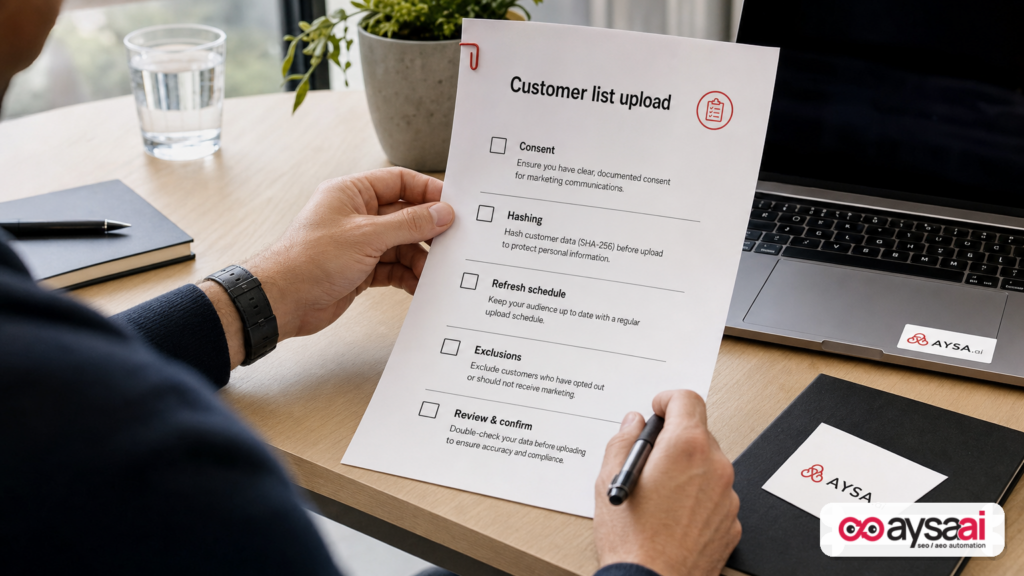
Customer Match is Google Ads’ capability to use your first-party customer data (typically email addresses, phone numbers, and/or mailing address details) to create audience segments inside Google Ads.
In practice, it enables three major things:
- Targeting: show ads to people who are on your list (when eligible, and depending on campaign type).
- Exclusions: do not show ads to people on your list (useful for “new customer only” goals, or reducing waste).
- Optimization signals: help Google’s systems understand what a “good” converter looks like, so it can find more like them.
If you only remember one sentence, make it this:
Customer Match turns your best customers into training data for your ad account.
This is why Customer Match is often more important than another round of Keyword sculpting or yet another landing page headline debate. Not because those things don’t matter—but because the learning system that decides who sees what needs a reliable definition of success.
If you want to build your broader visibility beyond ads—especially as AI-driven search experiences reduce Clicks—you should also look at how your brand is being represented in AI answers. AYSA has a dedicated guide on this at AYSA.ai AI Search Visibility, because the same first-party data mindset applies: better inputs, clearer signals, stronger outcomes.
The $50K lifetime spend myth: why you should upload even if you can’t “target” yet
Many SMEs stop the moment they hear about eligibility thresholds—especially the commonly cited $50,000 lifetime spend requirement for certain Customer Match uses. The mistake is thinking that if you can’t immediately apply the list as a targeting layer, the upload is pointless.
Search Engine Land’s piece made an important point: even without direct targeting eligibility, an uploaded customer list can still act as a valuable AI signal and unlock insights in Audience Manager. (Source)
My editorial take: most businesses should treat the upload like laying pipe. You don’t wait to install plumbing until the day you need the water. You install it, you test it, and you keep it clean—because your ability to act later depends on it.
There are three concrete reasons uploading early can still be rational:
- Model training: the platform can use it as a reference set for “similar to converters.”
- Audience Insights: you can learn who your customers resemble demographically or by affinity (useful for creative and landing page alignment).
- Operational readiness: when you do become eligible, you’re not scrambling under pressure, with outdated consent language and a stale CRM export.
At AYSA, we see the same pattern in organic search: teams wait until traffic drops to invest in structure and Monitoring. But by then, you’re reacting. If you want to be proactive, use a monitoring system for the site and for visibility trends. Start here: AYSA Monitoring.
Where Customer Match actually shows up in Google Ads (and where it doesn’t)
Customer Match is not “one feature.” It’s a capability that expresses itself differently depending on campaign type and objective.
Campaign compatibility (practical view)
Search Engine Land notes that once eligibility requirements are met, Customer Match can be applied across surfaces like Search, Shopping, Gmail, YouTube, and Display, and can be used for targeting or exclusions in several campaign types. Performance Max doesn’t support direct audience targeting in the same way, but you can use exclusions and lifecycle-oriented controls. (Source)
The practical way to think about this:
- Search / Shopping: use lists to separate “existing customers” vs “net new,” protect your budget, and tailor messaging.
- YouTube / Display / Gmail: use lists for retention, upsells, and sequential messaging (when appropriate and compliant).
- Performance Max: use first-party data as guidance and exclusions; align with lifecycle goals if applicable.
What Customer Match is not
- Not a replacement for conversion tracking. It’s complementary. If conversion tracking is broken, the system still won’t know what “good” is.
- Not a hack for “finding anyone.” It’s bounded by matching and policy.
- Not a set-it-and-forget-it audience. Stale lists degrade. Business reality changes. Offers change. Customers change.
If you’re building an Execution Plan across paid and organic—especially in an AI Search world—make sure your technical foundation is stable. AYSA’s toolbox view is here: AYSA AI SEO Tools.
Customer Lifecycle Goals: the part most teams skip
The most strategic use of customer lists isn’t “let’s run ads to customers.” It’s lifecycle control.
Search Engine Land points to Customer Lifecycle Goals as a feature that depends on Customer Match and allows you to prioritize segments (e.g., new customer only, retention). The core concept is powerful: within one campaign, you can tell the system who matters more based on relationship stage. (Source)
Here’s why I care about lifecycle controls for SMEs:
- Waste reduction: If you’re spending to acquire “new customers,” but half of your spend goes to existing customers, you are overpaying for growth you didn’t create.
- Message integrity: “20% off your first order” shown to loyal customers is brand damage and margin damage.
- Better measurement: If you separate acquisition vs retention behavior, you can evaluate CAC and LTV dynamics more honestly.
When lifecycle goals are worth it
Search Engine Land mentioned a heuristic (“1% rule”) for when lifecycle goals become meaningful at population scale. I won’t restate it as a universal law for every business—because the right threshold depends on list size, market density, and match rates—but the underlying idea is valid: if your list is too small relative to the market, lifecycle steering may not move the needle.
So what should you do if you’re small?
- Start with clean segmentation (customers vs leads vs high-value customers).
- Use exclusions where it’s obvious (e.g., exclude recent purchasers from “starter kit” campaigns).
- Build the refresh habit so when you do scale, you’re ready.
Conversion-based customer lists: the bridge between one conversion and a real audience
One of the most underappreciated gaps in many ad accounts is the difference between:
- A Conversion event (a point in time: purchase, form submit), and
- An audience segment (a living list you can use for exclusions, sequencing, or analysis).
Search Engine Land highlights that Customer Match, paired with Enhanced Conversions, can unlock conversion-based customer lists—automatically generated audiences tied to conversion actions (like purchasers or form fillers). (Source)
Why this matters operationally:
- It reduces manual work: you’re not exporting CSVs every week just to build a “recent leads” list.
- It reduces drift: automation stays aligned with your conversion definitions (assuming your tracking is correct).
- It enables smarter spend rules: you can keep acquisition budgets focused while giving retention a different message and different offer.
Caution: this only works if your conversion actions are well-defined and not polluted (e.g., counting low-intent events as conversions). If your conversions are messy, you’ll automate the mess.
Data quality and match rates: what matters (without chasing vanity metrics)
Teams love “match rate” because it sounds measurable. But chasing match rate can lead to the wrong behavior—like stuffing lists with old leads, unqualified newsletter signups, or questionable sources just to make the number go up.
Here’s a more useful hierarchy:
1) Quality of the list > size of the list
A list of 5,000 recent purchasers will often teach Google more than a list of 200,000 contacts accumulated over a decade. Recency and relevance matter.
2) Segmentation beats one giant blob
Create segments that reflect real business decisions, such as:
- All customers
- High-value customers (define this using your business logic)
- Recent purchasers (e.g., last 30/60/90 days)
- Leads who never bought
Even if you can’t target them all immediately, segmenting forces clarity. Clarity improves measurement and creative strategy.
3) Field hygiene matters
Make sure you’re exporting and formatting fields consistently. Small errors create big waste:
- Duplicate rows
- Placeholder emails
- Outdated phone formats
- Merged contact records with conflicting data
If you want to improve your site and tracking foundation, use a system that can monitor, propose fixes, and implement them only after approval. That’s the core workflow behind AYSA’s model. You can see how we think about monitors and execution here: AYSA Monitoring.
Consent, privacy, and policy: how to avoid turning an advantage into a liability
Customer Match is powerful precisely because it uses personal data. That also means it comes with responsibility.
Search Engine Land calls out two critical points:
- You must have user consent to upload customer data.
- Buying third-party lists and uploading them violates policy and may violate privacy laws.
(Source)
Here’s the business reality: most SMEs are not trying to do anything shady—they’re just busy. The risk comes from “default behavior,” like:
- Using an ancient privacy policy template
- Assuming a checkout checkbox covers advertising uploads
- Letting agencies operate without documenting data flows
Sensitive verticals: the hard stop
Search Engine Land also notes an exception: some sensitive categories may not be allowed to use Customer Match (“your data segments”). (Source)
If you’re in or adjacent to healthcare, religion, personal hardship, or financial distress, do not try to “interpret” the rules creatively. Your first move should be to get clear, current guidance from Google’s official policies and/or qualified legal counsel. I’m not going to invent a safe line for you in an editorial.
Important: If your marketing team can’t articulate (1) what data you upload, (2) why, (3) where it goes, and (4) how users consent, you don’t have a Customer Match strategy—you have an accidental risk.
List refresh cadence: the unsexy habit that wins
Most accounts that “have Customer Match” are not really using Customer Match. They uploaded a list once, two years ago, and moved on.
Search Engine Land calls this out as a common audit finding and recommends refresh cadence based on how frequently you get leads or transactions (daily vs monthly). (Source)
My take is even more opinionated:
If you don’t have a refresh mechanism, you don’t have a data advantage—your competitors do.
Because the compounding effect is in the update loop:
- New customers change the “shape” of your best audience.
- Seasonality changes what a good customer looks like (gift buyers vs personal use).
- Pricing changes alter who converts and why.
Integrations vs CSV: choose reliability
Search Engine Land points to direct integrations through Google Ads Data Manager for platforms like Shopify, HubSpot, and Salesforce, with CSV as a manual alternative. (Source)
Rule of thumb:
- If you have enough volume and a stable system: integrate so it refreshes automatically.
- If your CRM is messy or you’re early-stage: start with CSV, but set a calendar and assign ownership.
A concrete SME scenario: a local clinic vs. an ecommerce brand (and what each should do)
Let’s make this real with two scenarios. I’ll keep it realistic and not pretend these are “clients” with magical outcomes.
Scenario A: a mid-sized ecommerce brand selling home fitness equipment
Problem: Paid search spend is stable, but efficiency is drifting. Returning customers keep clicking “first order” ads. The team also sees inconsistent Attribution because user tracking is less deterministic than it used to be.
Customer Match playbook:
- Upload and refresh purchasers (last 180 days) and all customers.
- Create a high-value customer segment based on internal thresholds (e.g., repeat buyers or high AOV).
- Use exclusions in acquisition-oriented campaigns to reduce wasted spend.
- Run separate retention/upsell messaging where appropriate (YouTube/Display/Demand Gen depending on strategy).
- Align landing pages so “new customer” offers and “existing customer” offers don’t collide.
What can go wrong:
- Stale list causes “new customer” campaigns to keep hitting existing customers.
- Poor segmentation lumps bargain-hunters with high-LTV customers, training the system toward the wrong cohort.
- Consent language is unclear, creating legal and brand risk.
Scenario B: a local clinic or sensitive-category adjacent service business
Problem: The business wants better acquisition. They hear “upload your customers to Google” and assume it’s the obvious move.
Customer Match reality check: Depending on the exact vertical and policy constraints, Customer Match may be restricted or prohibited. Search Engine Land explicitly notes sensitive vertical limitations. (Source)
Safer approach:
- Invest first in clean conversion tracking (where permitted) and landing page clarity.
- Use contextual targeting and strong intent signals rather than customer uploads if policy blocks “your data segments.”
- Build trust assets on the site that improve both organic and paid performance (clear service pages, FAQs, policy pages, fast UX).
This is also where the line between paid and organic blurs. If organic clicks are getting squeezed by AI answers and zero-click behaviors, you need a visibility system that tracks where your brand shows up and what content supports it. The Search Engine Land ecosystem has been covering AI-driven shifts like disappearing organic traffic and new reporting/controls; for broader context, see their related coverage such as Google Search Console AI performance reports and controls and their reporting on changing click behavior like zero-click search trends. (These are context leads, not claims I’m independently validating here.)
Agency and in-house reality: what to change in your process
Customer Match sounds like a “marketing task.” In reality, it’s a cross-functional workflow.
To do it well, you need coordination across:
- Marketing (strategy, campaign structure, offers)
- Ops/CRM (data exports, segmentation logic, deduplication)
- Web/Engineering (Enhanced Conversions setup, tags, consent mode behavior)
- Legal/Compliance (policy alignment, consent language)
Most SMEs don’t fail because they disagree with Customer Match. They fail because nobody owns the end-to-end system.
A better operating rhythm
- Monthly: review list health (refreshes happening?), audience size trends, and “new vs returning” performance splits.
- Quarterly: revisit segmentation definitions (what counts as high value?), update privacy disclosures if needed, and align creative to lifecycle.
- Whenever offers change: ensure exclusions and messaging still match reality (don’t promote “first-time buyer” offers to existing customers).
And if you’re an agency: bake this into onboarding. If you wait for the client to “get around to it,” you’ll still be waiting when performance plateaus.
Where AYSA.ai fits: approved execution for first-party data + ads readiness
AYSA is not an ad platform. We’re an execution system for modern visibility—SEO, AEO/GEO, and the website foundations that paid acquisition depends on.
Here’s what that means in a Customer Match world:
- Monitors detect issues that quietly break performance: tracking disruptions, indexing problems, missing pages, inconsistent messaging, slow UX, or technical regressions. Start with AYSA Monitoring.
- Preparation: AYSA prepares specific website changes—like improving landing page clarity, tightening internal linking to key offers, or creating/refreshing FAQ blocks that reduce user confusion and improve conversion readiness.
- Approval: you review and approve what should change. Nothing is silently pushed.
- Execution: AYSA executes accepted changes, creating an operational loop rather than a “recommendations graveyard.”
Why this matters: Customer Match and Enhanced Conversions can be undermined by weak website execution. If your landing pages are inconsistent, your form experience is confusing, or your tracking is brittle, you’re feeding the ad system noisy outcomes. Cleaner outcomes = cleaner learning.
If you’re exploring how this fits your business size and risk tolerance, pricing and packaging are here: AYSA Pricing. For more playbooks, see the AYSA blog.
What to do next (action list)
- Inventory your first-party sources: CRM, ecommerce platform, newsletter tool, booking system. Decide which one is the “source of truth.”
- Define 3–5 segments that reflect business decisions: customers, high-value, recent purchasers, leads, churned customers.
- Confirm consent + disclosures: ensure your privacy policy and collection points explicitly cover data sharing for advertising, consistent with applicable laws and Google policies.
- Upload or integrate: choose a refresh method you can actually sustain.
- Set a refresh SLA: daily/weekly/monthly—assign an owner and set alerts.
- Align campaign intent: “new customer” campaigns should exclude customers; retention campaigns should not use acquisition messaging.
- Measure the right deltas: new customer rate, cost per new customer (where measurable), repeat purchase rate, assisted conversions, and landing page conversion rate.
- Stabilize your site execution loop: use AYSA to monitor and implement approved improvements that keep conversion signals clean. Start at AYSA Monitoring.
Sources and further reading
- Search Engine Land — Your #1 competitive advantage in Google Ads: Customer Match
- Search Engine Land — Google Search Console AI performance reports and controls (context on AI-era visibility and reporting)
- Search Engine Land — Zero-click searches study (context on changing click behavior)
- Search Engine Land — Brand campaign readiness for AI Max (context on automation shifts)
- Search Engine Land — Performance Max asset testing tools (context on creative + automation)
Related AYSA resources
Note on sources: The provided research context included Search Engine Land and related internal links. Where official Google policy documentation would normally be cited (e.g., Customer Match policy details, eligibility, and sensitive category restrictions), it was not included in the supplied context. For anything compliance-critical, confirm against Google’s official Ads policies and your counsel rather than relying on secondhand summaries.
Continue the AI search topic inside AYSA.
Use these pages to connect the article with AI SEO tools, AI visibility monitoring, AI Overviews and approved website execution.
Turn this topic into a website action plan.
Use these AYSA hubs to move from reading to technical fixes, AI visibility monitoring, research, glossary context and approval-first SEO execution.

