Measuring Content Alignment Is Now Easy. Not Getting Fooled By The Number Is The Hard Part.
Semantic alignment scores can finally quantify whether your content “matches” a topic in meaning—not just keywords. But treating those scores as truth can push teams to optimize for the wrong model, the wrong retrieval system, and the wrong outcomes. Here’s how SMEs and agencies should measure alignment responsibly, combine it with business signals, and operationalize changes with approved execution.

Content teams finally have what they’ve wanted for two decades: a way to quantify whether a page aligns with a topic in meaning—not just whether it repeats the right phrases. That’s progress.
It’s also a trap.
Because the minute “alignment” turns into a score with decimals, it starts to feel like truth. And when a metric feels like truth, teams stop asking the uncomfortable questions that used to protect them: Is this the right intent? Is this the system we’re actually optimizing for? Is this helping a customer make a decision?
This editorial builds on an important warning raised by Duane Forrester at Search Engine Journal—measurement has improved, but measurement literacy hasn’t kept up. Read the original perspective here: Search Engine Journal: “You Can Finally Measure Content Alignment. That’s The Dangerous Part”.
Concise Summary
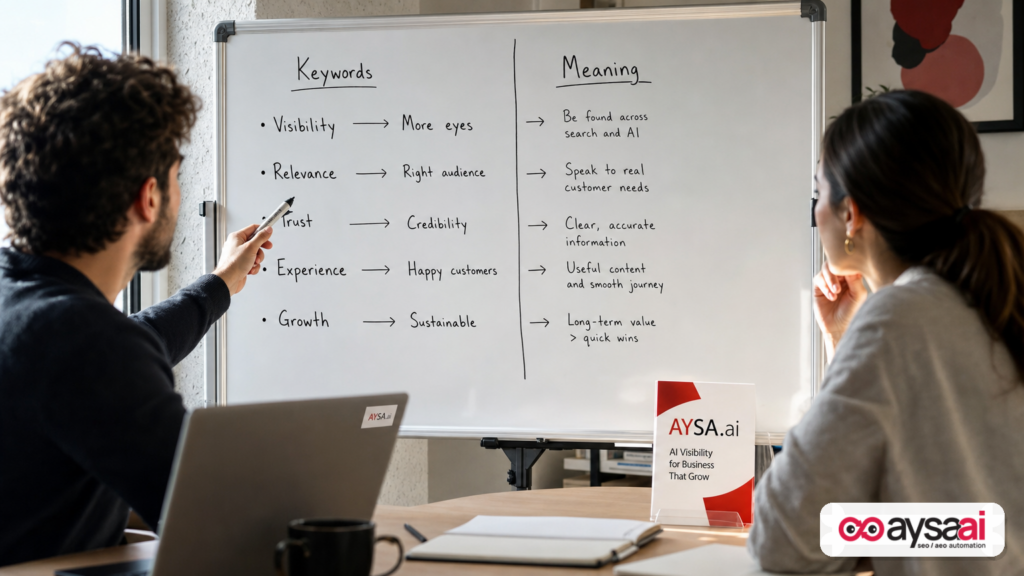
- Semantic alignment scores are a higher-resolution proxy for relevance, not a final verdict.
- Different embedding models create different “meaning spaces.” A score that looks great in your tool may not map to Google or an AI assistant’s retrieval system.
- The main risk is Goodhart’s Law: once alignment becomes the target, content starts optimizing for the metric’s geometry instead of the user and the market.
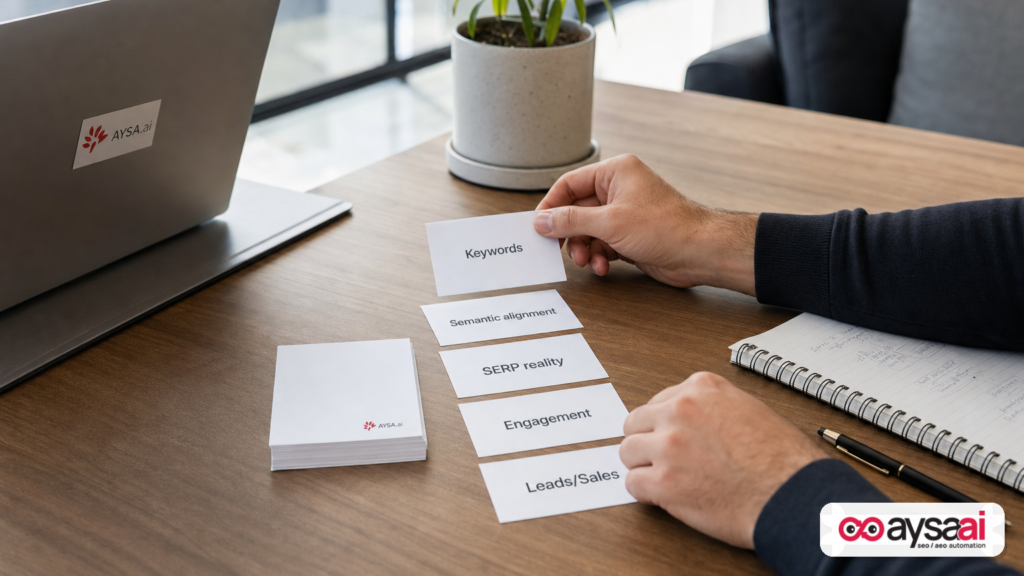
- The fix isn’t to abandon alignment. The fix is to layer it into a measurement stack that includes SERP reality, engagement, and business outcomes.
- AYSA’s role: monitor the right signals, prepare recommended changes, get approval, and execute safely—so teams move faster without blindly chasing a number.
Key Takeaways (For Busy Operators)
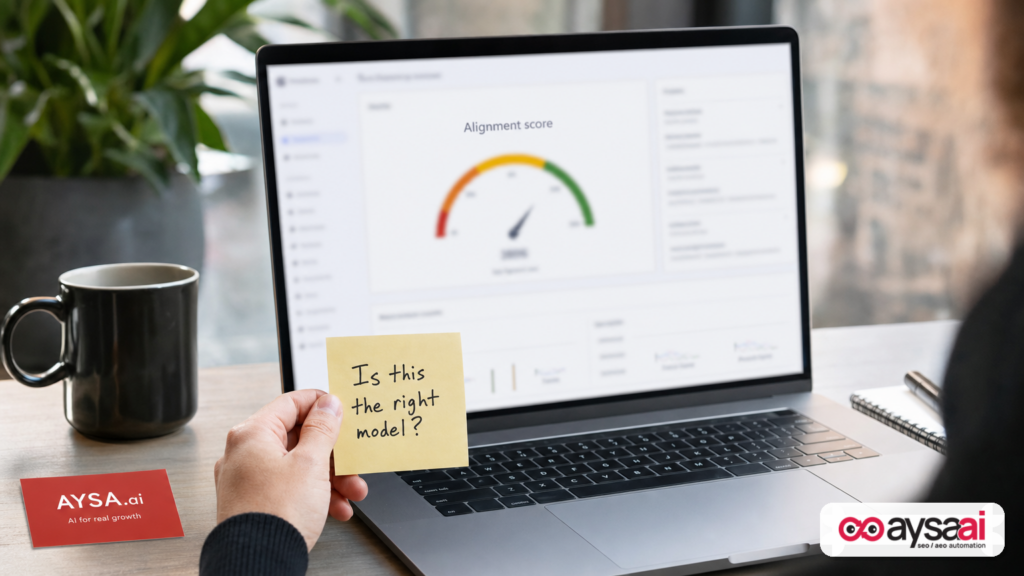
- Alignment is directional, not absolute. Treat it like a compass, not a GPS.
- Measure across layers. Retrieval signals (alignment) must be validated by performance signals (visibility, Clicks) and business signals (leads, sales).
- Don’t replace editorial judgment. Upgrade it. The best teams use semantic metrics to ask better questions, not to stop thinking.
- Execution is the bottleneck. You can’t benefit from better measurement if you can’t implement changes quickly and safely.
Table of Contents
- What Changed: From Keyword Matching To Semantic Retrieval
- Why This Matters Now (AI Search, AEO, GEO)
- The New Risk: Precision Without Truth
- How Goodhart’s Law Shows Up In Content Teams
- Keyword Errors vs Semantic Errors: Pick Your “Wrong”
- Representative, Not Identical: The Model Gap Problem
- A Practical Measurement Stack (That Won’t Lie To You)
- Concrete SME Scenario: Local Clinic Content That “Aligns” But Doesn’t Convert
- What Agencies Should Rethink (Deliverables, Reporting, Accountability)
- Operationalize Alignment: Governance, Workflows, and Guardrails
- Where AYSA Fits: Measurement Literacy + Approved Execution
- What To Do Next
- Sources and Further Reading
What Changed: From Keyword Matching To Semantic Retrieval
For most of SEO history, “relevance” was approximated using words. If a query contains commercial real estate appraisal, and a page contains that phrase (plus a bunch of related phrases), the page is probably about the thing.
That approach wasn’t stupid. It matched the tools we had and the retrieval systems we understood. It also forced a kind of humility: everyone knew we were guessing. Keyword research didn’t pretend to be physics.
Now we can measure semantic similarity—how close two pieces of text are in meaning—using vector representations (embeddings). Instead of asking “do the strings match?”, we ask “do the concepts cluster together?”
In practice, this means you can take:
- a query (or topic prompt),
- a candidate page,
- convert both into vectors,
- compute a similarity score,
- and call that “alignment.”
This is a real upgrade in resolution. It can reveal semantic drift that keywords miss—like a page that uses all the right terms but answers the wrong question.
It also changes how teams behave. When content can be “scored,” content starts being “optimized” like ad bidding. That’s the dangerous part—because content is not an auction, and retrieval systems are not all the same.
Context: the vector space model is not new. The general idea of representing documents in vector space goes back decades. What’s new is that modern embeddings encode richer meaning across huge dimensional spaces—making the scores feel definitive, even when they aren’t.
Why This Matters Now (AI Search, AEO, GEO)
Two shifts are happening at once:
- Search interfaces are changing. We’re moving toward experiences that summarize, answer, compare, and cite—sometimes without a traditional click.
- Retrieval under the hood is becoming more semantic. Whether it’s a classic search engine or an AI assistant using retrieval-augmented generation (RAG), the system needs to fetch “meaning-matched” sources, not just pages with the same words.
That’s why alignment measurement feels urgent: you can’t optimize what you can’t measure. Forrester’s SEJ piece puts a spotlight on that “measurement literacy gap”—and he’s right to do so.
In the AYSA world, we generally group modern visibility work into:
- SEO: ranking in traditional results
- AEO: being selected as an “answer” or cited source
- GEO: optimizing for generative experiences that synthesize information from multiple sources
If you’re new to these terms, start here: AYSA – AI Search Visibility.
The uncomfortable truth: your business can “win” classic rankings and still lose mindshare in AI Search if your content is semantically misaligned, structurally hard to interpret, or not chosen as a trusted source.
The New Risk: Precision Without Truth
Let’s name the problem cleanly:
A number can be precise and still be wrong in the way that matters.
Semantic alignment scores are calculated inside a particular embedding space—a model’s internal representation of language. Different models produce different spaces. Even different versions of the same model can shape space differently.
So when your tool says:
- Page A is 0.92 aligned to Query X
- Page B is 0.74 aligned to Query X
…the score is true in the narrow sense (“that’s what the math produced in this model”), but not necessarily true in the operational sense (“Google/other systems will retrieve and rank/cite this accordingly”).
Forrester cites research that warns cosine similarity can behave unpredictably across learned embedding spaces. The takeaway for operators isn’t “don’t measure”—it’s “don’t worship.”
Here’s what I see in real businesses: the moment a score appears on a dashboard, it becomes a KPI. And the moment it becomes a KPI, people will game it—sometimes unintentionally—by writing to the measurement tool instead of writing to the market.
How Goodhart’s Law Shows Up In Content Teams
Goodhart’s Law is simple: when a measure becomes a target, it stops being a good measure.
In content alignment, it tends to play out like this:
- A team adopts semantic scoring to improve relevance.
- They set a threshold (“everything must be above 0.85”).
- Writers and editors start revising to satisfy the model’s similarity function.
- Pages begin converging on the same concepts, phrasing patterns, and semantic center.
- Content becomes less differentiated, less persuasive, and sometimes less helpful.
And then the business gets surprised:
- Rankings don’t improve (because the search engine’s representation differs).
- Conversions drop (because pages become generic and non-committal).
- Brand voice erodes (because “align” beats “sound like us”).
- Cannibalization increases (because everything is “about” the same thing).
This is exactly why measurement literacy matters: you need to know what the number is not telling you.
Keyword Errors vs Semantic Errors: Pick Your “Wrong”
The debate isn’t “keywords vs vectors.” The right question is: what kind of wrong does each system produce?
When keyword methods are wrong
Keyword-driven evaluation fails loudly and predictably:
- It misses synonyms and paraphrases.
- It confuses term coverage with intent satisfaction.
- It can be tricked by superficial keyword inclusion.
But because it’s obviously limited, it encourages human judgment. It’s a known unknown.
When semantic scoring is wrong
Semantic scoring can fail quietly:
- It can over-reward “concept stuffing” that inflates similarity.
- It can underweight nuance (e.g., “prevention” vs “measurement”).
- It can encourage homogenization across pages.
- It can mislead teams into believing they’re optimizing for a production retrieval system they can’t observe.
Because it looks scientific, it tempts teams into certainty. It’s an unknown unknown unless you build the habit of skepticism.
Representative, Not Identical: The Model Gap Problem
There’s a practical way to avoid paralysis: stop demanding “identical to Google,” and start asking “representative enough to guide decisions.”
Every measurement tool has a measurement space. Your goal isn’t to find the one true space. Your goal is to understand:
- what your tool’s model likely represents well,
- where it might diverge from major retrieval systems,
- and how to validate the signal against reality.
This is the same mindset we use in business all the time:
- NPS is not revenue, but it can indicate future retention.
- Open rate is not pipeline, but it can indicate message resonance.
- Time on page is not trust, but it can indicate engagement.
Alignment is not “rank” and not “citation.” It’s a retrieval-adjacent signal. Use it like one.
A Practical Measurement Stack (That Won’t Lie To You)
If you run a business—or advise one—you don’t need more scores. You need a measurement stack where each layer checks the others.
Here’s a practical stack you can implement without pretending you have access to Google’s internal models.
Layer 1: Intent clarity (human + structured)
Before you score anything, define what “aligned” means in plain language.
- What job is the searcher trying to do?
- Are they researching, comparing, buying, troubleshooting, or looking for a local provider?
- What would a good answer include—and what would it intentionally exclude?
This is still the foundation. If you can’t articulate intent, the best embedding score in the world won’t save you.
Layer 2: Keyword reality (coverage + differentiation)
Keywords still matter as a “surface area” check:
- Are you missing obvious terms customers use?
- Do titles/headings communicate relevance clearly?
- Are you differentiating between adjacent intents (so you don’t cannibalize)?
Keyword analysis is also useful because it’s interpretable across teams. You can discuss it without a machine learning degree.
Layer 3: Semantic alignment (directional scoring)
Now bring in semantic scoring to detect drift:
- Is the page closer to the wrong subtopic?
- Does it emphasize measurement when the query implies action?
- Does it lean informational when the intent is transactional?
Important guardrail: don’t score against a single prompt only. Score against a small intent set (primary topic + 3–6 near neighbors). You’re not just trying to be “close” to the right thing; you’re trying to be farther from the wrong things.
Layer 4: SERP and platform reality checks
You need to validate your “alignment” against what the market is actually rewarding. Even without proprietary data, you can check:
- What kinds of pages show up for the query (guides, product pages, category pages, local pages)?
- What subtopics repeatedly appear (a hint at what systems interpret as core)?
- Whether your page type matches the dominant pattern.
This is where businesses overcomplicate things. You don’t need perfect reverse engineering. You need enough observation to avoid obvious mismatches (e.g., trying to rank an opinion blog post for a “near me” service intent).
Layer 5: Engagement and conversion signals
If you optimize alignment and your conversions fall, you didn’t “win.”
Pick a few business-tied signals, such as:
- lead form completion, calls, bookings
- product add-to-carts, checkouts
- demo requests, trial sign-ups
- assisted conversions from organic landing pages
Alignment is a means to an end: qualified demand and trust.
Layer 6: Content system hygiene (internal links, cannibalization, updates)
As semantic tools get adopted, a hidden failure mode increases: content cannibalization. If you “align” every page to the same semantic center, you create internal competition.
Mitigations that work in the real world:
- one primary page per intent (with supporting content that feeds it)
- clear internal linking and page roles
- periodic consolidation instead of endless expansion
Execution matters here—because consolidation involves redirects, internal link updates, and template changes that teams delay. This is one place where an execution system can produce real ROI.
Concrete SME Scenario: Local Clinic Content That “Aligns” But Doesn’t Convert
Let’s make this real with a scenario you can picture.
Business: a multi-location physical therapy clinic.
Goal: generate more bookings for “sports injury rehabilitation.”
Current situation:
- They publish a long guide on sports injuries.
- Keyword coverage is excellent: “sports injury rehab,” “physical therapy,” “recovery,” “treatment plan,” etc.
- A semantic alignment tool reports a high score against the target topic.
But bookings don’t increase.
What happened?
1) Semantic alignment ≠ commercial alignment
The page might be semantically close to “sports injury rehabilitation” while being operationally wrong for the user’s stage. If the searcher is trying to answer, “Where can I book an appointment this week?”, a long informational article may be the wrong page type—even if it’s “aligned.”
2) The page drifts toward diagnosis, not decision
Many health-related content pieces drift into explaining anatomy and symptoms (high semantic similarity) but avoid clear next steps because teams fear sounding “salesy.” That reduces conversions.
3) Local intent is under-served
For local services, intent often includes location modifiers even when not explicitly typed. If the page doesn’t connect the topic to nearby clinics, insurance acceptance, appointment availability, and practitioner credentials, it can “align” yet fail the user.
A measured, non-magical fix
Using the measurement stack:
- Keep the educational guide, but treat it as top-of-funnel support.
- Create/upgrade a dedicated service page per location (or per region) focused on booking and trust.
- Connect them with internal links and clear CTAs.
- Monitor the right outcomes: calls, bookings, and qualified leads—alongside visibility.
This is what modern “alignment” should enable: better architecture and intent matching—not just higher scores.
What Agencies Should Rethink (Deliverables, Reporting, Accountability)
If you run an agency, semantic alignment scoring will reshape what clients think they’re buying—and what you need to defend.
Stop selling “content output.” Sell “intent coverage + performance.”
Clients will increasingly ask: “Is this aligned?” If your answer is “yes, the score is high,” you’re one bad quarter away from losing the account.
Better positioning:
- Define intent sets and page roles.
- Use alignment as a diagnostic signal.
- Validate with actual search visibility and conversions.
Reporting needs fewer vanity metrics and more decision logs
In the alignment era, the best agencies will keep a decision log:
- What did we change?
- Why did we change it?
- What signal triggered it (alignment drift, cannibalization, SERP shift, conversion drop)?
- What did we expect to happen?
- What happened?
That’s how you build trust when the metrics are imperfect.
Accountability must include execution
Many agencies are great at audits and recommendations. But the market is punishing slow execution.
AI search changes faster. SERP layouts evolve. Content gets stale. If it takes 8 weeks to get a title tag updated or consolidate cannibal pages, you lose momentum.
This is why execution systems matter. Insights that don’t ship are theater.
Operationalize Alignment: Governance, Workflows, and Guardrails
Here’s how to operationalize semantic measurement without becoming a score-chasing machine.
Guardrail 1: Separate “diagnostic” metrics from “success” metrics
- Diagnostic: semantic alignment, topical coverage, internal link depth.
- Success: qualified traffic, leads, revenue, bookings, retention, pipeline influence.
Alignment should rarely be a success KPI. It’s a tool that helps you decide what to fix.
Guardrail 2: Score against competitors and internal neighbors, not just the query
A single score is ambiguous. But comparisons can be useful:
- How does your page compare to the pages that rank?
- How does it compare to your own pages that might be cannibalizing?
This turns alignment into a prioritization tool instead of a vanity metric.
Guardrail 3: Build a “do not optimize away” list
Every brand should protect:
- brand voice and clarity
- legal/medical compliance language
- conversion elements that work (CTAs, proof, guarantees)
- unique expertise and proprietary processes
If semantic rewriting starts sanding those down to raise a score, you are paying to become generic.
Guardrail 4: Treat content as a portfolio, not a pile
Semantic measurement makes it easy to create too many “similar” pages. Instead, manage a portfolio:
- pillar pages that own intents
- supporting content that answers sub-questions
- comparison pages that help decisions
- local/service pages that convert
Then measure how the portfolio performs—not just individual pages.
Where AYSA Fits: Measurement Literacy + Approved Execution
At AYSA.ai, we care about two things that most teams keep separate:
- Monitoring and insight (what’s happening, what drifted, what changed).
- Approved execution (shipping changes safely, with human control).
This matters in the alignment era because:
- Teams will find more “issues” than they can fix manually.
- Some fixes require cross-functional coordination (SEO + content + dev).
- Speed matters, but uncontrolled automation is risky.
AYSA is built to monitor, prepare changes, request approval, and then execute accepted website changes. That model is a direct response to the modern problem: insight without implementation doesn’t move the business.
Learn how AYSA approaches AI-driven optimization and tooling here: AYSA – AI SEO Tools.
And if you’re thinking about “how do we keep up week-to-week?”, start with monitoring: AYSA – Monitoring.
What’s different about the AYSA perspective is that we don’t treat alignment as a single number to chase. We treat it as one signal inside an operating system:
- Monitor: detect drift (semantic, keyword, cannibalization, visibility changes).
- Prepare: generate recommended edits, internal linking plans, consolidation options.
- Approve: humans review what changes and why.
- Execute: ship safely—without waiting months.
If you’re evaluating whether that approach fits your team, pricing is straightforward here: AYSA – Pricing.
For ongoing frameworks and field notes, the editorial hub is here: AYSA Blog.
What To Do Next
Use this as a pragmatic action list. Don’t boil the ocean.
1) Decide what “alignment” means for your business
- Write 3–5 intents that matter (not just keywords).
- Define what a “good page” must include to satisfy each intent.
2) Audit 10 pages that drive (or should drive) revenue
- Pick the landing pages tied to money: services, categories, demos, bookings.
- Check if page types match intent (guide vs service vs comparison vs product).
3) Add semantic scoring as a diagnostic—not a KPI
- Use it to find drift and cannibalization.
- Score against near-neighbor intents, not just the primary query.
4) Validate with reality: visibility and conversions
- If alignment rises but conversions fall, stop and investigate.
- If alignment falls but conversions rise, don’t “fix” what isn’t broken.
5) Build an execution pipeline
- Batch changes weekly.
- Use approvals to control risk.
- Ship fast enough to learn.
If you want this operationalized, start with an AI visibility baseline: AYSA – AI Search Visibility, then connect it to ongoing monitoring: AYSA – Monitoring.
Sources and Further Reading
- Search Engine Journal – You Can Finally Measure Content Alignment. That’s The Dangerous Part (Duane Forrester)
- Search Engine Journal – SEO section (background and ongoing coverage)
- Search Engine Journal – SEO News (industry updates and context)
- AYSA – AI SEO Tools
- AYSA – AI Search Visibility
- AYSA – Monitoring
- AYSA – Pricing
- AYSA – Blog
Note: The SEJ article references additional research and benchmark discussions (e.g., embedding similarity behavior and model performance leaderboards). Those primary links were not included in the provided source context here, so I’ve kept this editorial focused on what we can responsibly support from the supplied material and practical industry observation.
Continue the AI search topic inside AYSA.
Use these pages to connect the article with AI SEO tools, AI visibility monitoring, AI Overviews and approved website execution.
Turn this topic into a website action plan.
Use these AYSA hubs to move from reading to technical fixes, AI visibility monitoring, research, glossary context and approval-first SEO execution.