
Confident, Wrong, Expensive: How to Use AI in Search Without Letting It Wreck Your Business
AI can sound credible while being incomplete, wrong, or costly. Here’s how SMEs and agencies can operationalize skepticism, validation, and approved execution—so AI accelerates search growth instead of quietly breaking it.

AI has a new superpower in business: it can sound right even when it’s wrong. That’s not a moral failure. It’s a workflow failure—ours. When teams treat AI output as an answer (instead of a hypothesis), the cost shows up in missed revenue, wasted spend, broken Technical SEO, and decisions that “felt” validated because the text was polished.
This editorial was inspired by Nick LeRoy’s field notes on Gemini being confident, wrong, and sometimes expensive, published at Search Engine Land. The article isn’t about dunking on one model. It’s about the uncomfortable truth: AI systems can be persuasive without being reliable, and the more you delegate, the more verification becomes a core business function.
Concise summary

- AI outputs should be treated as drafts or hypotheses, not directives—especially in technical SEO and analytics interpretation.
- The risk isn’t “hallucinations” that look absurd. It’s plausible guidance that’s directionally correct but operationally wrong (and therefore costly).
- Search is shifting from Clicks to reading sessions and delegation; visibility now depends on how AI systems interpret your brand and content, not only rankings.
- Teams need an approval-based execution model: monitor → prepare → human approval → execute, with logs and rollback.
- AYSA fits as the execution system that monitors changes, prepares recommended updates, requests approval, and executes accepted website changes—without asking you to blindly trust a chatbot.
Key takeaways (for busy operators)

- If an AI answer affects Indexing, money, or customer promises, require citations, testing, and a second opinion.
- Make “approval” a product requirement for AI-assisted SEO changes. No direct-to-production publishing.
- Measure AI search visibility beyond clicks: brand inclusion, citation accuracy, content eligibility, and conversion quality.
- Use server logs and Search Console to validate what bots and systems are actually doing, not what an AI claims they’re doing.
Table of contents
- The new failure mode: AI answers that are “good enough” to be dangerous
- Why this matters now: AI is moving from “assistant” to “decision surface”
- From search to delegation: users outsource decisions to AI
- What can go wrong (in plain English): three cost categories
- Where AI is most dangerous: technical SEO and platform constraints
- The content trap: persuasive copy that invents facts or overpromises
- Measurement in the AI era: what to track when attribution gets fuzzy
- A practical framework: Trust tiers for AI outputs (and what to do at each tier)
- A concrete SME scenario: the local clinic that “optimized” itself into invisibility
- What agencies should rethink: deliverables, QA, and liability
- The AYSA approach: monitored, prepared, approved, executed
- What to do next: an action plan you can run this week
- Sources and further reading
The new failure mode: AI answers that are “good enough” to be dangerous
For years, the internet trained us to scan. We learned how to ignore fluff, spot Keyword Stuffing, and dismiss obviously low-quality pages. The problem with modern AI output is that it isn’t low-quality in the traditional sense. It’s often well structured, calm, confident, and “consultant-coded.”
That’s why the most damaging AI errors don’t feel like errors. They feel like clarity.
The Search Engine Land piece that sparked this editorial describes a pattern many of us are experiencing: an AI model gives a plausible explanation, the user accepts it because it sounds professional, and only later do we realize the recommendation was incomplete or wrong. In one case, the “cost” is implementation momentum and stakeholder trust. In another, it’s real money. The third is “just” a game, but the mechanics are the same: delegation + confidence + no validation = expensive outcomes.
If you’re a business owner, here’s the uncomfortable takeaway: your team’s biggest risk isn’t that AI will be silly. It’s that AI will be persuasive, and your processes will treat persuasion as truth.
Why this matters now: AI is moving from “assistant” to “decision surface”
AI isn’t just a tool that helps you write faster. It’s increasingly the layer between your customer and your brand. In SEO terms, we’re watching a shift from “search engine results” to “search engine interpretations.”
That shift shows up in several ways, many covered regularly by Search Engine Land (and linked from the same page as the Gemini story):
- AI Overviews turning search into reading sessions, changing how users consume information and whether they click through at all (see: What to do now that AI Overviews turned search into reading sessions).
- Attribution falling short, requiring new ways to estimate AI search visibility (see: 4 ways to track AI search visibility when attribution falls short).
- How AI forms opinions about brands, which impacts whether your company is recommended, excluded, or framed negatively (see: How AI forms opinions about your brand).
In other words: the stakes are bigger because AI is increasingly the front door—not just a copy intern in the back office.
From search to delegation: users outsource decisions to AI
One of the most important behavioral changes is simple: people don’t always want “ten blue links” or even “one best page.” They want a decision. They want the AI to shortlist, compare, and recommend.
Search Engine Land calls this shift delegation search (see: Delegation search: Why users outsource decisions to AI). You can see it in everyday queries:
- “Which payroll software is best for a 12-person landscaping company?”
- “What’s the safest stroller under $400?”
- “Find me a dermatologist near me who takes my insurance and has appointments this week.”
Those questions aren’t just informational—they’re operational. The user is handing the AI the steering wheel.
This matters because the AI’s output is an aggregation of signals: your website content, structured data, reviews, third-party mentions, and sometimes outdated or mismatched information. If your brand information is inconsistent—or your pages aren’t eligible to be interpreted well—AI can form the wrong conclusion even when your business is excellent.
And importantly: the user may never click to verify. They may act on the recommendation directly (call, buy, book, or dismiss you).
What can go wrong (in plain English): three cost categories
AI mistakes typically harm businesses in three ways. Think of these as cost categories you can explain to a CFO or a founder without using SEO jargon.
1) Decision cost (buying the wrong thing or making the wrong call)
In the Gemini story, this shows up as a recommendation to replace an expensive component based on incomplete evidence. In marketing, the analog is:
- Launching a site migration plan that breaks indexation.
- Rewriting titles/meta across thousands of pages based on “best practices” that don’t fit your SERP reality.
- Changing canonical tags, noindex rules, or internal linking in ways that collapse long-tail traffic.
These aren’t “content quality” issues. They’re operational changes that alter what search engines can crawl, index, and rank.
Credibility cost (stakeholder trust and internal momentum)
Even when an AI suggestion doesn’t ship, it can still do damage by derailing stakeholder confidence. One loaded word—like “penalty”—can freeze executive buy-in and cause teams to abandon valid recommendations.
In many organizations, SEO already fights an uphill battle because results are lagging indicators. Now add AI that speaks confidently and cites imaginary certainty, and you get a dangerous dynamic: leadership trusts the best-written answer, not the most validated one.
Execution cost (time, rework, and invisible breakage)
When AI is used to generate changes quickly, the cost often shows up later in rework:
- Fixing templated content that duplicated itself across categories.
- Rolling back schema that caused rich result eligibility issues.
- Cleaning up internal links that created crawl traps.
The painful part: these costs are often discovered weeks later, after traffic dips or conversions soften. At that point, you’re debugging a system of changes, not one change.
Where AI is most dangerous: technical SEO and platform constraints
Technical SEO is where “sounds right” fails most often, because the truth depends on implementation details: platform quirks, template logic, edge cases, and real crawling behavior.
The Search Engine Land example focuses on canonical behavior and parameter-based URLs in a Shopify context. You don’t have to be on Shopify to recognize the core risk:
- AI answers tend to generalize.
- Technical SEO problems tend to be specific.
Here are common technical areas where AI can be confidently wrong—or correct in theory but wrong for your setup:
Canonicals, parameters, and indexation logic
AI often speaks in absolutes (e.g., “Google ignores parameters”). In reality, parameter URLs can be indexed and can rank depending on how you implement internal linking, canonicalization, and uniqueness. The correct answer is usually: “It depends—and we can test.”
What businesses should do instead:
- Validate with Google Search Console: URL Inspection, Coverage/Indexing reports, and performance queries (official product page: Google Search Console).
- Confirm with server logs what Googlebot is actually crawling and how often (SEL has a strong primer: What server logs reveal that SEO tools miss).
- Use controlled experiments: change one variable, measure, then proceed.
Migrations and “safe” recommendations
AI loves to propose migration checklists. Many are decent. The danger is that migrations are less about checklists and more about edge cases: redirect patterns, canonical chains, faceted navigation, pagination, hreflang, and rendering.
AI can help draft a plan, but it cannot assume responsibility for what it cannot observe. That’s why in modern workflows, you need monitoring and approval gates—more on that later.
Structured data and rich result eligibility
Schema markup is another trap. AI can generate JSON-LD instantly, but a subtle error—wrong property type, mismatched content, missing required fields—can invalidate eligibility or create confusing signals. The fix is not “more schema.” It’s schema aligned to visible content, tested with official tooling.
Primary source: Google’s structured data documentation lives at Google Search Central.
Robots.txt, noindex, and accidental deindexing
If you remember only one rule: don’t let AI directly ship changes that can deindex your site. Noindex directives, robots rules, canonical tags, and redirect logic should always require human review and rollback capability.
The content trap: persuasive copy that invents facts or overpromises
Most SMEs started with AI for content—product descriptions, blogs, FAQs, service pages. The risk isn’t just thin content. It’s factual drift and accidental overpromising.
Common ways this goes wrong:
- Invented claims: “clinically proven,” “best in class,” “#1,” “guaranteed results.”
- Incorrect specs: wrong sizes, materials, compatibility, or safety details.
- Policy contradictions: return windows, shipping thresholds, warranty terms that differ from your actual policy pages.
- Local inaccuracies: service areas, opening hours, licensing details.
Why it matters more in AI search: delegated answers compress nuance. If your site contains a single confident but wrong statement, AI summaries may pick it up, amplify it, and present it as a definitive brand attribute.
So the strategy needs to evolve from “publish more” to “publish with verifiable constraints.”
How to harden AI-assisted content without killing speed
- Use a “source of truth” layer: one canonical policy page for shipping/returns, one for warranties, one for pricing rules, etc. Link to it everywhere.
- Require citations internally: if AI writes a factual claim, it must reference a business-owned source (policy, spec sheet, regulated documentation) or it gets removed.
- Write for eligibility: clear headings, concise definitions, and explicit constraints (who it’s for, who it’s not for).
- QA like a product: content changes should have tickets, diffs, approvals, and rollbacks—just like code.
Measurement in the AI era: what to track when attribution gets fuzzy
In classic SEO, the playbook was straightforward: rank → click → session → conversion. That model still matters, but it no longer captures the full picture when AI answers reduce clicks or shift discovery into “reading sessions.”
This is why Search Engine Land emphasizes new ways to track AI search visibility and why attribution falls short (see 4 ways to track AI search visibility when attribution falls short).
Without inventing new metrics, here’s a practical measurement layer most SMEs can implement:
1) Eligibility: can your content be used by AI systems?
- Is your content crawlable and indexable?
- Do you have clear topical pages (not just thin category pages)?
- Are key facts on-page (not trapped in images or PDFs)?
2) Inclusion: does AI mention your brand for your category?
This is “AI visibility” in a practical sense. You can track it via repeated prompt sets and consistent monitoring—carefully, because results can vary by time, model, and context. The important part is trend and coverage, not perfection.
AYSA has a dedicated overview of this concept here: AI Search Visibility.
3) Accuracy: when you’re included, is the info correct?
If AI says you offer “free returns,” but you don’t, that’s not a visibility win—it’s a customer support crisis waiting to happen. Accuracy monitoring is becoming as important as rankings monitoring.
4) Outcomes: conversions, lead quality, and sales efficiency
Even if clicks drop, revenue can rise if AI-qualified traffic converts better. Track business outcomes first, then tie them back to the content and technical work that supports eligibility and inclusion.
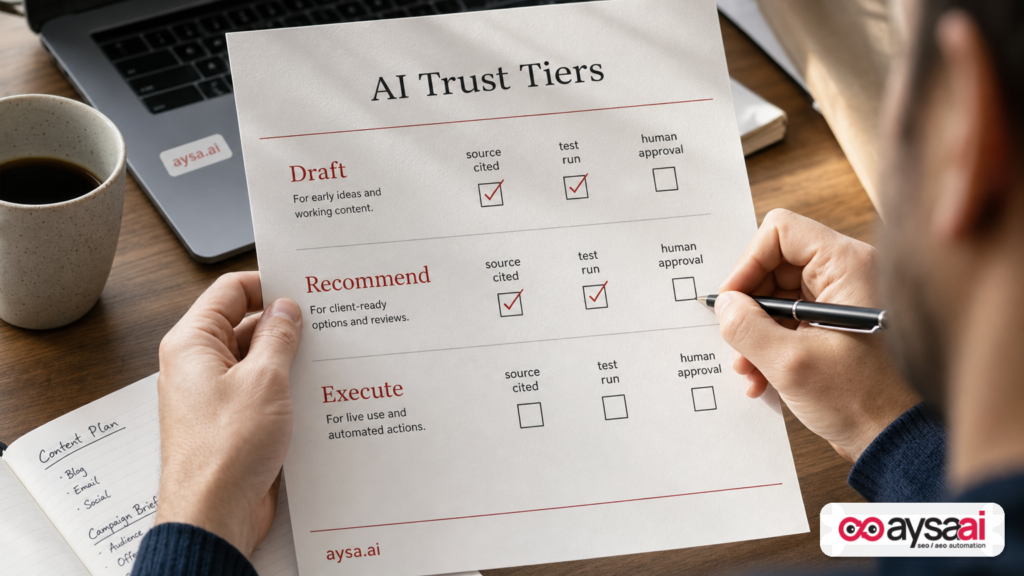
A practical framework: Trust tiers for AI outputs (and what to do at each tier)
Most teams have only two modes:
- AI is useless (ignore it).
- AI is smart (do what it says).
Both are lazy. The real solution is to define tiers of trust based on risk.
Tier 1: Draft (low risk)
AI can draft things like:
- Outline options for a landing page.
- FAQ candidates based on customer support tickets (with human validation).
- Meta title variations for review.
Required controls: human review, brand voice check, factual check.
Tier 2: Recommend (medium risk)
AI can recommend actions like:
- Internal links to add (with relevance validation).
- Pages to consolidate (with performance checks).
- Schema opportunities (tested against official guidelines).
Required controls: citations to first-party data, testing plan, approval gate.
Tier 3: Execute (high risk)
AI should only execute after approval—and only with monitoring, logging, and rollback—for changes like:
- Canonical rules
- Noindex/robots directives
- Redirect logic
- Template updates that affect thousands of URLs
- Structured data deployments sitewide
This is where “approved execution” becomes non-negotiable. AI can do the work, but humans must choose what ships.
A concrete SME scenario: the local clinic that “optimized” itself into invisibility
Let’s make this real with a scenario that mirrors what we see in the market.
Business: a 3-location physical therapy clinic with a small marketing team (one generalist) and an agency on retainer for SEO.
The goal: grow appointment requests for “sports injury rehab,” “post-op PT,” and “back pain physical therapy.”
What changed: the clinic used AI to rewrite service pages. The AI made the copy smoother, added “helpful” FAQs, and inserted a few confident medical-adjacent statements that were not reviewed by clinicians. It also suggested consolidating multiple location pages into a single “Our Locations” page to “avoid duplication.”
What went wrong:
- The consolidated page removed location-specific relevance (address context, local terminology, provider bios).
- FAQs included claims that were too broad and not aligned with what the clinic legally/clinically wanted to say.
- Internal links to the booking flow were reduced because the AI “optimized readability.”
- No one monitored indexation changes or local visibility shifts until leads softened.
The cost: not a dramatic “penalty,” but a quiet decline: fewer calls, lower-quality leads, and more time spent redoing content under pressure.
What would have prevented it: a workflow where AI prepared changes, but every factual claim required source confirmation, every page consolidation required a visibility impact assessment, and every deployment required approval and monitoring.
This isn’t hypothetical fearmongering. It’s the normal failure mode when AI is treated as a publisher instead of an assistant.
What agencies should rethink: deliverables, QA, and liability
Agencies are under the most pressure here, because clients expect speed and results—and AI tempts teams to scale output fast. But scaling output doesn’t scale accountability.
Three agency shifts matter most:
Shift 1: From deliverables to outcomes (and fewer, higher-quality changes)
AI makes it easy to produce “more.” Clients don’t need more. They need wins. In a world of AI Overviews and reduced clicks, agencies should focus on actions that improve eligibility, inclusion, and conversion—often through technical fixes and content clarity, not volume.
Shift 2: From “we wrote it” to “we verified it”
QA becomes a differentiator. Your agency brand should be: we validate claims, we test recommendations, and we can explain exactly why a change was made.
Shift 3: From “we sent a doc” to “we shipped work safely”
Execution is where strategies go to die. Search Engine Land has been increasingly vocal about execution gaps and measurement challenges across AI-era SEO (e.g., the emphasis on visibility tracking and server logs in the links surfaced on the source page).
Agencies that win will pair strategy with controlled execution: changes prepared, approved, implemented, logged, and monitored.
The AYSA approach: monitored, prepared, approved, executed
My point of view: the market doesn’t need another chatbot that produces SEO advice. The market needs a system that turns validated decisions into shipped website improvements—without gambling your business on unverified output.
That’s the lens we built AYSA around:
- Monitor what matters (visibility signals, technical issues, content gaps). See: AYSA Monitoring.
- Prepare concrete website changes, not vague recommendations.
- Ask for approval before publishing—because your brand, compliance, and revenue are on the line.
- Execute accepted changes reliably, with traceability.
If you want the broader context of how we think about AI SEO tooling, start here: AI SEO Tools.
And if you’re evaluating whether this kind of execution model fits your team size and risk tolerance, pricing and packaging live here: AYSA Pricing.
Why this model matters for “confident, wrong, expensive” AI: it changes the default from blind trust to controlled shipping. AI can still accelerate the work, but it cannot bypass governance.
In practice, approved execution also improves collaboration:
- Founders get confidence that nothing risky ships without sign-off.
- Marketers get leverage because they can move faster with guardrails.
- Agencies get a cleaner path from recommendation to implementation.
For more on our evolving point of view, see the AYSA blog: AYSA Blog.
What to do next: an action plan you can run this week
Here’s a practical, non-hyped checklist to reduce AI risk while keeping the upside.
1) Define your “no-ship without approval” list
Create a short list of changes that can never be deployed without human review:
- robots.txt
- noindex rules
- canonical templates
- redirect rules
- navigation and internal link templates
- schema sitewide deployment
2) Require citations for factual claims
In content workflows, enforce a rule: if it’s a fact (pricing, policy, medical claim, warranty, compatibility), the AI must link to a first-party source—or the statement is removed.
3) Put server logs and Search Console into your validation loop
Don’t debate crawling and indexing in the abstract. Validate with tooling. Start with Google Search Console. If you have scale, add log-based validation (and review the SEL piece on why logs show what tools miss: Search Engine Land).
4) Monitor AI visibility and brand interpretation
Start tracking whether AI systems include you for your category, and whether they describe you accurately. This is especially important if your brand depends on local intent, regulated claims, or nuanced differentiation.
AYSA’s starting point for this: AI Search Visibility.
5) Move from “AI writes” to “AI prepares changes”
If your current AI usage is primarily chat-based, shift the mindset: the goal is not a clever paragraph; it’s a validated change that improves performance. Systems that support monitoring and approved execution reduce the chance that you’ll discover the mistake after it has already cost you traffic.
6) Write down your trust tiers policy
Even a one-page policy changes behavior:
- What can AI draft?
- What can it recommend?
- What requires approval to execute?
- What sources are allowed?
- Who is accountable for review?
Sources and further reading
- Search Engine Land: AI in the wild: Confident, wrong, and weirdly expensive
- Search Engine Land: What to do now that AI Overviews turned search into reading sessions
- Search Engine Land: 4 ways to track AI search visibility when attribution falls short
- Search Engine Land: How AI forms opinions about your brand
- Search Engine Land: What server logs reveal that SEO tools miss
- Search Engine Land: Delegation search: Why users outsource decisions to AI
- Google Search Console (official)
- Google Search Central documentation (official)
Note: AI search behavior and visibility measurement are evolving quickly, and different platforms expose different data. When you can’t verify a claim with first-party tools (Search Console, logs, analytics), treat AI explanations as analysis—not as facts.
AYSA next steps: If you want a system that monitors, prepares changes, requests approval, and executes accepted updates, explore Monitoring, AI Search Visibility, and Pricing.
Continue the AI search topic inside AYSA.
Use these pages to connect the article with AI SEO tools, AI visibility monitoring, AI Overviews and approved website execution.
Turn this topic into a website action plan.
Use these AYSA hubs to move from reading to technical fixes, AI visibility monitoring, research, glossary context and approval-first SEO execution.

