
SEO for Hotels and HoReCa in the AI Era: What SMEs Should Do Now
A practical guide to SEO for hotels, restaurants, cafes, venues and HoReCa SMEs in the AI era: local visibility, reviews, direct bookings, Google Business Profile, content, technical SEO and approved execution.
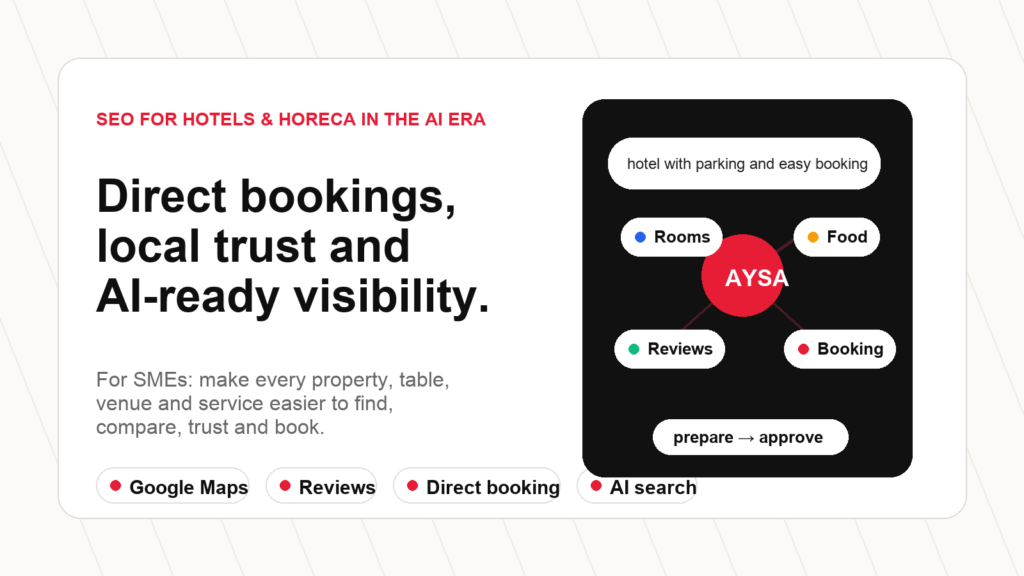
Executive summary: SEO for hotels, restaurants, cafes, venues and HoReCa businesses is no longer only about ranking for “hotel in city” or “restaurant near me.” In the AI era, people search with complete needs: parking, reviews, breakfast, child-friendly rooms, airport transfer, private events, menu options, online booking, cancellation rules, accessibility, opening hours and trust signals. Google Search, Google Maps, AI Overviews, AI Mode and answer engines all need the same thing: clear, current, crawlable, trustworthy information.
For SMEs, the opportunity is practical. You do not need to become an SEO expert. You need a system that keeps your website and local presence accurate, useful and easy to compare. In my opinion, HoReCa SEO in 2026 is about moving from “we have a website” to “our website, profile, reviews, booking information and content are continuously improved.” AYSA fits here as an Approved Execution layer: it monitors, prepares, asks for approval and helps execute accepted SEO, AEO and AI visibility changes inside the website workflow.
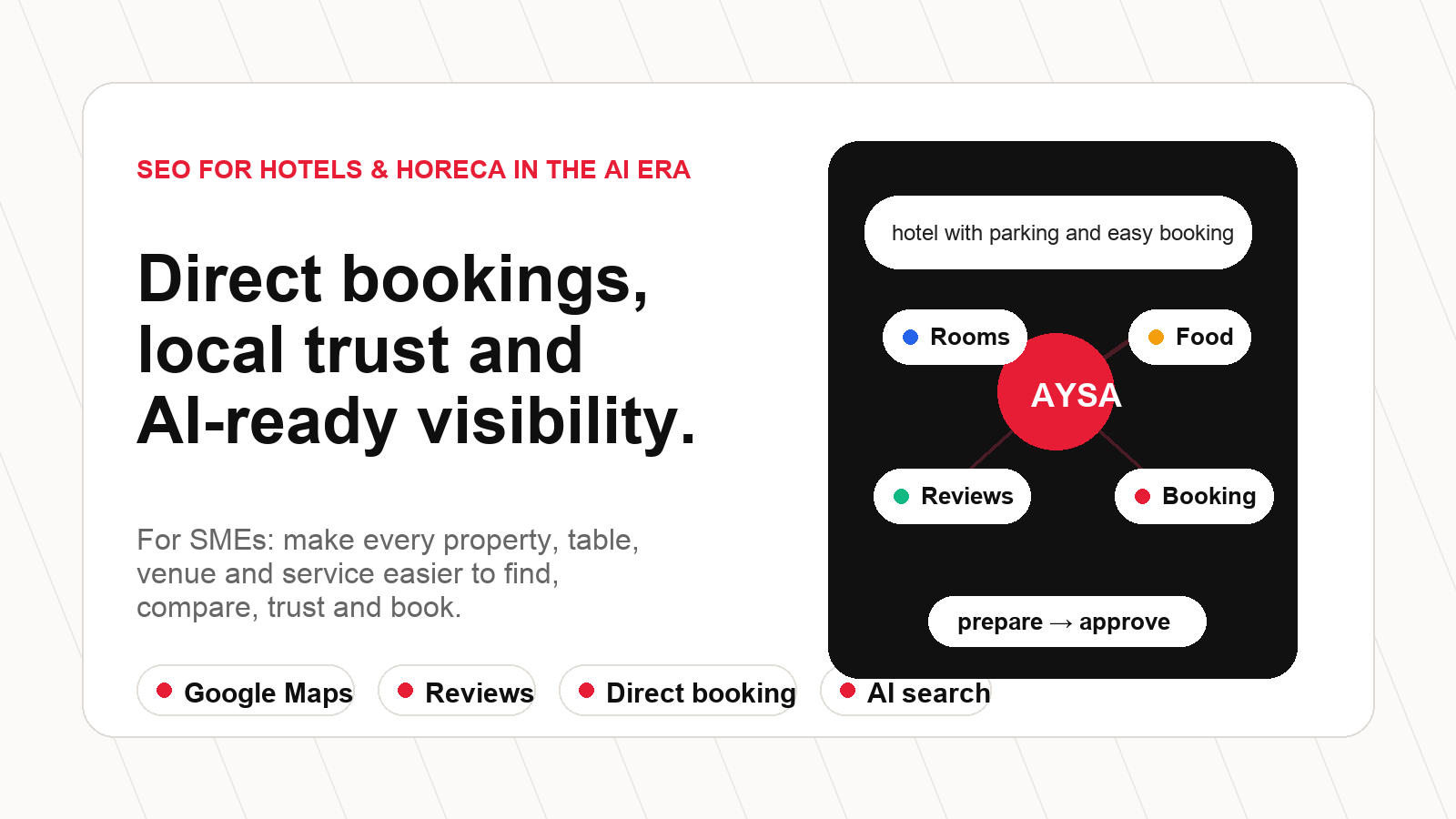
Why SEO for hotels and HoReCa has changed
HoReCa SEO used to be easier to describe: optimize a website, add city keywords, collect some links, create a few pages and wait. That model is no longer enough. The customer journey has become fragmented. A guest may discover a hotel on Google Maps, compare it in Google Search, check reviews, ask an AI assistant for recommendations, look at photos, verify parking, check cancellation conditions, compare direct booking with booking platforms and then call, reserve or abandon.
The same is true for restaurants, cafes, wedding venues, event spaces, spas, guesthouses and airport parking or shuttle businesses. Search is not just a traffic channel. It is part of the decision process. The user wants a confident answer: “Is this place right for me, right now, with my constraints?”
This is why HoReCa SEO in the AI era must be more operational. It is not enough to publish a generic “best hotel” page. The business must keep information accurate, answer real questions, make booking easy, prove trust, show what makes the location different and remove technical barriers that stop search systems from understanding the website.
For small and medium-sized businesses, this can feel overwhelming. Hotels and restaurants already deal with staff, guests, suppliers, reviews, operations, pricing, menus, booking systems, seasonality and competition. SEO becomes another thing on the list. The solution is not more dashboards. The solution is a clearer operating model: monitor, prepare, approve, execute.
How guests search in 2026
People increasingly search in natural language. They do not only type “hotel Bucharest.” They ask for the best option near an airport, with parking, late check-in, breakfast, family rooms, pet-friendly policy, quiet rooms, spa access, online booking or flexible cancellation. They ask about restaurants with vegetarian menus, outdoor seating, business lunch, private rooms, parking, live music, child-friendly atmosphere or group reservations.
AI Search makes this even more visible. A user may ask an assistant: “I need a hotel near the airport for an early flight, safe parking, breakfast from 5 AM and easy transfer. What should I compare?” That question contains multiple search intents. The system may need to retrieve information about location, amenities, reviews, transport, booking policies, room types and guest experience.
This is where many HoReCa websites fail. They have beautiful photos, but weak information. They have a booking button, but no clear FAQs. They have menus as PDFs that are hard to parse. They have outdated opening hours. They rely on platforms for visibility but do not build enough direct website authority. They have reviews on Google but do not reflect the strongest guest questions on their own pages.
The practical takeaway is simple: your website should answer the questions a real guest would ask before booking. Not with fluff. With useful, specific, current information.
Weak HoReCa SEO
Generic pages, outdated menus, unclear booking information, thin location details and no structured answers.
Strong HoReCa SEO
Useful pages that explain rooms, services, location, amenities, reviews, policies, events and next steps clearly.
Google Business Profile is not optional
For local discovery, Google Business Profile is one of the most important assets a HoReCa business controls. Hotels, restaurants and cafes need accurate categories, address, phone, opening hours, website, booking links, photos, amenities, menus and updates. Google’s own Business Profile documentation includes specific support areas for hotels and restaurants because these businesses depend heavily on local intent.
For restaurants, the profile should make it easy to understand cuisine, menu, hours, reservation options, delivery or takeaway options where relevant, photos and reviews. For hotels, the profile should support the decision with amenities, photos, rates and booking paths where available. For venues, the website and profile should make event capacity, location, parking, contact and booking steps obvious.
The mistake is treating the profile as a one-time setup. In reality, it should be maintained. Opening hours change. Menus change. Photos become old. Reviews reveal questions. Competitors update their profiles. Local search surfaces evolve. A stale profile can quietly reduce trust.
AYSA’s perspective is that Business Profile data should be part of the broader SEO workflow. If reviews mention parking, noise, breakfast, staff, cleanliness or booking confusion, those signals should influence website content. If the website has better information than the profile, the profile should be updated. If the profile says one thing and the website says another, that inconsistency should be fixed.
Direct bookings are the business goal, not just traffic
Many hotels and HoReCa businesses depend on intermediaries for visibility. Platforms can be valuable, but direct bookings matter because they protect margin, customer relationships and brand control. SEO should support direct booking, not only traffic.
A direct booking page should answer practical questions. What is included? What is the cancellation policy? Is breakfast included? Is parking available? Is there airport transfer? Can guests book online? What happens after booking? Is payment required? Is the room suitable for families? Is the restaurant open to non-guests? Can a company reserve a private event?
If the website hides these answers or sends users through a confusing booking flow, SEO traffic leaks. AI assistants and search engines may also struggle to understand why the business is a good recommendation. A clear booking path is both a conversion issue and a search visibility issue.
For restaurants, direct reservations can be just as important. A page should explain table booking, group reservations, private dining, menu options, dietary restrictions, parking, payment, dress code if relevant and how quickly the restaurant confirms. For event venues, the equivalent is lead capture: availability, capacity, packages, photos, location, testimonials and contact flow.
Reviews are content, trust and market research
Reviews are not only social proof. They are a source of language. Guests tell you what they care about: clean rooms, helpful staff, parking, breakfast, quiet location, check-in, view, child-friendly experience, food quality, speed of service, atmosphere, event coordination, value for money and problem handling.
Google’s review ecosystem is central to local decision-making, but reviews should also influence the website. If guests praise the breakfast, the breakfast page should be strong. If guests ask about parking, parking should not be buried. If guests mention family rooms, the website should answer family-related questions. If negative reviews reveal confusion, the website should clarify expectations.
Do not fake reviews. Do not manipulate reviews. Do not write review content that sounds artificial. The goal is to make real trust signals easier to understand. A business can ask customers for reviews ethically, respond professionally and use recurring themes to improve its pages.
In the AI era, reviews may also help systems understand sentiment and suitability. A hotel with clear reviews about airport transfer, parking and early breakfast may be easier to recommend for a specific traveler than a hotel with vague copy and little structured information.
Content that helps guests decide
HoReCa content should not be written only for keywords. It should reduce uncertainty. A good hotel page helps the guest understand the room, the location, the amenities, the booking process and the type of stay. A good restaurant page helps the guest understand the menu, atmosphere, reservation process, dietary options, opening hours and location. A good venue page helps the organizer understand capacity, packages, parking, catering, photos and next steps.
Useful content examples include:
Location pages: not just “hotel in Bucharest,” but useful details about neighborhoods, transport, airport access, parking, nearby landmarks and who the location is best for.
FAQ sections: check-in, check-out, parking, pet policy, breakfast, accessibility, reservation changes, cancellation, group bookings and payment.
Comparison content: direct booking vs platform booking, airport hotel vs city center hotel, restaurant private room vs event venue, guesthouse vs hotel.
Seasonal content: holidays, conferences, local events, wedding season, tourism peaks, summer terraces, Christmas menus, corporate parties.
Trust pages: reviews, awards, hygiene practices, staff experience, customer stories, event photos and policies.
The key is specificity. A generic article about “best restaurants” will not build much trust. A useful guide that explains how to choose a private dining room for a corporate dinner, what capacity matters, what menu options to compare and how booking works can support real demand.
Technical SEO for HoReCa websites
Technical SEO is often the hidden problem. Many HoReCa websites use heavy themes, sliders, large images, booking widgets, tracking scripts, menu PDFs, old plugins and slow hosting. The visual design may look good, but mobile performance suffers. Search engines and users both feel the friction.
Important technical priorities include fast mobile loading, optimized images, clean HTML, correct canonical tags, working internal links, structured data where appropriate, crawlable menus and pages, sitemaps, no broken booking links and no outdated redirects. For hotels and restaurants, image optimization is especially important because visuals are essential, but huge images can destroy page speed.
Structured data can help search engines understand business information, but it should match visible content. Schema is not magic. It is a clarity layer. If your opening hours, address, phone, menu, room information or booking details are wrong on the page, structured data will not fix the underlying problem.
Booking engines and third-party widgets also need attention. If the booking button is slow, blocked, confusing or not accessible on mobile, SEO traffic may not convert. Technical SEO should be measured against business outcomes, not only audit scores.
AI search readiness for hotels, restaurants and venues
AI search systems need clear facts and useful context. For a hotel, that means room types, amenities, location, parking, breakfast, policies, booking options, nearby attractions, reviews and suitability for different guests. For a restaurant, it means cuisine, menu, price range, reservation options, atmosphere, dietary options, location, opening hours and reviews. For a venue, it means capacity, packages, event types, catering, parking, photos and contact flow.
AI readiness does not mean writing robotic content. It means making the website easier to parse and easier to use as a source. Clear headings, concise answers, examples, FAQs, internal links, updated information and structured data all help.
AI search also increases the importance of entity consistency. The business name, address, phone, website, social profiles, booking links and descriptions should be consistent across the website, Google Business Profile, review platforms and important directories. Conflicting signals make the business harder to understand.
For SMEs, the practical question is: if a potential guest asks an AI assistant for a recommendation, does your public information make you easy to include in the answer? If not, the fix is not one trick. It is a continuous improvement process.
Restaurants, cafes and food businesses
Restaurant SEO is deeply local and intent-driven. People search for cuisine, location, opening hours, menus, dietary preferences, reservation availability, atmosphere and reviews. A restaurant website should make these details obvious.
Menus should be crawlable, not only uploaded as image-heavy PDFs. Photos should be optimized. Reservation links should work. Opening hours should be consistent. Pages should explain private dining, terrace, delivery, takeaway, events, tasting menus, lunch offers or business meals if those are relevant.
For cafes, bakeries and smaller food businesses, local pages and Google Maps visibility can matter more than long blog articles. The best content may be practical: menu, location, photos, seasonal products, events, catering options, FAQ and local guides. A bakery near an office district has different search intent than a fine dining restaurant or a wedding venue.
AI search can compare restaurants by constraints. “Quiet restaurant for a business lunch near Victoriei with parking” is a different search than “best pizza delivery.” The website should contain the signals that make those recommendations possible.
Venues, events and hospitality services
Venues often miss SEO opportunities because they publish beautiful galleries but weak decision content. Someone searching for a wedding venue, conference room, private party space or corporate event location needs capacity, layout, packages, catering, parking, location, availability, photos, reviews, restrictions and contact steps.
Event SEO should be built around use cases. A venue may need pages for weddings, corporate events, private parties, conferences, baptisms, product launches or holiday parties. Each page should be specific, not duplicated. It should explain what is included, what can be customized, how inquiry works and what makes the venue suitable.
For AI search and answer engines, structured and specific content matters. If a user asks for “a small corporate event venue near Bucharest with parking and catering,” a generic homepage may not be enough. A clear use-case page has a better chance of being understood.
What HoReCa SMEs should do now
Here is a practical operating checklist for hotels and HoReCa businesses:
Audit your Google Business Profile. Check categories, address, phone, website, hours, photos, menu, booking links, amenities and reviews.
Fix your direct booking path. Make sure users can book or inquire easily on mobile, without confusion.
Create useful service and location pages. Cover rooms, restaurant, events, parking, airport transfer, private dining, amenities, policies and local context.
Turn reviews into page improvements. Use real recurring review themes to improve content, not to manufacture fake claims.
Improve technical performance. Optimize images, reduce plugin bloat, fix broken links, clean redirects and make menus crawlable.
Add clear FAQs. Answer the questions people ask before booking.
Control indexation. Keep useful pages indexable and reduce low-value archives, duplicate URLs and thin pages.
Monitor continuously. Search behavior, reviews, competitors and AI visibility change. SEO cannot be frozen.
Where AYSA fits
For HoReCa SMEs, the main bottleneck is rarely knowing that SEO matters. The bottleneck is doing the work consistently. A hotel owner, restaurant manager or venue operator does not have time to live in SEO tools, interpret dashboards, rewrite pages, check technical issues and update internal links every week.
AYSA is designed for this gap. The agent can learn the business, monitor the website, prepare SEO and AI visibility actions, explain why they matter, ask for approval and help execute accepted changes. For a hotel, that may mean improving room pages, adding parking information, preparing FAQs, fixing technical problems, updating structured data, identifying missing local content or strengthening internal links. For a restaurant, it may mean menu clarity, reservation content, review-driven FAQs and local visibility improvements.
The important part is control. AYSA should not publish blindly. The user reviews and approves important actions. After approval, the system helps move execution forward. That is the difference between a report and an operating layer.
In my opinion, HoReCa businesses that win in AI-era search will not be the ones chasing every new trend. They will be the ones that keep their public information accurate, useful, fast, trusted and easy to act on.
Less SEO work. More organic growth.
Turn HoReCa search visibility into approved website action.
AYSA monitors your website, prepares local SEO, AEO and AI visibility work, asks for approval and helps execute accepted changes inside your website workflow.
Sources and further reading
- Google Business Profile Help
- Google Business Profile: hotel attributes and amenities
- Google Business Profile: food ordering and restaurant features
- Google Search Central: AI features and your website
- Google Search Central: creating helpful, reliable, people-first content
- Google Search Central: Local Business structured data
- Schema.org: Hotel and Schema.org: Restaurant
Continue the AI search topic inside AYSA.
Use these pages to connect the article with AI SEO tools, AI visibility monitoring, AI Overviews and approved website execution.
Turn this topic into a website action plan.
Use these AYSA hubs to move from reading to technical fixes, AI visibility monitoring, research, glossary context and approval-first SEO execution.

