
SEO Trends for 2026: AI Search, Ecommerce, Query Fan-Out and the New Execution Layer
A practical look at the SEO trends that matter in 2026: AI search, query fan-out, helpful content, ecommerce SEO, multilingual visibility, technical quality and why execution now matters more than reporting.
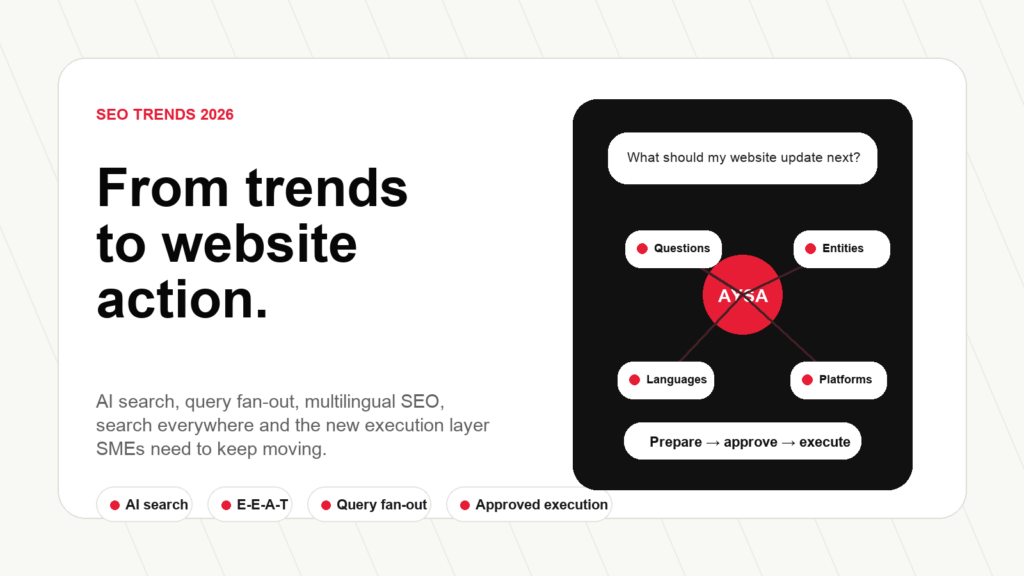
Executive summary: SEO trends for 2026 are not just about new tactics. The market is moving from ranking pages for isolated keywords toward making websites easier to understand, retrieve, cite, compare and update across classic Google Search, AI Overviews, AI Mode, answer engines, ecommerce surfaces, social discovery and multilingual markets.
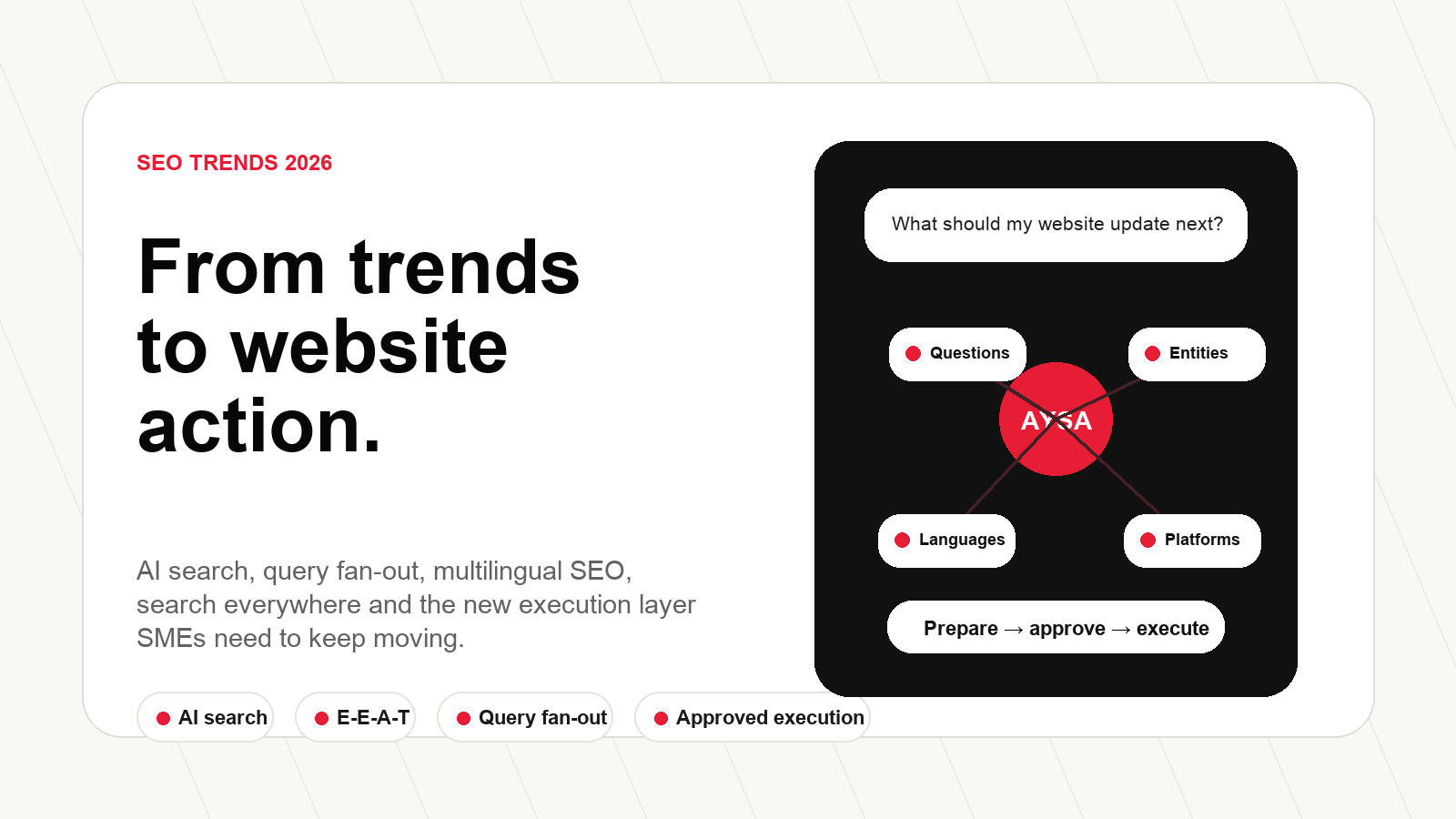
The practical conclusion is simple: the winners will not be the companies that read the most trend lists. The winners will be the companies that turn the right trends into approved website changes, repeatedly. In my opinion, that is where AYSA fits: not as another report, but as an execution layer that monitors, prepares, asks for approval and helps apply accepted SEO, AEO and AI visibility work inside the website workflow.
Why SEO trends matter, and why most trend lists are not enough
Every year, marketers publish lists of SEO trends. Some are useful. Some are recycled. Some are written to create urgency around whatever software category the author sells. The problem is not that trend analysis is useless. The problem is that trends are often consumed passively. A business owner reads about AI Search, E-E-A-T, page experience, topical authority, user-generated content, video, social search, Structured data, Multilingual SEO and query fan-out, then nothing changes on the website.
That gap between knowledge and execution is the real SEO problem for small and medium-sized businesses. A trend is only valuable if it helps the company decide what to update, what to remove, what to monitor, what to improve and what to approve. Otherwise it becomes another document, another meeting or another dashboard.
The Shopify article that inspired this analysis correctly points toward a broader SEO reality: search is no longer only “write content and rank on Google.” It now includes AI visibility, answer readiness, brand trust, social discovery, page experience, ecommerce data quality, multilingual markets and content designed for more complex questions. That is directionally right. But for most SMEs, the missing piece is operational: who turns those ideas into work?
In 2026, SEO is moving from a campaign model to an operating model. You do not optimize once and stop. You monitor performance signals, detect changes, refresh weak pages, improve internal links, update structured data, fix technical issues, expand topic coverage, control indexation, build authority safely and measure what changed. That is too much manual work for many teams, especially when they do not have an in-house SEO specialist.
1. AI search is now part of SEO strategy, not a side topic
AI search is no longer a future scenario. Google has been expanding AI features in Search, including AI Overviews and AI Mode. Other answer engines and assistants are also shaping how users discover information. The important shift is not that “blue links are dead.” They are not. The shift is that users increasingly expect synthesized answers, comparisons, summaries, follow-up prompts and direct recommendations.
Google’s own AI features guidance does not tell website owners to abandon SEO fundamentals. It points back to useful, crawlable, accessible, well-structured content. This is important because it keeps the conversation grounded. There is no magic “AI Mode SEO tag.” There is no guaranteed way to force inclusion in AI Overviews. The work is still about making the website useful, technically accessible, understandable and trusted.
For a business, the practical question becomes: “If an AI system tries to understand our company, products, services, locations, pricing, proof, expertise and next steps, is the website clear enough?” Many websites are not. They have thin service pages, outdated product pages, weak internal links, unclear author information, missing FAQs, poor schema, conflicting business details or no proof that the company is active and credible.
AI search also changes the way we think about visibility. A business may not only want to rank. It may want to be cited, mentioned, compared, recommended or used as a source. Those are not identical outcomes, but they share a foundation: the website must be easy to retrieve and easy to trust.
Old SEO habit
Track a ranking, rewrite a title, wait a month, then repeat.
2026 SEO habit
Monitor search and AI visibility signals, prepare concrete improvements, approve the work and execute inside the website.
2. Query fan-out changes how content must be planned
One of the most important concepts for AI-assisted search is query fan-out. In simple language, a system can take a complex user question and explore several related subquestions behind the scenes. A person may ask one question, but the retrieval process may involve many connected intents.
For example, “best SEO automation tool for a small ecommerce business” may involve subtopics such as ecommerce SEO, technical audits, content optimization, product pages, agency alternatives, pricing, AI search visibility, WordPress or Shopify support, reporting, approvals and safety. A page that only repeats the keyword is weak. A website that covers the topic cluster well is stronger.
This is why topical authority matters more than isolated keyword targeting. Topical authority does not mean publishing thousands of low-quality pages. It means covering the real decision space around a subject in a way that helps the user and helps search systems understand the relationships between concepts.
For SMEs, query fan-out has a practical implication: your website should not be a collection of disconnected pages. Product pages, service pages, blog articles, glossary terms, help pages, case examples and pricing pages should reinforce each other. If the site talks about SEO automation, it should also explain approval workflows, credits, technical SEO, content generation, AI visibility, authority building, internal links, ecommerce SEO and reporting.
3. Helpful content and E-E-A-T become harder to fake
Google’s helpful content guidance asks creators to focus on people-first content, expertise, experience and real usefulness. That sounds obvious, but it is still the biggest weakness in many SEO programs. Too many pages are written to target a query without truly helping a user make a decision.
Quality content starts with a harder question: what would make this page the most useful result for a specific user, at a specific stage of the journey, in a specific market? A page about “best pediatric clinic in Bucharest” should not look like a generic medical directory. It should help a parent compare options, understand when to choose emergency care, see real criteria, evaluate trust signals and decide what to do next. A page about “technical SEO audit” should not only define the term. It should explain the checks, risks, examples, prioritization and what happens after issues are found.
That is the difference between content volume and content value. In 2026, AI-assisted content production makes publishing easier, but it also makes generic content less defensible. If everyone can generate a basic article, the advantage moves toward specificity, proof, structure, freshness, authority and execution.
Businesses should review old content with a brutal lens. Does the page answer the question clearly? Does it include real details? Does it prove experience? Does it connect to related pages? Does it show who is responsible for the content? Does it include current information? Does it help the user do something?
4. Ecommerce SEO becomes product data, trust and decision support
Ecommerce SEO is not only category descriptions and product titles. Google’s ecommerce guidance emphasizes product information, structured data, product variants, availability, pricing, reviews, merchant listings and a clean buying experience. In AI search, ecommerce pages may also need to support comparison, recommendation and purchase-intent questions.
For online stores, this means category pages need to be useful, not just keyword containers. Product pages need accurate information, clear benefits, shipping and return details, media, structured data and internal links. Collections should help users compare. Blog content should not be detached from products; it should support real buying journeys.
A common ecommerce SEO failure is treating content as a separate layer from inventory. Search visibility depends on product reality. If products are unavailable, categories are thin, filters create crawl waste, canonical tags are wrong, images are heavy and product data is incomplete, no amount of blog publishing will fully compensate.
This is where automation can help, but only if it respects approval and business context. An agent can monitor category performance, identify thin pages, prepare title improvements, suggest FAQ additions, detect internal linking gaps, find products that need better descriptions and flag technical issues. The business should still approve important changes, but the work should not depend on manual spreadsheet management.
5. Search is everywhere, but your website remains the source of truth
People search on Google, YouTube, TikTok, Reddit, marketplaces, app stores, maps, answer engines and social platforms. That does not mean a business should panic and publish everywhere at once. It means the website needs a clear, consistent entity footprint that other surfaces can reinforce.
For a local business, this includes Google Business Profile, reviews, local pages, service information, opening hours, location details and clear contact options. For ecommerce, it includes product feeds, merchant data, category structure, reviews and brand presence. For SaaS, it includes documentation, use cases, pricing clarity, product pages, comparison pages and help content.
Search everywhere also increases the value of “voice of the customer.” Reviews, questions, support conversations, Reddit threads, social comments and sales objections often reveal what real users care about. The best SEO content in 2026 will not be written only from keyword tools. It will combine search data with customer language.
AYSA’s point of view is that these inputs should become execution signals. If users repeatedly ask about pricing, implementation, safety, compatibility or alternatives, those questions should appear in website content. If customers use different language than the company uses, pages should be updated. If reviews reveal trust criteria, local pages should reflect them honestly.
6. Multilingual SEO is not translation. It is market fit
Multilingual SEO is often handled badly. Companies translate pages mechanically, publish duplicates and assume the work is done. Google’s documentation around localized versions and hreflang makes it clear that international SEO requires proper language and regional signals, not just translated text.
For European SMEs, this matters. A Romanian business expanding into English, German, French or Bulgarian markets should not only translate keywords. It should adapt examples, terminology, pricing context, legal language, local proof, customer objections and search intent. A page that works in Romania may not work the same way in Germany or France.
Technical details also matter: hreflang, canonicals, language-specific URLs, internal links, translated metadata, structured data consistency and sitemap inclusion. Bad multilingual setups can create duplicate content, canonical conflicts and indexing confusion.
The practical trend is clear: multilingual visibility will matter more, but only if it is managed as an SEO system. Translation without search strategy creates noise. Search strategy without execution creates delay.
7. Technical quality is still the operating foundation
AI search does not remove technical SEO. It makes technical SEO more important because messy websites are harder to crawl, interpret and trust. Core Web Vitals, indexability, clean HTML, redirects, canonical tags, sitemaps, structured data, robots directives, internal links and page speed remain foundational.
For WordPress websites, the same problems appear again and again: plugin bloat, slow themes, heavy JavaScript, oversized images, duplicate archives, tag pages with no value, redirect chains, broken links, poor sitemap hygiene and inconsistent schema. These are not abstract technical problems. They affect whether pages are discovered, rendered, indexed and trusted.
One of the strongest SEO trends for 2026 is not glamorous: crawl quality. Search engines and AI systems should spend their attention on the pages that matter. That means reducing low-value URLs, cleaning archives, avoiding query parameter waste, fixing internal links, maintaining canonicals and ensuring important content is accessible in clean HTML.
Technical SEO should also become continuous. A site can be clean today and broken in two months after a plugin update, content migration, redesign, tag explosion or tracking script change. Monitoring is no longer optional for serious businesses.
8. Authority building must become safer, clearer and more relevant
Authority still matters, but the language around link building needs to mature. Businesses do not care about jargon. They care whether trusted mentions across the web help potential customers and search systems understand the brand. The risky part is not authority itself. The risky part is uncontrolled, irrelevant, manipulative or opaque authority work.
In 2026, authority building should be connected to relevance, context and approval. A business should understand where a mention or placement appears, why it is relevant, what it costs, what the expected role is and whether it fits the brand. It should not be a black box.
This is one reason AYSA integrates authority-building workflows with the broader SEO execution layer. Included permanent links and additional publisher opportunities can be treated as controlled actions: surfaced, explained, approved and tracked. The goal is not “buy links and hope.” The goal is visible, relevant, approved authority work.
9. Measurement will be messier, so decision quality matters more
SEO measurement is becoming more complex. AI answers can influence clicks. Zero-click behavior can change. Attribution across search, social, marketplaces and AI assistants is imperfect. Google Search Console remains essential, but it does not answer every AI visibility question in a clean dashboard.
That means teams need better decision quality, not just more metrics. Useful measurement should combine ranking data, impressions, clicks, page performance, conversions, content freshness, technical health, internal linking, brand mentions, AI visibility checks and business outcomes.
For SMEs, the danger is dashboard overload. More reports do not automatically produce growth. A useful system should translate signals into next actions: refresh this page, add this FAQ, fix this redirect, improve this title, create this missing page, add internal links here, update schema there, review this authority opportunity.
Where AYSA fits: from SEO trends to approved execution
The central problem with SEO trends is execution. A business can know that AI search matters, helpful content matters, ecommerce data matters, technical quality matters, authority matters and multilingual SEO matters. But who actually does the work every week?
AYSA is built around the idea that SEO should move from research to approved action. The agent learns the business, monitors the website, watches performance signals, prepares SEO, AEO, GEO and AI visibility work, explains what matters, asks for approval and helps execute accepted changes inside the website workflow.
That matters because SMEs usually do not fail at SEO because they lack information. They fail because implementation is slow, fragmented or too dependent on specialists. A report can identify the issue. A dashboard can display the metric. But growth comes from the approved changes that actually reach the website.
In my opinion, the biggest SEO trend for 2026 is not AI by itself. It is the move from SEO knowledge to SEO operations. Companies that can continuously detect, decide and execute will have an advantage over companies that only collect recommendations.
Less SEO work. More organic growth.
Turn SEO trends into approved website action.
AYSA monitors your website, prepares SEO, AEO and AI visibility work, asks for approval and helps execute accepted changes inside your website workflow.
Sources and further reading
Continue the AI search topic inside AYSA.
Use these pages to connect the article with AI SEO tools, AI visibility monitoring, AI Overviews and approved website execution.
Turn this topic into a website action plan.
Use these AYSA hubs to move from reading to technical fixes, AI visibility monitoring, research, glossary context and approval-first SEO execution.

