
Google’s AI Optimization “Mythbusting” Isn’t the End of AEO — It’s a Line Between Citations and Agent Actions
Google’s new AI optimization guide tells marketers to stop chasing shortcuts like llms.txt, AI-specific rewriting, and schema obsession for AI Overview citations. But that guidance is only complete if your goal is “getting cited.” If your goal is “getting chosen” by AI agents that take actions on your site, the playbook expands — and execution discipline matters more than ever.

Google just did the most useful thing it can do for the SEO industry: it told us what not to do.
In a new AI Optimization guide (and especially its “mythbusting” section), Google effectively says you can ignore several popular “AI SEO” tactics that vendors have been selling as shortcuts to getting cited in AI Overviews and other AI-generated answers. That’s an overdue reality check.
But there’s a second, more important conversation hiding in plain sight: Google’s guidance is primarily about AI citations inside Google Search. It’s not a full strategy for the emerging world of AI agents that don’t just summarize the web — they act on it (book, buy, compare, fill forms, navigate flows).
I’m Marius Dosinescu, and at AYSA we build systems that don’t just “recommend” SEO/AEO/GEO work. We monitor what’s happening, prepare changes, ask for approval, and then execute accepted changes on your website. That execution layer becomes even more important as the industry shifts from “ranking pages” to “helping machines complete tasks.”
This editorial will help you separate what Google actually debunked from what still matters — and how to build a practical, defensible plan that works for both citation-based AI Search and agent-driven experiences.
Concise summary
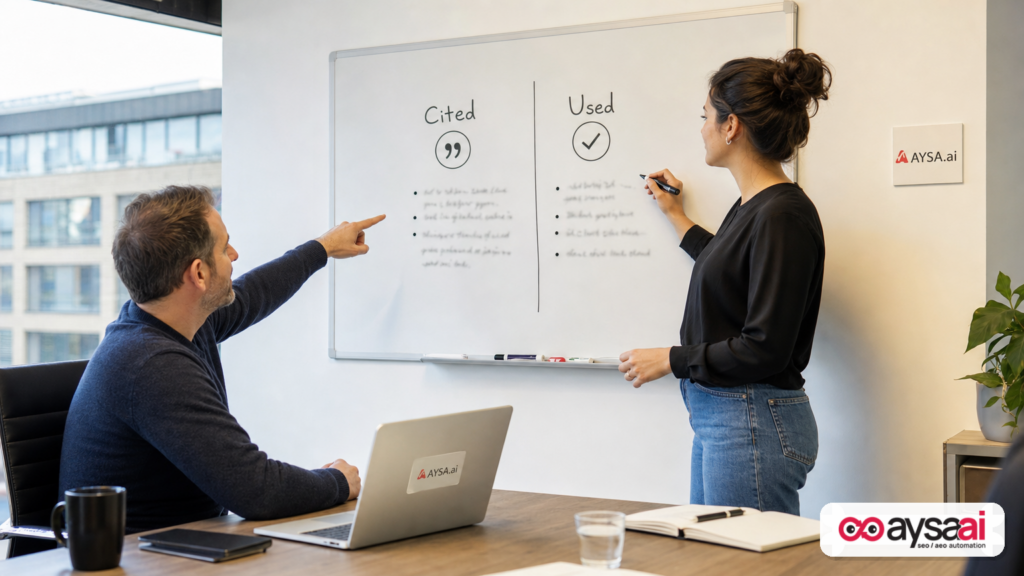
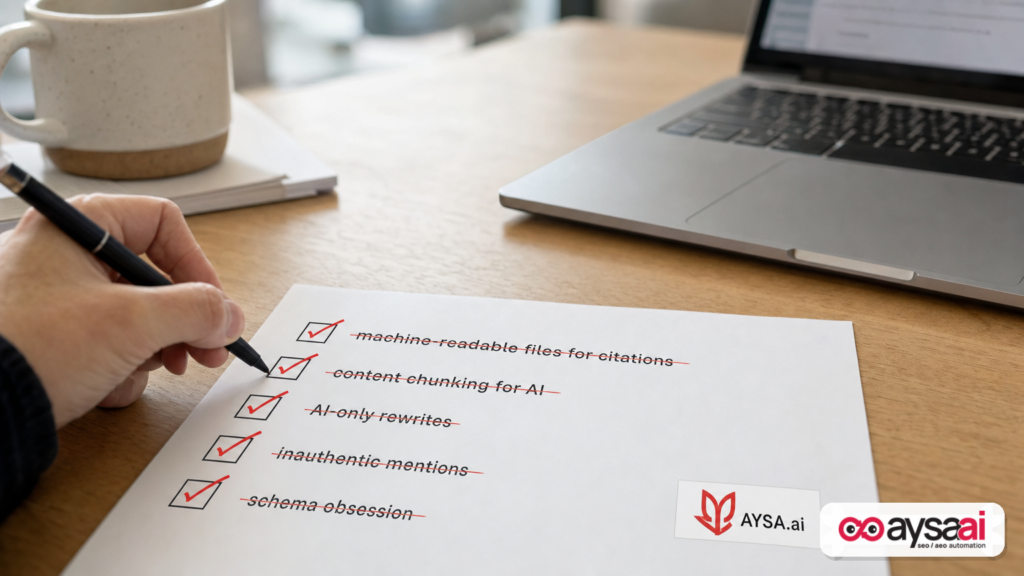
- Google’s new guide is a clear message: stop paying for tactics like llms.txt for citations, AI-only rewrites, chunking solely for AI, inauthentic mentions, and schema obsession as if they’re levers for AI Overviews.
- That mythbusting is scoped to Google Search citations. It does not fully address optimization for AI agents that use your site to complete tasks.
- The right durable strategy is not “AI hacks.” It’s machine-first clarity: content and Site architecture that is easy to identify, parse, verify, and use — for humans and machines.
- Most businesses don’t have visibility into how agents experience their site. That’s a Monitoring and execution problem, not a theory problem.
- AYSA fits here by turning strategy into approved execution at scale: monitoring, preparing changes, and shipping improvements safely.
Key takeaways (the opinionated version)
- “Wrong for Google Search” doesn’t mean “wrong everywhere.” It means you need to match the tactic to the scope: citations vs actions.
- If someone sells you a file, a plugin, or a schema pack as a direct path to AI citations, be skeptical. Citations are an output of trust, clarity, and retrieval—not a toggle.
- Agents raise the bar on UX. Accessibility trees, DOM clarity, predictable flows, and clean product/service data stop being “nice to have.”
- SEO is still the foundation. Google’s position (that AEO/GEO is still SEO) is basically a reminder: build a great search experience, not a gimmick.
- Execution is the bottleneck. Knowing what to do is common. Doing it consistently across hundreds of pages is rare.
Table of contents

- What changed: Google drew a boundary line
- The two scopes most people are mixing up: “cited” vs. “used”
- What Google debunked (for Google Search) — and why that’s not the whole story
- llms.txt and machine-readable maps: dead for citations, still a question for agents
- AI-specific rewriting: why it’s a tell, and what to do instead
- Chunking vs modularity: the difference that actually matters
- Inauthentic mentions: the one myth that isn’t really a “myth”
- Schema obsession vs schema hygiene: table-stakes identity infrastructure
- Agentic UX: why accessibility and predictable flows are your next growth lever
- A concrete SME scenario: the local clinic that needs to win both answers and bookings
- What businesses should monitor now (even with imperfect data)
- What agencies should rethink: deliver outcomes, not “AI SEO deliverables”
- The AYSA approach: Monitor → Prepare → Approve → Execute (at scale)
- What to do next (action list)
- Sources and further reading
What changed: Google drew a boundary line
The loudest part of Google’s new AI optimization messaging isn’t a new ranking factor. It’s the dismissal of a mini-industry that grew around “optimizing for AI answers” with tactics that sound technical but don’t map to how Google Search works.
Search Engine Journal’s coverage lays it out clearly: Google says you can ignore certain popular tactics when your goal is AI Overview citations, including llms.txt-style files, content chunking, AI-specific rewriting, inauthentic mentions, and “structured-data obsession.”
Here’s the important nuance: Google’s guidance is framed from Google Search’s perspective. Google is answering, “How do I get cited in Google’s AI answers?” That’s a valid question, and the debunking is welcome.
But business owners don’t wake up wanting a citation. They wake up wanting customers. And customers increasingly use systems that behave like agents: “Find the best option, compare, book, buy, summarize, shortlist.” Even when the final click is still human, the filtering is increasingly machine-mediated.
So the real change isn’t “Google killed GEO.” The change is: the market needs a two-track model—one for AI citation retrieval and one for AI agent completion.
The two scopes most people are mixing up: “cited” vs. “used”
Let’s simplify the landscape into two scopes that behave very differently.
Scope A: You want to be cited inside AI answers
This is the classic AEO/GEO pitch: “When a user asks a question, the AI summarizes the web. How do we get our brand and pages referenced?”
In this world, the core mechanics still look like search: crawling, indexing, retrieval, ranking, summarization. Google’s guide is mostly about this scope.
Outcome metric (imperfect but understandable): Do we appear as a cited source?
Scope B: You want to be used by AI agents completing tasks
This is the next layer: systems that attempt to do something on the user’s behalf.
An agent may:
- navigate your website and attempt a booking or purchase,
- extract product specs and compare them,
- find policies (returns, shipping, insurance),
- fill a lead form,
- validate location hours or services.
In the SEJ piece, Google acknowledges this under “agentic experiences” and points to separate guidance for agent-friendly patterns. That’s your clue: Google is not claiming the entire “AI optimization” conversation is nonsense. It’s claiming the shortcut tactics for citations in Google Search are nonsense.
Outcome metric (harder, but closer to revenue): Did the agent successfully complete the task, or did it fail and pick a competitor?
Why this distinction matters (in plain business language)
If your team doesn’t separate these scopes, you’ll see predictable failure patterns:
- You’ll buy “AI SEO deliverables” that can’t move citations.
- You’ll miss the real blockers that prevent agents (and humans) from converting.
- You’ll confuse activity (publishing files, adding schema, rewriting text) with outcomes (bookings, checkouts, leads).
Good strategy starts with defining which scope you’re optimizing for—then choosing tactics that match the scope.
What Google debunked (for Google Search) — and why that’s not the whole story
According to the SEJ coverage of Google’s guide, five tactics are singled out as ignorable myths (again: in the context of Google Search citations):
- Machine-readable files for AI like llms.txt
- Content chunking
- AI-specific content rewriting
- Inauthentic mentions
- Structured-data obsession
We should treat that list like a consumer protection notice: if you’re paying for these as a direct citation lever, pause.
But “ignore it for citations” doesn’t always translate to “ignore the underlying principle for agentic usage.” For example:
- A file format like llms.txt may be useless for Google citations today, but the broader idea of publishing machine-readable capability maps could still matter for agents tomorrow.
- Chunking content “for AI” is silly, but building modular, scannable, extractable content is just good communication and supports both humans and machines.
- Schema won’t magically earn citations, but it remains part of entity identity and product/service clarity.
The right response isn’t to swing from “everything is GEO” to “nothing matters.” The right response is to build durable assets that are helpful regardless of which model is answering the question next year.
llms.txt and machine-readable maps: dead for citations, still a question for agents
Let’s be direct: if you’re implementing llms.txt because someone promised it will increase your AI Overview citations in Google Search, Google’s message (as summarized by SEJ) is: that’s not how it works.
Googlebot reads and ranks web content through established mechanisms (HTML, links, rendering, etc.). Dropping a new file in your root directory doesn’t force citations.
But the underlying idea isn’t crazy
Where the conversation gets more interesting is in the second scope: AI agents performing tasks.
Agents benefit from:
- clear discovery of key pages (pricing, availability, returns, booking policies),
- consistent navigation and internal linking,
- stable URLs and predictable templates,
- documentation of APIs and workflows (where relevant),
- clean, accessible page structure.
A “machine-readable manual” for a site could eventually be a legitimate concept in agent ecosystems. The issue is adoption: the SEJ analysis notes that major platforms haven’t committed to using llms.txt as a standard discovery mechanism. Without adoption, it’s at best an experiment.
What to do instead (today)
If you want to be future-friendly without chasing hype:
- Invest in information architecture: make it obvious where key information lives.
- Make your site machine-legible: stable templates, semantic HTML, accessible components.
- Publish authoritative “source of truth” pages (policies, pricing, specs) and keep them updated.
- Use standard technical SEO basics (sitemaps, internal linking, canonicalization). Not glamorous. Extremely effective.
If you still want to test llms.txt or similar ideas for agent workflows, treat it like an R&D experiment with no guaranteed return—not like a required SEO deliverable.
AI-specific rewriting: why it’s a tell, and what to do instead
Google’s position (as covered by SEJ) is that rewriting content specifically “for AI” can look like low-effort content. In other words: it’s a tell.
That aligns with a broader truth: when businesses rewrite pages to “sound like what the model wants,” they usually remove the very thing that makes the page trustworthy—specificity, firsthand detail, constraints, and accountability.
A better frame: write for clarity, not for “the AI”
Here’s the standard we push at AYSA: write for extraction-quality clarity.
That means:
- Put the direct answer near the top (when the user intent calls for it).
- Define terms and avoid vague claims.
- Use specific numbers only when you can defend them.
- Separate “what we do” from “who it’s for” from “how it works.”
- Include constraints (availability, geography, prerequisites) to reduce ambiguity.
This kind of writing helps humans skim and helps machines extract. It’s not “AI rewriting.” It’s good publishing with modern discipline.
What to avoid
- Swapping your voice for generic model-speak.
- Inflating pages with “SEO paragraphs” that add no decision-making value.
- Publishing near-duplicates across locations/products with superficial changes.
- Over-optimizing headings to match prompt patterns instead of user needs.
Chunking vs modularity: the difference that actually matters
“Content chunking” is one of those tactics that sounds smart because it borrows language from how LLMs process context windows. But as SEJ highlights, Google’s guidance says you can ignore chunking as a citation tactic in Google Search.
Here’s the nuance:
- Chunking for AI often means breaking content into unnatural fragments solely to be “ingested.”
- Modularity for clarity means structuring content so each section can stand alone, be referenced, and be verified.
The second approach is durable. The first approach is usually a regression in usability.
Modular content patterns that work for humans and machines
- Decision blocks: “Who it’s for / who it’s not for,” “requirements,” “pricing ranges,” “timeline.”
- Process blocks: step-by-step, with clear inputs and outputs.
- Reference blocks: specs, compatibility, service areas, policies.
- FAQ blocks: real objections and edge cases, not filler.
Google doesn’t need you to micromanage chunks. But your users—and future agents—benefit when your content is organized like a system, not like a brochure.
Inauthentic mentions: the one myth that isn’t really a “myth”
When Google says “ignore inauthentic mentions,” that’s less a tactical note and more a warning label.
Fake mentions, manipulated citations, paid placements disguised as editorial, synthetic reviews—these aren’t clever tricks. They’re liabilities.
And in an AI world, the downside compounds:
- Models can reproduce reputational narratives at scale.
- Once a negative or inaccurate story is “learned” from repeated sources, you may spend months cleaning it up.
- Trust signals increasingly come from cross-source consistency, not just your own site.
The safest strategy is boring and effective: build real authority, earn real mentions, and keep your factual information consistent everywhere it appears.
Schema obsession vs schema hygiene: table-stakes identity infrastructure
“Structured-data obsession” is easy to misinterpret. Google is not saying “never use schema.” The point (as summarized in SEJ) is that there is no magical “AI schema” that guarantees citations—and that focusing on schema as the lever is misguided.
I agree. But I’ll add an important business interpretation: schema is not a growth hack; it’s infrastructure.
Where schema still matters (durably)
- Entity identity: helping machines disambiguate your brand, locations, products, and services.
- Product/service clarity: consistent attributes and relationships.
- Eligibility for certain search features (depends on the feature and vertical).
- Agent-readable data: for future flows where agents act as shoppers or assistants, clean structured data is an advantage.
Where schema is over-invested
- Adding schema to every page without fixing the content quality and UX first.
- Expecting schema additions to “flip a switch” for AI citations.
- Overcomplicating implementations that create maintenance debt.
In other words: get schema right, but don’t worship it.
Agentic UX: why accessibility and predictable flows are your next growth lever
This is the part many SEO teams are not staffed for: UX and product thinking.
Google’s guide (per SEJ) notes that browser agents may analyze visual renderings (screenshots), inspect the DOM, and interpret the accessibility tree. That sentence should change your roadmap.
What agents need from your site
- Stable structure: consistent page templates, predictable navigation.
- Semantic markup: headings that match content, labels tied to form inputs, meaningful buttons.
- Accessible components: if your accessibility tree is messy, you’re making the site harder for everyone—agents included.
- Low-friction flows: fewer popups, fewer confusing multi-step modals, clear error handling.
- Explicit policies: shipping, returns, cancellations, warranties, eligibility.
Why this is “SEO” now
Because the unit of value is shifting:
- From “can we rank a page?”
- To “can we be reliably selected, summarized, and acted on?”
In the old world, a confusing booking form still got leads because humans persisted. In the agentic world, a confusing booking form becomes a silent disqualifier.
A concrete SME scenario: the local clinic that needs to win both answers and bookings
Let’s make this real with a scenario I see constantly: a local clinic (dental, physio, dermatology—pick your vertical).
The problem
The clinic owner hears: “AI is replacing search.” They panic and hire someone to “optimize for AI,” who delivers:
- an llms.txt file,
- AI-rewritten service pages,
- more schema,
- a blog post series answering generic questions.
Three months later, bookings are flat.
What actually matters for the clinic
They need to win two moments:
- The answer moment: “What’s the best treatment for X?” “How much does Y cost?” “Is this covered?”
- The action moment: “Book the earliest available appointment within 10 miles” or “Find a clinic that accepts my insurance and has evening hours.”
Practical fixes that improve both scopes
- Create a single source-of-truth “Services & Pricing” page with clear ranges and what affects price (instead of hiding behind “call for quote”).
- Make “insurance accepted” explicit and keep it updated.
- Fix location data: hours, holiday updates, parking info, accessibility info.
- Improve booking UX: reduce steps, label fields clearly, remove intrusive overlays.
- Write outcome-focused FAQs based on actual patient calls (not keyword tools alone).
Notice what’s missing: gimmicks. This is operational clarity turned into web clarity.
What businesses should monitor now (even with imperfect data)
Most SMEs are flying blind because they’re trying to manage an AI transition using only classic SEO metrics (rankings, clicks, sessions). Those still matter, but they don’t fully capture what’s happening.
Baseline monitoring you should still run
- Search Console trends: impressions, clicks, queries shifting from long-tail to brand (or the reverse). (If you’re already using GSC, keep it central.)
- Page-level engagement: which pages drive leads/sales, and where drop-offs occur.
- Indexation hygiene: are key pages crawlable, canonicalized, and internally linked?
The new layer: AI visibility and narrative monitoring
Even if measurement is messy, you can still monitor patterns:
- Brand narrative: what do AI answers claim about you (pricing, policies, pros/cons)?
- Competitor substitution: do AI results frequently recommend a marketplace, directory, or aggregator instead of your brand?
- Content gaps: what questions are answered incorrectly because you don’t have a clear page for it?
This is exactly why we built dedicated visibility and monitoring layers at AYSA: AI search visibility and monitoring aren’t “nice extras.” They’re how you keep control of your brand in a machine-mediated world.
Agentic risk: your conversion blockers become selection blockers
If an agent can’t reliably:
- find your pricing,
- confirm availability,
- complete checkout,
- understand your service area,
…then it may route the user to a competitor that’s easier to transact with. That’s not “SEO.” That’s distribution.
What agencies should rethink: deliver outcomes, not “AI SEO deliverables”
Agencies are under pressure, and I understand why “AI SEO packages” sell. They sound new, they sound technical, and clients are anxious.
But Google’s debunking should force a reset: if your offer is built around deliverables that Google explicitly says to ignore for citations, your offer is fragile.
What to sell instead (that survives the next 24 months)
- Clarity engineering: turning business knowledge into clear, verifiable pages and blocks.
- Information architecture and internal linking: making the site navigable for humans and machines.
- Template-level improvements: headings, components, accessibility, consistency.
- Entity and location hygiene: consistent brand facts across the web.
- Execution systems: the ability to ship improvements continuously without creating risk.
This is why “approved execution” matters. The biggest failure mode in SEO isn’t ideas—it’s implementation debt.
The AYSA approach: Monitor → Prepare → Approve → Execute (at scale)
AYSA is built for the reality Google just reinforced: shortcuts don’t win long-term, but disciplined execution does.
Here’s how we think about it:
1) Monitor
We monitor signals that indicate visibility and risk — not just rankings. This includes AI search visibility concepts alongside classic technical and content monitoring. Start here: AYSA Monitoring.
2) Prepare
Recommendations are prepared as concrete, reviewable changes. Not a vague audit PDF. Real changes tied to pages, templates, and measurable outcomes.
3) Ask for approval
Businesses deserve governance. You should always be able to say “yes,” “no,” or “not yet.” This is how SMEs avoid the classic agency risk: changes shipped without context.
4) Execute accepted changes
This is the part most “AI SEO tools” skip. Execution is where outcomes happen. AYSA executes accepted website changes so improvements don’t die in a backlog.
Where to start with AYSA
- If you want the toolkit overview: AI SEO tools
- If you’re evaluating visibility in AI answers: AI search visibility
- If you want to explore pricing and fit: Pricing
- If you want more editorials like this: AYSA Blog
What to do next (action list)
If you’re a founder, marketing lead, or agency owner, here’s a practical next sequence you can run without guessing.
Step 1: Audit your spend against Google’s debunked list
- Are you paying for llms.txt “for citations”?
- Are you paying for AI-specific rewrites of existing pages?
- Are you paying for chunking as an “AI optimization” deliverable?
- Are you paying for schema packs with promised citation lifts?
If yes, demand the mechanism and evidence. If the mechanism is “trust me,” stop.
Step 2: Separate your roadmap into “citation” and “action” tracks
- Citation track: authority, clarity, verifiability, entity identity, content that matches intent.
- Action track: UX predictability, accessibility, structured product/service data, low-friction checkout/booking, stable site architecture.
Step 3: Build (or fix) your source-of-truth pages
Pick the pages agents and summarizers need most:
- pricing,
- availability,
- shipping/returns/cancellation,
- service areas,
- product specs and compatibility,
- contact and location details.
Make them explicit, current, and easy to navigate.
Step 4: Fix the “agent killers” in your UX
- unlabeled forms,
- modal-heavy flows,
- critical info hidden behind tabs that don’t render well,
- popups that interrupt navigation,
- inconsistent buttons (“Submit” vs “Request” vs “Continue” for the same action).
Step 5: Put monitoring and execution into a weekly cadence
This is where most teams lose. Ideas don’t compound; execution does.
- Monitor changes in AI visibility and brand narrative.
- Prepare improvements as concrete changes.
- Approve what’s safe and aligned.
- Execute continuously.
If you want that systemized, this is exactly the workflow AYSA is designed to support: monitoring + AI search visibility + approved execution.
Sources and further reading
- Search Engine Journal: What Google’s New AI Guide Actually Debunks. And What It Doesn’t (primary source for this editorial’s prompt and scope framing)
- Search Engine Journal: SEO section (context and ongoing industry coverage)
- Search Engine Journal: Latest news (to track updates as Google evolves guidance)
- Search Engine Journal: Local SEO (useful for multi-location implications)
- AYSA: AI SEO tools
- AYSA: AI search visibility
- AYSA: Monitoring
- AYSA: Pricing
- AYSA: Blog
Note on source limits: This editorial intentionally avoids claiming specific results or statistics beyond what’s in the supplied research context. Where the SEJ article references additional documents (e.g., agent-friendly UX guidance), treat that as a research direction; verify details directly before making implementation decisions.
Continue the AI search topic inside AYSA.
Use these pages to connect the article with AI SEO tools, AI visibility monitoring, AI Overviews and approved website execution.
Turn this topic into a website action plan.
Use these AYSA hubs to move from reading to technical fixes, AI visibility monitoring, research, glossary context and approval-first SEO execution.

