Top SEO Experts Lists Are Useful, But They Do Not Solve the Execution Gap
A practical AYSA analysis of OneLittleWeb’s top SEO experts study, E-E-A-T, influence, authority and why SMEs need execution, not only advice.
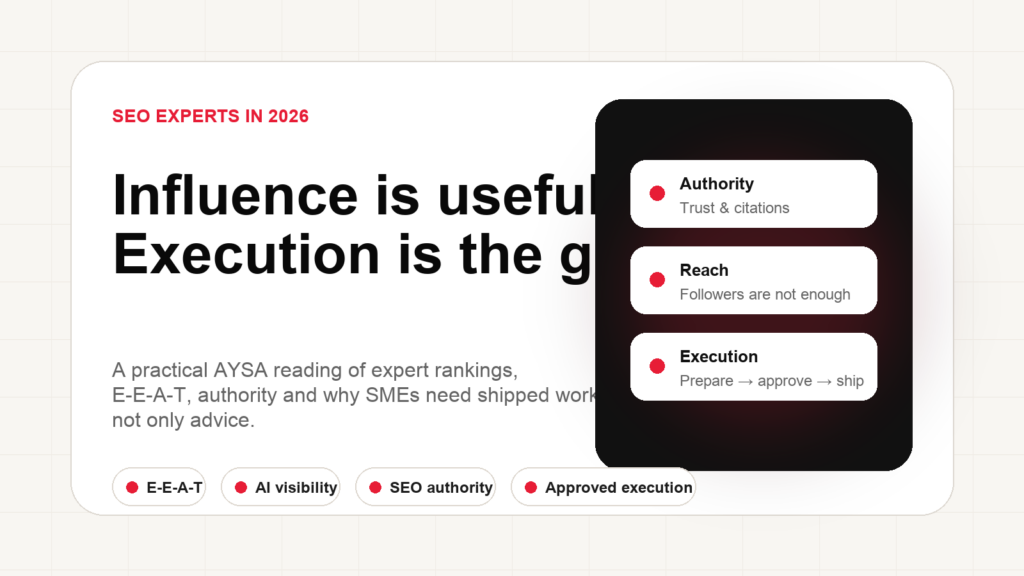
Executive summary: OneLittleWeb’s study of top SEO experts is useful because it shows who has public authority in the SEO industry. But it also reveals a limitation that matters for small and medium businesses: influence is not the same thing as execution. The study gives heavy weight to social reach, online presence and authority signals. Those are valid signals for visibility, but they do not tell a business owner who will fix canonical issues, rewrite weak category pages, improve internal links, prepare AI-search-ready content or ship approved technical changes.
In 2026, SEO expertise still matters. Public experts like Aleyda Solis, Lily Ray, Barry Schwartz, Rand Fishkin, Brian Dean, Mike King and others help the industry understand change. But SMEs need a different operational layer: expert knowledge turned into monitored, prioritized, approved Website Execution. That is where the AYSA view is different. The future is not “replace experts.” The future is to productize the repetitive execution layer so expert thinking can move faster.
What OneLittleWeb’s study actually measures
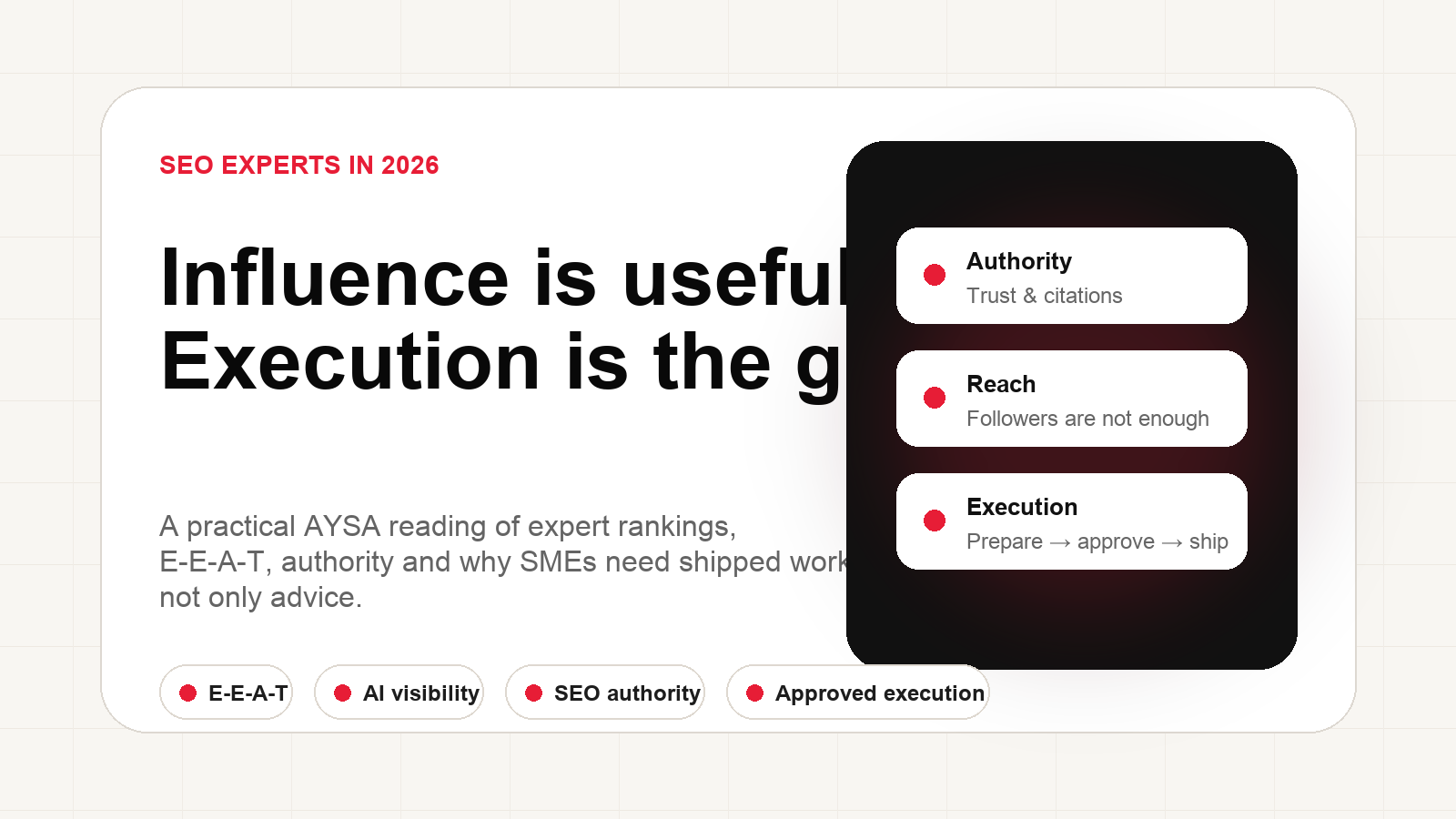
The OneLittleWeb Top SEO Experts study is a ranking of public SEO figures. It evaluates experts using a methodology based on follower reach, online presence and authority signals. The exact weighting matters: social reach carries the largest share, while authority and broader online presence also contribute.
That makes the study useful, but it also tells us what kind of usefulness it has. It is not a ranking of who can execute the most complex ecommerce migration. It is not a ranking of who has the best process for fixing a Romanian WordPress site with plugin bloat, duplicate titles, broken redirects and crawl waste. It is a visibility and authority ranking.
This does not make it bad. It makes it specific. The SEO industry needs visible experts. Their public work helps businesses, marketers and developers understand what is changing. When Google changes search results, when AI Overviews expand, when AI Mode changes discovery, when schema support shifts, when publishers lose traffic, when ecommerce journeys become more agentic, public experts interpret the signal.
The problem appears when SMEs confuse visibility with operational fit. The fact that someone is famous in SEO does not mean a small business can afford them, access them, implement their advice or translate their strategic thinking into website changes. That gap is where many businesses lose momentum.
Why expert authority still matters in SEO
Expert authority matters because SEO is not a static checklist. Search changes constantly. Google’s ranking systems evolve. AI Search changes how answers are produced and displayed. Ecommerce surfaces shift. Local results behave differently by category and geography. Publisher economics are under pressure. User behavior changes faster than most websites can react.
In that environment, trusted voices matter. They help the market avoid bad advice. They explain nuance. They challenge hype. They test ideas. They publish case studies. They notice patterns before generic tools do. They also build shared language around new concepts like AI visibility, GEO, AEO, Entity SEO, answer engines, UCP, agentic commerce and retrieval-based discovery.
Google’s own documentation also reinforces the importance of expertise and trust. The helpful content guidance asks whether content demonstrates experience, expertise, authoritativeness and trust. The AI features optimization guide points businesses back to the same fundamentals: useful content, accessibility, structured data, technical clarity and measurement.
So yes, the SEO industry still needs experts. It probably needs them more than before, because the environment is more complex. But the expert’s role is changing. The most valuable experts will not be those who merely describe the problem. They will be those whose thinking can be translated into scalable workflows, systems, checks, actions and measurable improvements.
The limits of influence: why a list of experts does not solve the business problem
A business owner does not wake up thinking, “I need a person with a high follower-weighted authority score.” They wake up thinking, “Why did traffic drop?”, “Why are my product pages not indexed?”, “Why is Google showing competitors?”, “Why is ChatGPT recommending someone else?”, “Why are ads getting more expensive?”, “Why did my agency send another report but nothing changed?”
This is where expert lists become only the first layer. They help you know whom to read, follow and learn from. They do not implement the work.
For SMEs, the bottleneck is usually not lack of information. It is lack of translation and execution. The business receives advice like:
- improve topical authority;
- clean up duplicate content;
- fix schema validation;
- reduce crawl waste;
- improve internal linking;
- update category copy;
- build brand mentions;
- monitor AI visibility;
- make content more helpful;
- connect organic visibility to revenue.
All of that may be correct. But then someone must decide what to do first, prepare the change, check risk, get approval, apply it, track the effect and keep improving. That is not a thought leadership problem. It is an operating model problem.
This is why I would not use a “top experts” list as a vendor selection shortcut. I would use it as a reading map. Follow the experts. Learn from them. But when choosing a solution for an SME, ask a different question: how does this help my website change faster and more safely?
E-E-A-T, authority and AI search: why names matter more, but not alone
AI search makes authority more visible and more complicated. When an answer engine, AI assistant or AI search surface summarizes a topic, it needs sources, entities and confidence signals. Known experts, reputable publications, strong brands and consistent references can influence what systems understand and cite.
That means expert authority is not just a social media vanity metric. It can become part of the broader information ecosystem. If a person, company or publication is frequently cited, linked, mentioned and associated with a topic, it becomes easier for both people and machines to recognize that entity as relevant.
But AI search also punishes shallow authority. A loud profile is not enough if the underlying content is thin, inaccessible, outdated or disconnected from real user needs. A business cannot become AI-visible by adding buzzwords to generic pages. It needs clear pages, useful comparisons, structured data, real examples, reviews, external proof and consistent brand information.
This is especially true for industries where users need trust before action: medical clinics, ecommerce, financial services, local services, travel, car rental, parking, SaaS and B2B services. In these categories, content must help the user decide. A page should not merely say “we are the best.” It should explain criteria, trade-offs, process, price, availability, location, guarantees, reviews and next steps.
In the AI era, authority is not only who talks the loudest. It is who is easiest to understand, verify, cite and choose.
Influence layer
Experts interpret changes, publish frameworks, challenge weak advice and help the market understand what matters.
Execution layer
Websites need monitored signals, prepared actions, approval workflows and shipped improvements.
What SMEs should learn from top SEO experts without getting overwhelmed
First, follow experts to understand change, not to copy every tactic. Aleyda Solis may publish a strong framework for AI search measurement. Lily Ray may explain quality and risk in Google updates. Barry Schwartz may track daily search volatility. Mike King may go deep on technical systems. Brian Dean may simplify content and link earning. Rand Fishkin may challenge platform incentives. These perspectives are useful because they help you see the landscape.
Second, translate advice into business-specific actions. If an expert says “build topical authority,” ask: which topic, for which audience, on which pages, with which internal links, with what proof, and what should be published next? If an expert says “prepare for AI search,” ask: which pages are answer-ready, which entities are unclear, where are citations missing, and how will we measure visibility?
Third, separate strategy from work volume. Many SMEs underestimate how much execution SEO requires. A proper program may include technical fixes, page updates, content improvements, schema changes, redirects, internal links, image optimization, product feed cleanup, Google Business Profile improvements, authority building, monitoring and reporting. Advice is cheap compared with the operational work of applying it.
Fourth, do not assume an agency or consultant is wrong because results are slower than expected. Search is more competitive and more volatile than before. But also do not accept endless reports without visible progress. A good SEO relationship should create decisions and shipped improvements, not just meetings.
Fifth, use automation carefully. Automation should not mean blind publishing or mass-produced content. It should mean faster research, cleaner prioritization, safer approvals, repeatable checks and better execution. The human stays in control of important decisions, but the machine reduces the manual burden.
The AYSA view: expert knowledge should become approved execution
AYSA is built on a simple belief: the SEO industry has enough advice, but most SMEs do not have enough execution capacity. They need the knowledge of experts translated into workflows that monitor, prepare, explain, approve and execute.
This is not anti-expert. It is the opposite. The more complex SEO becomes, the more important expert thinking becomes. But expert thinking must become operational. Otherwise it remains a newsletter, a webinar, a report or a LinkedIn post.
AYSA learns the business, monitors SEO, AEO and AI visibility signals, prepares website actions, explains why they matter, asks for approval and executes accepted changes inside the website workflow. That is the bridge between the expert layer and the SME reality.
In my opinion, “top SEO expert” lists are useful if we read them correctly. They tell us who shapes the conversation. They do not tell us how to get the work done. The next phase of SEO will reward companies that combine expert-grade interpretation with execution-grade systems.
The business owner should not need to become a professional SEO to benefit from professional SEO thinking. That is the real opportunity.
Advice is everywhere. Execution is the advantage.
If you follow SEO experts but still struggle to turn ideas into website changes, try AYSA.
AYSA turns SEO, AEO and AI visibility signals into approval-ready actions, then helps execute accepted changes inside your website workflow.
Sources and further reading
This article references OneLittleWeb’s Top SEO Experts data study, Google Search Central’s guidance on creating helpful content, Google’s AI features optimization guide, and Google’s documentation on structured data. The AYSA interpretation is our editorial and product point of view. We do not claim guaranteed rankings, guaranteed AI citations or guaranteed traffic recovery.
Continue the AI search topic inside AYSA.
Use these pages to connect the article with AI SEO tools, AI visibility monitoring, AI Overviews and approved website execution.
Turn this topic into a website action plan.
Use these AYSA hubs to move from reading to technical fixes, AI visibility monitoring, research, glossary context and approval-first SEO execution.