
Agentic Commerce Is Rewriting Ecommerce SEO: Why Products Must Become Machine-Readable
Stripe, Amazon, Alibaba and Alipay are showing that AI agents are becoming shoppers. Here is what agentic commerce means for ecommerce SEO, AEO and SMEs.
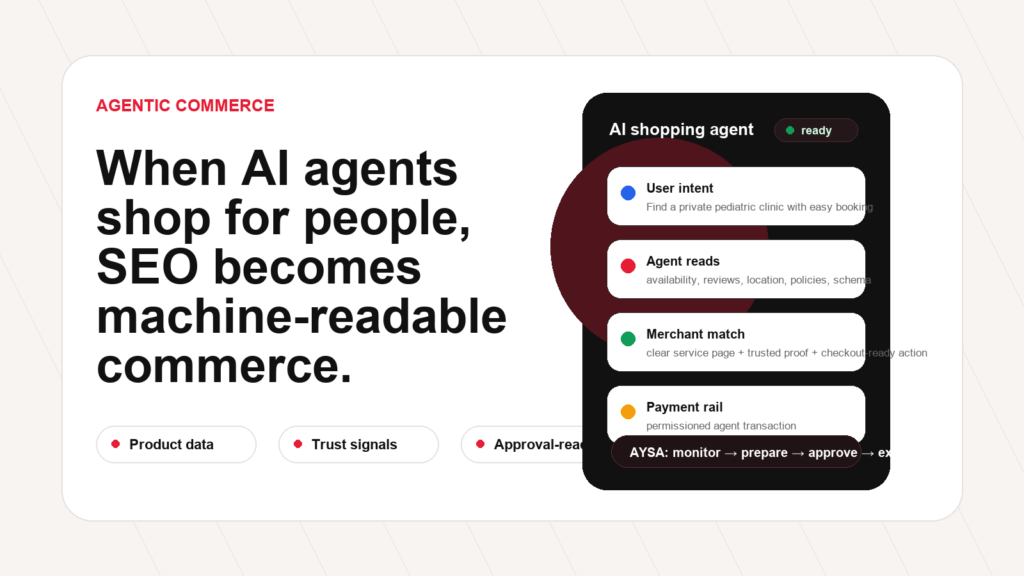
Executive summary: Agentic commerce is not a future buzzword anymore. Stripe is building payments infrastructure for AI agents. Amazon is moving Alexa for Shopping into the main search experience. Alibaba has connected Qwen to Taobao and Tmall’s enormous product catalog. Alipay has reported more than 120 million AI Pay transactions in one week. The direction is clear: shopping is moving from people clicking through pages to agents comparing, deciding, reserving, buying and paying on behalf of people.
For Ecommerce SEO, this is a major shift. Products will still need to rank for humans, but they also need to be legible to machines. Product feeds, Structured data, availability, policies, reviews, authority signals, internal links, return rules, pricing and trust evidence become part of the agentic discovery layer. In my opinion, this is exactly why AYSA’s model matters: SMEs need an execution agent that continuously prepares their website for SEO, AEO, GEO and agentic commerce, asks for approval, then executes accepted changes.
What happened: ecommerce is getting a new buyer
For twenty years, ecommerce has been optimized around the human visitor. The store owner tried to rank on Google, buy ads, improve category pages, write product descriptions, reduce checkout friction, add reviews, improve site speed and persuade a person to click “buy.”
That system is not disappearing. But it is gaining a second buyer: the AI agent.
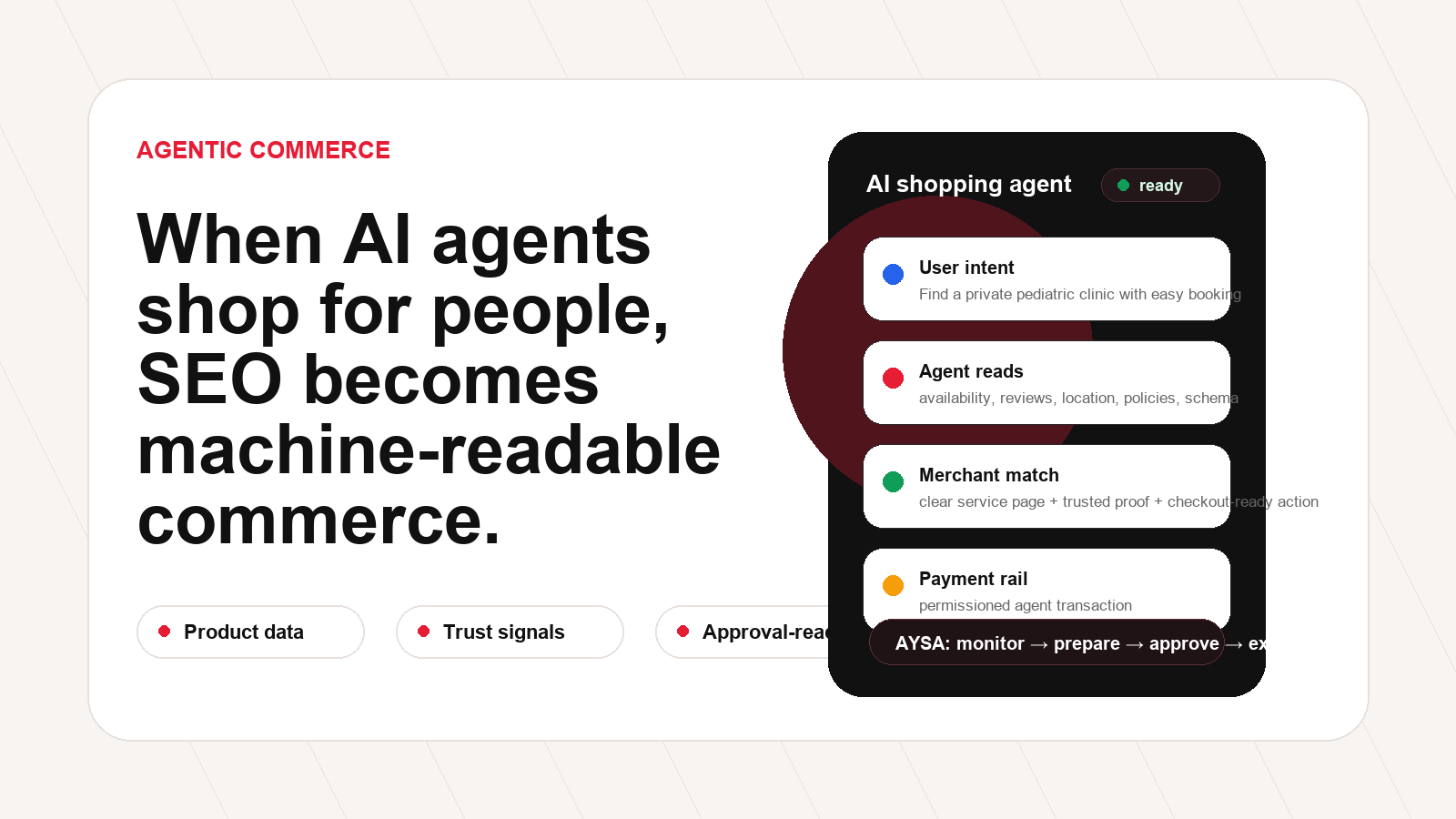
An agentic shopping flow looks different from a classic ecommerce session. The user may not browse category pages. They may not read ten product descriptions. They may not compare filters manually. They may ask a natural language question such as “find me a lightweight stroller that fits in a small car, ships this week, has good reviews and is under 300 euros.” The agent then interprets constraints, searches multiple sources, compares options, checks availability, evaluates trust signals and may proceed toward checkout.
That changes the competitive surface. In classic SEO, you were trying to be visible to a searcher. In agentic commerce, you must also be understandable to software acting for the searcher. The agent does not need your homepage animation. It needs reliable information: product attributes, price, stock, delivery, return policy, reviews, images, compatibility, size, location, payment flow and proof that the merchant is legitimate.
This is why the viral quote that Keyword search is becoming “ridiculous” resonates. I would not say keyword search disappears. People will still search with words. But keyword search alone is a primitive interface for complex buying tasks. A query like “best laptop for video editing” is not one intent. It contains budget, software, portability, battery, screen, warranty, urgency and trust considerations. AI agents are built to handle that complexity.
The real question for ecommerce businesses is not whether agentic commerce arrives. It is whether their websites and product systems are ready to be interpreted by agents.
Stripe’s role: the rail underneath agentic commerce
Stripe is one of the companies making this shift more concrete. At Stripe Sessions 2026, the company announced a large set of AI-economy products and described agentic commerce as a major new sales channel. One correction matters: some social posts describe Agentic Commerce Suite as if it launched for the first time at Sessions 2026. Stripe’s own announcement says it launched last year and was expanded at Sessions 2026, including support for Google, platforms and agent wallets.
That difference matters because it shows maturation, not just a press release. Stripe is not only talking about AI agents. It is building the infrastructure for discovery, checkout, payments, fraud, wallets, authorization and machine-to-machine transactions.
Stripe’s official Sessions announcement says the Agentic Commerce Suite allows businesses to sell inside AI apps through a single integration. It also says Stripe is bringing the suite to platforms such as Wix, BigCommerce, WooCommerce and others, which is especially important for SMEs. If a small merchant can become agent-ready through the platform they already use, agentic commerce becomes a practical distribution channel, not only an enterprise experiment.
Stripe also announced Link wallets for agents. Link is Stripe’s consumer wallet with more than 250 million users globally, and Stripe says users can allow agents to make payments on their behalf while real payment details are not exposed to the agent. That is a critical piece of trust infrastructure. Agentic commerce fails if payment authorization feels unsafe.
The Machine Payments Protocol is another sign of where the internet economy is moving. Stripe’s MPP announcement describes an open, internet-native way for agents to pay. Stripe’s machine payments documentation also describes private-preview support for machine payments, including USDC on Base. The commercial meaning is simple: agents will not only recommend products. They will transact, meter usage, pay for APIs, reserve services and complete tasks.
This is why agentic commerce is not just a marketing trend. Commerce is being re-architected at the payment rail level.
Amazon, Alibaba and Alipay: agentic commerce is already being tested at scale
Amazon sees the same threat and opportunity. Amazon’s own newsroom describes Alexa for Shopping as a personalized AI assistant available to U.S. customers on the Amazon app, website and Echo Show devices. Crucially, Amazon says users can ask Alexa for Shopping questions directly inside the main Amazon search bar. That is not a small UX change. It puts conversational product discovery where keyword search used to dominate.
For sellers, this means Amazon’s discovery layer becomes more interpretive. The customer may no longer scan dozens of listings. They may ask a question, receive a guided answer, compare a few recommended products and buy. If the agent does not understand why your product is the right match, you may not enter the consideration set.
Alibaba is even more aggressive. Alibaba announced that it fully connected the Qwen App to Taobao’s entire product catalog and launched a Qwen-powered shopping assistant inside Taobao. The announcement says Qwen has access to Taobao and Tmall’s catalog of more than 4 billion products, supported by AI agents with skills for order management, logistics and after-sales service.
That is a very different ecommerce interface. The agent is not just a search box. It sits across discovery, comparison, purchase and post-purchase support. The merchant is competing inside an intelligent layer that can interpret product data, service quality, logistics and user needs.
Alipay adds another piece. In February 2026, Alipay announced that AI Pay exceeded 120 million transactions in the previous week. The announcement framed AI Pay as a payment solution enabling secure payment through AI agents. Whether Western markets move at the same speed or not, China is already showing that agentic commerce can reach massive scale when payment, identity, marketplace and AI layers are tightly integrated.
For European and U.S. SMEs, the lesson is not “copy China.” The lesson is that agentic commerce is not theoretical. Once large platforms make agents part of the shopping flow, customer behavior can change quickly.
Classic ecommerce discovery
Customer searches a keyword, scans listings, opens product pages, reads reviews and decides manually.
Agentic commerce discovery
The agent interprets intent, compares products, checks constraints, evaluates proof and moves toward checkout.
Why SEO changes: ranking is no longer the whole discovery problem
SEO does not disappear in agentic commerce. It expands. A product that cannot be crawled, indexed, rendered or understood still has a visibility problem. But ranking in Google is no longer the only gate. The merchant also needs to be interpretable by AI systems, shopping agents, answer engines, product feeds, marketplace assistants and payment-aware commerce runtimes.
The old SEO question was: “Can we rank for this keyword?”
The new question becomes: “Can a machine understand when our product, offer or service is the right answer for a specific user need?”
That requires a broader optimization model:
- Product data completeness: price, stock, delivery, dimensions, colors, materials, compatibility, warranty, GTIN, SKU and variants.
- Structured data: Product, Offer, AggregateRating, Review, FAQ, Organization, LocalBusiness and Breadcrumb markup where appropriate and visible.
- Merchant trust: reviews, policies, contact details, business identity, return process, support, payment methods and legal clarity.
- Contextual content: guides, comparisons, use cases, buying criteria, sizing help, installation help and post-purchase support.
- Technical accessibility: crawlable pages, stable URLs, canonical consistency, fast mobile experience and clean Internal linking.
- Feed consistency: product feed data should match the website, schema, images and availability.
- Authority signals: Brand Mentions, publisher references, category expertise and topical depth.
- Execution speed: when data is missing or wrong, the business must fix it quickly.
This is why I prefer the phrase agent optimization as an extension of SEO, not a replacement. Search engine optimization, answer engine optimization, generative engine optimization and agentic commerce readiness all share the same foundation: make the business easier to understand, trust and transact with.
What machine-readable commerce actually means
“Machine-readable” does not mean writing for robots and ignoring people. It means the useful truth about your product must be explicit enough for both people and machines.
Most ecommerce websites are still full of ambiguity. Product pages often have missing attributes. Category pages are thin. Delivery promises are hidden in banners. Return policies are vague. Reviews are not structured. Images are not descriptive. Variant data is inconsistent. Stock status differs between the site and feed. Internal links do not explain relationships between products. Blog content is disconnected from commercial pages.
A human may tolerate some of that because they can infer meaning. An agent may not. If the user asks for “a waterproof hiking jacket for a tall man under 200 euros with fast delivery,” the agent needs structured evidence that your product matches those constraints. If the information is missing, the agent may choose a competitor whose data is clearer.
Machine-readable commerce includes:
- complete product attributes;
- consistent product feed and page data;
- clear availability and shipping rules;
- visible return and warranty information;
- structured reviews and ratings;
- comparison-ready buying guides;
- semantic internal links between products, categories and guides;
- clean schema markup that reflects visible page content;
- merchant identity and support signals;
- stable checkout and payment flows.
In classic ecommerce SEO, some of these were “nice to have.” In agentic commerce, they become eligibility signals. The agent cannot recommend what it cannot understand.
The SME playbook: how to prepare without pretending to be Amazon
Small and medium businesses should not panic. They do not need to build their own AI shopping assistant tomorrow. They need to make their commerce layer understandable and executable.
1. Audit product data. Start with missing attributes, inconsistent prices, out-of-stock pages, duplicate product titles, weak descriptions, missing images and broken variants. Agentic commerce punishes messy catalogs.
2. Fix product schema and feeds. Product schema should match visible content. Feeds should match product pages. Availability should be accurate. Price mismatches and canonical confusion can make agents less confident.
3. Build buying guides around real decisions. Do not write generic articles. Write pages that help users compare. For example: “Which stroller fits a small car?”, “Which flowers are safe for cats?”, “Which airport parking option is best for a 5 a.m. flight?”, or “Which SEO automation tool is right for a non-specialist?”
4. Connect content to products. If a guide helps a buyer decide, it should link to relevant product, category or service pages. If product pages answer a recurring objection, link back to the guide. This creates a semantic graph that agents can use.
5. Make policies explicit. Shipping, returns, warranty, support, pickup, local delivery, payment methods and cancellation rules should be easy to find and easy to parse.
6. Monitor AI and agentic visibility. Search Console is still useful, but it will not show the full picture. Businesses should also test AI search prompts, answer engines, shopping assistants and marketplace recommendations.
7. Execute continuously. This is the hard part. The winners will not be the merchants who run one audit. The winners will be the merchants who can detect gaps, prepare fixes, approve them and publish improvements every week.
Why AYSA is the future for SMEs: execution, not another dashboard
Agentic commerce creates a huge problem for SMEs: the work gets more granular. It is no longer enough to have a homepage, a few category pages and a basic SEO plugin. The business needs ongoing execution across technical SEO, product data, content, internal linking, AEO, GEO, authority building and monitoring.
Traditional SEO tools can show issues. Agencies can help, but human teams are limited by time, communication loops and budget. Ecommerce teams are already overloaded with operations, ads, inventory, support and fulfillment. The new agentic commerce layer adds even more tasks.
This is why AYSA’s model is built for the future. AYSA is not positioned as a reporting tool. It is an AI SEO execution agent. The workflow is simple:
- AYSA learns the business and website context;
- monitors SEO, AEO, GEO and AI visibility signals;
- detects missing content, weak structure, technical issues and authority opportunities;
- prepares approval-ready actions;
- explains why they matter;
- asks the user to approve important changes;
- executes accepted changes inside the website workflow.
For agentic commerce, that matters because the work is not one-off. A product feed changes. Google changes. AI Mode changes. Amazon changes. Stripe and payment protocols evolve. Competitors improve their product data. User expectations shift from browsing to delegated buying.
AYSA is useful because it can turn this moving landscape into an operating loop. Instead of telling a non-specialist business owner to “optimize schema,” “improve product data,” “monitor AI visibility,” “build topical authority” and “fix internal links,” AYSA can prepare the actual work, request approval and execute.
In my opinion, the future of ecommerce SEO belongs to businesses that can make their websites useful to humans and legible to agents. That is not a content trick. It is an execution discipline. AYSA exists because SMEs need that discipline without hiring a full SEO department.
Agentic commerce is coming for product discovery.
If your store is still optimized only for human browsing, AYSA can help prepare it for AI search and agentic shopping.
AYSA monitors your website, product and SEO context, prepares machine-readable improvements, asks for approval and executes accepted changes inside your website workflow.
Sources and further reading
This article uses public sources including Stripe’s Sessions 2026 announcement, Stripe’s Sessions product roundup, Stripe’s guide to agentic commerce, Stripe’s announcement of the Machine Payments Protocol, Stripe documentation on machine payments, Amazon’s newsroom pages on Alexa for Shopping and AI shopping experiences, Alibaba’s announcement connecting Qwen to Taobao and Tmall, and Alipay’s announcement reported via Nasdaq that AI Pay exceeded 120 million transactions in one week. Stripe’s reported $159 billion valuation was covered by Reuters via Investing.com. The AYSA sections are our editorial and product perspective. We do not claim guaranteed rankings, guaranteed AI citations or guaranteed sales from agentic commerce readiness.
Continue the AI search topic inside AYSA.
Use these pages to connect the article with AI SEO tools, AI visibility monitoring, AI Overviews and approved website execution.
Turn this topic into a website action plan.
Use these AYSA hubs to move from reading to technical fixes, AI visibility monitoring, research, glossary context and approval-first SEO execution.

