AI Max, AI Search Ads, and the New Rules of Google Advertising: What to Prioritize After GML 2026
Google’s AI-powered search experiences are expanding, but the real story after GML 2026 is control, data quality, and measurement. Here’s what Ginny Marvin’s clarifications mean in practice—and how advertisers and SMEs can prepare without flying blind.

Google Marketing Live 2026 added fuel to a debate that’s been building for years: are we still “doing search marketing,” or are we training and funding an AI discovery engine that happens to include ads?
In a wide-ranging Q&A with the PPC Chat community, Google Ads Liaison Ginny Marvin clarified several practical points that matter to anyone spending money on Google Ads—especially small and mid-sized businesses that can’t afford mystery performance. The short version: you don’t need AI Max to be eligible for AI-powered search ad placements, reporting for AI-powered placements is still limited, Google is pushing advertisers hard toward stronger first-party data, and measurement is evolving to better represent long sales cycles.
This editorial is not a recap. It’s a “what changed, why it matters, and what to do next” guide written from the perspective of building durable growth systems for SMEs—where ads, SEO, and AI Search visibility now collide.
Concise summary (for busy operators)

- Eligibility into AI-powered search isn’t gated by AI Max (yet). Broad match campaigns can still surface in AI Overviews and AI Mode placements, based on Marvin’s clarifications. AI Max expands eligibility behaviors across match types and adds keywordless matching.
- Placement reporting is still a black box. Ads shown in AI Overviews/AI Mode are currently rolled into “top of page” reporting; don’t expect clean breakdowns soon.
- Google is betting on “data strength.” Enhanced Conversions, tagging improvements, and first-party data integrations are becoming table stakes for bidding and measurement.
- Measurement is slowly acknowledging long cycles. Qualified Future Conversions (QFC) is meant to estimate downstream conversions up to 180 days after an ad interaction—especially relevant for B2B and lead gen.
- The strategic priority is control + evidence. If automation expands, your job is to set guardrails (brand, compliance, messaging), feed quality signals (first-party data), and build an experimentation discipline that survives imperfect reporting.
Table of contents
- What changed after GML 2026 (and why this isn’t just a PPC update)
- The big shift: you’re buying eligibility, not “keywords”
- AI Max vs. broad match eligibility: what Ginny Marvin clarified (and what she didn’t)
- AI Brief: Google’s attempt to reintroduce advertiser control
- Reporting reality: AI Search ads are still a black box
- Measurement is changing: why QFC matters (even if it’s imperfect)
- “Data strength” isn’t a slogan—it’s your new competitive moat
- What can go wrong: waste, brand risk, and invisible performance shifts
- A concrete SME scenario: the local clinic that can’t afford “trust me, it’s working”
- What agencies should rethink now
- Where execution matters most (and why most teams stall)
- Where AYSA fits: monitor, prepare, approve, execute
- What to do next (30/60/90-day action list)
- Sources and further reading
What changed after GML 2026 (and why this isn’t just a PPC update)

If you only look at Google’s announcements as “new campaign types” or “new ad formats,” you’ll miss the bigger operating change: search is turning into an AI-driven decision surface.
In that world, the tactical question isn’t “which keywords should I bid on?” It’s:
- What signals will Google’s systems use to decide my ad is relevant and safe to show?
- How do I ensure my brand is represented accurately when AI assembles messaging and placements dynamically?
- How do I prove incremental value when reporting doesn’t isolate the new surfaces?
Ginny Marvin’s clarifications—reported by Search Engine Land—are useful because they show what’s real today versus what’s implied by keynote demos. And for operators, that’s everything. We don’t run businesses on implied roadmaps.
The big shift: you’re buying eligibility, not “keywords”
Search advertising historically felt deterministic: you bid on a Keyword, you wrote an ad, and the query triggered the ad. Sure, there was always a layer of matching logic and auction dynamics, but the mental model was still “keyword → ad.”
AI-powered search experiences change the model to something closer to “intent interpretation → eligibility → assembly.” In plain English:
- The system interprets what the user is trying to accomplish (not just what they typed).
- It decides which ads are eligible to appear in the experience based on matching, predicted utility, policy, and available creative.
- It assembles the page—potentially blending AI-generated summaries, organic modules, and ads.
This is why debates about broad match vs. AI Max miss the point. The real strategic question is whether your account and website send enough high-quality signals for the system to confidently match you to valuable intent—without you paying for everything adjacent to it.
From an AYSA perspective, this “eligibility era” is where operational discipline becomes a competitive advantage. If your measurement is weak and your site doesn’t reflect your real offerings clearly, you’re essentially paying to teach the model the wrong lesson.
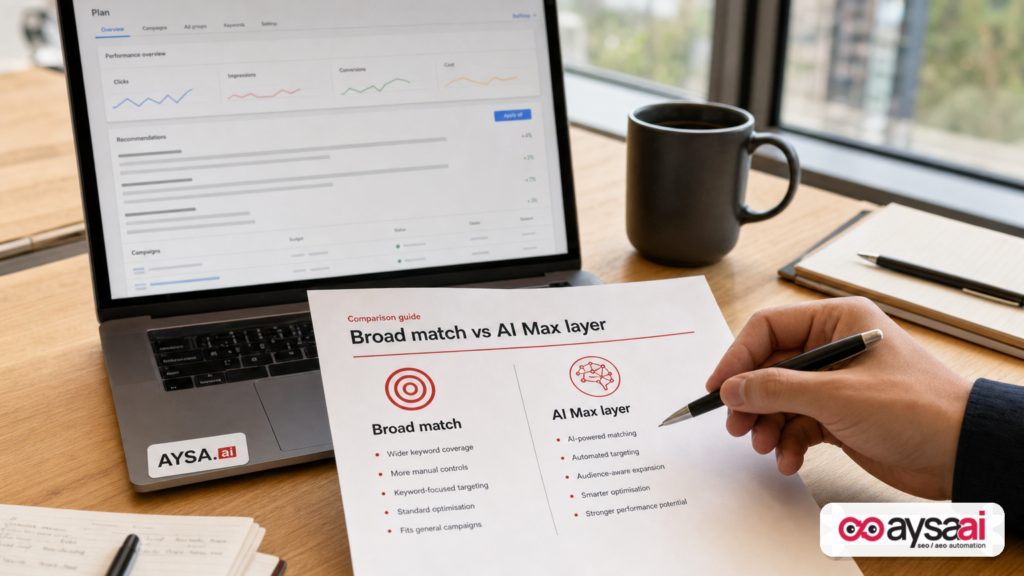
AI Max vs. broad match eligibility: what Ginny Marvin clarified (and what she didn’t)
Many advertisers assumed a simple rule: “If you want to appear in AI search placements, you’ll have to turn on AI Max.” Marvin’s clarification matters because it breaks that assumption.
What the clarification implies (today):
- Broad match campaigns can be eligible for ads in AI Overviews and AI Mode surfaces.
- AI Max expands eligibility by applying broad-match-like behavior to phrase and exact match keywords and enabling keywordless matching.
What it does not imply:
- That AI Max won’t become more central later. “Not required” is not the same as “not strategic.”
- That broad match is automatically safe. Broad match without guardrails has always been a fast way to buy irrelevant Clicks.
- That you’ll get clearer reporting if you use one approach vs. the other. Reporting limitations are currently structural.
My stance: treat AI Max as an amplifier, not a shortcut. If your fundamentals are shaky—Conversion tracking, lead quality feedback loops, landing page clarity—amplifying eligibility can amplify waste.
For businesses that rely on tight margins (local services, DTC ecommerce with thin contribution margin, small SaaS), the right sequence is usually:
- Prove you can steer broad match with negatives, intent segmentation, and conversion quality signals.
- Fix first-party data inputs.
- Only then expand automation/eligibility layers.
AI Brief: Google’s attempt to reintroduce advertiser control
One of the more important forward-looking elements in Marvin’s Q&A was the emphasis on AI Brief—a control layer meant to let advertisers guide automated systems with both positive and negative instructions.
Based on the Q&A coverage, AI Brief is expected to let advertisers provide guidance like:
- Messaging themes and priorities
- Audiences to prioritize
- Intent focus
- Negative guidance (e.g., “don’t mention prices”)
- Previews of sample assets and queries before deployment
If Google executes this well, it’s an admission of something advertisers have felt for years: automation without control is not “simplification,” it’s risk transfer. The risk moves from platform complexity to business outcomes—brand voice, compliance, lead quality, and budget efficiency.
What businesses should do now (before AI Brief arrives widely):
- Write down your “never say” list. This is brand safety and compliance in plain language.
- Write down your “must say” truths. What differentiators matter and must remain consistent?
- Clarify your offer boundaries. What you do not sell is as important as what you sell when matching expands.
This is not busywork. It becomes the specification document you’ll translate into AI Brief-style controls—and it also improves your website and organic presence for AI Overviews/AEO (Answer Engine Optimization).
If you’re building toward AI visibility, AYSA’s AI search monitoring tools are designed to keep that “spec” connected to reality as the SERP shifts: AI Search Visibility.
Reporting reality: AI Search ads are still a black box
Here’s the part that should bother every operator: as of now, ads served in AI Overviews and AI Mode are reported alongside other top-of-page ads, without a separate breakdown (per Marvin’s clarification reported by Search Engine Land).
That means you can’t easily answer basic questions like:
- What share of spend is going into AI Overview/AI Mode placements?
- Are those clicks converting differently?
- Are those impressions cannibalizing other high-performing placements or truly incremental?
Google says it’s evaluating what reporting should look like as these experiences evolve. I believe them. I also believe that the business cannot wait for perfect reporting to build resilient decision-making.
What you can do in the meantime (practical, not magical):
- Run controlled experiments. Use geographic splits, time-based tests, or campaign structure changes that isolate variables you can control.
- Track downstream quality. For lead gen: booked calls, qualified leads, revenue attribution via CRM import where possible.
- Watch query patterns and intent drift. If matching expands, query mix changes. That affects sales conversations and margins.
AYSA’s role here is less about “more dashboards” and more about maintaining operational clarity: monitor changes, prepare fixes, ask for approval, execute accepted changes quickly—especially on the site and tracking side where most teams stall. Start with monitoring: AYSA Monitoring.
Measurement is changing: why QFC matters (even if it’s imperfect)
One of the most business-relevant ideas mentioned in the Q&A coverage is Qualified Future Conversions (QFC)—a metric designed to estimate conversions that may happen up to 180 days after an ad interaction.
There’s a reason this matters. Traditional attribution often fails in categories where:
- The buying cycle is long (B2B services, enterprise SaaS, high-ticket local services)
- There are many touchpoints (YouTube, search, remarketing, email, sales outreach)
- The conversion event you can track is a proxy (lead form, call click), not the sale
QFC appears aimed at reducing the gap between “what the platform can measure quickly” and “what the business experiences slowly.” It’s currently in limited testing, with broader availability expected later (per the Q&A write-up).
My caution: any estimated future conversion metric can be useful, but it can also become a convenient story if you don’t keep a firm grip on real revenue data. For SMEs, the right posture is:
- Use QFC-like signals as directional indicators.
- Continue to optimize to actual qualified outcomes where you can measure them.
- Do not allow “future conversions” to justify persistent lead quality problems today.
If your CRM and analytics are disconnected, metrics like QFC will feel like a foreign language. Fixing that connectivity is the real work.
“Data strength” isn’t a slogan—it’s your new competitive moat
Across GML 2026 and the follow-up Q&A, Google’s emphasis on first-party data was consistent. Marvin referenced “Data Strength” and called out tools like Enhanced Conversions, tagging improvements, Data Manager, and database integrations as important inputs into bidding and measurement systems (as reported by Search Engine Land).
Let’s translate that into business reality:
- If your tracking is incomplete, the system will optimize based on partial truth.
- If your conversion events are low-quality proxies, the system will optimize toward the wrong customers.
- If you can’t send back real outcomes (qualified leads, revenue), you’re bidding blind against competitors who can.
What “data strength” means for an SME (a practical checklist):
- Conversion tracking that actually fires correctly (forms, calls, purchases).
- Enhanced conversions / hashed identifiers where appropriate and compliant with your jurisdiction and policies.
- Lead quality feedback: define what “qualified” means and connect it to your measurement stack.
- Clean site taxonomy: landing pages that clearly map to services/products and intent.
- Fast iteration: when you find a leak, you can fix it quickly.
This is where paid search and organic AI visibility converge. A site that communicates clearly to users and crawlers tends to convert better, match better, and produce better signals. If you’re treating your website as “done,” you’re effectively choosing to be out-signaled.
For teams that need help operationalizing this, AYSA can act as the execution system—not just advice—by preparing site changes and implementing them after approval. Explore tooling: AI SEO Tools.
What can go wrong: waste, brand risk, and invisible performance shifts
When eligibility expands and reporting stays fuzzy, three predictable failure modes show up.
1) Relevance waste (you pay for “adjacent” intent)
Expanded matching can scoop up queries that are conceptually related but commercially wrong. Example: a premium service business accidentally paying for bargain-seeker queries because the model sees topical similarity.
Mitigation: aggressive negative keyword strategy, intent-separated campaign structure, and landing pages that disqualify bad-fit users quickly (pricing clarity, service boundaries).
2) Brand voice and compliance drift
As AI assembles experiences, you risk drifting into claims you wouldn’t make explicitly—especially in regulated verticals.
Mitigation: codify “never say” rules and ensure your website copy is consistent, compliant, and unambiguous. When tools like AI Brief expand, you’ll need that spec ready.
3) Invisible placement shifts (performance changes you can’t attribute)
If your top-of-page performance changes, you won’t immediately know whether it’s creative, auction pressure, seasonality, or AI placement mix.
Mitigation: experimentation, holdouts where feasible, and a measurement stack that can validate revenue outcomes independently of platform UI.
For additional context on how AI search visibility and attribution are diverging, Search Engine Land also covered approaches to tracking AI search visibility when attribution falls short: 4 ways to track AI search visibility when attribution falls short. Use it as a research lead, but keep your process grounded in what you can verify in your own data.
A concrete SME scenario: the local clinic that can’t afford “trust me, it’s working”
Imagine a local dermatology clinic with two locations. The owner is growth-minded but skeptical of marketing because leads are inconsistent. The clinic spends on Google Ads for:
- medical dermatology (insurance-driven, lower margin per visit)
- cosmetic services (cash-pay, high margin, but more competitive)
Now AI-powered search experiences expand. Broad match eligibility can help the clinic appear for more nuanced intents (“treat adult acne scars,” “best option for melasma,” “laser for redness”), which sounds great.
But here’s where it goes wrong:
- Without clean conversion definitions, the system optimizes toward easy-to-generate low-quality inquiries.
- Front desk tags everything as “a lead,” but the real business goal is booked cosmetic consultations.
- Reporting can’t isolate AI Overview/AI Mode placements, so performance volatility feels random.
What a resilient setup looks like:
- Define conversion tiers: (a) appointment booked, (b) consult booked, (c) procedure scheduled. If you can’t track all, track at least one “quality” milestone beyond form submits.
- Align landing pages to intent: separate pages for medical vs cosmetic, with clear expectations and pricing ranges when appropriate.
- Feed quality back: even a lightweight weekly import or tagging process can outperform “set and forget.”
- Build guardrails: negatives for bargain intent, clear service exclusions, and messaging consistency.
This is the theme of 2026 search: success belongs to teams that can connect what the platform optimizes to what the business values.
What agencies should rethink now
Agencies and consultants are about to face a credibility moment. Historically, a lot of client trust came from: “We can see the levers, and we can explain performance.” When placements become less transparent, the value shifts to: “We can run a disciplined system that produces evidence anyway.”
Agency priorities that need an update:
- Stop overpromising reporting clarity. Be explicit about what Google does and doesn’t expose.
- Turn measurement into a product. Not dashboards—feedback loops, CRM alignment, lead quality definitions, and experiment design.
- Creative governance becomes core. If AI assembles assets, agencies must build brand-safe asset libraries and messaging rules.
- SEO + PPC + AI visibility converge. Clients don’t care which channel “gets credit.” They care whether demand is created and captured.
Search Engine Land’s broader coverage around AI search behavior shifts and zero-click dynamics is a useful macro signal. For example, they referenced research about zero-click searches increasing (as a separate article): Google zero-click searches hit 68% in early 2026: Study. Even if you don’t adopt every number as gospel, the direction is clear: clicks are not the only outcome; visibility and persuasion increasingly happen on-platform.
Where execution matters most (and why most teams stall)
In almost every SME I’ve worked with, strategy is not the bottleneck. Execution is.
Teams stall because changes require coordination across roles:
- Marketer identifies a tracking gap → developer backlog is two weeks → decisions are made on broken data.
- Agency recommends landing page improvements → client is nervous about changing the website → nothing happens.
- Leadership wants “more leads” → sales team says “leads are bad” → nobody defines “qualified.”
The AI era punishes execution lag. When matching expands quickly, you need to be able to:
- fix broken tags fast
- update messaging that causes confusion
- add clarifying content that reduces irrelevant clicks
- improve page speed and UX so conversion rates keep up with CPC pressure
This is exactly why we think about AYSA as an execution system, not just another analysis tool.
Where AYSA fits: monitor, prepare, approve, execute
As AI search experiences expand and ad systems become more automated, businesses need an operating model that keeps them in control. AYSA is built around a simple workflow:
- Monitor your site and AI search visibility for changes and opportunities: AYSA Monitoring
- Prepare recommended fixes and improvements (technical, content, structured clarity) with clear rationale
- Ask for approval so the business remains the decision-maker
- Execute accepted changes so nothing dies in a backlog
How that maps to the post-GML reality:
- AI eligibility expands → you need cleaner landing pages and clearer intent alignment.
- Reporting is limited → you need stronger first-party measurement and site-level signals you can verify.
- AI Brief-style controls emerge → you need a documented brand and offer spec that can be operationalized.
If you’re exploring how to operationalize AI visibility (paid and organic), start here: AI Search Visibility. If you want to understand packaging and fit for your team size, see pricing: AYSA Pricing.
And if you want more of our thinking on how AI is reshaping SEO/AEO/GEO execution, browse the AYSA blog: AYSA Blog.
What to do next (30/60/90-day action list)
This is the part most articles skip. Here’s an execution plan that doesn’t rely on privileged reporting or perfect platform transparency.
Next 30 days: stabilize truth
- Audit conversion tracking. Verify your primary conversions fire correctly end-to-end (test leads, test purchases). Fix obvious gaps first.
- Write your conversion hierarchy. Define what “good” looks like (qualified lead, booked call, revenue). If you can’t track it yet, define it anyway.
- Map intent to landing pages. Ensure every major service/product has a page that states: who it’s for, what it costs (or cost range), what happens next, and what you don’t do.
- Strengthen negatives and exclusions. Broad match eligibility without strong negatives is how budgets disappear quietly.
Next 60 days: build feedback loops
- Implement lead quality feedback. Even a weekly spreadsheet tagged by sales (“qualified / not qualified / won”) is better than nothing if done consistently.
- Create a brand messaging spec. “Must say,” “never say,” approved claims, regulated language rules.
- Run one controlled experiment. Change one variable (match strategy, landing page, offer framing) and measure downstream quality, not just CPL.
Next 90 days: scale responsibly
- Expand automation only where proof exists. If a segment shows stable qualified outcomes, then test broader eligibility layers (like AI Max expansions) in a controlled way.
- Improve your first-party data posture. Prioritize the integration that makes qualified outcomes visible to bidding systems.
- Unify SEO + PPC around the same “truth.” The same pages, offers, and differentiators that convert should also be the ones you strengthen for AI search visibility.
Sources and further reading
- Search Engine Land: Ginny Marvin clarifies AI Max, AI Search ads and what advertisers should prioritize after GML
- Search Engine Land: 4 ways to track AI search visibility when attribution falls short
- Search Engine Land: Google zero-click searches hit 68% in early 2026: Study
- Search Engine Land: Why so much SEO work no longer drives growth
- Search Engine Land: How real people actually prompt AI — and what it means for GEO
Note: This editorial intentionally avoids inventing performance statistics or quoting platform documentation not included in the supplied research context. Where the ecosystem lacks transparent reporting (e.g., AI placement breakdowns), we recommend experimentation and first-party measurement improvements as the durable path forward.
Continue the AI search topic inside AYSA.
Use these pages to connect the article with AI SEO tools, AI visibility monitoring, AI Overviews and approved website execution.
Turn this topic into a website action plan.
Use these AYSA hubs to move from reading to technical fixes, AI visibility monitoring, research, glossary context and approval-first SEO execution.