AI Mode Is Rewriting Search Behavior in the U.S.—Here’s What SMEs Must Change Now
AI Mode is pushing people from keyword fragments to real questions, more voice and image search, and more planning-driven queries. This isn’t “SEO is dead”—it’s “execution speed and clarity win.” Here’s what changed, why it matters, and what to do next with an approval-first system like AYSA.

By Marius Dosinescu / AYSA.ai
Search is still the biggest intent signal on the internet. But the shape of that intent is changing fast.
Google’s AI Mode—now a year into its U.S. rollout—has accelerated a shift most of us felt coming: people are moving away from Keyword fragments and toward natural language questions, voice input, and image-led exploration. More importantly, they’re using AI Search to finish a task (plan, compare, decide), not just to “find a page.” Google’s own reported insights highlight longer queries, faster growth in planning and brainstorming behaviors, and rising use of voice/images in the U.S. (source: Google Search Blog).
This is not a “SEO is dead” moment. It’s an “execution wins” moment.
In an AI-first search experience, you don’t just compete for a blue link. You compete to be the most useful, citable, verifiable answer—and to support the next step a customer wants to take (book, buy, call, compare, shortlist, qualify).
In this editorial, I’ll break down what changed, why it matters for SMEs and agencies, what can go wrong, and a practical action plan you can run in weeks—not months. I’ll also explain where AYSA fits: as an approved-execution system that monitors, prepares changes, asks for approval, and then executes the accepted updates on your website so you’re not stuck in an endless backlog.
Concise summary
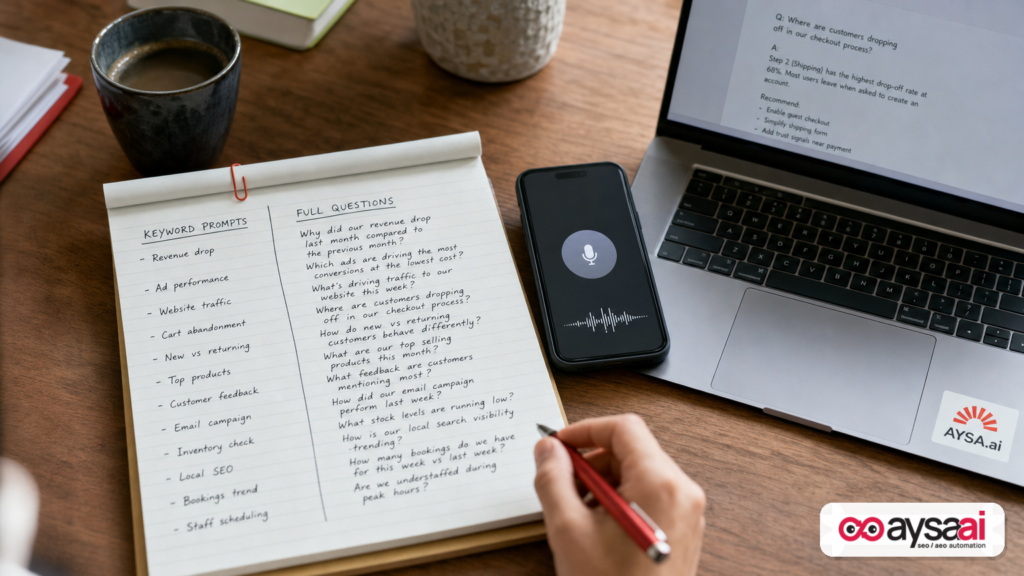
- AI Mode is pulling search toward conversational, multi-step decision-making. Queries are longer and increasingly include voice and images, according to Google’s reported U.S. insights. That means “Keyword mapping” alone is no longer a sufficient strategy.
- The unit of competition is shifting from pages to answers. Your content needs to be structured for “selection” (what AI systems choose to summarize/cite) and for “completion” (what helps users decide and act).
- SMEs should prioritize answer readiness: clear offerings, policies, proof, comparisons, pricing guidance, and decision support—built directly into revenue pages.
- Execution speed is now a moat. The winners will be teams that can monitor demand shifts and ship site improvements continuously with governance.
- AYSA’s role: treat AI Search Optimization like operational excellence—monitor changes, generate recommended edits, require approval, and execute updates consistently at scale. Learn more at AI search visibility and monitoring.
Table of contents

- What actually changed: AI Mode pushes search from “keywords” to “conversations”
- Why it matters now: the compounding effect of new search habits
- The new “query” is a task: planning and decision-making rise
- Beyond text: voice and images turn the web into an interface
- What this means for SMEs: visibility shifts from ranking pages to being the best answer
- What can go wrong: the hidden risks of AI-shaped search demand
- A practical content strategy for AI Mode: decision support, not content volume
- Technical foundation: make your site “readable” for machines and humans
- Measurement in an AI search world: what to watch (and what not to panic about)
- Concrete SME scenario: a local clinic adapting to AI Mode behavior
- What agencies must rethink: deliver outcomes, not audits
- The execution gap: why “knowing what to do” is no longer enough
- Where AYSA fits: monitor, prepare, approve, execute
- What to do next: a 30-day action list
- Sources and further reading
What actually changed: AI Mode pushes search from “keywords” to “conversations”
For two decades, most SEO advice could be boiled down to a simple model:
- People type short phrases (“best running shoes”)…
- Search engines match those phrases to pages…
- Pages that best satisfy the intent (plus authority and technical competence) rank.
AI Mode doesn’t delete that model—but it changes the center of gravity.
Google’s own AI Mode insights for the U.S. describe three major behavior shifts:
- Queries are longer in AI Mode than traditional Search, reflecting natural language and multi-part questions.
- Voice and images are rising as inputs, with image search growth highlighted as particularly strong.
- Planning and brainstorming (task-focused queries) are growing faster than overall query growth within AI Mode.
The key editorial point: in AI search, users don’t “translate” their need into a keyword as much. They describe the situation and constraints directly.
Instead of:
- “emergency plumber miami”
They ask:
- “My water heater is leaking and I need someone today—what should I do first, how much does it usually cost, and who can come within 2 hours?”
Instead of:
- “best crm for small business”
They ask:
- “We’re a 12-person HVAC company, we need texting + scheduling + QuickBooks integration, and I don’t want a 6-month implementation—what are 3 options and what are the tradeoffs?”
Those are not just longer queries—they’re decision frameworks. And that changes what your website must deliver.
The real shift: from matching words to satisfying constraints
Traditional SEO already cared about intent. AI Mode pushes that to the extreme: the “intent” includes constraints (budget, timing, compatibility, risk, taste, location, availability) and often multiple steps.
For businesses, that means:
- If your site is vague, AI experiences will route around you.
- If your site is clear but incomplete (missing policies, proof, comparisons), AI experiences may not “trust” you enough to recommend you.
- If your site is complete but outdated, you’ll fall behind the moment demand shifts.
AI Mode is expanding what people consider “searchable,” per Google’s framing (again, see the original post: Google Search Blog). In practice, that means the web is becoming a place to ask anything you’d normally ask a friend, a specialist, or an internal team.
Why it matters now: the compounding effect of new search habits
The most dangerous misconception I see in the market is that AI search changes are “just another feature.” SMEs and even mid-market brands treat it like a cosmetic SERP change—something to worry about later.
But behavior shifts compound.
When users learn they can ask better questions (and get better, more structured answers), they do three things:
- They search more. When friction drops, demand expands.
- They search earlier. They ask planning questions weeks before a purchase, not days.
- They search deeper. They ask follow-ups and refine constraints instead of bouncing between 10 tabs.
This matters because your website is no longer only competing at the last click. You’re competing to be the best guide through the journey.
And if you miss the early and middle stages—planning, brainstorming, comparison—you may never be considered at the end.
Search as an interface, not a list of links
AI Mode sits between classic search and conversational AI. That hybrid changes expectations. Users still want sources, options, and pathways—but they increasingly want the system to do the synthesis.
So the question for your business becomes:
- Are we structured so an AI system can accurately summarize what we do?
- Do we provide enough specificity that the summary is compelling?
- Do we offer proof and policies that make us safe to recommend?
- Do we help people take the next step without confusion?
If not, you may still “rank,” but you’ll be less likely to be selected.
The new “query” is a task: planning and decision-making rise
Google’s AI Mode insights emphasize increased growth in planning and brainstorming query patterns in the U.S. compared to overall AI Mode query growth (source: Google Search Blog). We should take that seriously because it aligns with what SMEs experience in customer calls: people want help making a decision, not just information.
This is where “AEO” and “GEO” start to matter in plain business terms:
- AEO (Answer Engine Optimization): design your content so it is the best answer to a real question.
- GEO (Generative Engine Optimization): ensure your brand is represented accurately and convincingly when AI systems generate summaries, comparisons, and recommendations.
In both cases, the end goal is the same: show up in the moment of decision with clarity and credibility.
Planning queries change the “content that wins”
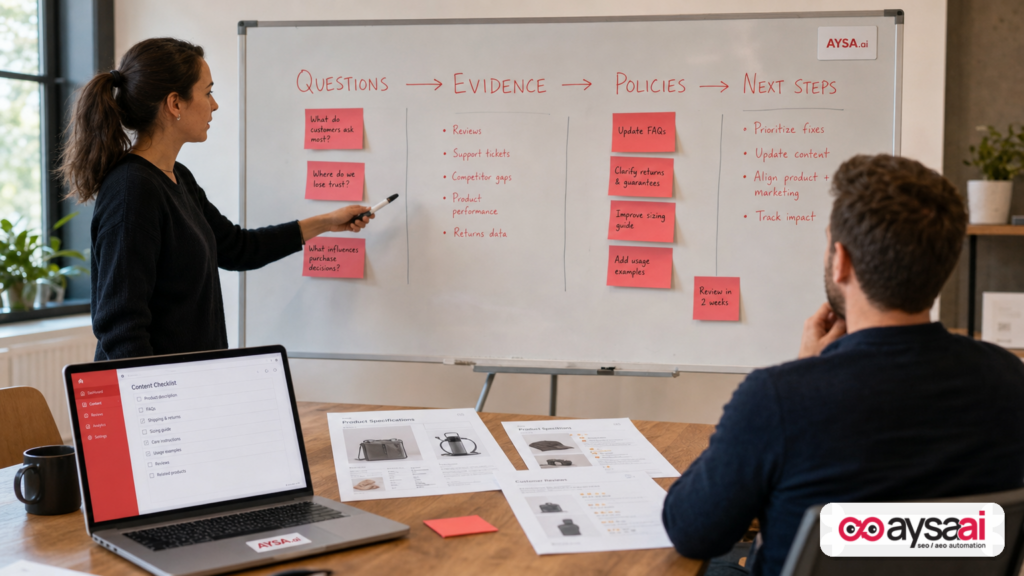
Planning queries are rarely satisfied by a single blog post. They require a decision hub that includes:
- Options and packages
- Constraints and requirements
- Tradeoffs
- Timelines
- Pricing ranges or at least pricing logic
- Policies and guarantees
- Next steps (book, quote, consult, sample, demo)
That decision hub might be:
- a service page upgraded to include comparison sections, FAQs, and proof
- a category page that actually helps shoppers choose
- a “how to choose” page tightly connected to money pages
If your content strategy is still “publish 4 blogs/month targeting keywords,” you’re likely building inventory that doesn’t close the gap between question and action.
Beyond text: voice and images turn the web into an interface
Google reports that a meaningful share of U.S. searches now use voice or images and that image-led searching is growing quickly (source: Google Search Blog). We should treat this as more than a UX detail.
Voice and images do two things:
- They widen the funnel. People who hate typing (or can’t type in the moment) still search. That includes busy operators, field service staff, and shoppers standing in a store aisle.
- They change the information required. Image search often demands strong product photography, clear labeling, and unambiguous page context. Voice search often demands succinct, direct answers and strong local/operational details.
What voice search means for a business site
Voice queries tend to be:
- More local (“near me,” “open now,” “same day”) even if the user doesn’t say those words explicitly
- More urgent (especially in services)
- More conversational (“Do you have…”, “Can I…”, “What’s the best…”)
So your pages need operational truth: hours, service areas, response times, cancellations, insurance accepted, lead times, and a clear path to book/call.
What image search means for ecommerce (and beyond)
Image-led discovery pushes you to do the basics exceptionally well:
- High-quality, consistent images (multiple angles, real scale)
- Descriptive alt text that reflects what’s actually in the image
- Clear product titles and variants
- Context around the image (what it is, who it’s for, how it compares)
I’m intentionally not claiming which specific Google systems read which fields in which way—because that detail isn’t present in the supplied source context, and it changes frequently. The durable guidance is: clarity, consistency, and context win across modalities.
What this means for SMEs: visibility shifts from ranking pages to being the best answer
SMEs often approach SEO like a leaderboard: “Where do we rank?” That’s understandable. It’s measurable. It feels like progress.
But AI search experiences shift the practical goal:
- Old framing: Rank a page for a keyword.
- New framing: Be the best answer for a customer’s situation, and be easy to verify and act on.
This doesn’t eliminate rankings; it changes the path to revenue. If AI Mode is increasingly used for planning and decision-making, then the business that helps users plan and decide will earn the click, the call, the visit, or the purchase.
Answer readiness: the new baseline
If you want to be “AI search ready,” start by making your site answer-ready in five categories:
- Offer clarity: What exactly do you sell? What’s included? Who is it for?
- Constraint handling: Pricing guidance, lead times, availability, geography, compatibility, sizing, requirements.
- Proof: Case studies, reviews, credentials, outcomes, before/after (where allowed), guarantees.
- Policies: Returns, cancellations, shipping, warranties, privacy, safety standards.
- Next step: Book, buy, quote, demo, sample, consultation—without friction.
In classic SEO, you could often rank a thin page with decent links and a bit of keyword tuning. In AI search, thin pages are a liability because they don’t give enough substance for a system to confidently recommend you—or enough substance for a customer to choose you.
Becoming “citable” without becoming “spammy”
There’s a temptation to “optimize for AI” by stuffing pages with robotic Q&A blocks. That’s not the move.
Instead, think like a buyer and a reviewer:
- Is the information specific enough to use?
- Is it consistent across pages?
- Is it updated?
- Is it backed by evidence?
When your site reads like an internal playbook—clear, operational, and honest—you become easier to summarize and safer to recommend.
What can go wrong: the hidden risks of AI-shaped search demand
Whenever search behavior changes, businesses face two categories of risk:
- Visibility risk: you stop showing up when and where customers decide.
- Conversion risk: you get visibility but lose the sale because your site doesn’t support the decision.
AI Mode amplifies both, because the system can compress the journey. That means fewer “second chances” to win the click.
Risk #1: Vague positioning loses to specific answers
“We offer high-quality solutions” is invisible in an AI decision flow. Specificity is what allows matching:
- “Same-day AC repair in Phoenix for residential units, including after-hours service”
- “Dermatology clinic offering acne scar treatment; consultation required; typical pricing ranges; downtime expectations”
You can still write elegantly. But you must be operationally clear.
Risk #2: Inconsistency across pages undermines trust
AI systems and users notice contradictions:
- One page says “free shipping over $50,” another says “over $75.”
- One page says “24/7,” another lists limited hours.
- One page lists a service area, another implies nationwide.
Inconsistent sites are hard to summarize. And if a system can’t summarize you confidently, it may summarize someone else.
Risk #3: Stale content becomes a competitive disadvantage
When search becomes more conversational and planning-driven, content needs maintenance. Offers change, inventory changes, regulations change, and customer questions change.
Old SEO playbooks underinvest in maintenance because “publishing new pages” feels more productive. AI search flips that: the best-maintained answer often beats the most aggressively published one.
Risk #4: Overreacting and chasing every trend
Some teams will respond to AI Mode by rewriting everything, launching dozens of new pages, or reorganizing their entire site. That’s expensive and often counterproductive.
The best approach is systematic:
- Monitor shifting demand
- Identify gaps that block decision-making
- Ship targeted improvements on your most important pages
- Measure outcomes and iterate
This is exactly the operational rhythm that tools like AYSA are designed to support: monitoring + controlled execution.
A practical content strategy for AI Mode: decision support, not content volume
If you’re an SME, you don’t have time to publish endlessly. If you’re an agency, your clients won’t pay indefinitely for content that doesn’t convert.
So here’s the strategy shift I recommend:
- Stop treating blogs as the primary growth lever.
- Start treating “money pages” as decision products.
Money pages are:
- service pages
- category pages
- product pages
- location pages (where relevant)
- booking/quote landing flows
Find decision blockers: what questions prevent a purchase?
Most purchases are blocked by uncertainty. In AI Mode, users explicitly ask to remove that uncertainty.
Decision blockers typically include:
- Price uncertainty: “How much does this cost for my situation?”
- Fit uncertainty: “Will this work for my needs?”
- Risk uncertainty: “What happens if it doesn’t work?”
- Process uncertainty: “What happens after I book/buy?”
- Time uncertainty: “When will it arrive / when can you come?”
Your job is to remove uncertainty directly on the page that makes money. Not buried three clicks deep. Not hidden behind a contact form. Not “call for pricing” unless that’s truly unavoidable.
Content patterns that match AI Mode behavior
Here are durable patterns that align with longer, planning-heavy queries (without relying on any unverified claims about AI Mode internals):
- “Best for” sections (best for families, best for small teams, best for sensitive skin)
- Tradeoff comparisons (Option A vs Option B, with who should choose what)
- Step-by-step process (what happens first, second, third)
- Pricing logic (what influences price, typical ranges, add-ons)
- Common mistakes (what to avoid, what to ask providers)
- Evidence blocks (reviews, certifications, guarantees)
- FAQ that is truly FAQ (real questions with direct answers, not keyword stuffing)
Notice what’s missing: “10 tips” content that doesn’t connect to an offering. That kind of content can still be useful, but it’s no longer the spine of a growth strategy.
Technical foundation: make your site “readable” for machines and humans
AI Mode is changing behavior. But your technical foundation still matters because it impacts crawlability, speed, and comprehension.
Since the supplied research context doesn’t include technical implementation details from Google, I’ll keep this section focused on durable best practices rather than speculative “AI Mode hacks.”
1) Structure your pages like you want them summarized
- Use clear headings that reflect real questions
- Lead with the answer, then add nuance
- Make key constraints visible (pricing, timing, availability)
- Keep definitions consistent across pages
2) Build internal linking for journeys, not just SEO
When people plan and compare, they need guided paths:
- Service page → “how to choose” guide → booking
- Category page → comparison → product page → policy → checkout
Internal links are your “sales assistant” on the site. If AI search compresses the journey, your internal links help complete it when users land.
3) Treat images as product information, not decoration
- Use descriptive filenames and alt text
- Show context (size, use case, before/after where appropriate)
- Keep image sets consistent across products/locations/services
4) Trust signals: show who you are and why you’re credible
In AI-shaped discovery, trust is a prerequisite. At minimum, ensure you have:
- clear business identity and contact information
- about page with real expertise and history
- policies that are easy to find
- evidence (reviews, testimonials, certifications) presented honestly
If you want a practical way to operationalize this, AYSA’s tooling is built around making changes measurable and shippable: AI SEO tools.
Measurement in an AI search world: what to watch (and what not to panic about)
When AI experiences change how people search, classic metrics can get noisy. You might see traffic patterns shift even if demand is stable.
Without over-claiming what AI Mode does to clicks (the supplied source doesn’t provide click data), we can still set a sensible measurement approach.
Your north star: qualified actions, not raw sessions
SMEs should bias toward outcomes:
- calls
- bookings
- quote requests
- demo requests
- transactions
- direction requests (local)
Traffic is useful, but it’s not the point.
Leading indicators: are you becoming more “answerable”?
- Are impressions growing for question-like queries?
- Are long-tail queries expanding in variety (a sign you’re covering constraints)?
- Are conversions improving on landing pages where you added decision support?
- Are your top pages updated quarterly (or monthly in fast-moving verticals)?
AYSA’s product philosophy is to keep teams in a continuous improvement loop—monitor, propose, approve, execute—so measurement actually leads to action. Start at monitoring, then build an execution cadence.
What not to panic about
A few common overreactions:
- “Our blog traffic dropped, SEO is dead.” It might be that users are getting answers faster, or that your blog is not aligned to decisions. Fix the business outcome pages first.
- “We need to rewrite everything for AI.” You need to rewrite what blocks decisions and what creates confusion.
- “We should create a separate AI page for every question.” Often the better move is to consolidate into stronger hubs that are easy to maintain and internally link.
Concrete SME scenario: a local clinic adapting to AI Mode behavior
Let’s make this real.
Scenario: A local dermatology clinic in a U.S. metro area. For years, they relied on SEO blog posts like “What causes acne?” and “Best sunscreen for oily skin.” They ranked. They got traffic. But bookings plateaued.
Now, AI Mode-style behavior increases queries like:
- “I have acne scars and a wedding in 10 weeks—what treatments work, what’s the downtime, and how much does it cost?”
- “Where should I go for a skin check near me if I’m nervous about biopsy—what’s the process?”
- “Ideas for treating melasma if I’m breastfeeding—what’s safe and what should I avoid?”
These are not pure informational queries. They’re planning and risk-management queries.
What the clinic changes (practical and shippable)
- Upgrade core service pages (acne scar treatment, skin checks, melasma): add treatment options, candidacy, typical timelines, downtime, pricing guidance, and “what happens at your first visit.”
- Create a decision hub for time-based planning: “Treatments by timeline” (2 weeks, 6 weeks, 12 weeks). Not medical advice—just process and consultation framing.
- Add strong policy clarity: what insurance is accepted, cancellation policy, what to bring, how to prepare.
- Improve conversion paths: a short booking flow that matches the new question patterns (“What are you trying to achieve?” “When do you need results?”).
- Maintain quarterly: update pricing ranges, new services, new FAQs based on staff feedback.
What success looks like (without inventing numbers)
Success isn’t “more blog visits.” It’s:
- more qualified calls/bookings from people who already understand timelines and expectations
- fewer low-quality inquiries (because the site filters)
- higher conversion rate on service pages because uncertainty is reduced
This is the playbook across verticals: build pages that answer planning questions and remove uncertainty—then keep them updated.
What agencies must rethink: deliver outcomes, not audits
If you run an agency, AI Mode doesn’t just change “how to optimize.” It changes how clients judge value.
In an AI-shaped environment:
- Clients will tolerate fewer long cycles of strategy and documentation.
- They will demand faster iteration.
- They will expect tighter connection between on-site improvements and business outcomes.
The deliverables that are losing power
- 100-page SEO audits that sit in Google Drive
- content calendars disconnected from revenue pages
- monthly reporting that explains declines without a shipping plan
The deliverables that win now
- Decision page upgrades (service/category/product pages made into conversion assets)
- Maintenance programs (refresh top pages based on changing demand)
- Testing frameworks (iterate messaging and sections that remove uncertainty)
- Operational execution (changes shipped on time with approvals)
This is why I’m bullish on systems that connect insight to execution. The next era belongs to teams that can ship.
The execution gap: why “knowing what to do” is no longer enough
Most businesses aren’t losing because they don’t know SEO basics. They’re losing because they can’t execute consistently.
Here’s the modern reality for SMEs:
- The owner is busy running operations.
- The marketer is stretched across channels.
- The developer is on product work.
- The website is maintained “when there’s time.”
In AI search, “when there’s time” becomes expensive. Because AI Mode-style search behavior is dynamic and task-driven, you need a workflow that turns new demand into updated pages without chaos.
Why approval-first matters (and why full autopilot is risky)
Automation is necessary, but blind autopilot is a governance risk. Websites include compliance, pricing, medical/legal sensitivity, brand voice, and operational truths.
The ideal model is:
- Monitor what’s changing (queries, pages, visibility patterns)
- Prepare recommended edits (structured, explainable)
- Approve what should go live (human accountability)
- Execute quickly and safely (remove bottlenecks)
This “approved execution” philosophy is central to AYSA. It’s not about replacing humans; it’s about eliminating the backlog that kills growth.
Where AYSA fits: monitor, prepare, approve, execute
At AYSA.ai, we think about AI search readiness as an operational system, not a one-time project.
AI Mode’s reported behavior shifts—longer questions, more planning, more voice/images—mean your website must be updated more like a product. That requires four capabilities:
1) Monitor what’s changing
AI search visibility is not static. Your business needs monitoring that spots shifts early—before revenue feels it. Explore: AYSA Monitoring
2) Prepare the right changes (not random busywork)
The goal isn’t “more content.” The goal is better decision support on the pages that matter. AYSA is designed to help identify and prepare high-leverage site improvements: AI SEO tools.
3) Keep humans in control with explicit approval
Especially for SMEs in regulated or sensitive industries, approvals are non-negotiable. The workflow must be fast, but accountable.
4) Execute accepted changes so strategy becomes reality
The advantage is not the audit—it’s what you ship. AYSA’s approach is built to close the loop between insight and implementation, so your site stays current as AI search behavior evolves.
If you want to understand how this translates to outcomes and workflows, start with:
What to do next: a 30-day action list
If you’re an SME owner, marketing lead, or agency strategist, here’s a practical plan you can run without reinventing your business.
Week 1: Identify your “decision pages” and their blockers
- Pick 10 pages that drive (or should drive) revenue: top services, top categories, top products, top locations.
- For each page, list the top 10 customer questions your team hears (sales, support, front desk).
- Mark which questions are decision blockers (price, fit, risk, process, time).
Week 2: Upgrade pages to answer planning-style queries
- Add “best for” sections and candidacy/fit guidance.
- Add timelines, process steps, and what to expect.
- Add pricing logic or ranges (as transparently as you can).
- Add policies and proof near the point of decision.
Week 3: Build 1–2 comparison or decision hubs
- Create one “How to choose” hub connected to your top pages.
- Create one comparison hub if your market demands it (packages, service tiers, product lines).
- Ensure internal links are obvious and helpful.
Week 4: Establish a maintenance cadence (the real moat)
- Set monthly reviews for top pages: offers, policies, pricing notes, FAQs.
- Set quarterly refreshes for evergreen decision hubs.
- Operationalize monitoring and execution so updates don’t stall.
If you want an execution system rather than a pile of tasks, this is where an approval-first workflow helps. Start with AYSA monitoring and visibility:
Sources and further reading
- Google Search Blog: How AI Mode is changing the way people search in the U.S.
- Google DeepMind blog (research lead): Google DeepMind Blog
- Google Research blog (research lead): Google Research Blog
- Google Developers blog (implementation lead): Google Developers Blog
- Google Cloud blog (AI/infra lead): Google Cloud Blog
Final AYSA perspective
AI Mode is not just a new interface. It’s a behavior change: more natural language, more multi-step planning, more voice/images, more “help me decide.” Google’s published U.S. insights confirm what businesses are already seeing in the wild: customers are asking bigger questions, earlier in the journey, with more constraints.
The response isn’t to chase gimmicks. The response is to build a website that functions like a great salesperson and a great operations manager at the same time: clear offerings, honest constraints, strong proof, and a frictionless next step—kept up to date continuously.
That’s why we built AYSA around approved execution. Because in 2026, “strategy” that doesn’t ship is just theater. And AI search will reward the businesses that turn insight into action—week after week.
Continue the AI search topic inside AYSA.
Use these pages to connect the article with AI SEO tools, AI visibility monitoring, AI Overviews and approved website execution.
Turn this topic into a website action plan.
Use these AYSA hubs to move from reading to technical fixes, AI visibility monitoring, research, glossary context and approval-first SEO execution.