AI ‘Slop Grenades’ Are the New Hidden Tax on Teams: How to Use AI Without Shifting Work to Coworkers (or Google)
Shopify’s CEO calls unreviewed AI output “slop grenades” — work that looks complete but silently dumps verification and cleanup onto someone else. Here’s how SMEs and agencies can build review gates, measurable standards, and approved execution so AI speeds teams up instead of creating rework, risk, and search visibility losses.
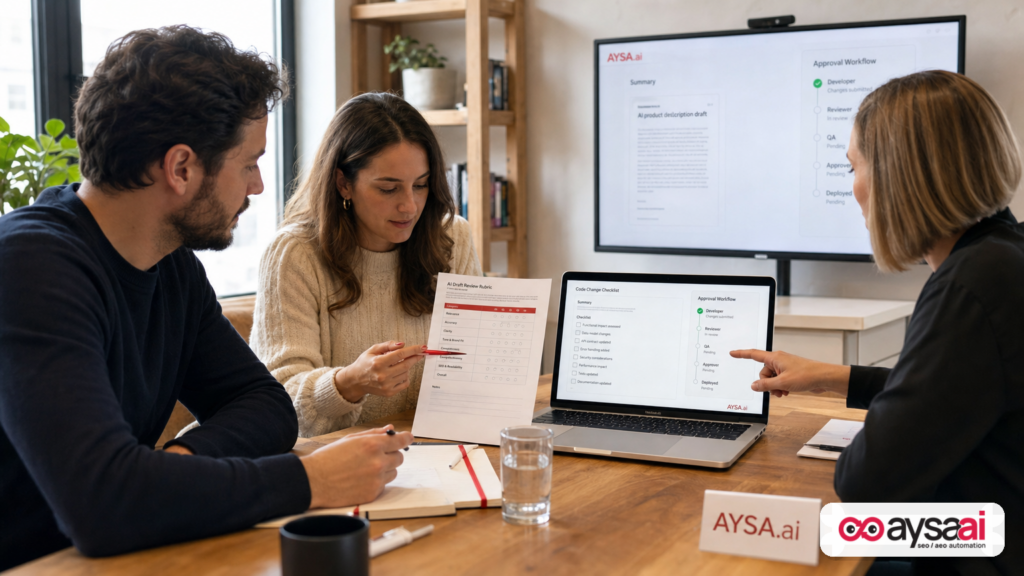
Shopify CEO Tobi Lftke recently warned about a new flavor of “lazy work” enabled by generative AI: shipping a pile of output that looks complete but hasn’t been read, verified, or owned by the person who generated it. Internally, Shopify calls these unreviewed handoffs “slop grenades.” That phrase is sticky for a reason: it captures the moment AI stops being leverage and starts being a productivity debt that explodes in someone else’s hands.
This isn’t just a tech-company culture story. It’s a blueprint for what will happen to any business that treats AI output as the finish line instead of the first draft. In marketing and SEO, slop grenades don’t only waste timethey quietly degrade the signals that search engines (and now AI answer engines) use to decide whether to trust you. In engineering, they create brittle code and “review tax.” In operations, they erode accountability.
At AYSA.ai, we think the next era of SEO Automation belongs to teams who build a system: monitor what matters, prepare changes with evidence, ask for approval, and execute only what’s accepted. That “Approved Execution” loop is the practical antidote to slop grenadesbecause it forces ownership back into the workflow.
Concise summary

- “Slop grenades” are unreviewed AI outputs tossed to coworkers (or published to the web) that shift the real work to someone else.
- AI doesn’t automatically remove workit reallocates it. If you don’t measure review and remediation time, you will overestimate ROI.
- For SEO/AEO/GEO, quality control is now a competitive advantage because AI Search experiences reward trustworthy, consistent, well-maintained information.
- The fix is operational, not philosophical: review gates, standards, change logs, and “no-ship-without-owner” rules.
- AYSA fits as an execution system that monitors, prepares, requests approval, and executes accepted website changesso AI accelerates outcomes without dumping risk on the team.
Table of contents

- What Shopify’s “Slop Grenade” Warning Really Means (And Why It’s Not Just a Tech Problem)
- The New Cost Model: AI Doesn’t Remove WorkIt Reallocates It
- The “Cleanup Economy” Is RealAnd It’s A Signal
- Where Slop Grenades Hurt Search: SEO, AEO, GEO, And Brand Trust
- A Concrete SME Scenario: The Ecommerce Brand That “Scaled Content” (And Then Stalled)
- What Changed in 20252026: From “Can AI Write?” to “Who Owns The Output?”
- Common Slop Grenade Failure Modes (Marketing + SEO + Web)
- The “AI Review Gate” System: A Practical Framework That Scales
- Create Standards That Make Review Fast (Not Heroic)
- How to Measure AI ROI Honestly (So You Don’t Lie to Yourself)
- What Agencies Must Rethink: Deliverables, Pricing, and Accountability
- Where AYSA.ai Fits: Monitor Prepare Approve Execute
- What to do next (Action list)
- Sources and further reading
What Shopify’s “Slop Grenade” Warning Really Means (And Why It’s Not Just a Tech Problem)

Let’s translate the Shopify story into plain business language.
Shopify’s CEO described two patterns:
- Engineering slop grenade: an employee asks an internal AI agent to produce a code change, then approves it without reading, pushing the true review burden onto colleagues.
- Communication slop grenade: someone expands a short point into a long AI-written email, only for the recipient to compress it back down with another model.
Both are the same operational failure: the person who requested the output didn’t “own” it. They outsourced thinking to a model, then outsourced responsibility to a coworker.
The underlying insight is bigger than Shopify: AI raises the ceiling on output but lowers the friction of shipping unowned work. When the cost of producing words or code approaches zero, the bottleneck becomes review, verification, and decision-making. That bottleneck doesn’t disappearit moves.
Our editorial lens at AYSA is simple: if AI makes it easier to create, then systems must make it easier to approve, execute, and maintain. Otherwise you are just accelerating chaos.
Primary research lead: This concept is based on reporting by Search Engine Journal covering Lftke’s comments on The Knowledge Project podcast and internal Shopify AI practices. See: Search Engine Journal Shopify CEO Warns AI ‘Slop Grenades’ Shift Work To Coworkers.
The New Cost Model: AI Doesn’t Remove WorkIt Reallocates It
Most teams calculate AI ROI like this:
- “It took 30 minutes to draft instead of 3 hours.”
- “We published 10 pages this week instead of 2.”
- “We shipped the PR fast.”
But that’s only the visible part of the cost.
The real cost model is:
- Draft time (lower with AI)
- Review time (often higher because you must verify claims, fix structure, ensure brand voice, and check for subtle errors)
- Remediation time (fixing what went wrong after publication: customer support issues, refunds, dev hotfixes, SEO regressions)
- Risk cost (the “tail risk” of being wrong at scale: compliance, reputation, indexation mistakes, poor shopping experiences)
In Shopify’s framing, the problem isn’t that AI creates “bad output.” The problem is that it makes it tempting to skip the expensive part: checking. So the cost lands on coworkersor on your customers, or on your analytics months later.
Leadership principle: If a team member uses AI, the deliverable isn’t the AI output. The deliverable is the reviewed, owned, accountable final result. No exceptions.
The “Cleanup Economy” Is RealAnd It’s A Signal
The SEJ reporting also points to rising demand on freelance marketplaces for work that corrects AI-generated output (“AI cleanup,” “correct AI,” “AI hallucination”). That trend matters even if you don’t hire freelancers, because it reveals a broader shift in the labor market: verification and remediation are becoming paid skills.
Two important takeaways for operators:
- Cleanup isn’t a temporary nuisance; it’s an emerging category of work. Whether it lasts 2 years or 10, businesses need a process now.
- In-house teams often don’t “bill” cleanup time. That makes it invisibleso leaders overinvest in “more AI content” and underinvest in quality systems.
Even if models improve, the organizational failure mode remains: people will always be incentivized to ship faster unless the system rewards ownership.
Where Slop Grenades Hurt Search: SEO, AEO, GEO, And Brand Trust
In search, the penalty for slop grenades is rarely immediate. It looks like “we’re producing more” while performance quietly stalls or declines.
Here’s how the damage happens in practice:
1) You publish plausible-but-wrong information at scale
AI is great at producing “polished” text. That’s exactly the problem: polished writing can hide weak reasoning and unverified facts. For an SME, the consequences are real:
- Incorrect pricing, availability, or shipping policies
- Outdated service details (clinic hours, appointment requirements)
- Wrong specs and compatibility (ecommerce returns spike)
- Misleading claims (brand risk and potential compliance exposure)
2) You inflate content without increasing usefulness
Search engines and AI answer engines are getting better at discounting pages that are long but not helpful. A slop grenade workflow tends to optimize for word count and “completeness theater” instead of clarity.
3) You create inconsistency across the site
When multiple people prompt models differently, you end up with contradictory statements across pages: return windows, ingredient lists, guarantees, or service areas. That inconsistency hurts users firstand then hurts search as engagement and trust signals deteriorate.
4) You create technical SEO regressions through AI-assisted changes
In engineering and web operations, unreviewed AI suggestions can introduce:
- Broken internal links
- Wrong canonical tags
- Accidental Noindex rules
- Redirect loops
- Schema markup errors that make structured data unusable
These are classic examples of “cheap to propose, expensive to diagnose.”
5) You lose the chance to earn AI citations and brand mentions
In AI-driven discovery, you want your content to be easy to quote accurately: concise, structured, and consistent. Sloppy AI expansions do the oppositethey bury the point under filler. In Lftke’s email example, the right move was to make the point shorter, not longer.
If you’re serious about visibility in AI answers, treat clarity as a ranking factor even when no one officially calls it that.
Related reading lead (category context): Search Engine Journal maintains ongoing coverage of AI search developments in its AI Search section: SEJ AI Search.
A Concrete SME Scenario: The Ecommerce Brand That “Scaled Content” (And Then Stalled)
Consider a realistic ecommerce business: a 12-person team selling specialty home goods (high-margin products, lots of variants, seasonal demand). They adopt AI to scale category pages and product descriptions.
Month 1: Output explodes. The marketing manager prompts an LLM to produce 200 product descriptions, plus buying guides and FAQ blocks. The team celebrates.
Month 2: Customer support notices odd questions: “Does this item come with batteries?” (it doesn’t), “Is this dishwasher safe?” (sometimes). Returns creep up. Reviews mention “description not accurate.” The team spends hours correcting listings.
Month 3: Organic traffic plateaus. Some pages rank briefly then slide. The team responds by publishing even more content. They’re convinced they need “more SEO.”
What actually happened:
- The AI text created confident-sounding inaccuracies that harmed conversion and reviews.
- The site accumulated inconsistent claims across variants.
- The time saved in drafting got repaid with interest in remediation work.
- No one had a defined review gate. Content went live because it existed, not because it was owned.
What would have changed the outcome: a workflow where AI drafts are treated like raw materials. Review is mandatory. And execution is controlled through approvals and monitored outcomesexactly the operating posture we build toward with AYSA.
What Changed in 20252026: From “Can AI Write?” to “Who Owns The Output?”
In the early wave of generative AI adoption, the conversation was capability-focused:
- Can AI write blog posts?
- Can AI summarize meetings?
- Can AI generate code?
That conversation is now outdated. Capability is table stakes. Shopify’s internal posturemaking AI usage a baseline expectationshows where many organizations are going: AI becomes embedded in the default workflow. The question becomes: what does “good” look like when AI is everywhere?
The answer is ownership and governance:
- Who is accountable for the output’s correctness?
- What is the definition of done (beyond “the AI wrote it”)?
- How do we prevent rework from accumulating quietly?
In other words: AI maturity is less about prompts and more about process.
Common Slop Grenade Failure Modes (Marketing + SEO + Web)
If you run a business site, you’ll recognize these patterns immediately. They’re the operational equivalents of “didn’t show your work.”
Failure mode A: “Make it longer” content
You start with a clear idea. AI expands it into a 1,200-word page. It reads well. It also adds:
- generic filler
- unverifiable claims
- weak differentiation
- vague CTAs
Then someone else has to compress it back down or fact-check it. That is the email example, but applied to SEO pages.
Failure mode B: “Template SEO” that ignores the business
AI produces the same meta titles, headings, and intros across dozens of pages. It looks consistent but not specific. The site becomes interchangeable. In competitive markets, interchangeable loses.
Failure mode C: “Schema everywhere” without verification
Teams add structured data because it feels like an SEO win. But schema needs to match page reality. Misaligned markup is a trust problem and a maintenance burden. (If you can’t confidently maintain it, don’t ship it.)
Failure mode D: “AI suggested this code change” without understanding
This is the engineering slop grenade. A suggested fix looks reasonable but changes behavior in edge cases. Reviewers spend time reconstructing intent.
Failure mode E: “Publish first, we’ll fix later” becomes permanent
In small companies, “later” rarely comes. AI makes it easy to create a backlog of content debt you never repay.
The “AI Review Gate” System: A Practical Framework That Scales
If you want to keep AI as leverageand avoid slop grenadesyou need an explicit gate between generation and shipping.
Here’s a framework you can implement without enterprise bureaucracy.
Gate 1: Ownership (name the human responsible)
- Every deliverable has a single owner.
- The owner’s job is not to “get output.” It’s to guarantee correctness.
- If something ships and is wrong, you know who fixes it and how the process changes.
Gate 2: Evidence (show inputs, not just outputs)
For content and SEO changes, require lightweight evidence:
- What page/problem is this addressing?
- What data supports the change? (Search Console query patterns, customer questions, internal search, support tickets)
- What will we measure after shipping?
Gate 3: Review rubric (standard checks)
Make review fast by standardizing it. Use a rubric (more in the next section).
Gate 4: Approval (explicit go/no-go)
Approval can be a simple checkbox in your workflow tool, but it must be explicit. “Looks good” in chat is not a process.
Gate 5: Execution (controlled publishing + logs)
Execution is where most teams are weakest. They either:
- publish changes ad hoc without tracking, or
- require so much engineering time that nothing ships.
The win is a controlled execution path that can ship quickly after approval, with traceability.
This is exactly why we built AYSA as an execution system, not a “generate content” toy. More on that below.
Create Standards That Make Review Fast (Not Heroic)
The reason slop grenades spread is simple: reviewing AI output is cognitively expensive. People avoid it unless the system makes it easier.
Standards reduce that cognitive load. Here are standards that work for SMEs and agencies.
Content standards (for SEO pages, FAQs, guides)
- One page, one job: define the page’s purpose in one sentence.
- Fact policy: no unverifiable claims; cite internal sources or remove.
- Clarity bias: if a sentence doesn’t help a customer decide, cut it.
- Local/operational accuracy: hours, service area, shipping, returns, appointment rules must match reality.
- Unique value: require at least 3 details that only your business can credibly say.
SEO standards (titles, metas, internal links)
- Title tags: prioritize clarity and differentiation over stuffing.
- Internal links: link where it helps a user take the next step; avoid automated “spray and pray.”
- Thin page rule: no indexing of pages that don’t add value beyond a template.
- Change documentation: track what changed and why, so you can correlate outcomes later.
Technical standards (schema, canonicals, robots, redirects)
- Schema parity: markup must match what users can see and verify.
- Canonical discipline: never “guess” canonicals via AI; validate with site logic.
- Robots/noindex rules: treat as high-risk changes requiring senior review.
- Rollback plan: if a change breaks traffic, you need a clear revert path.
These aren’t “AI policies.” They’re quality policies that AI makes non-optional.
How to Measure AI ROI Honestly (So You Don’t Lie to Yourself)
If you don’t measure remediation, the business will drift toward slop grenades because “output” will look like progress.
You don’t need perfect instrumentation. You need consistent measurement.
1) Track total cycle time, not draft time
For each deliverable type (blog post, category page, schema update, redirect batch), track:
- time to draft
- time to review
- time to fix issues found in review
- time to remediate post-publish (bugs, customer issues, corrections)
2) Add a “rework rate” metric
Count how often something needs significant revision after review or after publishing. If rework rate climbs as AI usage climbs, you’re not scalingyou’re borrowing time from the future.
3) Require a measurable hypothesis for SEO changes
Examples:
- “This page targets questions from customer support; success = fewer tickets + improved conversion.”
- “This internal link change improves discoverability of a high-margin collection; success = more organic entrances to that collection and better assisted conversion.”
4) Watch leading indicators, not just rankings
For SMEs, rankings are lagging. Leading indicators include:
- CTR changes on important queries
- engagement and conversion by landing page
- support tickets tied to misinformation
- returns and refunds linked to inaccurate product details
Measurement is what turns “AI adoption” into “AI advantage.”
What Agencies Must Rethink: Deliverables, Pricing, and Accountability
Agencies are uniquely exposed to slop grenades because AI can inflate deliverable volume. A client may love the idea of “50 new pages,” but if those pages create rework or risk, the agency loses trust.
Stop selling volume; sell outcomes with governance
Agencies should move from “we produced X assets” to:
- “We shipped X approved changes with a change log.”
- “We improved Y pages tied to conversion goals.”
- “We reduced content debt and inconsistencies across the site.”
Update your SOW to include review and remediation
If review isn’t scoped, it becomes a margin killer. The SEJ piece highlights a key dynamic: cleanup work is rising. If you don’t price for verification, someone will eat that cost.
Build an approval-based operating model
The best agency-client relationships are explicit:
- Agency prepares changes with rationale
- Client approves (or the agency approves within agreed guardrails)
- Execution is logged and reversible
This is where SEO automation should go: not “auto-publish,” but “auto-prepare + human-approved execute.”
Where AYSA.ai Fits: Monitor Prepare Approve Execute
AI shouldn’t be a grenade launcher. It should be a disciplined assistant inside a workflow that preserves accountability.
AYSA is designed around that operating reality: it monitors, prepares, asks for approval, and executes accepted website changes. That sequence matters. It is the opposite of “generate and dump.”
1) Monitoring: catch problems early
Slop grenades do the most damage when issues stay hidden. Monitoring is your early warning layernot just for rankings, but for site and content signals that indicate drift. Learn more: AYSA Monitoring.
2) Preparation: turn signal into a specific change
The hard part in SEO isn’t “getting ideas.” It’s translating signals into changes that are safe, specific, and aligned with the business. Explore our approach to AI SEO tooling: AYSA AI SEO Tools.
3) Approval: put humans back in the loop (on purpose)
Approval is how you prevent coworker time from being silently taxed. It’s how you ensure someone owns the change before it touches production.
4) Execution: ship what was accepted, log what changed
Execution should be fast after approval and traceable afterward. That’s how you scale without chaos.
AI search visibility: the new scoreboard
As discovery shifts toward AI-driven answers, your brand’s visibility becomes less about “sessions” and more about whether you show up credibly and consistently. See how we think about that: AYSA AI Search Visibility.
Pricing and adoption
If you’re evaluating how to operationalize an approval-based execution model, start here: AYSA Pricing. For more practical editorials and frameworks, visit: AYSA Blog.
Important note: This editorial uses Search Engine Journal’s reporting as research input. We are not claiming Shopify’s internal metrics beyond what was reported, and we are not asserting specific time savings or performance outcomes without verifiable data.
What to do next (Action list)
If you want AI speed without slop grenades, here’s a direct plan you can implement in the next 30 days.
Week 1: Set the rules of ownership
- Assign an owner to every AI-assisted deliverable.
- Define “done” as reviewed and verified, not “generated.”
- Create a short list of “high-risk changes” that require senior approval (robots/noindex, canonicals, redirects, pricing/policies).
Week 2: Build a review rubric
- Create a 1015 item checklist for content accuracy and usefulness.
- Create a separate checklist for technical SEO changes.
- Train the team on how to use it fast (10 minutes per review, not perfection).
Week 3: Measure the full cycle time
- Track draftreviewfix0remediation for a sample of work.
- Compute rework rate and identify the biggest recurring error types.
Week 4: Implement an approval-based execution path
- Stop ad hoc publishing of AI-generated changes.
- Move to a system where changes are prepared, approved, and logged.
- If you need a scalable workflow, evaluate an execution system like AYSA that matches this model.
AI doesn’t remove the need for leadership. It increases it. If you want your team to move faster, you must make it easier to be accountable than to be lazy.
Sources and further reading
- Search Engine Journal: Shopify CEO Warns AI ‘Slop Grenades’ Shift Work To Coworkers
- Search Engine Journal: AI Search coverage
- Search Engine Journal: SEO coverage
- Search Engine Journal: Technical SEO coverage
- Search Engine Journal: Ask An SEO
AYSA internal references:
Continue the AI search topic inside AYSA.
Use these pages to connect the article with AI SEO tools, AI visibility monitoring, AI Overviews and approved website execution.
Turn this topic into a website action plan.
Use these AYSA hubs to move from reading to technical fixes, AI visibility monitoring, research, glossary context and approval-first SEO execution.