
Cyber Week PPC Doesn’t Need More Assets—It Needs a Story (and a System That Can Prove It)
When AI can generate a thousand headlines overnight, creative volume stops being an advantage. The differentiator is story—and a measurement plan that ties emotion-driven video to branded search, conversion lift, and customer experience. Here’s a practical playbook for SMEs and agencies heading into Cyber Week.

Every Cyber Week, the same advice circulates: “refresh creatives,” “add more assets,” “turn on automation,” “let the algorithm find winners.” That advice isn’t wrong—but it’s incomplete.
In 2026 and beyond, creative volume is no longer a moat. Google’s own leadership has talked publicly about integrating AI creative tools into advertising products, and the pace of asset generation is exploding. When everyone can produce thousands of headlines, images, and video variants quickly, the competitive edge shifts to what AI can’t manufacture on autopilot: a story that makes people care, plus a measurement plan that proves whether it worked.
A recent analysis in Search Engine Journal highlighted a UK Christmas ad ranking (from DAIVID) where a charity’s rescue-dog film scored above Amazon’s holiday spot. Don’t get stuck on the leaderboard. The useful takeaway for U.S. advertisers is the underlying pattern: simple narrative + relatable character + delayed product reveal can outperform spectacle—especially when your audience has discount fatigue.
This editorial is my playbook for SMEs and agencies: what changed in paid media, why story matters to performance marketing, how to measure it without fooling yourself, and what to implement this week so you enter Cyber Week with a creative system—not a pile of AI-generated variations.
Concise summary

- AI makes ad assets abundant. Differentiation moves from “more variants” to “better narrative.”
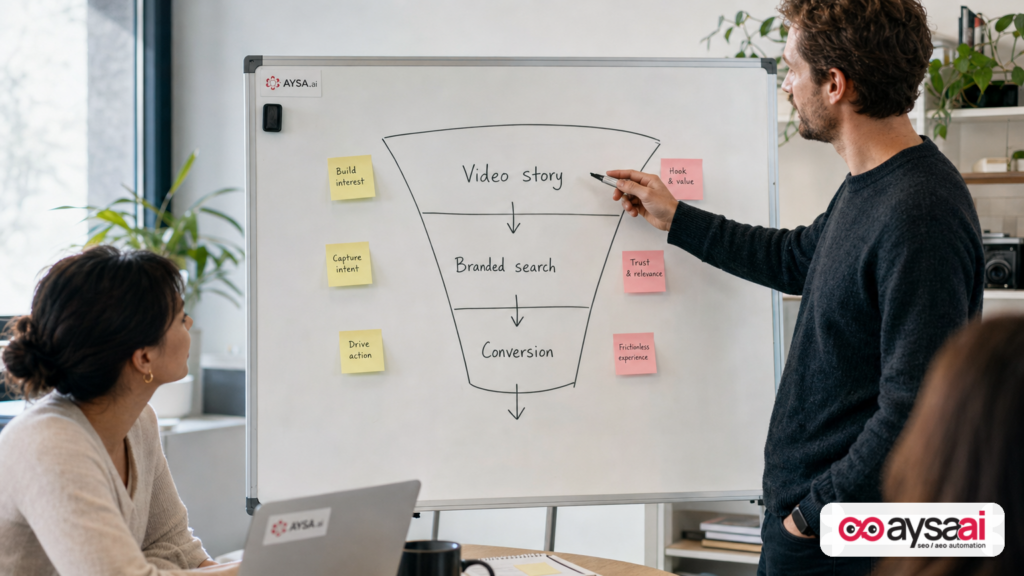
- Cyber Week performance is increasingly full-funnel. Story-led video can create demand you later capture via branded and category search.
- Branded Search is the bridge KPI. Watch branded queries, impression share, and branded conversions weekly—not just last-click ROAS.
- Don’t guess: run controlled creative tests. Keep audiences, bids, and budgets constant so creative is the only variable.
- Operations are part of the ad. If shipping, returns, inventory, or customer service can’t support your promise, your creative will backfire.
- AYSA fits as the execution layer. Monitor visibility and demand signals, prepare site updates, ask for approval, and execute changes safely during peak season.
Table of contents

- The new Cyber Week problem: creative abundance
- What a rescue dog beating Amazon really tells us
- Why story suddenly matters more in performance accounts
- What changed in Google Ads (and what didn’t)
- The measurement bridge: branded search is the missing KPI
- How story-led PPC fails (and how to avoid it)
- A practical Cyber Week creative system (15–30 seconds, not a “hero film”)
- How to apply this to Performance Max and Demand Gen
- Tracking and experiments: a clean testing plan for busy teams
- Concrete SME scenario: a mid-size ecommerce brand entering Cyber Week
- Agency reset: what you should stop selling as “optimization”
- Where AYSA.ai fits: monitor → prepare → approve → execute
- What to do next (action list)
- Sources and further reading
The new Cyber Week problem: creative abundance
For years, performance marketing rewarded the teams that could out-iterate everyone else: more Keyword coverage, more ads, more landing pages, more bid adjustments, more audience layers. That was the playbook when humans did most of the work and platforms were relatively limited.
Now, two forces flipped the table:
- Automation absorbed the mechanical optimizations. Smart bidding, broad match, dynamic creative assembly, and campaign types like Performance Max collapsed many levers into a smaller set of inputs.
- Generative AI removed the cost of “more creative.” Many advertisers can generate countless headlines and images, and produce passable video variants, faster than they can build a coherent messaging strategy.
When everyone has a spreadsheet of 50 headline options and a folder of AI-generated lifestyle shots, the “edge” becomes:
- Insight: Do you understand the customer’s job-to-be-done right now?
- Story: Can you articulate a narrative arc in 15–30 seconds?
- Trust: Can your business deliver the promise (shipping, support, returns, availability)?
- Measurement: Can you prove whether your upper-funnel creative created demand?
That’s why the UK Christmas ad ranking referenced by Search Engine Journal matters—even if you don’t care about holiday ads as “brand.” It’s a dataset (imperfect, but directional) showing that emotional connection can beat budget. The editorial question for your PPC account isn’t “Can we generate enough assets?” It’s “Do any of these assets give a human a reason to choose us?”
What a rescue dog beating Amazon really tells us
When an underdog story outperforms a major brand in predicted emotional response, it’s tempting to reduce the lesson to: “Use dogs.” That’s not the lesson.
The lesson is that clarity beats complexity and relatability beats polish when audiences are saturated with offers.
The SEJ piece describes patterns from high-performing holiday ads:
- A simple story viewers can follow instantly
- A character you root for
- Very little product shown until late
- Emotions that discounts can’t create (hope, gratitude, trust)
That structure is portable. You can translate it into a local service business, a clinic, a SaaS trial, a B2B demo request, or an ecommerce purchase.
Example translations:
- Local clinic: “A parent trying to get answers” → relief and confidence → clinic solution revealed late.
- Ecommerce: “A rushed gift-buyer who wants to get it right” → small emotional payoff → brand promise + shipping cutoff revealed late.
- B2B SaaS: “Ops manager drowning in spreadsheets” → moment of calm/control → product appears as the tool that restores sanity.
The goal is not to make an art film. The goal is to build a memory hook that survives the scroll and creates a preference that shows up later—often as a branded search, a direct visit, or an easier conversion on retargeting.
Why story suddenly matters more in performance accounts
“Brand” and “performance” used to be organizational silos. Brand teams did video, performance teams did search and shopping. But platforms collapsed those boundaries:
- YouTube is measurable and auction-based.
- Search campaigns increasingly react to demand created elsewhere.
- Performance Max blends inventory across surfaces.
As Search Engine Journal notes, YouTube’s role and Google’s push toward AI-generated creative assets means creative quality is no longer a “nice-to-have.” It is an input that affects how efficiently the machine can find and persuade buyers.
At the same time, consumer behavior changed:
- Discount fatigue: Shoppers expect promotions. “20% off” is not a differentiator.
- Trust pressure: Shipping delays, porch theft, return complexity, and customer service failures make “Will this go smoothly?” a primary buying concern.
- Discovery fragmentation: People don’t only discover brands via keyword search; they bounce between social feeds, video, creator content, marketplaces, and AI-driven recommendations.
So if your Cyber Week plan is “turn up budgets on the same catalog creative,” you might still get sales—but you’ll likely pay more per conversion than the advertiser who pairs a good offer with a believable narrative and operational confidence.
What changed in Google Ads (and what didn’t)
Let’s separate platform reality from marketing hype.
What changed
- Campaign types became creative-hungry. Performance Max and Demand Gen reward advertisers who supply real, high-quality creative inputs, especially video.
- Asset generation scaled. The platform ecosystem increasingly encourages AI-assisted creative production. That means “more assets” becomes table stakes.
- Measurement is more complex. Incrementality, Attribution gaps, and blended journeys make it harder to credit a single click.
What didn’t change
- Human attention is still scarce. If your ad doesn’t earn a second of attention, the algorithm can’t save you.
- Trust is still the conversion multiplier. A brilliant video can’t fix a confusing return policy, inaccurate delivery promise, or a broken checkout.
- Testing discipline still wins. Teams that run clean experiments beat teams that “swap stuff and hope.”
In other words: the platform can manufacture permutations; it can’t manufacture meaning. That’s your job.
The measurement bridge: branded search is the missing KPI
Here’s the most practical idea in the SEJ article: treat branded search as the bridge metric between story-led video and revenue.
Why? Because when story works, many people don’t immediately click and buy. They:
- remember your name, then search it later
- search “[your brand] reviews”
- search “[your brand] shipping”
- come back via direct or email
- convert on retargeting after they’ve seen you multiple times
If you only grade story-led creative on last-click ROAS inside a 7-day window, you’ll often kill it too early.
Branded-search signals to monitor weekly during peak
- Branded query volume (trend line, not one-day spikes)
- Branded impression share (are you losing demand you created?)
- Branded conversions and assisted conversions (if you have the setup)
- Search terms drift (are people searching “returns,” “cancel,” or “scam” alongside your name?)
Note: You do not need to overcomplicate this. Even a disciplined baseline screenshot and a weekly check-in can prevent you from making the classic mistake: turning off your best demand-creation creative because it didn’t immediately “pay back” in the attribution model you happen to be using.
How story-led PPC fails (and how to avoid it)
Story is powerful—but it can also become a performance trap if you treat it like a vibe instead of a business tool.
Failure mode 1: The story is emotional but irrelevant
If the narrative doesn’t connect to the buyer’s real job-to-be-done, you get cheap engagement and expensive revenue.
Fix: Write the last frame first. What belief must the viewer hold about you to buy? Build the story to earn that belief.
Failure mode 2: The story promises what operations can’t deliver
Cyber Week is when operations meet advertising. Your ad may “win” the click, but your business loses the customer if delivery, returns, and service aren’t aligned.
Fix: Treat shipping cutoffs, inventory accuracy, and return policy clarity as conversion assets—not footnotes. Ensure landing pages match ad promises.
Failure mode 3: You measure it like a coupon
If you demand immediate ROAS parity versus bottom-funnel shopping ads, you’ll systematically underinvest in demand creation.
Fix: Use a two-layer scorecard: (1) brand demand signals (branded search, direct) and (2) conversion efficiency over a longer window.
Failure mode 4: You let the platform generate the narrative for you
AI can suggest lines. It can’t ensure your message is distinctive. If your “brand voice” becomes platform-default, you’ll blend in.
Fix: Define two or three non-negotiable brand truths (speed, craft, guarantees, service). Approve creative that reflects them; reject creative that doesn’t—even if it looks polished.
A practical Cyber Week creative system (15–30 seconds, not a “hero film”)
Most SMEs don’t have time for a cinematic holiday production. Good. You don’t need one.
You need a repeatable system that can produce one story-led asset (plus cutdowns) that’s good enough to test, learn from, and scale if it works.
The 6-frame storyboard template
- Frame 1 (0–2s): The human situation (problem or desire). No product.
- Frame 2 (2–6s): Stakes: what matters emotionally (time, trust, relief, pride, belonging).
- Frame 3 (6–12s): Tension: the obstacle (confusion, risk, fear of getting it wrong).
- Frame 4 (12–18s): Turn: your brand enters as a guide, not a hero.
- Frame 5 (18–25s): Proof: one believable reason to trust (policy clarity, warranty, ratings, shipping promise, support).
- Frame 6 (25–30s): Offer + call to action, simple and direct.
Three story angles that work for SMEs during Cyber Week
- “Relief” story: You reduce anxiety (shipping certainty, easy returns, human support).
- “Pride” story: You help someone feel competent (choosing the right gift, finding the right service, making a smart decision).
- “Belonging” story: You connect the buyer to something meaningful (community, family tradition, self-care).
What to avoid in the first test
- Too many product shots early
- Jokes that don’t translate without sound
- Claims you can’t substantiate on-site (especially during peak)
- Multiple CTAs (pick one)
How to apply this to Performance Max and Demand Gen
The SEJ piece focused on Performance Max and Demand Gen for good reason: these campaign types are where creative quality meets automated distribution.
Performance Max: stop relying on auto-built video
If you don’t supply video, platforms often assemble something from images and text. It can function, but it rarely feels intentional.
Practical move: Upload at least one advertiser-made video (15s or 30s). If you only have a day, shoot it on a modern phone with good lighting and clean audio—or use simple on-screen captions. The point is narrative coherence, not production perfection.
Demand Gen: use it as your controlled creative test bed
Demand Gen (and YouTube placements within it) can be a strong environment to test story-led creative because it’s designed for discovery and consideration, not only bottom-funnel shopping intent.
Practical move: Run a split test where the only variable is creative: story-led vs offer-led.
Search campaigns: protect and harvest branded demand
If your story works, branded search interest may rise. That’s a gift—unless you fail to capture it.
Practical move: Ensure branded campaigns have enough budget and strong ad/landing alignment so you don’t lose demand to competitors or marketplaces.
Tracking and experiments: a clean testing plan for busy teams
Most “creative tests” fail because too many variables change at once. The platform changes audiences, budgets, bids, and placements—then your team swaps creative and declares victory. That’s not a test.
A simple 3-step test design
- Pick one hypothesis: “A narrative-first 15s video will increase branded search and improve Conversion rate vs offer-first static creative.”
- Create a real control: Keep budget, targeting, and bidding as consistent as possible. Change only the creative set.
- Define two scorecards:
- Short-term: CTR/engagement + site behavior (bounce/engagement rate) + early conversions
- Bridge: branded search trend + branded conversions + impression share
How long should you run it?
There’s no universal answer without volumes. The practical answer for Cyber Week is: run it long enough to cover your key purchase window, including shipping cutoff urgency. If you can’t run it long, don’t pretend the result is definitive—treat it as directional and decide whether to iterate or pause.
What “winning” looks like
Story-led creative can “win” in different ways:
- Lower CPA at similar CVR
- Similar CPA but higher branded demand (future efficiency)
- Higher CTR + better on-site engagement (leading indicator)
The key is to decide in advance which outcome you’ll accept as success, so you don’t move the goalposts after the fact.
Concrete SME scenario: a mid-size ecommerce brand entering Cyber Week
Let’s make this real. Imagine a mid-size ecommerce business selling premium home goods (average order value: a few hundred dollars). They have:
- One strong category: giftable kitchen products
- Decent returning customer base
- A Cyber Week offer planned (sitewide discount + free shipping threshold)
- Google Ads running Shopping + Performance Max
- Some social spend but inconsistent creative testing
The problem
Last year, they raised budgets and saw sales rise—but efficiency fell. Their creative was mostly product-on-white and discount overlays. Competitors looked identical.
The story-led solution in 10 days
They produce one 15-second narrative video:
- Opens with a buyer trying to choose a gift that feels “thoughtful,” not generic
- Shows the moment of relief when they find something that feels right
- Ends with a simple trust proof: “Ships fast. Gift-ready. Easy returns.”
They run:
- Demand Gen A/B: story video vs offer-led carousel
- Performance Max: add story video to key asset groups
- Search: ensure branded coverage and budget
What they monitor weekly
- Branded search trend and impression share
- Conversion rate changes on returning vs new visitors
- Customer service tickets mentioning shipping/returns confusion (qualitative)
What they change on the website (fast)
- Shipping cutoff banner that matches ads
- Returns policy snippet near add-to-cart
- Gift-ready packaging info on product pages
Notice how this isn’t “do more marketing.” It’s “make one narrative asset and align the site to fulfill the promise.” That alignment is often where performance gains come from during peak.
Agency reset: what you should stop selling as “optimization”
If you run an agency or manage PPC for clients, Cyber Week exposes a hard truth: many retainers are built around levers the platform has automated.
Here’s what I’d stop positioning as premium optimization:
- Endless micro-tweaks to bids without a creative/testing strategy
- Asset “quantity” reports that don’t evaluate narrative quality
- Attribution theater (overconfident conclusions from messy data)
Here’s what I’d reposition as premium:
- Creative briefs that produce measurable hypotheses
- Experiment design (real controls, clear success metrics)
- Brand demand Monitoring (branded search as a KPI)
- Operations alignment (shipping, returns, inventory, customer service)
- Website readiness (speed, messaging clarity, policy transparency)
This is where the future of performance management is headed: not “managing Google,” but managing the business inputs that Google responds to.
Where AYSA.ai fits: monitor → prepare → approve → execute
Most teams fail Cyber Week for a boring reason: execution bottlenecks. Great ideas don’t ship. Or they ship late. Or they ship without measurement. Or they ship but the site doesn’t support them.
AYSA is built to solve the operational gap between strategy and implementation—especially for SMEs that don’t have a 20-person growth team.
Here’s how the workflow looks in practice:
1) Monitor what matters
During peak season, you need early warning signals and stability. AYSA monitoring helps you keep an eye on the signals that tend to shift when story-led advertising is working: visibility patterns, branded demand proxies, and content/site readiness indicators. Learn more about AYSA Monitoring.
2) Prepare changes that support the promise
When creative shifts from “discount” to “trust,” the website must do its part: shipping cutoffs, returns clarity, gift messaging, service availability, and FAQ content. AYSA can prepare these changes for review so you don’t break revenue pages at the worst time.
3) Ask for approval (because peak season is not a sandbox)
Automation without governance is how you end up with a broken template, a policy mismatch, or a rushed content update that confuses customers. AYSA’s model is built around Approved Execution: proposed updates are staged for your review first.
4) Execute accepted updates quickly
Once approved, execution speed is the advantage. During Cyber Week, a two-day delay can erase the value of a good insight. AYSA is designed as an execution system for SEO/AEO/GEO readiness—not just recommendations. Explore the product areas at AYSA AI SEO Tools and AI Search Visibility.
How this connects to PPC
Even though this editorial is about paid search, the strongest Cyber Week accounts are coordinated:
- PPC runs the story test.
- The site communicates trust and reduces friction.
- Content supports the questions people search after seeing the ad (“reviews,” “shipping,” “returns,” “warranty”).
That’s where AYSA fits: making sure the website side of the equation keeps up with the paid media plan—without creating chaos.
If you want to see how we think about execution and editorial strategy, browse the AYSA blog. For teams planning Q4 budgets, see AYSA pricing.
What to do next (action list)
- Audit your current creative: In Performance Max and Demand Gen, identify whether you have at least one intentional narrative video asset. If not, plan one.
- Create one 15–30 second story-led video: Use the 6-frame storyboard. Keep product shots late. Add one trust proof.
- Run a controlled creative test: Story-led vs offer-led. Hold other variables constant as much as possible.
- Baseline branded search metrics now: Record branded query trend, branded impression share, and branded conversions (if tracked). Re-check weekly.
- Align operations with the promise: Confirm shipping cutoffs, inventory accuracy, and returns clarity. Put it on key landing pages.
- Protect demand capture: Ensure branded search campaigns have sufficient budget and clean messaging.
- Use AYSA to ship site updates safely: Monitor readiness signals, prepare changes, approve, and execute quickly. Start with Monitoring.
Sources and further reading
- Search Engine Journal: A Charity Rescue Dog Outscored Amazon’s Christmas Ad – PPC Accounts Need A Story Before Cyber Week
- Search Engine Journal: Paid Media section
- Search Engine Journal: AI Search coverage
- Search Engine Journal: SEO coverage
- SEJ webinar landing page (context on evolving KPIs)
Note: The SEJ source references additional studies and claims (e.g., surveys and earnings call commentary). In this editorial, I’ve focused on the strategic and operational implications that can be applied without relying on unverified numbers. When you build your internal plan, corroborate any benchmark stats with primary sources from the original publishers.
Editorial note from AYSA.ai
This article is written from my perspective (Marius Dosinescu) for SMEs and agencies that need results, not buzzwords. The core bet is simple: Cyber Week performance improves when you pair a clear story with disciplined measurement and fast on-site execution. If your account has “enough assets” but no narrative, you don’t have a creative strategy—you have a content pile.
AYSA exists to turn strategy into shipped, approved changes—so your advertising doesn’t outpace your website’s ability to convert and retain the customer.
Continue the AI search topic inside AYSA.
Use these pages to connect the article with AI SEO tools, AI visibility monitoring, AI Overviews and approved website execution.
Turn this topic into a website action plan.
Use these AYSA hubs to move from reading to technical fixes, AI visibility monitoring, research, glossary context and approval-first SEO execution.