Connected Apps in Google Search: What This Shift Means for SMEs, Local Services, and Ecommerce (and How to Win With AEO/GEO)
Google is turning Search into an action layer: groceries, credit checks, tax estimates, and local home services can now be initiated directly from Search via Connected Apps. Here’s what changed, why it matters for visibility and revenue, and how SMEs should adapt with AEO/GEO-ready content, data hygiene, and fast, approved site execution.
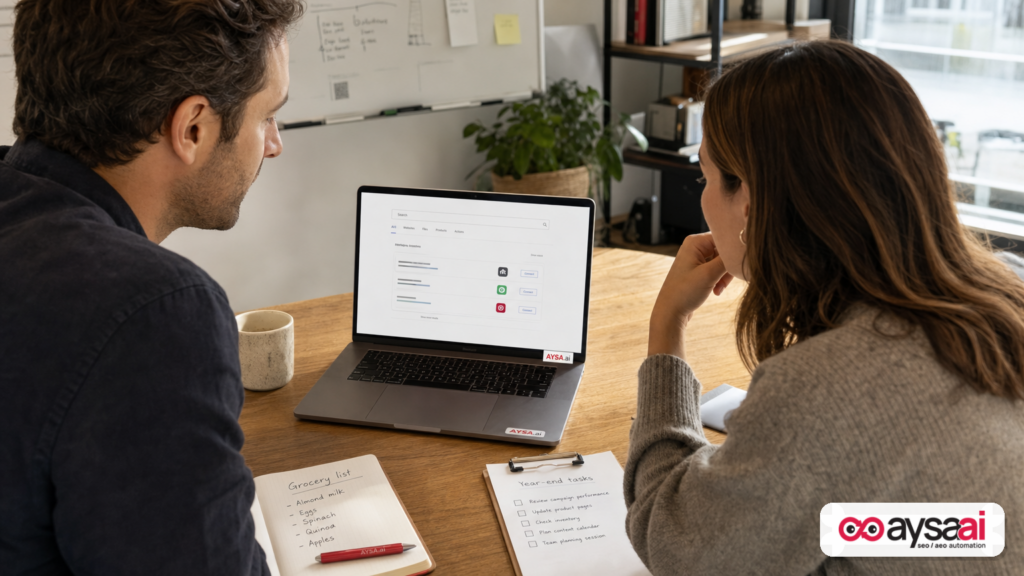
Google is steadily pushing Search from a place you research into a place you complete tasks. The latest example is a rollout of Connected Apps that lets people handle practical errands—like building a grocery order, checking a credit score, estimating a tax refund, or finding a local pro—directly from Search and the Gemini app.
As a business operator, you should read that as a structural shift: when the action happens inside the search experience (or inside a connected partner flow), classic SEO that depends on “get the click → convert on the site” becomes less reliable. Visibility still matters, but it shows up differently: eligibility, trust, integration readiness, product/service data quality, and being the recommended next step inside an AI-driven journey.
This editorial breaks down what changed, why it matters for SMEs, and what to do now—especially if you sell products, local services, or lead-based offers. I’ll also explain how AYSA fits as an SEO/AEO/GEO execution system: we monitor, prepare changes, ask for approval, and execute accepted updates so you can keep pace with Search’s new “do” layer.
Concise summary
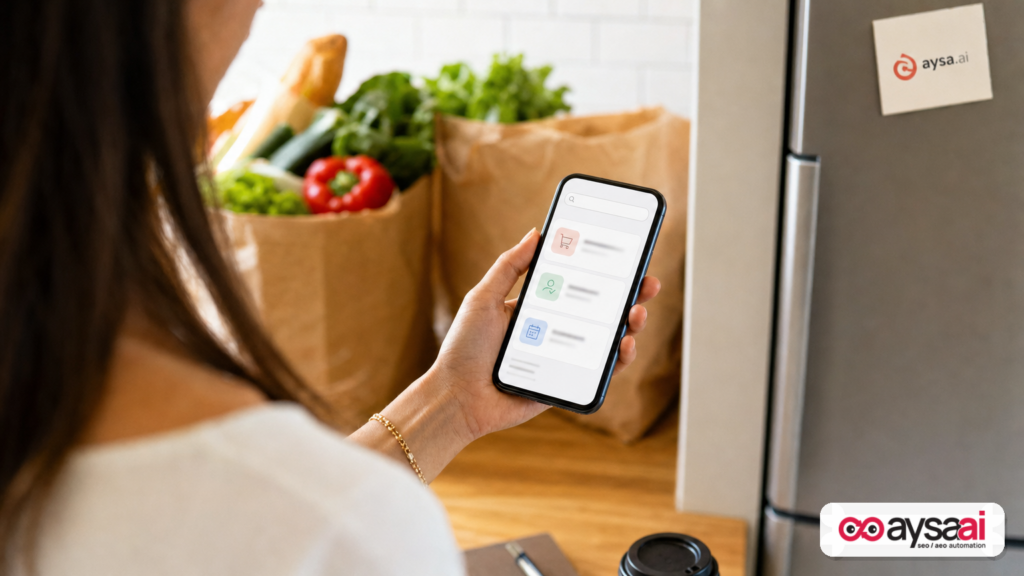
Connected Apps expand what users can accomplish without leaving Google’s surfaces. In Google’s announcement, the initial examples include grocery partners (e.g., Albertsons banners like Safeway and Shaw’s, plus Target), personal finance (Experian for credit and loans; H&R Block for tax estimates), and local services marketplaces (Angi and Thumbtack) connected inside Search in the U.S. The connective tissue is Google’s Universal Commerce Protocol, positioned as an enabler for these in-search workflows.
For businesses, this points to a near-term reality: some queries will convert without a traditional website visit. Your job is to ensure that (1) your brand and offerings are represented correctly in those flows, (2) your own website becomes the most credible “source of truth” for AI Retrieval and customer decision-making, and (3) you can ship updates continuously as Search evolves.
Key takeaways
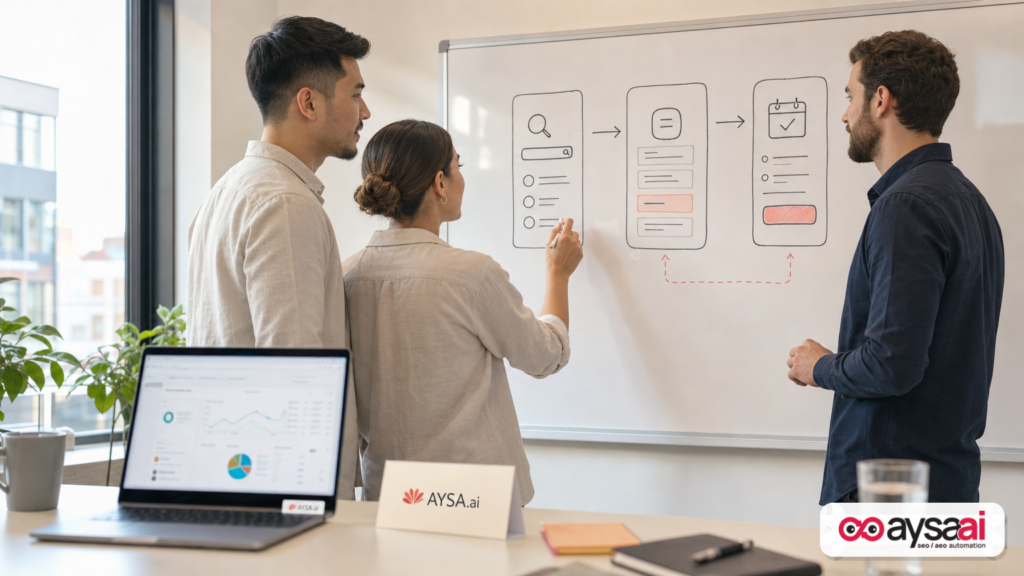
- Search is becoming an action layer: Google is integrating partner apps so users can complete errands from within Search and Gemini. Source: Google Search Blog announcement.
- Expect fewer Clicks for some high-intent queries: Especially where the user’s goal is transactional (order groceries, book a pro, check eligibility).
- SEO becomes “eligibility + understanding”: Structured data, clear service/product information, and trust signals become more important as AI-mediated journeys compress the funnel.
- Marketplaces and aggregators gain leverage: If Angi/Thumbtack-style marketplaces are the action endpoint, local providers must treat them as distribution channels—while still building direct brand demand.
- Measurement needs to mature: Sessions and CTR won’t fully explain performance when conversions happen inside connected flows.
- Execution speed is the advantage: Teams that can safely publish improvements weekly (not quarterly) will win; this is where AYSA’s Approved Execution model matters. See: AYSA AI Search Visibility and AYSA Monitoring.
Table of contents

- What changed: Search is becoming an action layer (not just an answer layer)
- Connected Apps in context: a continuation of AI-first search
- Why businesses should care: fewer clicks, higher stakes, and a new kind of visibility
- What Connected Apps signals for key verticals (grocery/ecommerce, finance, taxes, local services)
- How this changes search behavior and the funnel
- What can go wrong (and why this is not “set it and forget it”)
- A concrete SME scenario: the local HVAC company vs. the connected marketplace
- AEO/GEO readiness: how to become the best “next step” for AI journeys
- What to fix on your website (so AI and users trust it)
- What to monitor weekly: signals that Connected Apps are reshaping your SERP
- What agencies should rethink: deliver execution, not just strategy decks
- Where AYSA fits: monitor → prepare → approve → execute
- What to do next (action list)
- Sources and further reading
What changed: Search is becoming an action layer (not just an answer layer)
In November 2026, Google announced new Connected Apps rolling out through Search and the Gemini app in the U.S. The thrust is simple: rather than forcing users to jump between browser tabs and apps, Google is integrating “task completion” flows directly into the search experience—starting with errands that spike around the holidays and year-end.
From the announcement, the early Connected Apps examples include:
- Groceries / retail: Support for building orders and checking out more easily with grocery runs, including Albertsons brands (Albertsons, Safeway, Shaw’s) and Target.
- Personal finance: Experian in Search (in addition to Gemini app) so users can check credit rating and shop for a personal loan.
- Taxes: H&R Block so users can calculate taxes and estimate refunds from Search.
- Local services: Ability to link accounts to Angi and Thumbtack in Search to streamline hiring local pros.
Source: Get your year-end tasks done with new Connected Apps (Google Search Blog).
Google also frames these experiences as being powered by the Universal Commerce Protocol, which Google has discussed elsewhere on its blog (lead link provided in the source page): Connected Apps and the related Universal Commerce Protocol.
My read: this isn’t “one more feature.” It’s an accelerant. The more Search can finish the job, the less it needs to refer the job to your website. That changes both the opportunity and the risk profile for SMEs.
Connected Apps in context: a continuation of AI-first search
Connected Apps should be viewed as a continuation of a broader pattern: Search evolving toward AI-mediated experiences where results are assembled, summarized, and actioned—often with fewer visible steps for the user.
Google’s own navigation around the announcement points readers toward Gemini and “put Gemini to work” storylines—an editorial signal that Connected Apps sit inside a bigger narrative: AI systems that can orchestrate actions across services. The source page itself links to related Gemini app stories (as context):
- Gemini app (category hub)
Even without relying on claims beyond the provided context, we can responsibly say: Google is connecting Search and Gemini as complementary surfaces for “get things done” workflows. For businesses, that means your digital presence is now evaluated not just on “is this page relevant?” but also on “can this business be reliably acted on?”
That’s the core AEO/GEO shift: optimization is no longer only about rankings; it’s about being the most actionable entity in an AI-driven decision path.
Why businesses should care: fewer clicks, higher stakes, and a new kind of visibility
There are three practical implications SMEs should internalize right now.
1) Some queries will produce fewer website clicks—even when you “win”
If a user can build a grocery cart, estimate a refund, check a credit score, or request a service pro without leaving Search, then “success” may be measured by action completion, not by a pageview.
That’s uncomfortable if your only KPI is organic sessions. But it’s also an opportunity if you can show up as the preferred, trusted action endpoint in your category.
2) The stakes are higher because these are money moments
Grocery checkout, personal loans, taxes, and home services aren’t casual browsing. These are high-intent, high-value actions. When Search compresses the journey, users make choices faster, with fewer brand touchpoints.
In plain English: you may have less time to convince someone you’re the right option.
3) Visibility is now multi-surface and multi-format
“Ranking #1” used to be the dream. In connected, AI-heavy SERPs, the dream is:
- Being included in the action module (eligibility)
- Having accurate data (inventory/service availability, location, pricing cues, policies)
- Being trusted (reviews/reputation, clear terms, transparent practices)
- Being understandable (schema, clean site structure, clear offerings)
AYSA’s role in this world is to treat search visibility as an operational discipline, not a quarterly project: AI Search Visibility, plus continuous tracking via Monitoring, and then shipping changes with an approval step so businesses stay in control.
What Connected Apps signals for key verticals (grocery/ecommerce, finance, taxes, local services)
Connected Apps weren’t launched in a random set of categories. These are categories where:
- Users have repeat needs
- Tasks are easy to template
- Trust and identity matter
- Integration unlocks fast conversion
Grocery and retail: the SERP becomes the cart builder
Grocery is one of the most “actionable” intent spaces in existence. The user’s goal is clear: “I need these items.” When Search can help build an order and route the user into a checkout flow, the SERP effectively becomes the top of the ecommerce funnel—and in some cases, the middle of the funnel too.
Implication for ecommerce SMEs: even if you’re not one of the named partners, your customers will increasingly expect frictionless ordering. If your on-site UX is slow, confusing, or missing key info (availability, delivery options, substitutions, returns), you’ll feel that difference more quickly as connected flows raise the bar.
Also:</strong don’t ignore the “party planning” dimension. Holiday queries often start broad (“appetizers,” “snack tray,” “gluten-free desserts”), then become transactional. AI systems are increasingly comfortable bridging that gap. Your content needs to bridge it too.
Finance: trust and compliance cues matter even more
Google’s mention of Experian for credit rating checks and personal loan shopping emphasizes something important: Search is not only answering questions; it’s becoming a launchpad for regulated decisions.
For financial businesses (or any business that touches credit decisions, payments, subscriptions, or sensitive data), your brand trust signals need to be crystal clear, consistent, and easy to verify.
I’m not going to claim specific policy requirements beyond the supplied context, but the direction is obvious: if Search can broker finance-adjacent actions, it will prioritize safety, clarity, and reliable entities.
Taxes: help is moving closer to the query
Taxes are a “need it now” moment. Google’s inclusion of H&R Block for in-search calculation and refund estimation signals that Search is trying to shorten the gap between “I’m confused” and “I’m done.”
For accountants, tax software providers, and local tax firms: you may see more competition at the SERP feature level. To stay competitive, you’ll need content that answers the immediate question and proves you can handle the broader job.
Local services: marketplaces can become the default action
Angi and Thumbtack being linkable in Search is a clear sign: local services are becoming more platform-mediated. For local pros, that can be both good and bad:
- Good: easier access to demand and “ready to hire” leads
- Bad: more commoditization, more fee pressure, less brand differentiation
The strategic move is to treat these connected marketplaces as distribution, while building enough brand gravity to generate direct demand too.
How this changes search behavior and the funnel
SMEs often think of the funnel as: search → website → contact/checkout. Connected Apps introduce more patterns:
Pattern A: Search → action → confirmation (no website visit)
For certain intents (reorder staples, check a score, get a quick estimate), the user might never hit your domain. That can be fine if you still win revenue, but it complicates attribution and makes brand building more important.
Pattern B: Search → marketplace action → provider selection
For local services, Search may route the user into a marketplace flow. If you’re a provider, you need to optimize your marketplace presence with the same seriousness you treat your website—while also ensuring your website makes you stand out.
Pattern C: Search → site for verification → action elsewhere
Even when Search can perform actions, many people still “trust but verify.” They’ll check your site for proof: pricing transparency, warranty, credentials, photos, policies, reviews, location pages, etc. Your website becomes a trust artifact as much as a conversion engine.
This is where AEO/GEO intersects classic SEO: clarity and entity consistency across the web increases the probability that AI-mediated journeys interpret your business correctly.
What can go wrong (and why this is not “set it and forget it”)
When Search becomes more integrated with partner flows, the downside of messy digital operations increases.
1) Data mismatch and customer confusion
If your website says one thing (pricing, service area, availability) and your third-party profiles say another, customers lose trust. In connected flows, customers may make decisions with less back-and-forth—so inconsistencies hurt faster.
2) Thin content becomes a liability
If your pages don’t clearly explain what you do, who it’s for, where you operate, and what happens next, AI systems and users have less to work with. Thin pages may still “rank” sometimes, but they won’t necessarily be chosen inside action-oriented experiences.
3) Broken measurement leads to wrong decisions
If your team only tracks sessions and last-click conversions, Connected Apps can create the illusion of decline—even when leads are happening elsewhere. You need more robust monitoring and reporting discipline.
4) Slow execution is now a competitive disadvantage
Search features evolve quickly. If it takes your team 6–10 weeks to update key pages, add structured data, publish FAQs, or fix internal linking, you’re always reacting after the market moves.
That’s why AYSA focuses on operationalizing SEO/AEO/GEO: we monitor and prepare changes, then request approval, then execute accepted updates. Learn more: AYSA AI SEO Tools.
A concrete SME scenario: the local HVAC company vs. the connected marketplace
Let’s make this real with a scenario I see constantly.
Business: A local HVAC company in Ohio with 12 employees. They rely on a mix of referrals, Google Business Profile visibility, and organic traffic to service pages like “Furnace repair” and “AC installation.” They also have profiles on a couple lead marketplaces.
What changes with Connected Apps:
- A customer searches “furnace repair near me” during a cold snap.
- Search surfaces a more action-oriented journey: fewer “research” steps, more “request/booking” prompts.
- The user is nudged toward a connected marketplace flow (think Angi/Thumbtack-style), where the marketplace UI standardizes quotes and requests.
What the HVAC company risks:
- They become interchangeable with competitors if their differentiators aren’t obvious.
- They lose the chance to educate the customer on why their process is safer/better (licensed techs, warranties, same-day service rules).
- They pay higher acquisition costs if marketplaces become the default.
What they should do:
- Build a “trust moat” on-site: clear credentials, proof of service area, transparent pricing ranges (when possible), emergency policy, financing info (if applicable), and customer expectations.
- Write content that answers “should I?” questions: “Is my furnace dangerous?” “What does a repair cost?” “How fast can someone come?”
- Structure pages for AI comprehension: service pages, FAQs, and schema where appropriate—without stuffing keywords.
- Operationalize updates: track queries and SERP feature changes; ship improvements weekly.
AYSA is built for this kind of operational cadence: monitor shifts, prepare fixes and upgrades, get owner approval, then publish. See Monitoring and Pricing.
AEO/GEO readiness: how to become the best “next step” for AI journeys
Let’s define terms simply:
- AEO (Answer Engine Optimization): making your content and entity information easy for AI systems to retrieve, trust, and summarize correctly.
- GEO (Generative Engine Optimization): ensuring your brand and offerings appear accurately and favorably in generative results and AI-assisted journeys.
Connected Apps raise the importance of AEO/GEO because the “result” might be an action card, a connected flow, or an AI-guided next step—not a simple blue link.
Be eligible: remove ambiguity
AI systems struggle most with ambiguity: unclear service areas, unclear offerings, mismatched brand names, outdated hours, missing policies. Your job is to remove ambiguity with:
- Clean site structure (service/category clarity)
- Consistent NAP (name/address/phone) for local
- Explicit coverage details (shipping zones, service radius)
- Clear contact and next steps
Be understandable: write for humans, structure for machines
Write in plain language for customers, but ensure the site is structured in a way machines can interpret. That includes:
- Logical headings and page templates
- Descriptive internal links
- FAQ sections that reflect real questions
- Structured data where appropriate (don’t spam it)
Be trustworthy: prove the business behind the content
Year-end tasks (finance, taxes, home repairs, big orders) amplify trust needs. Your site should make it easy to verify:
- Who runs the business
- How to contact you
- Policies (returns, cancellations, warranties)
- Credentials (licenses, certifications when relevant)
If you want a deeper resource hub on adapting to AI search, start here: AYSA AI Search Visibility.
What to fix on your website (so AI and users trust it)
Even if actions increasingly happen inside Search, your website still matters—often as the trust anchor and canonical reference. Here’s what I’d prioritize for SMEs.
1) Build (and maintain) “pages that pay”
Identify the handful of pages that represent your revenue engine:
- Ecommerce: top categories, best-sellers, seasonal collections, shipping/returns
- Local services: top service pages + service area pages
- Professional services: core offering pages + pricing/engagement model page
Then make those pages exceptionally clear: what it is, who it’s for, how it works, what it costs (even ranges), and what happens next.
2) Add real FAQs that match “errand intent”
Connected Apps are built for errands. Your content should reflect errand questions:
- “Can I get it by Thursday?”
- “Do you install this in my zip code?”
- “What documents do I need?”
- “How long does it take?”
This is not about stuffing Q&A blocks everywhere. It’s about reducing friction for the next step.
3) Use structured data responsibly
I’m not going to list every schema type here because the right approach depends on your business model and CMS, and we’re not using additional sources beyond the provided context. But directionally: structured data can help reduce ambiguity.
Be conservative: implement what you can support truthfully and maintain over time.
4) Improve internal linking so important pages become obvious
AI retrieval and human navigation both benefit from clear internal links. If your “money pages” are buried, you’re making it harder for both systems and customers.
5) Treat seasonality as a product feature, not a blog idea
Connected Apps are explicitly framed around holiday/year-end tasks. SMEs should mirror that operationally:
- Refresh seasonal pages early
- Update inventory/service availability messaging
- Clarify deadlines (shipping cutoffs, appointment lead times)
AYSA can help by monitoring changes and preparing updates you can approve quickly. Start at AI SEO Tools or browse guidance in the AYSA blog.
What to monitor weekly: signals that Connected Apps are reshaping your SERP
If you’re an SME, you don’t need a research department. You need a weekly visibility discipline. Here are the signals that matter when Search becomes more action-oriented:
1) SERP layout changes for your top queries
Watch for:
- More modules that prompt actions (order, book, request)
- More “in-SERP” pathways replacing organic listings
- More marketplace prominence in local intent
2) Query mix shifts: informational → transactional compression
When AI-guided experiences compress the funnel, you may see fewer long exploratory visits, but more qualified inquiries elsewhere. Track which pages are losing impressions/clicks and which queries are evolving.
3) Brand demand and navigational searches
In action-first SERPs, brand becomes a shortcut. If people search your business name specifically, you’re harder to disintermediate. This is why content, reputation, and consistency matter: they create memory.
4) Third-party channel dependency
If a growing portion of your leads are coming from marketplaces, you need to know. Not to reject it—but to manage it: margins, close rates, review velocity, and operational capacity.
AYSA Monitoring is designed to make these shifts observable so you can act. See: AYSA Monitoring.
What agencies should rethink: deliver execution, not just strategy decks
Connected Apps is another nail in the coffin of “SEO as a monthly report.” As Search becomes more dynamic, clients need two things:
- Fast detection of changes that impact demand capture
- Fast implementation of improvements
Agencies that win will look more like operators:
- They’ll run weekly SERP reviews for target query sets.
- They’ll maintain a prioritized backlog of changes.
- They’ll ship improvements continuously.
The uncomfortable truth: the best strategy in the world doesn’t matter if it takes two months to publish a new service page or fix a broken template.
Where AYSA fits: monitor → prepare → approve → execute
AYSA exists for the execution reality of modern search.
Here’s the model, mapped to Connected Apps and AI-first Search:
- Monitor: track visibility shifts, query movement, and page-level performance signals that indicate SERP behavior changes. (Monitoring)
- Prepare: generate a prioritized set of recommended changes: content improvements, internal links, structured updates, clarity fixes, and page enhancements designed for AEO/GEO readiness. (AI SEO Tools)
- Ask for approval: you stay in control; nothing publishes without sign-off.
- Execute accepted changes: implement updates so your site keeps pace with Search evolution.
This matters more as Search becomes more action-oriented because the competitive edge is operational: the business that can respond quickly (without breaking things) wins.
If you want to evaluate whether this model fits your team size and velocity, start with Pricing and then explore guidance on AI Search Visibility.
What to do next (action list)
Use this as a practical checklist for the next 30 days.
1) Identify your “connected intent” queries
- Make a list of top 20 queries that represent errands: ordering, booking, eligibility, estimates, near-me services, “best” comparisons.
- Manually inspect those SERPs weekly for layout changes and action prompts.
2) Upgrade your money pages for clarity and trust
- Add “what happens next” sections.
- Clarify service areas/shipping, timelines, pricing approach, and policies.
- Add FAQs that reflect real customer friction points.
3) Clean up entity consistency
- Ensure your business name, address, phone, and core descriptors are consistent across your website and key profiles.
- Align messaging: don’t promise “24/7” in one place and “Mon–Fri” in another.
4) Decide your marketplace posture (especially local services)
- Choose: are you using marketplaces as a primary growth lever, a filler channel, or a testing channel?
- Build a plan to convert marketplace customers into repeat/direct customers where allowed and ethical.
5) Implement a weekly monitoring + shipping cadence
- Weekly: review top queries and page performance; ship 3–10 improvements.
- Monthly: refresh seasonal pages; audit internal linking; review conversion paths.
If you want AYSA to operationalize this cadence—monitoring, preparing changes, routing approvals, and executing accepted updates—start here: AYSA Monitoring and AYSA AI SEO Tools.
Sources and further reading
- Google Search Blog: Get your year-end tasks done with new Connected Apps
- Google Blog: Connected Apps (linked from the source page)
- Google Blog: Universal Commerce Protocol (linked from the source page)
- Google Blog: Products & Platforms (context hub linked from source navigation)
- Google Blog: Search (context hub linked from source navigation)
Related AYSA resources:
Author: Marius Dosinescu / AYSA.ai
Continue the AI search topic inside AYSA.
Use these pages to connect the article with AI SEO tools, AI visibility monitoring, AI Overviews and approved website execution.
Turn this topic into a website action plan.
Use these AYSA hubs to move from reading to technical fixes, AI visibility monitoring, research, glossary context and approval-first SEO execution.