Best SEO Content Optimization Tools: Why Scores Help, but Execution Wins
A practical guide to SEO content optimization tools, content scoring, briefs, AI search readiness and why SMEs need approved execution, not only recommendations.
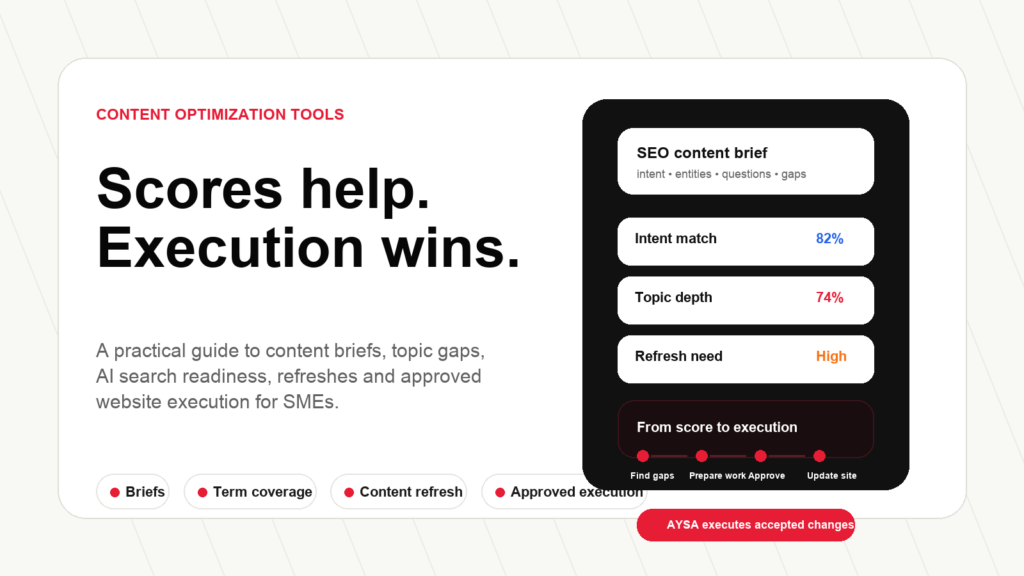
Executive summary: SEO Content optimization tools are useful. They help teams understand Search intent, compare competing pages, identify missing topics, build briefs, improve term coverage, structure headings, refresh older content and reduce guesswork. But they also create a dangerous illusion: that a better score automatically means a better page. In reality, content performance depends on strategy, usefulness, trust, technical health, internal links, authority, freshness, conversion clarity and the ability to execute improvements consistently.
This guide looks at the content optimization tool category from a practical SME perspective. Tools like the ones discussed by Rankability, Surfer, Clearscope, MarketMuse, Frase, Semrush and others can support better content decisions. But the biggest gap is usually not “we do not have another score.” The gap is “who turns the insight into approved website changes?” That is where AYSA fits: it monitors, prepares, asks for approval and executes accepted SEO, AEO and AI visibility work inside the website workflow.
What SEO content optimization tools actually do
SEO content optimization tools try to answer a practical question: “What should this page include to have a better chance of satisfying the search intent?” Different platforms answer that question in different ways, but the common workflow is similar. They analyze the search results, extract terms and topics, compare competing content, estimate gaps, suggest headings, recommend questions, evaluate readability, measure term coverage and sometimes generate drafts or briefs.
That can be extremely useful. A writer who starts from a blank page can miss important subtopics. A business owner may not know what questions customers ask before buying. An SEO manager may need to update 100 pages and needs prioritization. A content team may need consistent briefs across writers. A tool can reduce manual research time and make content planning more systematic.
But content optimization tools are not the same as content strategy. They are not the same as brand expertise. They do not automatically know your margins, business model, service quality, sales process, local market, customer objections or operational constraints. They can show patterns in competing pages, but they cannot replace judgment.
Google’s own guidance around creating helpful, reliable, people-first content is important here. The goal is not to write for a score. The goal is to create content that genuinely helps a user accomplish a task, understand a topic, compare options or make a decision. A score can support that work, but it should not become the work.
The content score problem
Most content optimization tools use some form of scoring. Scores can be helpful because they create a visible benchmark. They can show that a draft is too thin, missing important topics, overusing a term, ignoring related questions or failing to match the structure of the search results. For teams, scores also create a shared language between SEO, writers and editors.
The problem begins when the score becomes the objective. A page can reach a high optimization score and still be a mediocre result. It may include all the suggested terms but fail to help the user. It may match competitors too closely. It may add sections that do not fit the business. It may ignore local nuance, pricing clarity, trust signals, product availability, expert review or conversion flow.
In my opinion, the worst use of content optimization software is to treat it as a term-stuffing machine with a modern interface. If the tool says a page should mention “Internal linking” 12 times, that does not mean the writer should mechanically add the phrase. It means the page may need a useful section that explains internal linking in context.
Quality content starts with a harder question: what would make this page the most useful result for a specific user, at a specific stage of the journey, in a specific market? A page about “best pediatric clinic in Bucharest” should not look like a generic medical directory. It should help a parent compare options, understand when to choose emergency care, see real criteria, evaluate trust signals and decide what to do next. A page about “Technical SEO audit” should not only define the term. It should explain checks, risks, examples, prioritization and what happens after issues are found.
That is the standard content tools should support. They should help reveal gaps, but the final page must be built for the user.
The main categories of SEO content optimization tools
The “best tool” depends on the job. Some tools are strongest for briefs. Some are strongest for SERP analysis. Some are strongest for semantic coverage. Some help with content inventory and planning. Some focus on AI-assisted writing. Some sit inside broader SEO suites. For SMEs, the right question is not “Which tool has the most features?” It is “Which part of the workflow do we actually need help with?”
Brief and SERP analysis tools help identify what top-ranking pages cover, what headings they use, what questions appear, and what terms are common. These tools are useful before writing or refreshing a page.
Content scoring tools evaluate drafts against a topic model or SERP-derived recommendations. They can help editors spot missing coverage, but scores must be interpreted carefully.
Content inventory tools help teams identify decaying pages, duplicate content, thin pages, cannibalization and refresh opportunities. These are especially useful for websites with hundreds or thousands of pages.
AI writing and rewriting tools can accelerate drafts, outlines and variations. They are useful when governed properly, but they can produce generic content if the business context, examples and editorial standards are weak.
All-in-one SEO platforms combine keyword research, rankings, content suggestions, audits and competitor data. They are powerful, but they often still leave the user with the implementation burden.
Where content optimization tools are genuinely useful
Content optimization tools are strongest when they are used as research and QA systems, not as autopilot publishing systems. A good workflow starts with intent. What does the user need? What decision are they trying to make? What would make the page better than the current results? Then the tool can help identify missing angles.
For new articles, tools can help build briefs that include search intent, headings, related questions, entities, examples, internal links and source requirements. For existing pages, they can help identify missing sections, stale information, weak introductions, poor heading structure and content gaps. For ecommerce, they can support category descriptions, product comparison sections, FAQs and buying guides. For local businesses, they can reveal service-area questions and decision criteria.
They are also useful for content refreshes. Many websites already have pages that receive impressions but weak clicks. The page may be ranking on page two, or ranking for queries it does not answer well. A tool can help identify what the page lacks. But then someone must edit, approve and publish the improvements.
Another useful case is internal linking. Content optimization should not stop at the page itself. If a page belongs to a topical cluster, it should link to related pages and glossary terms. A page about content optimization should link to SEO content, search intent, topical authority, semantic SEO, internal linking and AI visibility where relevant. This helps users and crawlers understand the knowledge structure.
Content optimization for AI search, AEO and GEO
AI-assisted search increases the importance of clear, structured, useful content. Google’s guidance for AI features still points back to fundamentals: helpful content, accessible pages, clear context, crawlability and structured data that matches visible content. In other words, AI search does not eliminate SEO fundamentals. It raises the cost of vague content.
For answer engines, a page needs more than keyword coverage. It needs extractable explanations, direct answers, examples, definitions, comparison criteria and trustworthy context. A page should be easy to summarize without losing meaning. It should answer real questions in a way that can be cited or referenced.
Content tools can help by surfacing questions and related concepts, but they cannot always determine what is true for your business. For example, if a page says a company offers same-day delivery, airport shuttle, medical consultations, free parking or no deposit car rental, that must be real. AI search visibility should not be built on hallucinated claims.
This is why AYSA’s approval-first model matters. The system can prepare content improvements, but the business owner or team approves important claims before publishing. That is especially important in sectors like healthcare, finance, legal services, travel, car rental, parking and ecommerce.
The real SME problem: tools create work
For large content teams, another optimization tool can be helpful because they have people to process the recommendations. For SMEs, it often creates a new problem. The owner now has another dashboard, another score, another list of gaps and another set of tasks that nobody has time to implement.
This is the silent failure of many SEO tools. They are not wrong. They are incomplete. They tell you what to improve, but they do not reliably move the work through approval and execution. The business owner still has to understand the recommendation, brief a writer, update WordPress, add internal links, change metadata, check formatting, update images, test the page and monitor results.
That is why the future of SME SEO is not only better analytics. It is execution. The winning system will not only say “your content score is 64.” It will say: “This page receives impressions for these queries, lacks this section, needs these internal links, should answer these questions, has outdated examples and is ready for your approval.” Then it will apply the accepted changes.
In my opinion, this is the gap AYSA is built to fill. It does not replace strategic thinking. It reduces the operational drag between insight and website change.
A better workflow: research, brief, approve, execute, monitor
The strongest workflow combines content optimization tools with an execution system. First, research the topic and intent. Second, build a brief. Third, prepare the page or refresh. Fourth, review the business-sensitive claims. Fifth, publish the approved changes. Sixth, monitor performance and update again when needed.
This workflow is especially important for content refreshes. A page that performed well two years ago may decay because competitors improved, search intent changed, Google’s results evolved, products changed or the content became incomplete. Refreshing content is not only about adding more words. It may require a new structure, better examples, improved internal links, updated screenshots, more precise FAQs, stronger author proof and clearer next steps.
For AI search, the workflow also needs entity clarity. The page should make it clear who the business is, what it offers, who it serves, where it operates, what makes it trustworthy and what action the user can take. Generic content is less useful than context-rich content.
AYSA can sit after the analysis layer. It can use signals from the website and Google data, prepare the work, show the recommendation, ask for approval and execute accepted changes. This makes content optimization practical for companies that do not want to manage another manual SEO process.
The SEO content optimization tool landscape
Rankability’s article lists several content optimization tools and compares them from a practical SEO workflow perspective. That kind of comparison is useful because the category is crowded. The names change, features evolve, and many platforms now include AI writing or AI brief generation. But the core categories remain stable.
Surfer-style platforms are often used for SERP-based content scoring, term suggestions and content editor workflows. They can be useful for teams that want a clear optimization score and brief process.
Clearscope-style platforms are often used by editorial teams for topic coverage, content grading and writer guidance. They are useful when the team already has strong editorial discipline.
MarketMuse-style platforms are often positioned around content strategy, topical authority and inventory-level planning. They can help larger sites think beyond one article at a time.
Frase-style platforms are often used for briefs, questions, outlines and AI-assisted content creation. They can speed up early research but still require editorial judgment.
All-in-one SEO suites such as Semrush-like platforms combine keyword research, audits, ranking data and content recommendations. They are powerful, but SMEs can still struggle with implementation.
The right tool depends on the team. A solo business owner does not need the same workflow as an enterprise content department. An ecommerce site does not need the same workflow as a B2B SaaS company. A medical clinic does not need the same workflow as a recipe blog. The best content optimization stack is the one that matches the business model and leads to actual improvements on the website.
Where AYSA fits: from content optimization to approved execution
AYSA is not trying to be just another content score. Scores are useful, but they are not the final outcome. The final outcome is better content published on the website, connected to the right pages, monitored over time and improved when search behavior changes.
AYSA’s role is to turn SEO, AEO and AI visibility work into approval-ready actions. For content optimization, that can mean identifying pages with weak CTR, preparing updated titles and descriptions, improving page sections, adding FAQs, recommending internal links, refreshing outdated content, identifying missing topics, preparing briefs and applying accepted changes inside the website.
For SMEs, this matters because time is the real bottleneck. A business owner does not want another weekly task list. They want the website to keep improving without becoming an SEO specialist. AYSA helps by preparing the work and keeping the human in control of approval.
The best future for content optimization is not “AI writes everything.” It is a controlled operating model: AI helps detect opportunities, prepares useful work, explains why it matters, asks for approval and executes accepted changes. That is how a score becomes growth.
Turn content recommendations into approved website execution.
AYSA monitors your website, prepares SEO and AI visibility actions, asks for approval and executes accepted changes inside your website workflow.
Sources and further reading
Continue the AI search topic inside AYSA.
Use these pages to connect the article with AI SEO tools, AI visibility monitoring, AI Overviews and approved website execution.
Turn this topic into a website action plan.
Use these AYSA hubs to move from reading to technical fixes, AI visibility monitoring, research, glossary context and approval-first SEO execution.