
How to Prepare Your Product Feed for ChatGPT Shopping and AI Search
ChatGPT shopping makes product data a new AI visibility layer. Here is how ecommerce SMEs should prepare feeds, product pages and approval workflows without turning it into another manual SEO project.
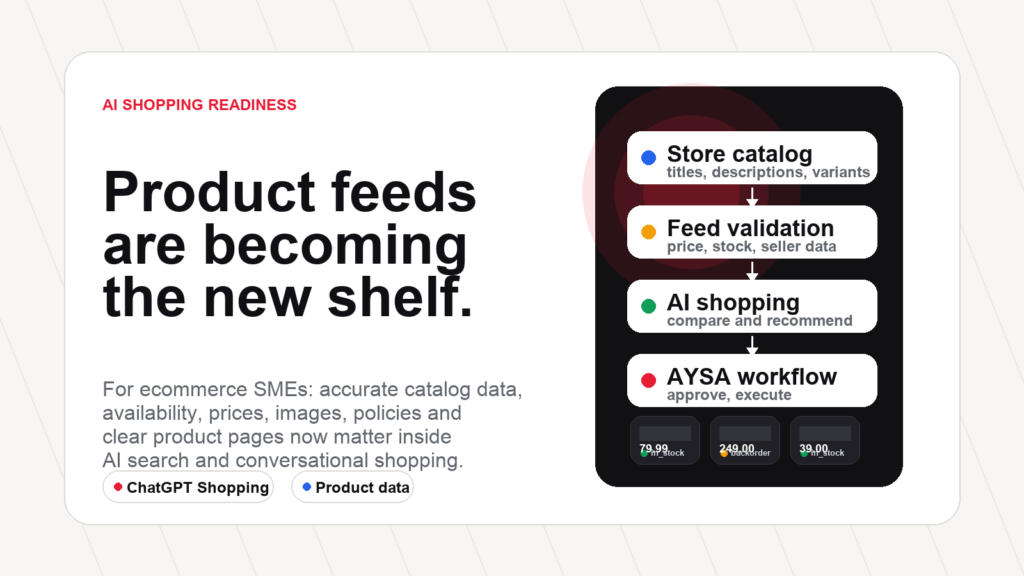
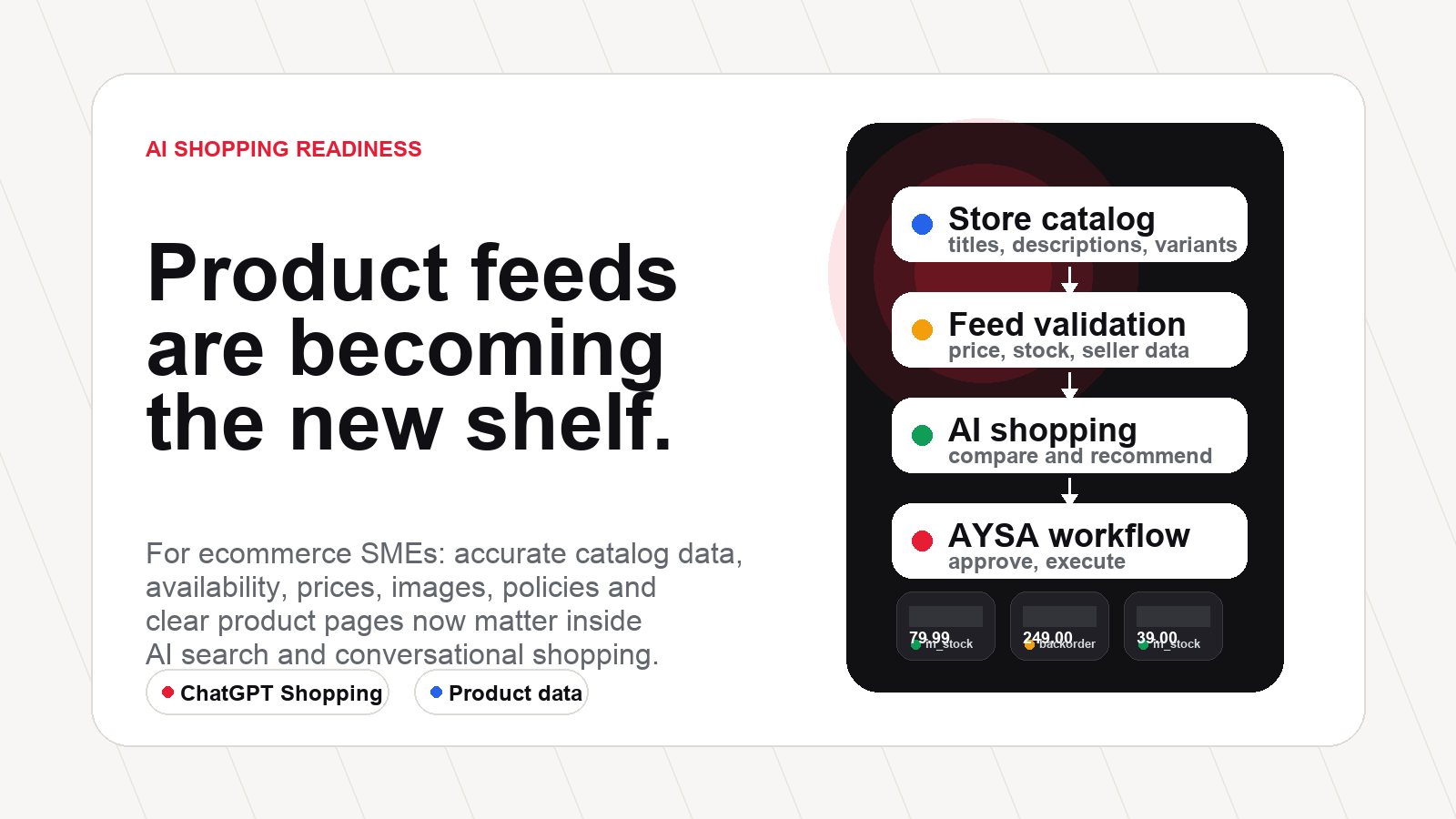
Executive summary: ChatGPT shopping changes how ecommerce websites should think about product visibility. It is no longer enough to have a product page that can rank in Google. A store also needs clean catalog data, accurate prices, availability, product images, merchant policies, structured product information and pages that clearly explain why the product is useful. OpenAI now has a Product Feed Specification for commerce integrations, and ChatGPT shopping experiences can use product information to help users compare and discover products.
My opinion: product feeds are becoming the new shelf. If your product data is incomplete, inconsistent or outdated, AI shopping systems have less to work with. But feed submission alone is not a strategy. The real work is product data governance: keeping titles, descriptions, images, categories, variants, prices, stock, reviews, policies and product pages aligned. This is exactly where an execution workflow matters. AYSA can help ecommerce SMEs monitor product and category visibility, prepare SEO/AEO improvements, ask for approval and execute accepted changes inside the website workflow.
What changed: ChatGPT is becoming a shopping discovery surface
For years, Ecommerce SEO was mostly discussed around Google rankings, category pages, product pages, Structured data, internal links, reviews and shopping feeds for advertising or marketplace distribution. That is still important. But conversational AI adds another layer: users can now ask product questions in natural language, compare options and receive recommendations inside an AI experience.
OpenAI’s Help Center explains that ChatGPT can show improved shopping results when users ask shopping-related questions. The experience is designed to help users discover and compare products, with product results that may include images, prices, ratings, reviews and links to merchants. OpenAI also states that shopping results are not ads in that Help Center explanation, which is important because it frames the experience as a relevance and product information challenge, not simply a paid placement channel.
The practical consequence is simple: product information quality becomes a visibility problem. If your store has poor titles, weak descriptions, inconsistent variants, missing availability, outdated prices or thin category pages, you are not only hurting classic SEO. You are also making the store harder for AI systems to understand, compare and recommend.
The SEO.ai article that triggered this analysis argues that merchants should think seriously about submitting product feeds to ChatGPT/OpenAI. I agree with the direction, but I would frame it more carefully: the feed is one part of the system. AI shopping visibility depends on the feed, the merchant website, product pages, structured data, trust signals, policies, reputation and the ability to keep all of that updated.
What OpenAI’s Product Feed Specification means
OpenAI’s developer documentation includes a Product Feed Specification for commerce. That matters because it signals a more structured path for merchant product information. A feed specification exists because AI shopping cannot rely only on Crawling random product pages and guessing the meaning of every field. It needs normalized product data.
In plain language, a product feed is a structured file or data source that describes your catalog. It typically includes product identifiers, titles, descriptions, product URLs, image URLs, prices, availability, brand, categories, variants and other attributes. The exact fields and requirements depend on the platform. OpenAI’s commerce feed documentation should be treated as the source of truth for the OpenAI-specific format.
OpenAI also has a merchant page for businesses interested in commerce experiences. That does not mean every store can instantly upload a feed and appear everywhere. It means merchants should prepare their catalog and apply or integrate through the available OpenAI commerce path when eligible. The safest SEO message is this: prepare your feed and your site so that when AI shopping surfaces expand, your store is not starting from chaos.
This is not new in spirit. Google Merchant Center, product structured data and marketplace feeds have trained ecommerce teams to maintain product catalogs for years. What is new is that conversational AI can turn catalog data into a comparison and recommendation experience. The user does not always search for “red running shoes size 42”. They may ask, “What lightweight running shoes should I buy if I run 5 km twice a week, have knee pain and want something under 100 dollars?” That query requires products, attributes, constraints, reviews, use cases and trust.
Weak catalog setup
Generic titles, missing variants, outdated stock, weak product descriptions, no structured data and category pages that do not help users compare.
AI-ready catalog setup
What your product feed needs before you think about ChatGPT
The exact OpenAI commerce feed fields should be checked against the official specification, but the operational checklist for ecommerce SMEs is clear. Before submitting a product feed anywhere, the catalog needs to be reliable.
Product IDs must be stable. If product identifiers change constantly, it becomes harder to match products across systems. Stable IDs also help with analytics, product updates and debugging.
Titles must describe the product, not spam keywords. A title should include the product name and key attributes that matter to buyers. It should not be a pile of keywords. AI systems need clarity, not noise.
Descriptions should explain use cases. A weak product description says what the product is. A useful product description explains who it is for, when to use it, what problem it solves, what makes it different and what the buyer should know before choosing.
Images must be accessible and representative. Product images should be high quality, stable, crawlable and aligned with the product. If the image URL breaks or the image does not match the product, the feed becomes less trustworthy.
Price and availability must be accurate. Nothing damages user trust faster than showing one price in a discovery surface and another price on the website. Availability also matters because AI shopping is action-oriented. If a product is out of stock, the system needs to know.
Variants need clear logic. Ecommerce stores often struggle with color, size, material, bundle and regional variants. If variants are messy on the website, they will be messy in a feed.
Merchant policies should be visible. Shipping, returns, warranty, payment options and delivery estimates help users make decisions. AI shopping systems can only reason about what they can retrieve or receive.
Structured data should match visible content. Product schema is useful when it accurately reflects the page. Conflicting schema from multiple plugins, outdated prices or hidden markup creates risk.
What ChatGPT needs beyond the feed
A feed can help systems understand the catalog, but it does not replace the website. In many buying journeys, the website still provides context that a feed alone cannot provide: buying guides, category explanations, comparisons, FAQs, compatibility notes, trust signals, brand story and support content.
This is why ecommerce SEO and AI shopping readiness should not be separated. A feed may say “women’s waterproof hiking boot, size 38, in stock, 129 euros.” A useful website explains whether the boot is suitable for winter, urban use, long trails, wide feet, rain, snow, ankle support, return policy and how it compares with alternatives.
For SMEs, this is the opportunity. Large retailers often have large catalogs but thin product knowledge. Smaller expert stores can win by explaining products better. A florist can explain bouquets by occasion, freshness, delivery window and local context. A car rental or airport parking business can explain timing, shuttle, security, booking, cancellation and location. A medical ecommerce store can explain compatibility, warnings and user scenarios. The feed is the shelf; the content is the salesperson.
AI systems need retrievable evidence. Product pages, category pages, guides and FAQs should be written for humans, but structured in a way that machines can parse: clear headings, concise answers, strong entity names, visible facts, consistent terminology, internal links and no hidden critical information.
How this connects to SEO, AEO and AI shopping visibility
Classic SEO still matters. Google can crawl product pages, evaluate structured data, understand internal links and rank category or product pages. But AEO and AI visibility add another question: can an AI system extract the right answer and recommend the right product for a user’s specific situation?
The answer depends on several layers. First, technical access: can the product pages be crawled, indexed and rendered? Second, data consistency: do the feed, page content, schema and merchant policies agree? Third, semantic clarity: does the page clearly explain what the product is, who it is for and how it differs from alternatives? Fourth, authority and trust: are there reviews, evidence, brand reputation and external signals? Fifth, freshness: are prices, stock and policies current?
In my opinion, many ecommerce stores will fail at the fifth layer. They may create a feed once, then forget that AI shopping visibility is a maintenance problem. Product catalogs change every day. Prices change. Stock changes. Delivery promises change. Reviews change. Seasonal intent changes. A static feed strategy becomes outdated quickly.
This is why the future is not “submit feed and relax.” The future is continuous catalog SEO operations.
A practical checklist for ecommerce SMEs
If you run an ecommerce business and want to prepare for ChatGPT shopping and AI Search, start with this checklist.
1. Clean your product catalog. Remove duplicates, fix broken products, consolidate variants where necessary and make sure each product has a stable URL.
2. Improve product titles. Make titles specific enough to identify the item, but not overloaded with keyword stuffing. Include meaningful attributes only when they help the buyer.
3. Rewrite weak descriptions. Add use cases, buying criteria, compatibility, materials, dimensions, benefits, limitations and practical advice. Do not publish generic manufacturer text across hundreds of products.
4. Fix category pages. Category pages should not be empty product grids. They should help users choose. Explain differences, filters, popular use cases and what buyers should compare.
5. Validate product schema. Make sure structured data matches visible page content. Avoid multiple plugins generating conflicting Product markup.
6. Align feed and website data. Price, availability, image, URL and product name should be consistent between feed and website.
7. Make policies easy to find. Shipping, return, payment and support pages should be clear and linked from product and checkout journeys.
8. Monitor errors continuously. Product feeds break. Images disappear. Prices mismatch. Products go out of stock. URLs redirect. AI shopping readiness requires monitoring.
9. Build helpful content around products. Buying guides, comparison pages, FAQs and product education improve both classic SEO and AI search retrieval.
10. Approve changes safely. Product content and feed changes affect revenue. The business owner should be able to review important changes before execution.
Common mistakes when preparing product feeds for AI shopping
The first mistake is treating the feed as a magic ranking button. A feed can help a platform understand your catalog, but it does not guarantee visibility, clicks or sales. OpenAI’s shopping documentation does not promise guaranteed inclusion for every merchant.
The second mistake is copying Google Merchant Center thinking without adapting to conversational discovery. Traditional feeds are often optimized for product listings. AI shopping also needs context. If your product page does not answer why the product is the right choice, the feed may not be enough.
The third mistake is letting feed data conflict with page data. If the feed says one price and the page says another, trust drops. If the feed says in stock and the product page says unavailable, the experience breaks. If schema says one rating and visible content says something else, validation and trust suffer.
The fourth mistake is over-automation without approval. Product data is commercial data. Updating titles, descriptions, categories or prices without human review can create business risk. Automation should prepare and execute, but important changes should still be approved.
The fifth mistake is ignoring international markets. If your store sells across countries, product feeds, currencies, language, shipping, VAT, availability and policies must be handled carefully. A Romanian ecommerce store selling in the EU may need different details than a US-only merchant.
Where AYSA fits: from catalog chaos to approved execution
AYSA’s role is not to replace OpenAI’s merchant tools or official feed submission process. OpenAI owns its commerce systems and specifications. AYSA’s role is to help the ecommerce business become ready for that world.
That means monitoring product and category pages, identifying weak content, detecting technical issues, preparing structured improvements, improving internal links, finding missing buying guides, checking AI visibility gaps and helping the store build clearer product information. Most importantly, AYSA turns recommendations into approval-ready actions.
For example, AYSA can help an ecommerce business identify products with impressions but poor click-through rate, categories with thin content, product pages missing key attributes, duplicate product descriptions, internal linking gaps, schema opportunities, outdated meta titles, broken product URLs, missing FAQs and feed-page mismatches that need review.
The workflow matters: AYSA prepares the work, explains why it matters, asks for approval and executes accepted changes inside the website workflow. That is valuable because ecommerce teams do not need another dashboard telling them they have 4,000 problems. They need a system that helps decide what matters, prepares the fix and moves the work forward safely.
In my opinion, ChatGPT shopping and AI search will make ecommerce SEO more operational, not less. The stores that win will not be the ones that only chase keywords. They will be the ones that keep their product data accurate, their pages useful and their execution fast.
Less SEO work. More organic growth.
Turn product data into AI shopping readiness.
AYSA can monitor ecommerce SEO and AI visibility, prepare catalog and product-page improvements, ask for approval and execute accepted website changes.
Sources
Continue the AI search topic inside AYSA.
Use these pages to connect the article with AI SEO tools, AI visibility monitoring, AI Overviews and approved website execution.
Turn this topic into a website action plan.
Use these AYSA hubs to move from reading to technical fixes, AI visibility monitoring, research, glossary context and approval-first SEO execution.

