
What ChatGPT Search Tooling Reveals About AI Visibility
A practical AYSA analysis of ChatGPT Search tooling, fan-out queries, source selection and what SMEs should do to become easier to find, read and cite in AI answers.
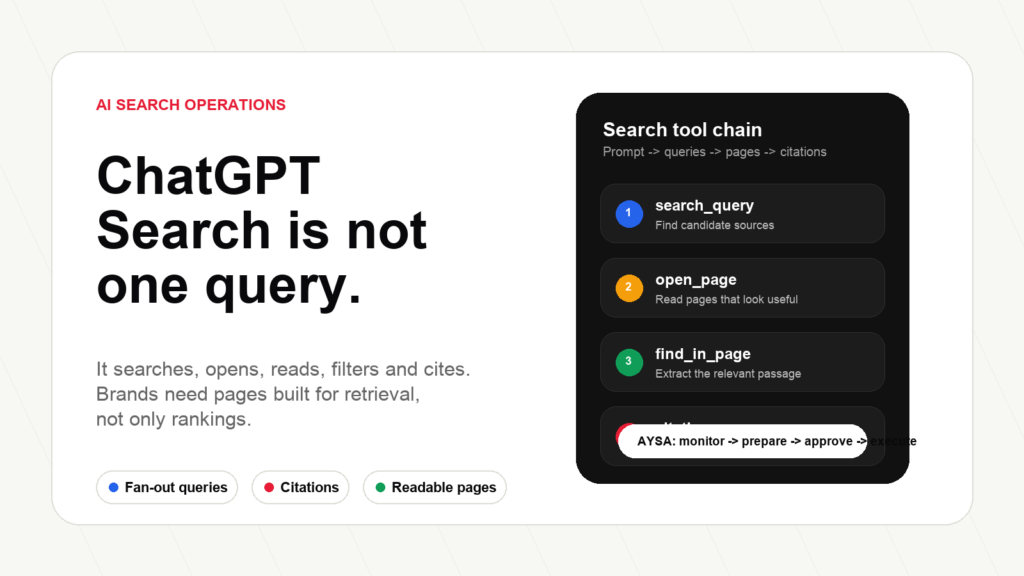
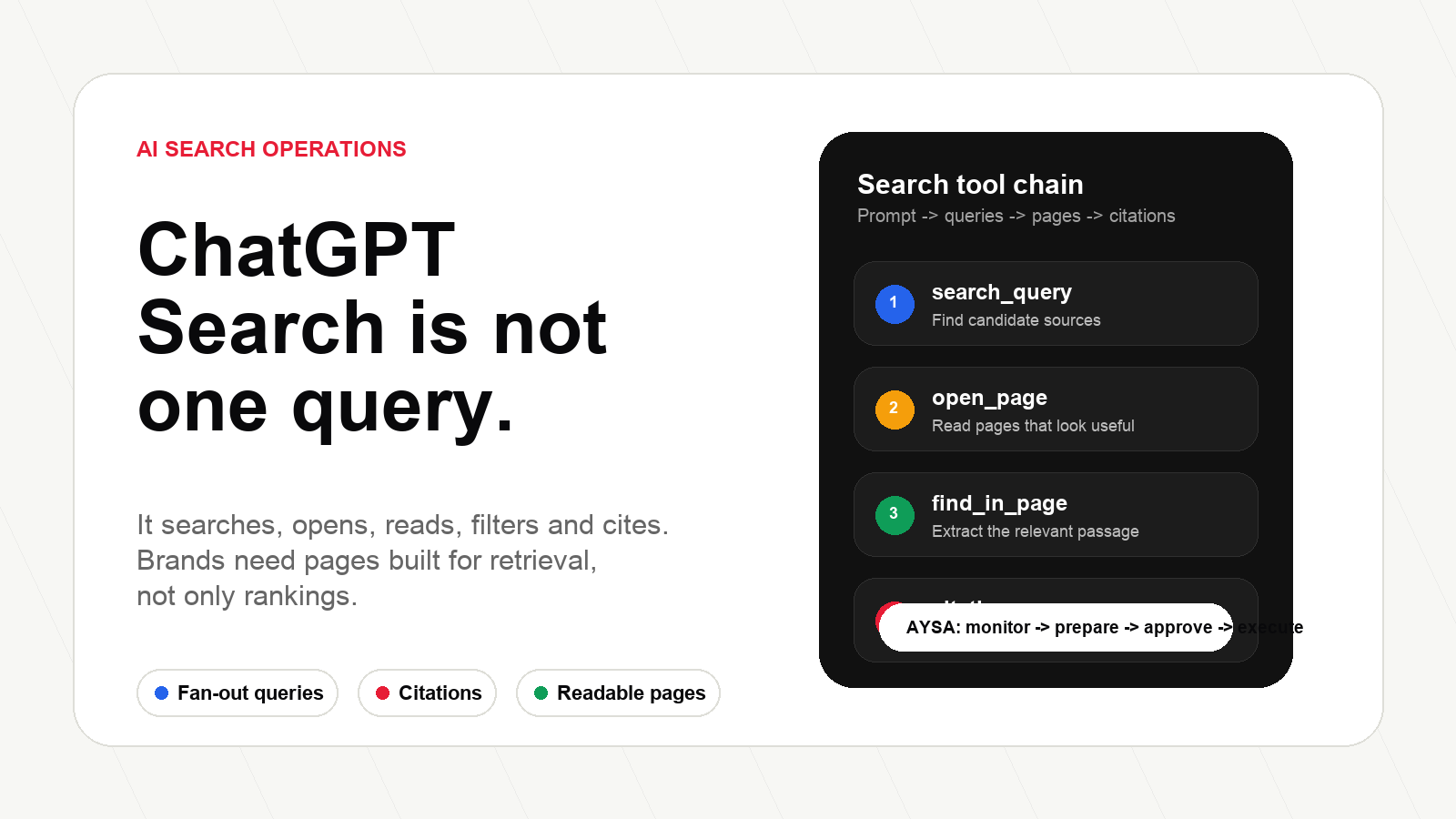
A LinkedIn post from Chris Long brought attention back to a Search Engine Land article by Olivier de Segonzac about ChatGPT Search, fan-out queries and what appears to be internal-style tooling exposed through prompts. The post describes actions such as web search, image search, product search, opening URLs, clicking links, finding text on pages and taking screenshots of PDFs. For SEOs, this is fascinating because it makes AI search feel less abstract. It suggests a system that does not only “know” answers from training data, but can actively search, inspect and assemble information from the live web.
Before we get carried away, the responsible interpretation is important. This is not the same as discovering the full ChatGPT Search ranking algorithm. It does not tell us every weight, filter, trust signal, shopping integration or citation rule. But it does make one thing obvious: the future of search is more agentic. The system can perform work. It can generate multiple searches, open results, inspect pages and choose what to use. That changes how we should think about SEO, AEO and AI visibility.
What Happened?
The conversation started from observations around prompts that appear to reveal a schema-like description of tools available during ChatGPT Search. Search Engine Land’s article, “Inside ChatGPT Search: Web run, fan-out queries, and AI visibility”, discusses how ChatGPT Search may break a user question into multiple searches and use web retrieval to construct an answer.
Chris Long’s LinkedIn summary focused on the same practical takeaway: if a system can search, open pages, find text and interact with source documents, SEO cannot only be about ranking for one exact Keyword. It has to be about being a good source for a chain of retrieval operations.
OpenAI also documents web search capabilities in official developer materials. The OpenAI web search tool guide describes models searching the web and returning answers with citations. The public product documentation for ChatGPT Search explains that ChatGPT can search the web and include links to sources. This does not confirm every detail circulating in social posts, but it does confirm the direction: AI answers can use live web retrieval and cited sources.
The Real SEO Lesson: AI Search Is a Workflow, Not a SERP
Classic Google search feels like a ranked list. Even when the ranking system is complex, the output is familiar: a page of results, snippets, ads, maps, images, videos, shopping units and other SERP Features. AI search feels different. The visible answer is a synthesis. The user may not see the full retrieval path. They may only see the final response and a handful of citations.
That means the competition is not only “Can I rank number three?” It becomes: can your page be discovered by the query fan-out, opened as a candidate source, understood quickly, trusted enough to support the answer and cited when the final response is assembled?
This is a massive shift for SMEs. In traditional SEO, a small business could think in terms of keywords and pages. In AI search, the business must think in terms of questions, entities, proof and source usefulness. A local clinic, an ecommerce store, a parking company near the airport or a B2B SaaS website needs pages that are easy for both humans and retrieval systems to parse.
What This Does Not Prove
Let’s be precise. A tool schema does not equal a ranking formula. Seeing that an AI system can perform a search or open a page does not tell us exactly why one source is selected over another. It does not prove that product search uses one specific commercial graph in every case. It does not prove that screenshots are used for normal web pages rather than PDFs or documents in specific workflows. It does not prove that every ChatGPT answer follows the same chain.
This matters because SEO loves overinterpretation. One screenshot becomes a strategy. One prompt becomes a “hack.” One observed citation becomes a rule. That is dangerous. The correct response is not to chase the prompt. The correct response is to ask what the behavior implies about durable visibility.
The durable implication is this: AI systems need sources that are retrievable, readable, trustworthy, specific and useful. That aligns with Google’s own advice around helpful content and AI features. Google’s people-first content guidance emphasizes usefulness and reliability. Its AI features guidance points back to crawlability, indexability, Structured data where appropriate and content that can be understood.
Fan-Out Queries: Why One Keyword Is No Longer Enough
Fan-out is the idea that an AI system may take one user question and break it into several related searches. For example, a user might ask: “I need a pediatric clinic in Bucharest for a toddler with recurring fever, preferably private, good reviews, easy parking and online booking. What should I compare?”
A classic SEO strategy might target “pediatric clinic Bucharest.” An AI search workflow may fan out into many supporting needs:
- private pediatric clinic Bucharest;
- pediatric clinic reviews Bucharest;
- children clinic online booking Bucharest;
- pediatric clinic parking Bucharest;
- recurring fever toddler when to see a doctor;
- clinic location pages, Google Business Profile data and review signals;
- pages that explain services, doctors, booking process and trust signals.
If your website only has one generic service page, it may not satisfy enough of that retrieval chain. If your website has clear pages, visible facts, structured service information, FAQs, reviews, location context and strong internal links, it becomes a better candidate source.
This is why keyword research must evolve. It is still useful, but it should not stop at keyword lists. It should create topic coverage, intent coverage, entity clarity and answer readiness.
Citation Readiness: How to Become a Better Source
AI visibility is not only about being mentioned. It is about being useful enough to cite. A citation-ready page usually has several qualities.
It answers a specific question clearly
A page should make the answer easy to extract. If the page is about “technical SEO audit,” explain what gets checked, why it matters, what risks exist and what happens after the audit. Do not only define the term.
It shows context and proof
AI systems are more likely to trust pages that show real context: who wrote it, what the business does, examples, data, sources, customer cases, reviews, methods and limitations. Generic content has less retrieval value.
It is technically accessible
Important facts should be in crawlable HTML, not hidden in images or blocked scripts. Internal links should connect related pages. Canonicals, redirects and sitemaps should not confuse crawlers. Structured data should match visible content and follow Google’s structured data guidelines.
It has entity clarity
The page should make it clear who the brand is, what it offers, where it operates, what topics it covers and why it is credible. AEO is partly a brand problem because answer engines need to understand the entity behind the page.
It is not isolated
One page rarely carries the whole answer. Internal links, glossary pages, product pages, case studies, documentation, reviews and external mentions all support retrieval. A page that sits alone is weaker than a page inside a coherent topical system.
What SMEs Should Do Now
Small and mid-sized businesses do not need to reverse engineer every tool used by ChatGPT Search. They need a practical plan.
First, clean the website foundation. Make sure important pages are indexable, canonical, fast enough and internally linked. Remove crawl waste. Fix broken links. Keep important content in readable HTML.
Second, map customer questions. Do not only map keywords. Map the questions that customers ask before they buy, compare, book, trust or contact. These questions are often the same questions AI systems need to answer.
Third, build answer-ready pages. A service page should explain the service. A comparison page should compare. A pricing page should clarify price logic. A local page should include location context. A glossary page should explain related terms. A blog post should be useful enough to stand alone.
Fourth, strengthen brand proof. Reviews, author profiles, press mentions, case studies, partner pages, social profiles and external references help the brand become more recognizable. AI search does not only retrieve text. It tries to understand trust.
Fifth, monitor and update continuously. AI visibility will not be a one-time setup. Query patterns will change. Citations will change. Google AI Overviews, ChatGPT Search, Perplexity, Gemini and other systems will keep evolving. The winning websites will keep improving.
Where AYSA Fits
AYSA was built for exactly this kind of search environment. If AI search behaves more like a browsing agent, then websites need an execution agent on their side.
AYSA can help monitor SEO, AEO, GEO and AI visibility opportunities, identify pages that need clearer answers, detect technical issues that reduce crawlability, prepare content improvements, suggest internal links, surface structured data opportunities, connect authority-building workflows and ask for approval before changes are applied.
The key is execution. Many tools can show reports. Many AI chatbots can suggest ideas. But the hard part for SMEs is turning those ideas into controlled website action. AYSA’s model is: monitor, prepare, approve, execute and learn. That is how a business moves from “interesting AI search insight” to actual visibility improvement.
This is why the ChatGPT tooling discussion matters. It reminds us that AI search is operational. It is not only a new SERP feature. It is a system that searches, reads, filters and cites. Your website needs to be ready for that system.
If AI search can inspect your website, make sure it finds something worth citing.
AYSA helps SMEs monitor search and AI visibility signals, prepare approved website improvements and execute accepted changes without turning the owner into an SEO specialist.
Sources and Further Reading
- Search Engine Land: Inside ChatGPT Search: Web run, fan-out queries, and AI visibility
- OpenAI Documentation: Web search tool
- OpenAI Help: ChatGPT Search
- Google Search Central: Creating helpful, reliable, people-first content
- Google Search Central: AI features and your website
- Google Search Central: Structured data guidelines
Continue the AI search topic inside AYSA.
Use these pages to connect the article with AI SEO tools, AI visibility monitoring, AI Overviews and approved website execution.
Turn this topic into a website action plan.
Use these AYSA hubs to move from reading to technical fixes, AI visibility monitoring, research, glossary context and approval-first SEO execution.

