
How to Fix Thin Content Across Similar Product Pages Without Creating SEO Spam
Thin content across similar product pages is usually an ecommerce architecture problem, not a copywriting problem. Here is how to handle variants, canonicals, categories, internal links and useful buying content.
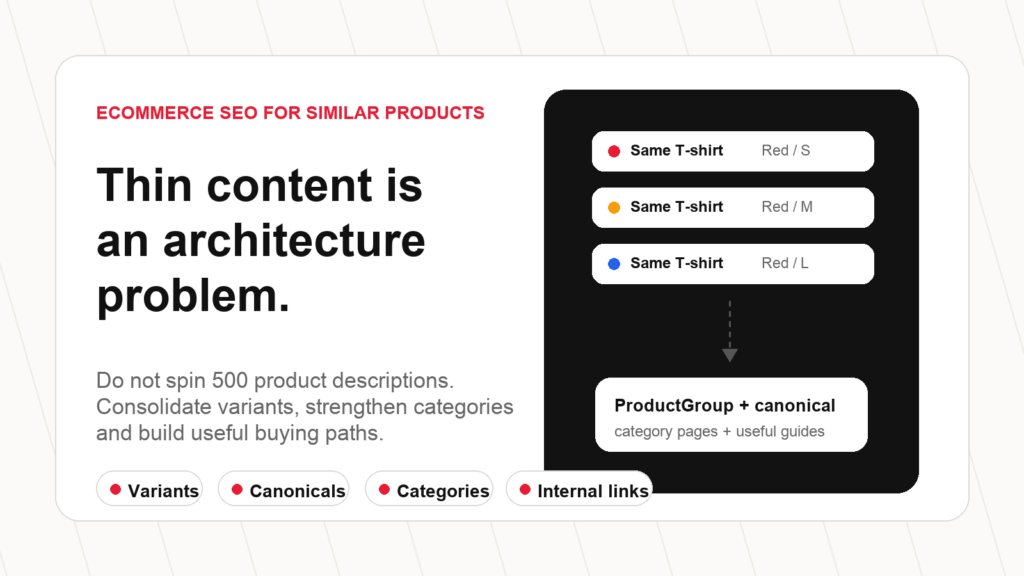
Executive summary: Thin content across similar product pages is rarely fixed by asking someone to “write 300 unique words” for every variant. On ecommerce websites, especially WooCommerce and Shopify stores, the real problem is usually architecture: duplicate variants, weak category pages, uncontrolled filters, poor canonical rules, thin product templates, missing buying guidance and internal links that treat every near-identical URL as equally important.
My opinion: if a store has 500 similar product pages, the answer is not 500 slightly different AI descriptions. That creates content noise. The answer is to decide what deserves to be indexable, consolidate what is genuinely the same, strengthen category and guide pages, add product data that helps buyers decide and monitor what Google actually indexes. AYSA fits naturally here because the work is operational: detect patterns, prepare changes, ask for approval and execute accepted improvements inside the website workflow.
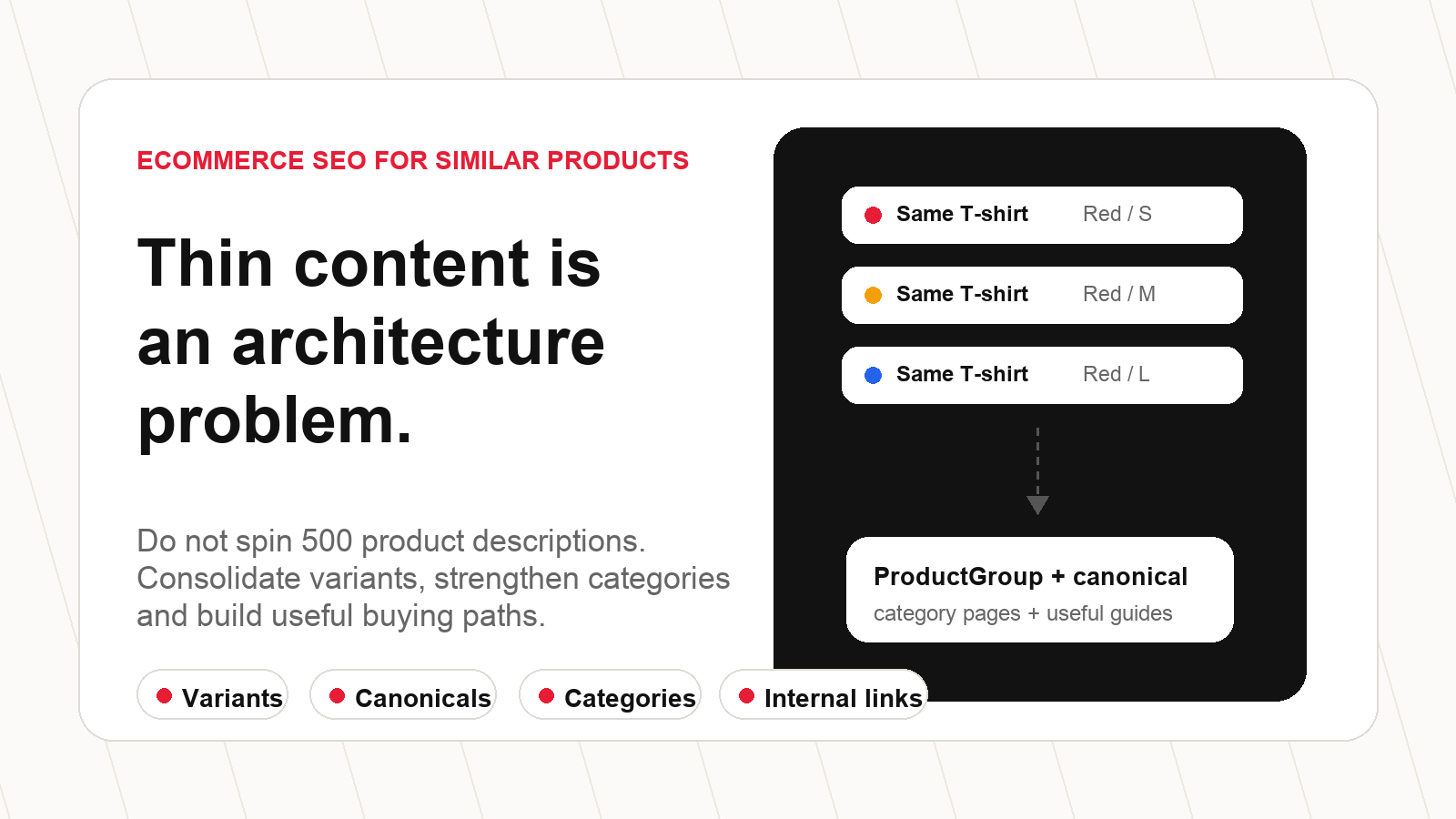
The real problem with thin content on similar product pages
Similar product pages are normal in ecommerce. A clothing store may have one T-shirt in five colors and six sizes. A florist may have bouquets that differ by size, color, occasion or delivery city. A furniture store may sell the same chair in several fabrics. A car parts store may have hundreds of near-identical pages where only compatibility changes. A cosmetics store may have shade variations. A hotel or rental business may have near-identical location/service pages.
The SEO problem appears when each variation becomes a separate indexable URL with almost the same title, description, body copy, images, schema, internal links and user value. Google then sees many pages that are not clearly different. Some may be crawled but not indexed. Some may compete with each other. Some may waste Crawl budget. Some may dilute Internal linking. Some may create Duplicate title and meta problems. And in AI Search environments, the site becomes harder to understand because it looks like a pile of fragments rather than a coherent product catalog.
This is why the Search Engine Journal question is useful: how do you fix thin content across similar product pages? The answer must be practical. You cannot tell a merchant to manually rewrite every SKU. You also cannot publish thousands of spun descriptions and call that “unique content.” Search systems are better than that, and users deserve better than that.
The first decision is editorial and technical: which pages are actually useful as standalone search destinations? Everything else follows from that.
Why this is not just a copywriting task
There is a common bad fix for thin product pages: generate a unique paragraph for every product variation. That may reduce visible duplicate text, but it does not necessarily make the page useful. If a page about “red cotton T-shirt size M” says the same thing as “red cotton T-shirt size L” with slightly different adjectives, the page is still not meaningfully useful as a separate search result.
Google’s canonical guidance is explicit that duplicate or very similar pages can be consolidated through signals such as redirects, canonical annotations and sitemap inclusion. Google also recommends linking internally to the Canonical URL rather than duplicate URLs. In ecommerce, this matters because product variants and faceted URLs can explode into thousands of crawlable pages.
The better question is: what is the page’s unique job?
A product page can be useful when it answers questions that buyers genuinely have: dimensions, materials, delivery, availability, compatibility, warranty, sizing, use cases, care instructions, returns, trust signals, reviews, comparisons, photos, variants and what makes this exact item different. A Category page can be useful when it helps users compare options, understand selection criteria and move toward a decision. A guide can be useful when it explains how to choose. A variant URL is useful only if the variation changes Search intent or buying decisions enough to deserve its own page.
That is the heart of the issue. Thin content is not solved by word count. It is solved by purpose, structure and usefulness.
Weak approach
Every variant gets an indexable page and a generated paragraph. The site looks bigger, but not more useful.
Stronger approach
How to diagnose thin content across product pages
Before changing anything, you need a diagnosis. Ecommerce sites often have several problems at the same time. If you treat all of them as “thin content,” you will make blunt decisions.
Start with indexation data. In Google Search Console, look for product and category URLs that are crawled but not indexed, discovered but not indexed, duplicate without user-selected canonical or indexed despite another canonical preference. These patterns show whether Google is struggling to choose useful URLs.
Review duplicate title and meta clusters. If hundreds of product pages have nearly identical titles and descriptions, the store may be asking Google to choose between pages that are not clearly distinct.
Compare impressions and clicks. Some “thin” product pages may still receive impressions because they match precise long-tail demand. Others receive nothing. Do not apply the same rule to both.
Check crawl paths. If filters, sorting parameters, internal search URLs and variant URLs are heavily linked, Google may spend time on low-value URLs while important categories and guides remain weak.
Audit templates. Sometimes the issue is not the product data but the template. Product pages may hide useful information in tabs, load key details with JavaScript, omit unique specs, lack reviews, or display boilerplate above meaningful content.
Look at internal linking. Are category pages linking to every minor variant? Are related products useful or random? Are guides linking to products and categories? Are product pages linking back to helpful collections?
This is where automation helps. A human can review strategy, but pattern detection across thousands of URLs should not be done manually in spreadsheets forever.
Canonicals, redirects and variant strategy
Canonicalization is one of the most important tools for similar product pages. But it has to be used carefully. A canonical tag is a signal, not a magical command. If the page content, internal links, sitemaps and redirects contradict each other, Google may choose a different canonical.
For product variants, there are several possible models:
One canonical product page with selectable variants. This works well when color, size or small configuration changes do not create separate search intent. The main product page represents the item, and users choose variants on the page.
Separate indexable pages for meaningful variants. This can make sense when variants have distinct demand, different visuals, different use cases or different buyer intent. For example, “white wedding bouquet” and “red roses bouquet” may deserve different pages if the intent and merchandising are genuinely different.
Canonicalized variant pages. If separate URLs are needed for UX or tracking, variants may canonicalize to a main product page when they are not useful as standalone search results.
Redirect deprecated duplicates. If old URLs are obsolete and have no reason to exist, permanent redirects can consolidate signals and improve user experience.
Google’s documentation on product variants also shows that ecommerce sites can use structured data such as ProductGroup in appropriate cases to describe products with variants. That does not replace good architecture, but it can help communicate product relationships when implemented correctly.
The key is consistency. If a page is canonicalized away, do not place it in the sitemap as if it were a primary page. Do not build internal links to the duplicate URL if the canonical URL is the page you want indexed. Do not create category pages that send Google into thousands of parameter combinations.
Strong category pages often fix more than product rewrites
In many ecommerce stores, category pages are more important than individual product pages. A user searching for “black leather office chair” or “birthday flowers Bucharest” often wants to compare options, not land on one SKU immediately. If the category page is weak, the store loses the opportunity to satisfy broader commercial intent.
A strong category page does several jobs. It introduces the selection clearly. It helps buyers understand how to choose. It uses internal links to important subcategories, guides and products. It includes useful filters without creating crawl chaos. It answers practical questions. It shows trust signals. It explains delivery, returns, quality, materials, compatibility or service differences where relevant.
This is not about turning every category into a 2,000-word blog post. That can hurt UX. The goal is useful buying guidance. A flower category can explain occasions, delivery windows, freshness, bouquet sizes and how to choose. A medical supplies category can explain compatibility and safety considerations. A fashion category can explain fit, material and styling. A B2B parts category can explain specs and use cases.
When category pages are strong, product pages do not have to carry the whole SEO burden. The site architecture becomes healthier: category pages target broader demand, product pages target specific items, guides support informational research, and internal links connect the journey.
What useful product content actually looks like
Useful product content is specific. It should help a buyer make a decision. Depending on the product, that may include:
Unique specifications. Size, material, color, compatibility, dimensions, weight, ingredients, certifications, included accessories and technical requirements.
Use cases. Who the product is for, when it is a good fit, when another product is better and what problem it solves.
Comparison context. How this product differs from similar items in the same category.
Buying objections. Delivery time, returns, warranty, safety, installation, maintenance, care instructions and availability.
Trust signals. Reviews, photos, real customer use, expert notes, brand information and clear policies.
Internal links. Links to related guides, collections, alternatives, accessories and parent categories.
For AI search and answer engines, this kind of content is also more extractable. A system can understand what the product is, who it helps, what constraints matter and how it relates to other pages. Generic copy like “high quality product made with care” does very little for humans or AI systems.
In my opinion, the best ecommerce content strategy is not “more text everywhere.” It is “more useful decision support in the right places.”
Filters, facets and crawl waste
Faceted navigation is one of the biggest sources of ecommerce SEO problems. Filters are useful for users, but they can create an enormous number of URLs: size, color, brand, price, rating, availability, material, sorting, pagination and combinations of all of them. If search engines crawl every combination, the site can waste crawl budget and generate thin or duplicate pages.
Google’s documentation on faceted navigation explains why uncontrolled faceted URLs can cause crawling issues. The fix depends on the site. Some filtered pages may deserve indexation if they match real demand and have useful content. Many should not be indexable. Some should be blocked, canonicalized, noindexed or handled through URL design and internal linking choices.
For example, a page for “red roses delivery Bucharest” may be valuable. A URL like `?color=red&sort=price-desc&page=7&availability=instock` probably is not. The job is not to kill all filters. The job is to decide which filtered combinations are search landing pages and which are merely user interface states.
This is another place where manual SEO struggles at scale. A store with thousands of products and dozens of filters needs rules, monitoring and repeatable execution, not occasional spreadsheet cleanup.
Structured data helps, but it cannot rescue weak pages
Product structured data can help Google understand product information such as name, image, description, offers, availability, price, ratings and variants. For variant-heavy products, Google’s product variant guidance and ProductGroup patterns can be useful when the implementation matches visible content and real product relationships.
But structured data is not a substitute for useful pages. If the visible page is thin, confusing or duplicated, schema alone will not make it valuable. Structured data should support the page, not pretend the page contains information it does not show.
The safest approach is simple: keep product data accurate, visible and consistent. Mark up what users can see. Keep prices and availability current. Avoid duplicate or conflicting schema from multiple plugins. Make sure canonical URLs, structured data URLs and sitemap URLs agree.
On WordPress and WooCommerce sites, duplicate schema is very common because themes, SEO plugins, review plugins and ecommerce extensions may all output markup. This can create messy signals. It is worth auditing, especially when product pages already have thin or duplicate content problems.
A practical execution workflow
Here is a realistic workflow for fixing thin content across similar product pages:
1. Segment the catalog. Group products by template, category, variant type, traffic, indexation status and business importance.
2. Identify indexable winners. Decide which product, category, subcategory and guide pages deserve to be primary search destinations.
3. Consolidate near-duplicates. Use canonical tags, redirects or variant selectors where appropriate. Remove duplicate URLs from sitemaps and internal links.
4. Strengthen categories. Add useful buying guidance, internal links, FAQ sections where genuinely helpful and clear commercial information.
5. Improve product templates. Add fields that create useful specificity: specs, use cases, comparisons, policies, reviews, delivery and compatibility.
6. Control faceted navigation. Decide which filter URLs can be indexed and which should not be crawl priorities.
7. Fix structured data. Ensure Product, Offer, AggregateRating and ProductGroup markup match visible content and do not conflict.
8. Monitor Search Console. Watch indexation, impressions, duplicate canonical reports, crawl behavior and landing-page performance after changes.
9. Refresh continuously. Ecommerce catalogs change. Products go out of stock, categories shift, demand changes and new queries appear. Thin content fixes are not a one-time project.
Manual workflow
Export URLs, inspect spreadsheets, write recommendations, wait for implementation and hope nothing breaks.
AYSA workflow
Where AYSA fits
AYSA is not designed to create random ecommerce text at scale. The point is more useful than that: turn SEO research into approved execution. For thin content across similar product pages, AYSA can help identify duplicate patterns, weak categories, low-value indexed pages, missing internal links, schema opportunities, canonical conflicts and content gaps.
Then the agent can prepare specific actions: consolidate variant URLs, improve category copy, generate useful product content briefs, recommend internal links, flag filters that waste crawl, prepare FAQ content where it helps buyers, and identify pages that should not compete in the index. The user remains in control. Sensitive changes are presented for approval before execution.
This matters for SMEs because ecommerce SEO is usually not blocked by a lack of advice. It is blocked by execution capacity. Store owners know products change. Agencies know catalogs are messy. Developers have queues. Content teams cannot rewrite hundreds of pages by hand. The winning system is not another dashboard. It is a workflow that turns diagnosis into safe, approved action.
Thin content is not a shameful problem. It is a normal symptom of ecommerce growth. The mistake is letting it become permanent.
Less SEO work. More organic growth.
Fix ecommerce thin content with approved execution, not content spam.
AYSA monitors product pages, categories, canonicals, internal links and AI visibility signals, then prepares useful website improvements for approval and execution.
Sources
Continue the AI search topic inside AYSA.
Use these pages to connect the article with AI SEO tools, AI visibility monitoring, AI Overviews and approved website execution.
Turn this topic into a website action plan.
Use these AYSA hubs to move from reading to technical fixes, AI visibility monitoring, research, glossary context and approval-first SEO execution.

