
Fresh Content SEO: What to Update, What to Leave Alone and What AYSA Should Execute
A practical AYSA guide to fresh content SEO: when updates matter, how to spot content decay, and how SMEs can turn refresh opportunities into approved execution.
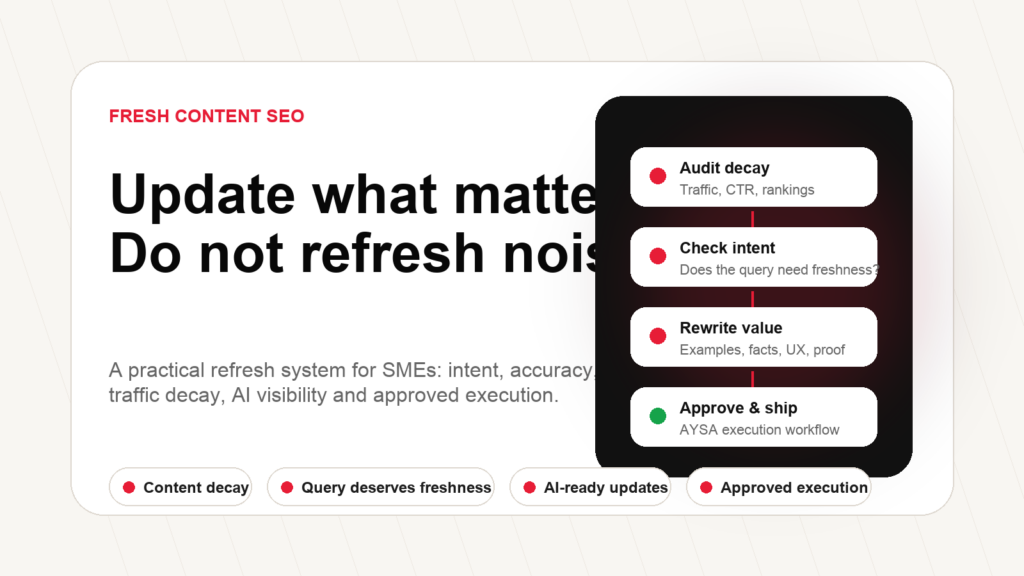
Executive summary: Fresh content is not a magic ranking trick. Updating a date, adding a paragraph or changing a few words does not automatically make a page more useful. Freshness matters when the user intent demands recent, accurate or changing information: prices, tools, regulations, product availability, medical guidance, local recommendations, algorithm updates, ecommerce policies, AI Search changes and market comparisons.
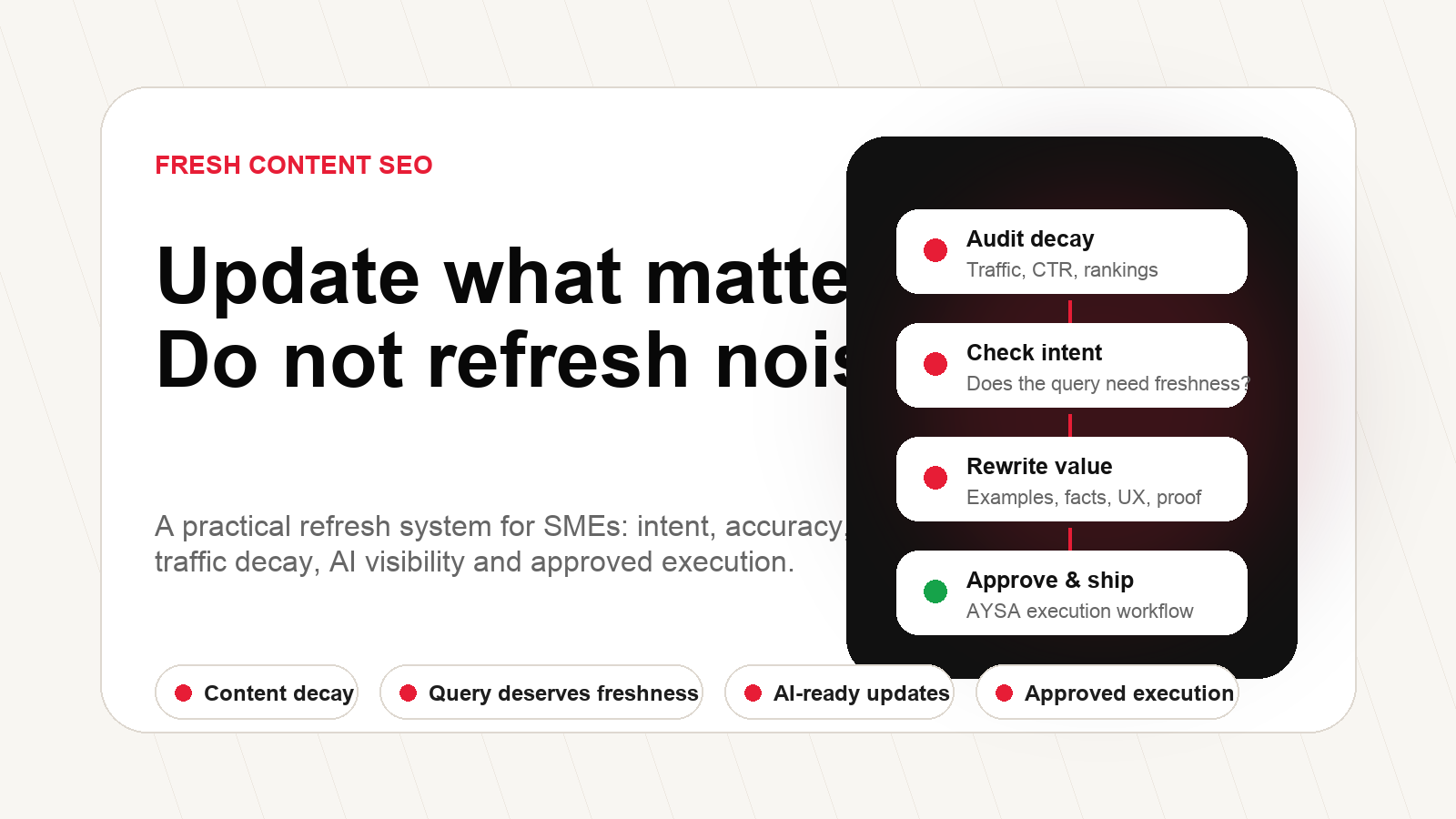
The real opportunity for SMEs is not “publish more.” It is building a refresh system: find pages losing Impressions, rankings or conversions; check whether the Query Deserves Freshness; update facts, examples, structure and proof; improve internal links; add answer-ready sections; then approve and execute the change. That is where AYSA fits: Monitoring Content decay, preparing useful updates and turning them into approved Website Execution.
What fresh content really means
The phrase “fresh content” is often misunderstood. Some teams think it means publishing new blog posts every week. Others think it means changing the publication date. Some add a few random paragraphs to old posts and hope Google notices. That is not a strategy. It is maintenance theater.
Fresh content is content that remains accurate, useful and competitive for the user’s current need. Sometimes that means a brand-new page. Sometimes it means a full rewrite. Sometimes it means adding updated examples, prices, screenshots, product details, regulatory context, internal links, expert commentary, FAQs, schema and conversion paths. Sometimes it means deleting or consolidating weak pages because they no longer deserve to exist as separate URLs.
The key question is not “is this page old?” The key question is: would the user be worse served if this page did not reflect the current reality?
A page about “how to ask for Google reviews” should be updated when Google changes review policies, local business behavior shifts or new practical examples appear. A page about “best SEO Automation tools” should be updated because tools, pricing, AI features and market positioning change quickly. A page about “what is a Canonical tag” may not need constant rewriting if the explanation is still correct, but it may benefit from better examples or links to related concepts.
Freshness is not one thing. It is a relationship between user intent, topic volatility and business value.
Why freshness is not a ranking trick
Google has long recognized that some queries deserve fresher results than others. News, trending topics, recurring events, products, reviews, laws, pricing and fast-changing industries naturally require recency. Other queries are more stable. A user searching for “what is HTTPS” or “what is a 301 redirect” probably needs clarity and accuracy more than yesterday’s timestamp.
This is why blindly refreshing every page is a poor use of time. It can also damage quality. If an update adds fluff, weak AI text, irrelevant sections or fake “updated for 2026” wording, the page may become less useful. Freshness should improve the answer, not decorate it.
Google’s guidance on helpful content asks whether pages are made primarily for people and whether visitors would leave satisfied. That is the standard to apply to refresh work. Did the update make the page more useful? Did it fix outdated information? Did it improve the user’s ability to decide? Did it add first-hand experience, examples, clearer structure or better evidence? Did it remove confusion?
For SMEs, this matters because content teams and agencies often overproduce. They publish more pages than the business can maintain. After a year, the site has dozens or hundreds of pages with old screenshots, outdated claims, broken links, old pricing, thin explanations and stale CTAs. The problem is not lack of content. It is lack of content governance.
Which pages deserve freshness?
The best content refresh programs start with prioritization. Not every page deserves the same attention. A good refresh candidate usually has at least one of these signals:
- Traffic decay: organic clicks or impressions are declining compared with the previous period.
- Ranking loss: the page dropped for important queries or lost visibility to newer competitors.
- CTR weakness: impressions remain healthy, but the title, meta description or SERP positioning no longer earns clicks.
- Business value: the page supports leads, bookings, revenue, ecommerce conversions or sales conversations.
- Topic volatility: the subject changes often, such as AI search, SEO tools, Google updates, pricing, compliance or technology.
- Intent drift: the search results have changed because users now expect a different type of answer.
- Missing proof: competitors include examples, screenshots, templates, data or expert commentary that your page lacks.
- AI visibility gaps: the brand or page is not easy to identify, cite, summarize or recommend in AI-assisted search.
Some pages should be updated frequently. Examples include ecommerce category guides, product comparisons, “best tools” pages, local service pages, medical or legal informational pages, AI search explainers, SEO trend articles and content tied to changing platforms.
Other pages may need less frequent updates but still require quality control. Glossary pages, evergreen tutorials, service pages and foundational explainers should be checked for accuracy, internal linking, examples and structured clarity, not rewritten just to look new.
How to detect content decay
Content decay is not always obvious from traffic alone. A page can decay slowly. Impressions may fall before clicks. CTR may drop while rankings remain stable. Conversions may decline because the page no longer answers the buyer’s current objections. AI search may start citing competitors even though classic rankings still look acceptable.
A practical decay audit should look at multiple signals:
- Google Search Console clicks, impressions, CTR and average position;
- query-level changes, especially new queries that the page almost answers;
- top competing pages and what they now include;
- internal links pointing to and from the page;
- broken links, outdated screenshots, outdated examples and weak CTAs;
- ranking changes for commercial terms;
- conversion behavior in analytics;
- AI visibility signals such as mentions, citations or answer inclusion where measurable.
The best refresh opportunities are often pages with strong impressions but weak clicks, pages that rank between positions 4 and 15, pages that used to convert but have become stale, and pages that cover important business topics but lack current proof.
For example, a flower shop article about “flowers for Valentine’s Day” deserves seasonal updates, product availability, delivery deadlines, local modifiers, fresh imagery and clear ordering CTAs. A clinic page about pediatric services may need updated doctors, booking options, reviews, emergency guidance and insurance/payment clarity. A SaaS article about AI Mode must be updated when Google changes the interface, documentation or availability.
A practical content refresh framework
A useful refresh process should be simple enough to repeat and strict enough to prevent noise.
1. Diagnose the page. Identify whether the issue is traffic decline, CTR weakness, outdated facts, poor intent match, weak conversion, thin examples, technical problems or lack of authority.
2. Re-check the search intent. Search results change. A keyword that used to reward a short guide may now reward comparison pages, product grids, local results, video, Reddit discussions, expert opinions or AI summaries. Before rewriting, understand what the user now expects.
3. Update facts and proof. Replace outdated claims, add current examples, update screenshots, cite reliable sources, include real business context and remove unsupported statements.
4. Improve structure. Add clearer headings, summary sections, comparison tables, step-by-step guidance, examples, FAQs where useful and internal links to related pages. Make the page easier to scan and easier for AI systems to extract.
5. Strengthen conversion paths. A refreshed page should not only rank. It should help the user act. Add appropriate CTAs, product links, service links, booking paths, pricing clarity or next steps.
6. Update metadata and schema carefully. Improve title tags and meta descriptions for CTR. Use structured data only when it matches visible content. Do not add fake FAQ schema or unsupported markup.
7. Re-submit and monitor. After publishing, monitor impressions, clicks, CTR, rankings, conversions and AI visibility signals. A refresh is not complete until you measure whether it helped.
Weak refresh
Change the date, add generic paragraphs, keep old examples and hope Google rewards freshness.
Useful refresh
Match current intent, update facts, add proof, improve structure, strengthen links and ship approved changes.
Freshness in AI search, AEO and GEO
Freshness becomes more complex in AI search because users may not click the source immediately. They may ask an AI assistant for a summary, comparison, recommendation or next step. If your content is outdated, unclear or poorly structured, it becomes harder to cite or recommend.
AI systems need content that is current enough for the question, clear enough to extract and trustworthy enough to reference. This does not mean every page needs daily updates. It means pages should be maintained according to topic volatility and business importance.
For AI visibility, useful refresh work often includes:
- adding concise definitions near the top of the page;
- turning vague claims into specific examples;
- clarifying entities such as brand, service area, product type, audience and use case;
- adding comparison criteria;
- improving internal links between related topics;
- updating author, review and credibility signals;
- making content easier to quote, summarize and verify;
- connecting content to product feeds, local profiles and structured data when relevant.
This is where traditional content refresh and AI search optimization overlap. A page that is more accurate, better structured and more helpful for users is also more likely to be useful as a source for AI-assisted answers.
The AYSA view: fresh content should become approved execution
From the AYSA perspective, the hard part of fresh content is not knowing that old pages should be reviewed. The hard part is operationalizing the review. Most SMEs do not have time to monitor every page, compare Search Console trends, inspect competitors, rewrite content, update metadata, check schema and track results.
AYSA is designed to help with that execution gap. It can monitor website and search signals, detect pages that may need updates, prepare improvement actions, explain the reason, ask for approval and execute accepted changes inside the website workflow.
That means a business owner does not need to ask, “Which pages should I refresh this month?” AYSA can surface candidates: pages losing CTR, pages with outdated examples, pages missing answer-ready sections, pages with weak internal links, pages that need technical cleanup, and pages where AI visibility signals suggest the brand is not easy to identify or recommend.
In my opinion, the winning content teams in 2026 will not be the ones publishing the most. They will be the ones maintaining the most useful content system. Freshness will not be a cosmetic layer. It will be a workflow: monitor, decide, improve, approve, publish and measure.
Fresh content should not mean more busywork
If your old pages are losing traffic, do not just change the date. Let AYSA prepare the work.
AYSA monitors content decay, SEO and AI visibility signals, prepares refresh actions, asks for approval and executes accepted changes inside your website workflow.
Sources and further reading
This article was inspired by Semrush’s article on fresh content and cross-checked against Google Search Central guidance on creating helpful, reliable, people-first content, Google’s guidance on ecommerce search documentation, and Google’s AI features optimization guide. The AYSA sections are our editorial and product perspective. We do not claim guaranteed rankings, guaranteed AI citations or guaranteed traffic recovery.
Continue the AI search topic inside AYSA.
Use these pages to connect the article with AI SEO tools, AI visibility monitoring, AI Overviews and approved website execution.
Turn this topic into a website action plan.
Use these AYSA hubs to move from reading to technical fixes, AI visibility monitoring, research, glossary context and approval-first SEO execution.

