
Google Says AI Search Is Still SEO. That Is True, But Not Enough.
Google's AI Search guidance is useful, but incomplete as a full operating model. Here is what SMEs need to understand about SEO, AEO, GEO, citations and approved execution.
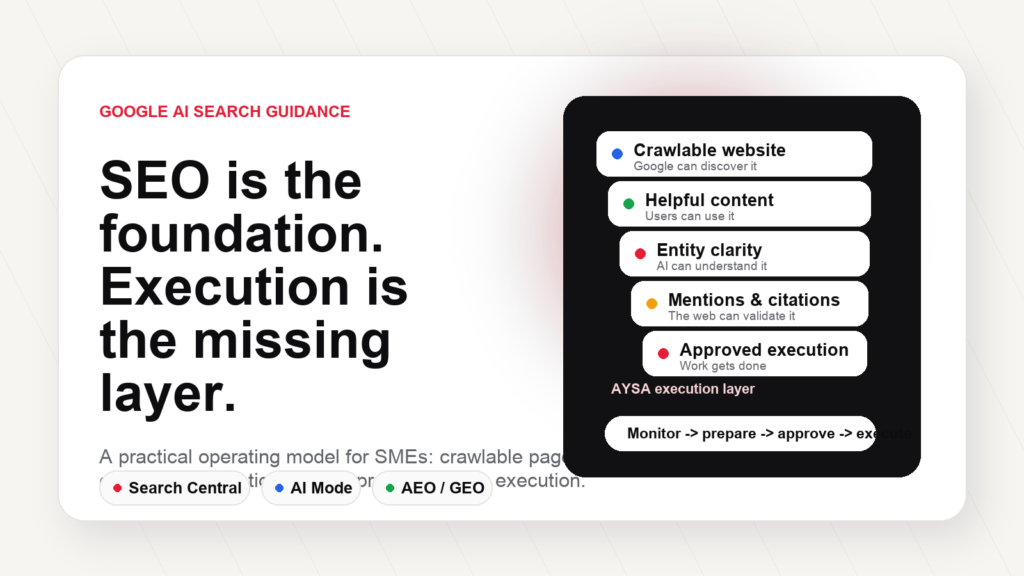
Executive summary: Google’s new guidance for generative AI features says the fundamentals of SEO still matter. That is true. But it is not enough for companies that now need visibility across AI Overviews, AI Mode, ChatGPT, Copilot, Perplexity and other answer surfaces. The practical question is not whether AI Search is “still SEO.” The practical question is whether your website, your content, your Brand Mentions and your execution workflow are ready for systems that retrieve, synthesize and cite information differently from classic search results.
In my opinion, the best reading is this: SEO remains the foundation, but AI visibility adds a new operating layer. SMEs should not chase gimmicks. They should build useful pages, clean technical infrastructure, clear entity signals, trusted references and a repeatable way to turn findings into approved website changes. That is exactly where AYSA.ai fits.
Why this debate matters
Google’s official documentation for generative AI search has given the SEO industry a useful reference point. It states that AI Overviews and AI Mode are grounded in Google’s core Search systems, and that foundational SEO practices remain relevant for generative AI features. That is important because it prevents the worst kind of AI-search panic: the idea that every website suddenly needs a strange new file, a secret markup trick or hundreds of pages written only for machines.
But the debate became more interesting after Mike King published his iPullRank analysis, arguing that Google’s guidance is too narrow and too self-serving. I do not think the useful conclusion is “Google is wrong” or “iPullRank is right.” The useful conclusion is that both positions describe different parts of the same reality.
Google is describing how to be eligible and useful inside Google’s own AI search experiences. That matters. Google still owns enormous demand. AI Overviews and AI Mode still depend heavily on Crawlability, Indexing, content quality, page experience and Google’s ability to understand the page. But a business owner does not live inside one Google document. Their brand can be discovered in Google, cited in Copilot, summarized in ChatGPT, compared in Perplexity, discussed on Reddit, evaluated in reviews and referenced in publications. Those systems do not all expose the same metrics, use the same infrastructure or reward the same signals.
That is the gap. The SEO fundamentals remain necessary. They are not the full operating model anymore.
What Google gets right
Google’s official guide to optimizing for generative AI features makes several points that website owners should take seriously.
First, eligibility starts with the basics. A page needs to be crawlable, indexable and eligible to appear with snippets. Google says its generative AI features rely on core Search ranking and quality systems, including retrieval-augmented generation and query fan-out. In plain language: if Google cannot discover, index, understand and trust your page, you have a visibility problem before the AI layer even starts.
Second, Google pushes against commodity content. This is a healthy correction. A page that simply rewrites what every competitor already says is weak in classic SEO and even weaker in AI search. AI systems can summarize generic content very easily. They need distinctive information, specific examples, clear evidence and useful structure if your page is going to be a good source.
Third, Google is right to warn against creating pages for every possible query variation. In AI Mode, one user question may trigger a set of related subqueries. If every fan-out angle becomes a thin landing page, the website becomes worse, not better. SMEs do not need one hundred shallow articles. They need fewer, stronger pages that answer real questions completely and clearly.
Fourth, Google is right that there is no magic schema for AI Overviews. Structured data remains useful when it accurately describes visible content, but it is not a special AI-visibility shortcut. The same applies to many tactical debates: no file or label can compensate for weak content, poor technical health or unclear business information.
Still essential. But the user journey is no longer only ten blue links and a landing page click.
Your content must be easy to understand, verify, mention, compare and execute against.
What Google does not solve
The limitation is not that Google’s guidance is useless. The limitation is that it is Google guidance. It tells you what Google wants site owners to know about Google Search. It does not give a full model for AI visibility across the broader discovery environment.
That matters because AI search changes the unit of competition. In classic SEO, you often competed page against page. In AI search, you may compete fact against fact, passage against passage, brand mention against brand mention, review against review and source against source. The model may not need your whole page. It may retrieve a paragraph, compare it with several other passages, then synthesize a response in which your brand is named, ignored or used only as background evidence.
Google’s guide says you do not need to write in a special way for generative AI search. As a warning against awkward keyword stuffing, that is sensible. But as a complete editorial strategy, it is too soft. A business page should be written for humans, but it should also be structured so machines can identify the entity, the offer, the location, the evidence, the constraints and the next step. That is not spam. That is clarity.
A page for a private medical clinic should not only say “we provide quality healthcare.” It should explain specialties, doctors, location, appointment process, insurance or payment context, emergency limitations, patient journey, reviews and practical decision criteria. A page for ecommerce should not only say “fast delivery.” It should make shipping, returns, product data, availability, reviews, comparisons and support information legible. This is useful for people and machine systems at the same time.
The same applies to off-site signals. Google can tell you not to chase inauthentic mentions. Correct. But real mentions, citations, reviews, expert references, publisher coverage and community discussions are now more important, not less. AI answers often blend owned content with third-party validation. A brand with clean website copy but no external footprint can still look weak compared with a competitor that is referenced consistently across trusted sources.
The Bing contrast
The contrast with Microsoft/Bing is useful because it shows how quickly the measurement layer is changing. In February 2026, Bing described grounding as the layer that connects AI systems to current, authoritative information and argued that agents increasingly browse on behalf of users. Microsoft also introduced AI Performance in Bing Webmaster Tools, showing citation activity, cited pages and grounding queries across supported AI experiences.
This is a big conceptual shift. Classic Search Console tells you about impressions, clicks, queries and positions. AI visibility tools are starting to ask different questions: which pages are cited? Which phrases triggered retrieval? Which sources are repeatedly used? Which facts are clear enough to support an answer? These are not vanity metrics. They are early signs of how AI systems see the website.
Microsoft’s later post on the evolving role of the index makes the difference even clearer: traditional search asks which pages a user should visit; grounding asks what information an AI system can responsibly use to construct an answer. That distinction should change how we think about content quality. A good page is not only rankable. It is also a reliable source of discrete, verifiable, up-to-date information.
This does not mean every SME needs an enterprise GEO team. It means the old model of “publish content, check rankings, wait” is weaker than it used to be. The new model requires monitoring, evidence, structure and execution.
The SME operating model for AI search
For SMEs, the answer should not be more complexity. Most business owners do not have time to follow every Search Central update, every LinkedIn debate, every AI Mode test and every new measurement tool. They need a practical operating model.
In my opinion, that model has five layers.
1. Technical access. The website must be fast, crawlable, indexable and stable. Broken redirects, duplicate canonicals, blocked content, heavy JavaScript and poor mobile performance reduce both classic SEO and AI search readiness.
2. Useful, specific content. Pages should answer real buyer questions with concrete details. The goal is not to write more. The goal is to make each important page more useful than a generic competitor page.
3. Entity clarity. AI systems need to understand who the business is, what it offers, where it operates, who it serves and why it should be trusted. This includes business profile information, schema where appropriate, consistent naming, clear service pages and strong internal linking.
4. Authority and validation. The brand needs credible signals beyond its own website: reviews, references, articles, publisher mentions, partnerships, citations and relevant links. This is not about buying noise. It is about building a verifiable footprint.
5. Approved execution. Insights do not matter if nobody implements them. This is where many SEO projects fail. The audit is done, the recommendations are written, the dashboard looks impressive, and then nothing changes on the website for weeks.
The last layer is the one people underestimate. AI search is moving too quickly for quarterly SEO decks and manual copy-paste workflows. If the site needs a title rewrite, an internal link, a schema improvement, a missing FAQ section, a redirect, a content refresh or an authority-building review, the work has to move from detection to approved execution quickly.
Where AYSA fits
AYSA.ai is built for this exact gap. It does not treat SEO, AEO and GEO as separate slogans. It treats them as a continuous workflow: understand the business, monitor the website and Google data, identify opportunities, prepare the work, ask for approval and execute accepted changes inside the website workflow.
That matters for SMEs because most companies do not lose because they lack reports. They lose because the work is not done consistently. The meta title is still weak. The service page still lacks proof. The internal links are still missing. The content plan is still in a spreadsheet. The Google Business Profile signals are still incomplete. The technical issue was noticed but not prioritized. The authority opportunity was discussed but never approved. The page that should explain the business still sounds like every other page in the market.
AYSA’s position is not “ignore Google’s guidance.” It is the opposite. Use the guidance, but turn it into action. Make the website technically accessible. Make the content genuinely useful. Make the business entity clear. Build authority carefully. Monitor AI visibility and answer readiness. Then execute the approved work instead of letting recommendations sit in a deck.
This is why the phrase “still SEO” can be both true and incomplete. The foundation is still SEO. The operating system is now broader: SEO plus AEO, GEO, AI visibility, entity clarity, authority building and approved execution.
What I would do next if I owned an SME website
I would not start by creating an llms.txt file, rewriting every page for AI or buying a random AI visibility report. I would start with the business pages that matter most: homepage, key service pages, category pages, local pages, product pages and important articles.
For each one, I would ask:
- Can Google and AI crawlers access and understand the page?
- Does the page answer the real decision-making questions a customer has?
- Does it include clear evidence, examples, location, pricing context or process details where relevant?
- Does it connect to related pages through useful internal links?
- Does the brand have external proof that supports the claims made on the page?
- Are there measurable opportunities from Search Console, Analytics, rankings, reviews or AI visibility checks?
- Who is responsible for turning the findings into website changes?
If the answer to the last question is “nobody,” then the strategy is already broken. The future of SEO is not only better analysis. It is better execution.
Turn Google guidance into approved website execution.
If you are tired of reading what should be fixed but nothing changes on the website, AYSA can help monitor, prepare, explain and execute approved SEO, AEO and AI visibility actions inside your website workflow.
Sources and further reading
- iPullRank: Google’s Guidance on AI Search is Naive and Self-Serving
- Google Search Central: Optimizing your website for generative AI features on Google Search
- Google Search Central: AI features and your website
- Google Blog: AI Mode and AI Overviews updates
- Bing Search Blog: Elevating the Role of Grounding on the AI Web
- Bing Webmaster Blog: Introducing AI Performance in Bing Webmaster Tools
- Bing Search Blog: Evolving role of the index
Continue the AI search topic inside AYSA.
Use these pages to connect the article with AI SEO tools, AI visibility monitoring, AI Overviews and approved website execution.
Turn this topic into a website action plan.
Use these AYSA hubs to move from reading to technical fixes, AI visibility monitoring, research, glossary context and approval-first SEO execution.

