
Google’s AI Search Box Changes SEO More Than Rankings
Google says its new AI-powered Search box is the biggest upgrade to Search input in more than 25 years. Here is what it means for SEO, AEO, AI Mode and SME websites.
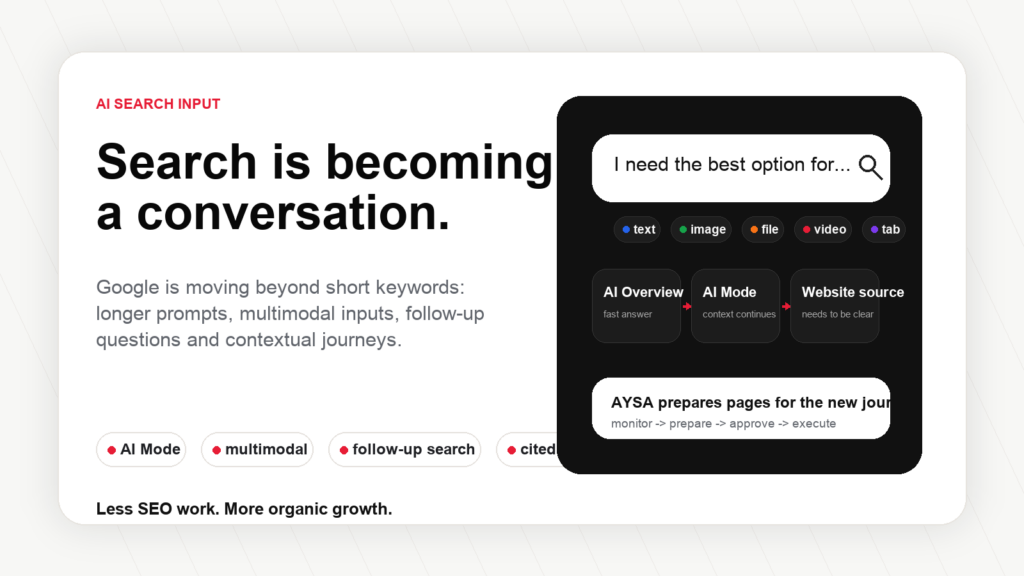
Executive summary: Google’s new AI-powered Search box is not just a cosmetic change. It moves the starting point of search from short keywords toward longer, richer, multimodal prompts. For businesses, that means SEO has to evolve from ranking for isolated terms to helping websites become understandable, useful and executable across classic Search, AI Overviews and AI Mode.
For SMEs, this is both a threat and an opportunity. The threat is obvious: if your website only targets old Keyword patterns, AI-driven journeys may skip over you. The opportunity is better: a well-structured website with clear answers, visible proof, strong entities, useful service pages and continuous execution can become easier for AI-assisted Search to understand, cite and recommend.
What Google announced
At Search I/O 2026, Google described a new AI-powered Search box as the biggest upgrade to the Search box in more than 25 years. The important part is not only that Google is adding AI to results. The more structural change is that Google is changing the way people begin a search.
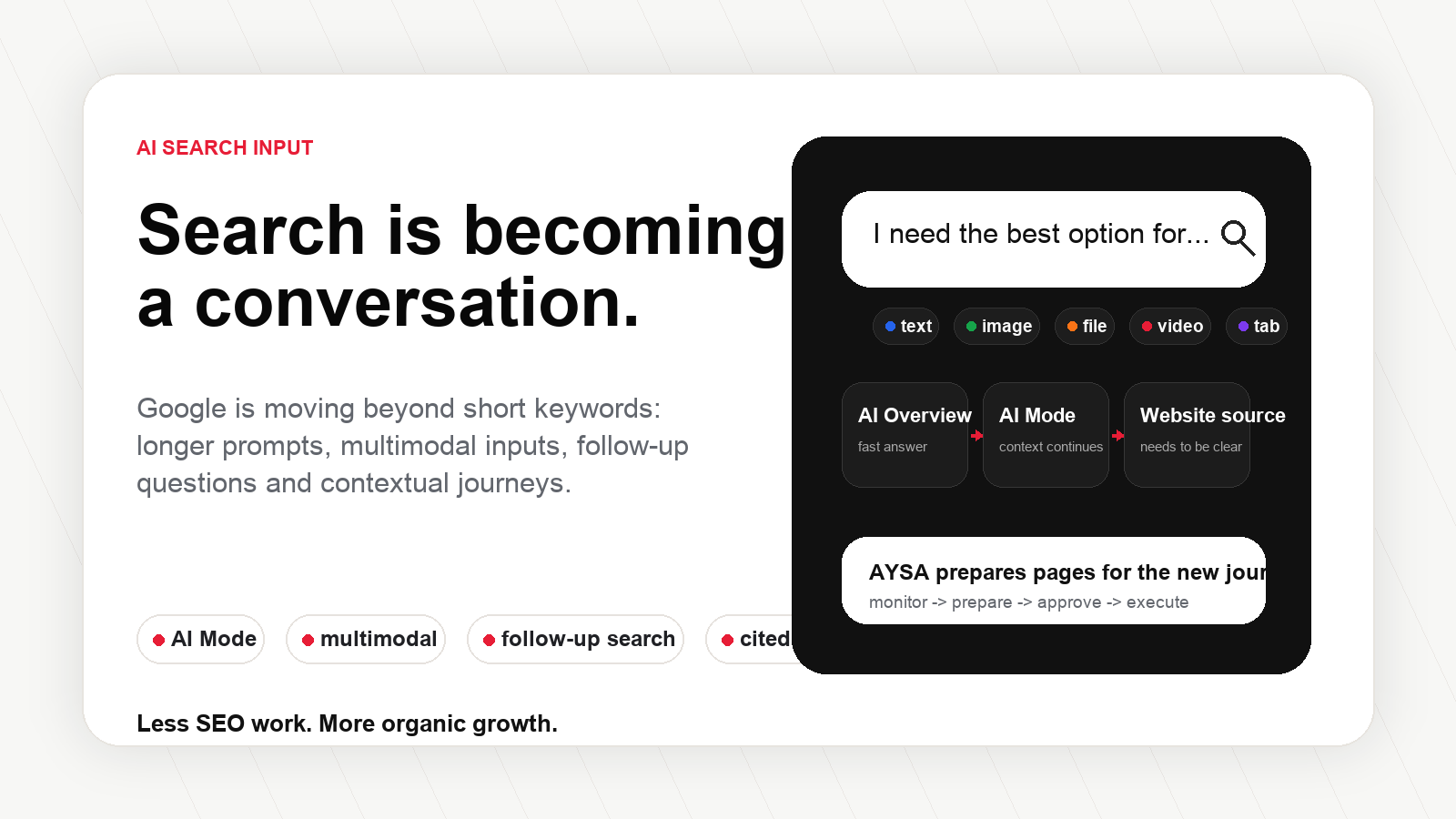
According to Google, the new Search box can expand dynamically so people can describe what they need in more detail. It can suggest better ways to ask, beyond traditional autocomplete. It can support text, images, files, videos and Chrome tabs as input. It also lets users move from AI Overviews into AI Mode and continue with follow-up questions while context is preserved.
Google also says Search will still show a range of results. That matters. The web is not disappearing from the journey. But the journey is becoming more conversational, more contextual and less dependent on the old habit of typing two or three keywords and scanning ten blue links.
In a related AI Mode update, Google said AI Mode has passed more than 1 billion monthly users and that AI Mode queries are about three times longer than traditional searches. That is the clearest signal in the announcement: user behavior is changing at the input layer, not only at the results layer.
Why this matters for SEO
Traditional SEO was built around a familiar ritual: a user types a query, Google returns a results page, the user Clicks a link, and the website receives a visit. That still exists, but it is no longer the full picture.
The new behavior is closer to a conversation. A user might ask: “I need a pediatric clinic in Bucharest for a toddler with recurring fever, preferably private, good reviews, easy parking and online booking. What should I compare?” That is not a keyword. It is a task. It includes location, urgency, review signals, logistics, service expectations and decision criteria.
For a website to compete in that environment, it cannot only have a page titled “Pediatric clinic Bucharest.” It needs content that answers how to choose, when to seek urgent care, what services are available, what trust signals matter, where the clinic is located, how appointments work and what parents should know before visiting. The same applies to ecommerce, legal services, florists, hotels, car rental, parking, SaaS and almost every SME category.
Google’s direction makes weak SEO harder to hide. Thin pages, generic copy, disconnected FAQs, vague service descriptions and unstructured content become less useful when the search system can understand richer intent. A business does not need more “SEO tricks.” It needs clearer, more complete and better connected website information.
From keywords to prompts
The biggest practical change is that more searches will look like prompts. A prompt is longer, messier and closer to how a real person explains a problem. That means SEO teams should stop thinking only in exact-match keyword groups and start thinking in user tasks.
A keyword like “best SEO tools” can become a prompt like: “I run a small ecommerce store, I do not have an SEO specialist, I need something that tells me what to fix and can help apply changes after approval.” A keyword like “Technical SEO audit” can become: “My WordPress site is slow on mobile, Google is not Indexing some pages, and I do not know which fixes matter first.”
Those longer requests create different expectations. The page has to help the system answer the task, not just match the phrase. It should include definitions, examples, comparisons, steps, limitations, visible proof, related questions, Entity Clarity and internal links to deeper pages.
This does not mean keywords are dead. Keywords are still useful evidence of demand. But keywords are becoming ingredients in a broader intent model. The winning content strategy will connect keywords to tasks, tasks to pages, pages to entities and entities to proof.
Multimodal search changes what “content” means
Google’s announcement also points to a more multimodal search environment. If users can search with text, images, files, videos or browser context, then website content has to be useful beyond a single article body.
For ecommerce, product feeds, product pages, images, reviews, availability, pricing, shipping and return details become part of machine readability. For local businesses, location pages, Google Business Profile consistency, opening hours, service areas, parking information, reviews and appointment workflows matter. For publishers, clear authorship, topical coverage, citations and update history matter. For SaaS, product pages, documentation, comparison pages, pricing, security pages and use cases become discoverability assets.
Images and videos should not live as isolated decoration. They need surrounding context, alt text where appropriate, captions, transcripts or summaries, and pages that explain what the asset means. Structured data can help when it matches visible content and follows Google’s policies, but it cannot compensate for thin or unclear pages.
The SEO and AEO impact
Google’s official guidance for AI features keeps repeating a familiar idea: create helpful, reliable, people-first content and make sure Google can access and understand it. The difference in 2026 is that “understand it” now has more layers. Classic crawlability and indexability still matter. So do clear answers, entity consistency, structured content, topical coverage, authority signals and user proof.
That is where SEO, AEO and AI visibility meet. SEO helps a page be found and ranked. AEO helps a page answer questions clearly. GEO and AI visibility work focus on whether a brand, product or page can be understood and cited in generated answers. None of these replace the others. They stack.
The danger is treating AI search as a separate magic channel. It is not. AI search still depends on accessible pages, clear information architecture, trustworthy sources and useful content. If the site has weak service pages, poor internal links, duplicate content, slow mobile performance or vague business information, AI visibility work will sit on a weak base.
Old search behavior
- Short keyword query
- Scan blue links
- Click one result
- Repeat search if the result is incomplete
AI-assisted search behavior
- Longer natural-language task
- AI Overview gives a starting answer
- AI Mode continues with follow-ups
- Sources are selected for clarity, usefulness and relevance
What SMEs should do now
Most SMEs do not need to panic and rebuild everything. They need a practical operating model. The first step is to audit whether the website can answer real customer questions, not only rank for keywords.
Start with the pages that matter most commercially: homepage, service pages, product/category pages, location pages, pricing, FAQs, about page, case studies, reviews and contact flows. Then ask whether those pages are clear enough for a person and structured enough for a machine.
Here is the practical checklist:
- Make important pages crawlable, indexable and included in the sitemap.
- Write service and product pages around real decisions, not generic descriptions.
- Add visible FAQs only where they genuinely help the user.
- Use internal links to connect related topics, services, examples and glossary terms.
- Clarify entities: brand, founder, locations, products, integrations, industries and proof.
- Improve titles and meta descriptions for clarity, not keyword stuffing.
- Add structured data only when it matches visible content.
- Monitor Search Console data for impressions, CTR, indexing drift and page opportunities.
- Review AI visibility: where the brand is mentioned, cited, missing or misrepresented.
- Turn recommendations into approved execution, not another report that nobody implements.
The last point is the hardest. Many businesses already know they need better content, faster pages, cleaner technical SEO and stronger topical coverage. The blocker is execution. That is why the AI Search box announcement should be read as an execution warning, not only a technology update.
Where AYSA fits
AYSA is built for the shift from search reports to approved website execution. If search behavior becomes longer, more contextual and more AI-assisted, websites need a system that can keep improving continuously.
AYSA monitors SEO, AEO and AI visibility signals, finds opportunities, prepares website actions, explains why they matter, asks for approval and executes accepted changes inside the website workflow. For a non-specialist, that means less time trying to interpret SEO dashboards and more time approving work that can actually move the site forward.
In this new Search environment, a business owner should not have to become an SEO engineer, AEO specialist, schema expert, content strategist and technical auditor at the same time. The business owner should understand the recommendation, approve the important work and stay in control. The agent should do the heavy lifting.
That is the point of AYSA: less SEO work, more organic growth, with approval before execution.
Sources and further reading
Search is becoming conversational. Your website should be ready.
If users ask deeper questions, AYSA helps your website give better answers.
AYSA monitors SEO, AEO and AI visibility signals, prepares approved website improvements and executes accepted changes without turning the owner into an SEO specialist.
Continue the AI search topic inside AYSA.
Use these pages to connect the article with AI SEO tools, AI visibility monitoring, AI Overviews and approved website execution.
Turn this topic into a website action plan.
Use these AYSA hubs to move from reading to technical fixes, AI visibility monitoring, research, glossary context and approval-first SEO execution.

