
Google March 2026 Core Update: What Changed and What SMEs Should Do Next
A practical AYSA analysis of Google’s March 2026 core update: source-type shifts, winners and losers, AI search implications and an execution workflow for SMEs.
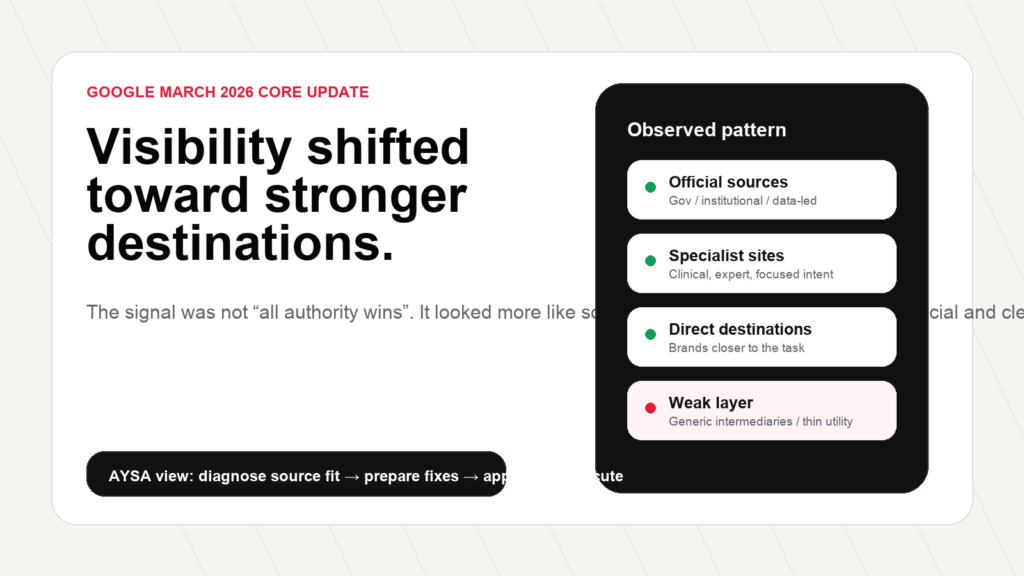
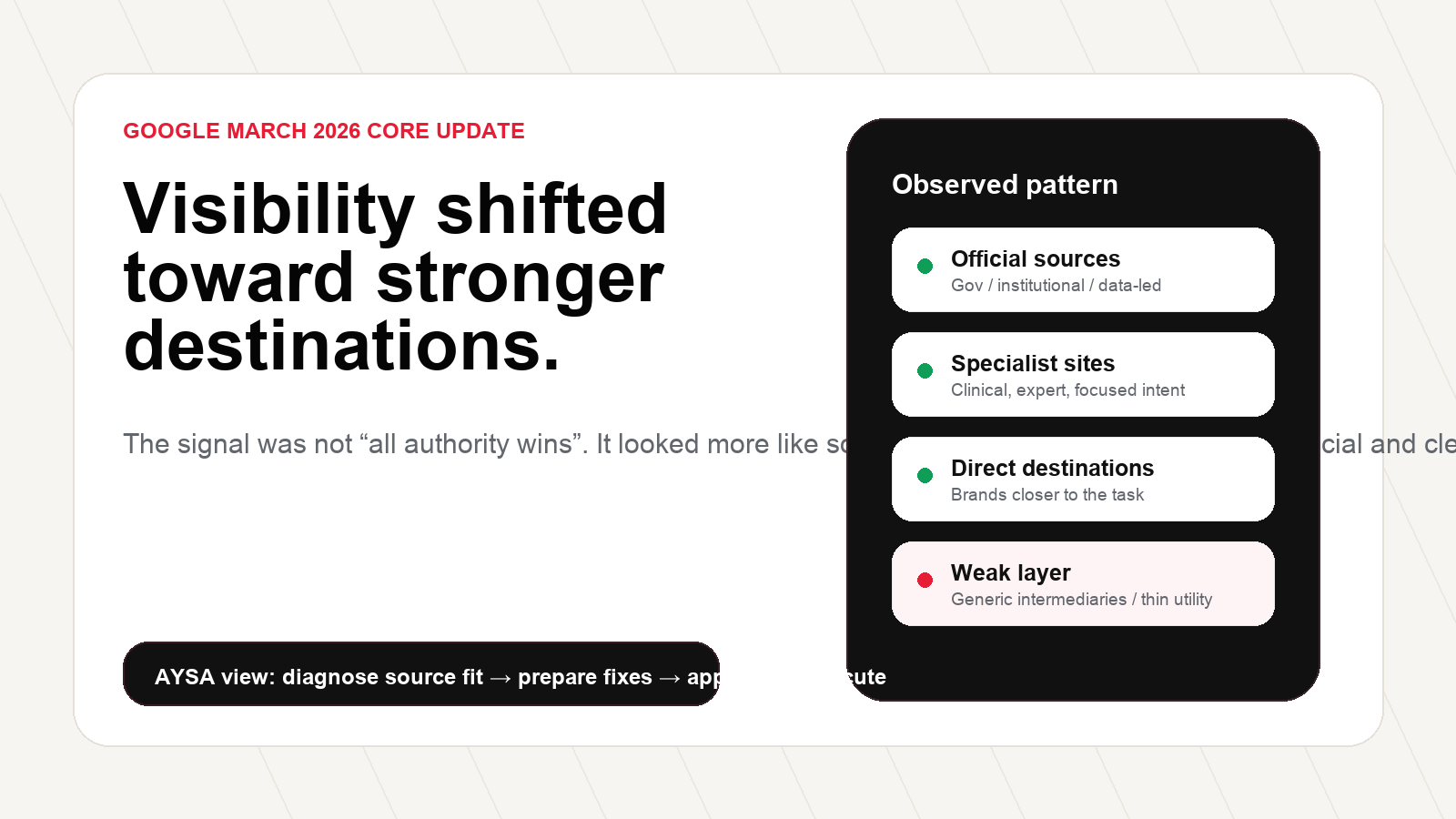
Executive summary: Google’s March 2026 core update, reported as rolling out from March 26 to April 9, looked less like a simple “big brands win” update and more like a source-type and usefulness recalibration. In many query classes, the sites that looked closer to the actual user task gained ground: official sources, specialist publishers, direct providers, data-led pages and pages with stronger topical fit. Generic intermediary pages, thin utility content and pages that looked replaceable were more exposed.
This article builds on Aleyda Solis’ March 2026 core update analysis, Google’s official core update guidance and the AYSA perspective: do not chase the update. Diagnose what changed by page type, query type, source type and market, then turn the diagnosis into Approved Execution. For SMEs, the real risk is not only Ranking Volatility. It is slow implementation after the market has already moved.
What happened in the Google March 2026 core update
Google core updates are broad changes to Search ranking systems. They are not usually about one technical bug or one single ranking factor. Google’s own guidance explains that core updates are designed to improve how its systems assess content overall. When a core update rolls out, some pages gain, some lose, and many remain stable. A ranking drop after a core update does not automatically mean a page violated a policy or received a penalty.
The March 2026 core update was confirmed by industry tracking and reported as beginning around March 26 and completing around April 9. Aleyda Solis’ analysis, based on SISTRIX visibility data, focused on the kinds of domains and source types that gained or lost visibility. The important lesson is not that every site in a category moved the same way. The lesson is that Google appeared to reward certain kinds of usefulness and source fit for specific query contexts.
For business owners, this distinction matters. If traffic dropped, the answer is not “Google hates my website.” The answer is to investigate which pages moved, which queries changed, which competitors gained, what kind of source Google appears to prefer now, and whether your page still deserves to be the most useful result for that intent.
As we have argued in our article about global AI search strategy, search is no longer one universal playbook. A local medical query, a software comparison query, an ecommerce product query and a legal information query may require different evidence. Core updates often expose when a page is not aligned with the source type Google now prefers for that query.
The source-type shift: why the kind of page matters
One of the most useful ways to understand the March 2026 update is source-type fit. Source-type fit asks: for this query, what kind of source is most useful to the user? An official source? A specialist? A direct provider? A comparison platform? A local business? A forum? A publisher? A product page? A Category page? A documentation page?
If Google’s systems increasingly prefer a different source type for a query, your page can lose even if it is not objectively “bad.” A generic affiliate article may lose to a specialist site. A thin category page may lose to a better structured ecommerce page. A directory may lose to a direct provider. A generic health article may lose to a more authoritative medical source. A software listicle may lose to product documentation, comparison pages or more useful hands-on analysis.
This is why core update analysis cannot stop at “our traffic is down 30%.” You need segmentation. Which URLs lost? Which templates lost? Which query clusters lost? Did informational pages drop more than commercial pages? Did local pages drop? Did category pages drop? Did AI-related articles drop? Did older Content decay? Did pages with weak authorship or weak evidence lose more?
A source-type shift is especially important for SMEs. A small business may not beat a huge publisher on broad informational queries, but it can often win where it is the best direct source: local service pages, practical process pages, product availability, pricing clarity, case-specific advice, delivery information, support documentation, local proof, reviews and first-hand experience.
Why this is not a simple “authority wins” story
It is tempting to reduce every Google update to “big brands won again.” Sometimes larger brands do gain, because they have stronger recognition, more links, more historical trust and more user signals. But that explanation is too lazy for serious SEO work.
Authority is not one thing. A government website can be authoritative for official information. A specialist clinic can be authoritative for a specific medical service. A local parking company can be authoritative for airport parking instructions if it has accurate location, pricing, process and reviews. A florist can be authoritative for same-day flower delivery in its city if the website provides real delivery rules, product availability and customer proof. A SaaS company can be authoritative for its own product category if it publishes clear documentation, comparisons, use cases and technical explanations.
The March 2026 update is better read as a reminder that pages need to justify their place in the results. Generic content is more fragile. Content that only rewrites what everyone else says is more fragile. Pages that do not show why the publisher is a good source are more fragile. Pages that answer the query halfway are more fragile.
This connects to a principle we keep repeating inside AYSA content: quality content starts with a harder question. What would make this page the most useful result for a specific user, at a specific stage of the journey, in a specific market? If you cannot answer that, a core update can expose the weakness.
Why the March 2026 core update matters for AI search
Core updates and AI Search are not the same thing, but they are connected by the same underlying problem: Source selection. In classic search, Google chooses which pages to rank. In AI-assisted search, answer systems choose which sources to retrieve, summarize, cite or use as evidence. In both cases, the system is trying to decide what sources deserve attention for a specific task.
Google’s AI Optimization guidance does not recommend a separate trick for AI features. It emphasizes useful content, accessibility, structured data where appropriate and the same technical foundations that help Google understand pages. That means the work after a core update is also relevant to AI visibility: improve clarity, usefulness, source fit, technical accessibility, structure, freshness and evidence.
As we discussed in our article on AI search measurement, presence alone is not enough. A brand can be mentioned in an AI answer but still be weak from a readiness perspective. The same is true after a core update. You need to understand whether the site is ready to be retrieved, cited and recommended, not only whether it ranked last month.
For SMEs, this is good and bad news. The bad news is that volatility will continue. The good news is that many improvements are practical: better service pages, clearer FAQs, stronger internal links, technical cleanup, better schema, stronger reviews, local proof, product data, authority mentions and more useful comparison content.
How to diagnose your website after a core update
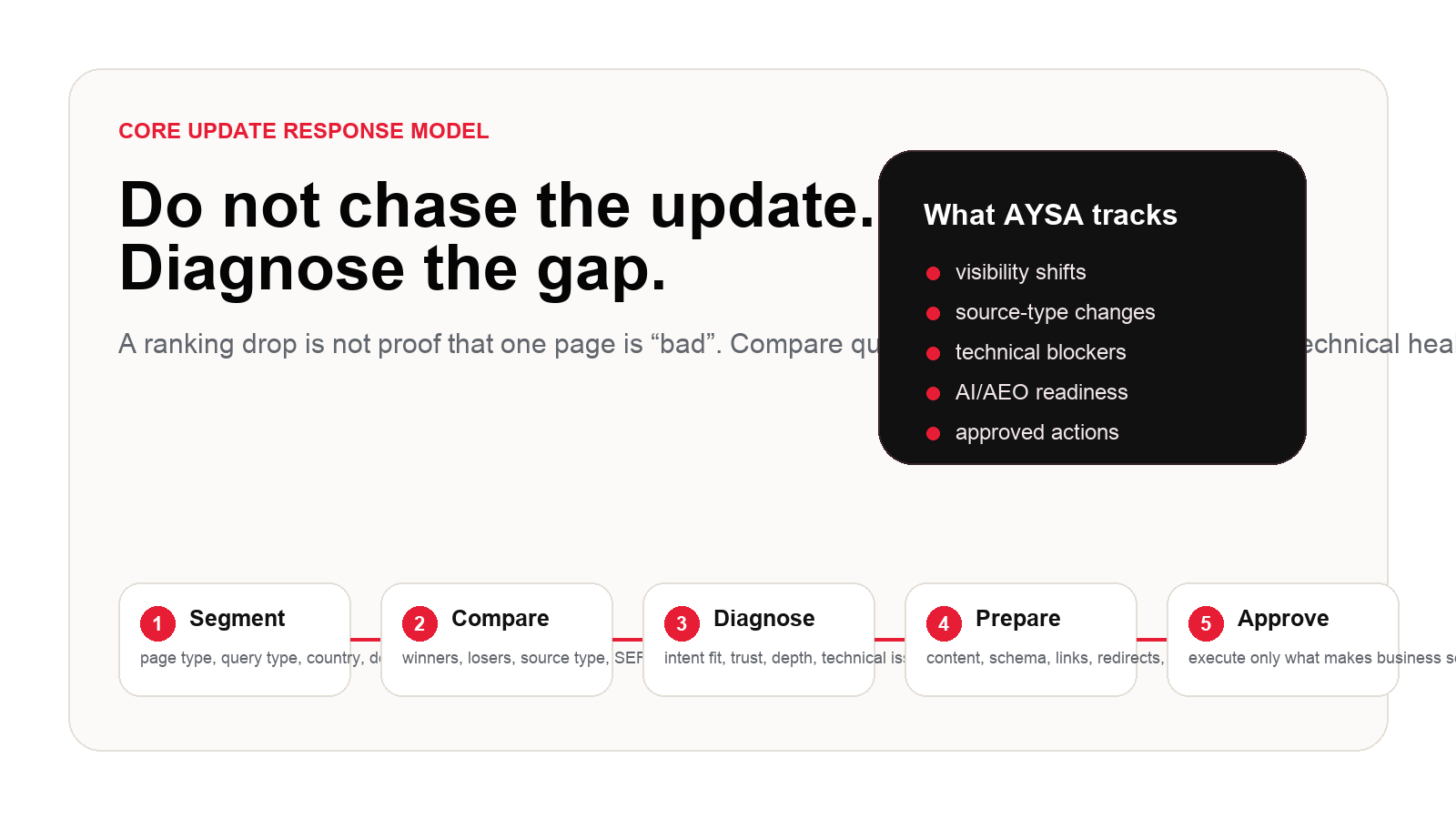
Start with segmentation. Do not look only at total traffic. Segment by URL type, template, category, country, device, query intent and conversion value. A 20% decline in low-value informational traffic is different from a 20% decline in high-intent service pages.
Next, compare winners and losers. For the queries where you lost visibility, who gained? Are they official sources, specialist sites, direct providers, review platforms, forums, ecommerce pages or publishers? What do they provide that your page does not? Do they have better evidence, clearer answers, fresher information, stronger authorship, better structure or better source fit?
Then inspect the page itself. Does it answer the query directly? Does it explain the topic better than competitors? Does it include examples? Does it show why the business or author is qualified? Is the content fresh? Is it easy to scan? Are headings logical? Are important answers buried? Are internal links helping users move to the next step?
Technical checks matter too. Verify indexability, canonical tags, redirect chains, 404 errors, sitemap inclusion, Core Web Vitals, mobile rendering, structured data, duplicate titles, duplicate meta descriptions and internal link depth. A core update may not be caused by a technical issue, but technical weakness can amplify losses.
Finally, connect the diagnosis to business value. Do not spend two weeks rewriting a page that never generated leads. Prioritize pages that influence revenue, sales conversations, qualified traffic or strategic authority.
What SMEs should do next
First, improve pages that deserve to exist. If a service page is important, make it genuinely useful. Add process details, pricing context where possible, location information, eligibility, examples, FAQs, proof, reviews, images, internal links and clear next steps. If a product category matters, add selection criteria, comparison logic, delivery information, availability and useful supporting content.
Second, remove or consolidate weak pages. Many SME websites have thin tag pages, duplicated service pages, outdated blog posts, empty categories, boilerplate location pages and old campaign pages. More pages do not automatically mean more SEO value. A smaller, cleaner, more useful site can be easier for Google and AI systems to understand.
Third, strengthen internal links. Important pages should not sit three or four clicks deep with no contextual support. Connect related guides, service pages, glossary terms, case studies, product pages and FAQs. Internal links help users, crawlers and retrieval systems understand relationships.
Fourth, improve source signals outside the website. Reviews, publisher mentions, local profiles, partner pages and industry references can help reinforce why the business is a credible source. Authority building should be controlled and approved, not random.
Fifth, build a monitoring loop. Core updates are not one-off events. Search and AI visibility will keep changing. The businesses that win are not necessarily the ones with the largest content teams. They are the ones that detect changes, decide what matters, and execute improvements faster.
Panic response
Rewrite everything, blame the algorithm, publish more generic content and wait for the next update.
Execution response
Mistakes to avoid after a core update
Do not rewrite every page immediately. A fast rewrite without diagnosis can damage pages that were working. Do not delete pages only because traffic dropped. Check whether they serve users, support internal links or influence conversions.
Do not chase word count. Longer content is not automatically better. A useful page answers the task. Sometimes that requires 3,000 words. Sometimes it requires a concise service page with clear pricing, process, reviews and FAQs.
Do not assume AI-generated content is the problem or the solution. Google’s position is not that all AI-assisted content is bad. The issue is whether content is useful, reliable and created for people rather than manipulation. Poorly reviewed AI content can create scale problems, but human-written generic content can also fail.
Do not ignore conversion value. SEO teams sometimes fight to recover traffic that never mattered commercially. Business owners care about leads, sales, calls and revenue. Recovery work should prioritize business impact.
Do not treat core updates and AI search separately. Both expose whether your website is clear, useful, technically accessible and credible enough to be selected as a source.
Where AYSA fits
AYSA is built for the part most SMEs struggle with: turning diagnosis into action. A core update can reveal dozens of issues: thin pages, weak internal links, missing service details, outdated content, technical errors, unclear entities, low-value archives, missing FAQs, weak source proof and authority gaps. Most business owners do not have time to translate those findings into a practical SEO backlog.
AYSA can monitor website and search signals, prepare SEO, AEO and AI visibility actions, explain why they matter, ask for approval and execute accepted changes inside the website workflow. That matters after core updates because speed and control both matter. You do not want blind autopilot. You also do not want a report that sits untouched for six weeks.
If Google updates keep turning your SEO work into emergency meetings, AYSA is designed for the next phase: agentic SEO execution. The agent helps you see what changed, prepare the work that matters, approve important actions and keep improving without forcing the business owner to become a full-time SEO specialist.
Core updates should create action, not panic
Tired of reacting to every Google update with another manual audit?
Try AYSA: an AI SEO agent that monitors SEO, AEO and AI visibility signals, prepares approved website actions and helps SMEs execute faster after the market changes.
Sources and further reading
This article cites and builds on Aleyda Solis’ analysis of the Google March 2026 core update, Google Search Central’s core update guidance, Google’s AI features optimization guide, and industry reporting on the March 2026 update timeline. The AYSA sections are our product and author perspective. We do not claim guaranteed recovery, guaranteed rankings, guaranteed AI citations or guaranteed AI Overview inclusion.
Continue the AI search topic inside AYSA.
Use these pages to connect the article with AI SEO tools, AI visibility monitoring, AI Overviews and approved website execution.
Turn this topic into a website action plan.
Use these AYSA hubs to move from reading to technical fixes, AI visibility monitoring, research, glossary context and approval-first SEO execution.

