
AI Search Measurement: Presence, Readiness and Business Impact
A practical AYSA framework for measuring AI search: presence, readiness and business impact without turning AI visibility into another vanity dashboard.
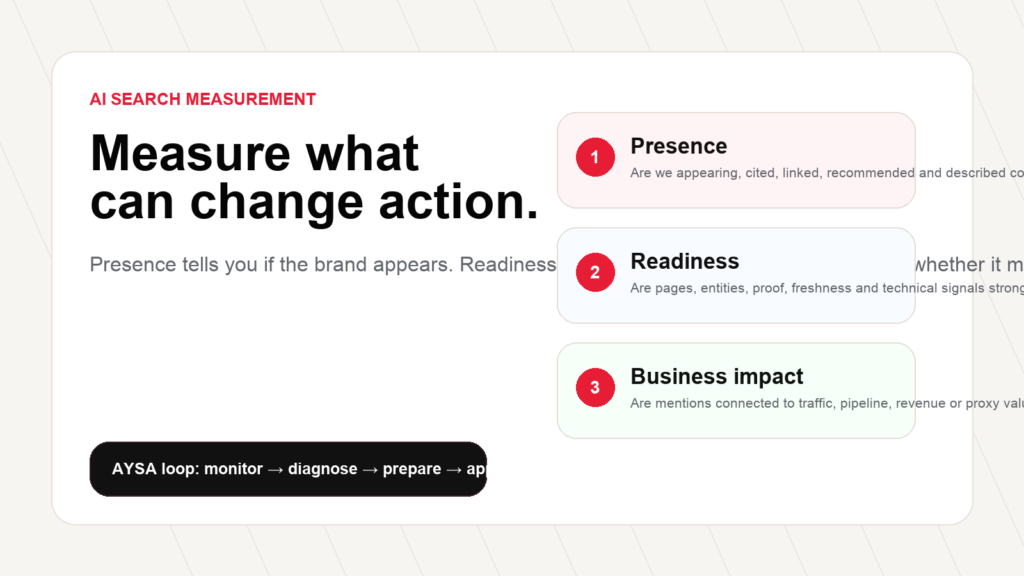
Executive summary: AI Search measurement is becoming one of the most confusing areas in SEO, AEO and GEO. A brand can be mentioned in an AI answer, cited by one platform, ignored by another, receive no measurable Referral traffic, and still be influenced by that answer in the buyer journey. Measuring only rankings is too narrow. Measuring only AI mentions is too shallow. Measuring everything as if it has the same confidence level is dangerous.
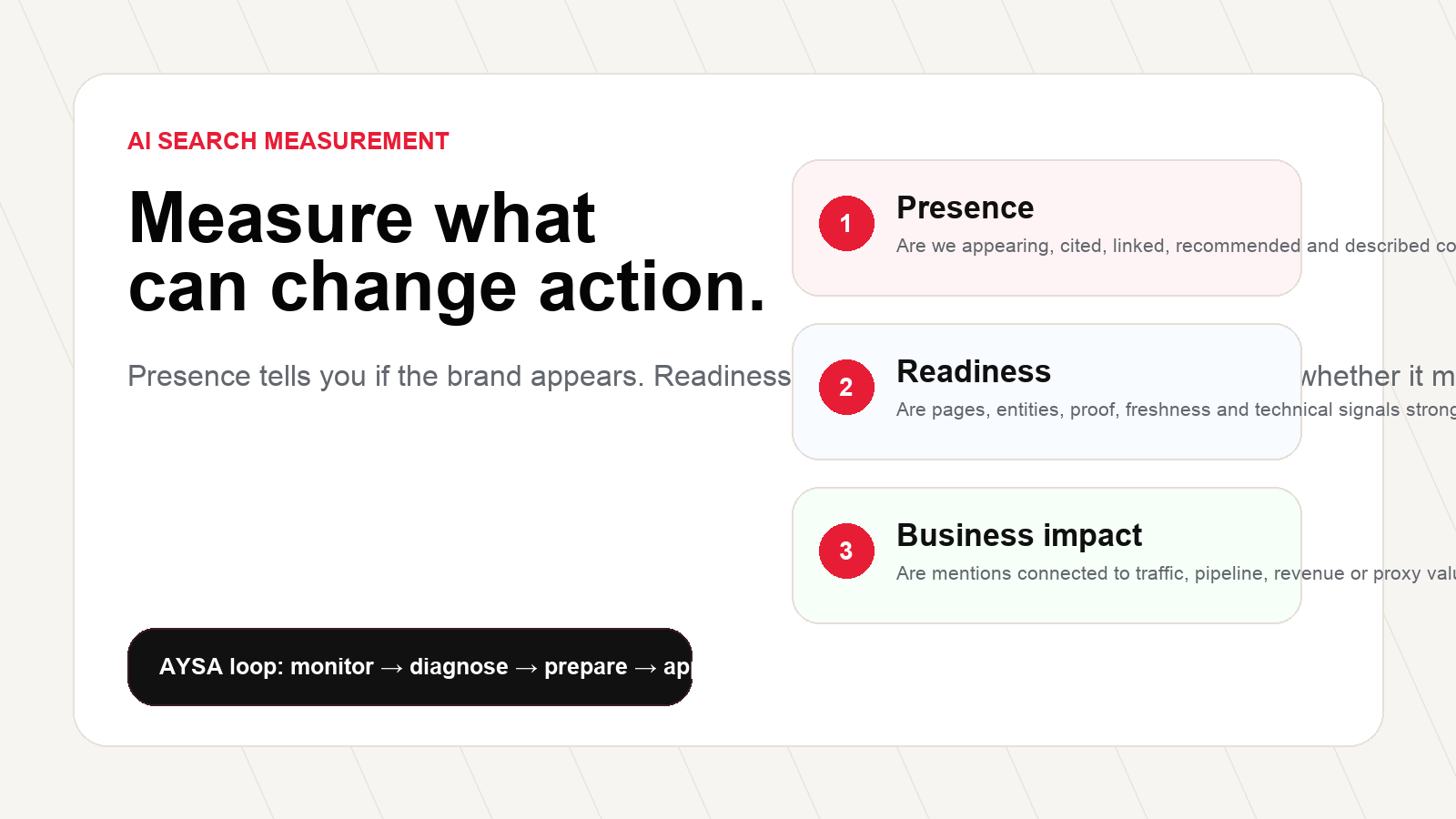
This article builds on Aleyda Solis’ three-layer AI search measurement framework and expands it from the AYSA point of view: measurement is useful only when it changes execution. Presence tells you if the brand appears. Readiness explains whether your website and source ecosystem are prepared to be understood, cited and recommended. Business impact connects AI visibility to demand, traffic, leads, revenue or credible proxy value.
Why old SEO measurement broke
Classic SEO measurement was never perfect, but it had a familiar logic. Track rankings, Impressions, clicks, CTR, organic sessions, conversions, revenue, backlinks, technical health and maybe Share of Voice. If rankings improved and traffic grew, the work looked successful. If traffic fell, the team investigated algorithm updates, technical issues, content quality, competitors or seasonality.
AI search complicates that model. The user may receive a synthesized answer before clicking. The answer may cite a source, mention a brand without linking, recommend a product without a referral, or influence a later branded search. It may vary by platform, country, language, prompt wording, personalization, freshness and source availability. A brand can be present in ChatGPT but absent in Google AI Overviews. It can be cited by Perplexity but not recommended by Gemini. It can be recommended in English but invisible in Romanian, German or French.
That does not mean measurement is impossible. It means measurement must become more honest. We need to separate what we can directly observe, what we can reasonably infer and what we are modelling as a business proxy. When these layers get mixed together, dashboards become theatre.
Aleyda Solis’ framework is useful because it pushes AI search measurement away from one vanity metric. The question is not “What is our AI visibility score?” The better question is: “Are we present, are we prepared, and does that presence connect to business outcomes?”
As we discussed in our article on global AI search strategy, AI visibility changes by market, vertical, language, source ecosystem and platform. Measurement must respect those differences. Otherwise, a company may celebrate a global score while failing in the markets that actually matter.
Layer 1: AI presence
AI presence is the visibility layer. It asks whether the brand, product, service, author, website or source appears in AI-generated answers. Presence can include brand mentions, citations, links, recommendations, product inclusions, comparison appearances, source references and answer sentiment.
Presence is important because it shows whether an AI system can retrieve and use your brand in a relevant context. If your brand never appears for the prompts that matter, you have an awareness or retrieval problem. If it appears but is described incorrectly, you have an entity clarity problem. If competitors are cited and you are not, you may have a source ecosystem or evidence gap. If your brand is mentioned but never linked, you may still have influence, but you need to measure it differently.
Presence should be measured by query type. A brand may perform well for branded prompts but poorly for non-branded commercial prompts. It may appear for informational prompts but not for comparison prompts. It may be cited for “what is” queries but not for “which provider should I choose” queries. For ecommerce, as we covered in our article on ecommerce AI search citations, product pages are not the only citation surface. Guides, reviews, policies and third-party references can influence the answer.
Presence should also be measured by platform. Google AI Overviews, Google AI Mode, ChatGPT, Perplexity, Gemini and other systems do not always use the same sources or produce the same answer structure. A single-platform view is useful but incomplete.
Useful presence metrics include mention rate, citation rate, linked citation rate, recommendation rate, competitor co-occurrence, source type distribution, sentiment or framing, answer position, answer consistency across repeated checks, market-level presence and prompt cluster presence.
The limitation is obvious: presence does not equal revenue. A mention may be valuable, neutral or meaningless depending on context. That is why presence is only the first layer.
Layer 2: AI readiness
Readiness measures whether the website and wider source ecosystem are prepared to be understood, retrieved, cited and recommended by AI-assisted search systems. This is where many teams underinvest. They want to measure AI presence, but they do not measure the reasons behind presence or absence.
Readiness starts with technical accessibility. Search systems and AI retrieval layers need crawlable, indexable, fast and well-structured pages. Google’s AI features guidance points back to the same foundations: make unique, valuable content for users, make pages accessible to Google, use structured data where appropriate, and avoid blocking relevant resources. In other words, AI optimization is not a trick layer detached from SEO. It is built on the same technical and content foundations.
Readiness also includes entity clarity. Does the website make it clear who the company is, what it offers, where it operates, which audience it serves, why it is trustworthy and how it differs from competitors? Is that information consistent across the website, business profiles, publisher mentions, social profiles and third-party sources?
Content structure matters as well. Pages should answer specific questions clearly, use meaningful headings, include examples, expose definitions, show evidence, link to related concepts and avoid burying the answer inside generic marketing copy. A page about “AI visibility monitoring” should not only define the term. It should explain platforms, prompts, metrics, limitations, source analysis, confidence levels and what actions follow. A page about “best pediatric clinic in Bucharest” should help a parent compare real criteria, not look like a generic directory.
Readiness also includes local and vertical proof. A private clinic needs qualifications, reviews, location, appointment process and trust signals. A hotel needs amenities, policies, local context and reviews. A florist needs delivery rules, freshness proof, occasion pages and local service coverage. A SaaS company needs use cases, documentation, integrations, pricing clarity and security information.
Useful readiness metrics include crawl/indexation health, structured data validity, internal link depth, orphan pages, content freshness, entity consistency, source coverage, review coverage, author credibility, product feed health, answer block quality, FAQ clarity, citation-friendly formatting, topical coverage and authority gaps.
Readiness is the bridge between a measurement dashboard and an execution backlog. If a brand is absent in AI answers, readiness metrics help explain what to fix.
Layer 3: business impact
Business impact is the hardest layer and the most important one. It asks whether AI search visibility influences real business outcomes. This may include direct referral traffic, assisted conversions, branded search growth, demo requests, lead quality, sales conversations, ecommerce revenue, call volume, store visits, qualified pipeline or customer acquisition cost.
The challenge is attribution. AI systems often do not pass clean referral data. Some users see an AI answer and later search the brand directly. Some copy a recommendation into another platform. Some ask multiple assistants. Some compare the answer with classic search results. Treating every AI mention as revenue would be fantasy. Ignoring AI influence because attribution is messy would also be wrong.
A practical business impact model should combine direct signals, assisted signals and proxy signals. Direct signals include AI referral traffic where detectable, conversions from known AI sources, and CRM notes when prospects mention AI tools. Assisted signals include branded search growth, direct traffic changes, improved CTR on query clusters where AI presence increased, sales call references and market-level demand changes. Proxy signals include share of AI presence, recommendation rate, citation quality and competitor displacement.
McKinsey’s 2025 State of AI survey reported that 88% of respondents say their organizations use AI regularly in at least one business function. This does not prove that every AI mention drives revenue. It does show that AI is becoming normal inside work and decision processes. For B2B, ecommerce, local services and professional services, it is increasingly reasonable to assume that AI-assisted research can influence the buyer journey.
The best impact models label confidence. A direct conversion from a known AI referral is high confidence. A branded search increase after repeated AI recommendations is medium confidence. A modelled revenue value from mention share is low confidence unless supported by other data. The point is not to pretend uncertainty does not exist. The point is to separate uncertainty from observed reality.
Observed, proxy and modelled data
One of the biggest problems in AI search measurement is that teams blend different confidence levels into one chart. A direct click from a known AI source is not the same as a prompt test where a brand was mentioned once. A citation is not the same as a recommendation. A recommendation is not the same as a lead. A lead is not the same as revenue.
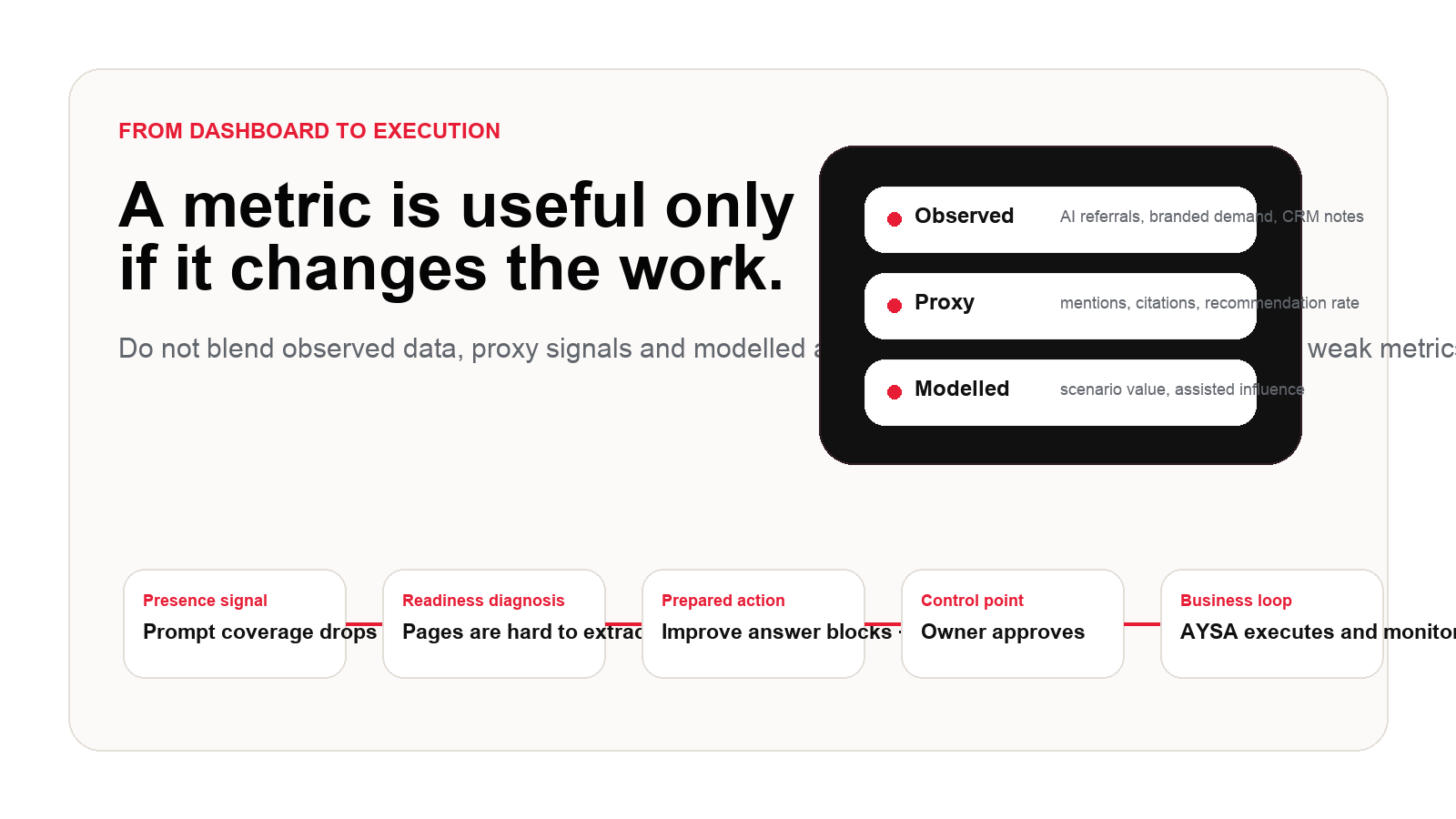
Observed data is data you can directly see. Examples include Search Console impressions, analytics referrals, server logs, known AI user agents, conversions, CRM fields, rank tracking, indexation status, structured data errors and actual citations collected during controlled checks.
Proxy data is data that suggests influence but does not prove it alone. Examples include mention rate, citation rate, recommendation rate, source overlap, branded search demand, direct traffic changes, answer sentiment and competitor displacement in AI answers.
Modelled data estimates value from observed and proxy signals. For example, a team might estimate the value of improved AI presence by combining prompt volume assumptions, conversion rates, brand demand changes and sales feedback. That can be useful for planning, but it must be labelled as modelled.
In my opinion, the best AI visibility dashboards will not be the ones with the prettiest score. They will be the ones that clearly label confidence and show what needs to be executed next.
KPIs worth tracking
For AI presence, track brand mention rate, citation rate, linked citation rate, recommendation rate, answer sentiment, answer accuracy, competitor comparison, source type distribution, platform-level visibility and market-level visibility.
For readiness, track crawlability, indexability, page speed, structured data validity, internal links, entity consistency, author and company proof, review quality, topical coverage, freshness, policy clarity, product or service data completeness, content chunkability, source coverage and local trust signals.
For business impact, track AI referral traffic where available, branded search demand, direct traffic trends, assisted conversions, demo requests, calls, form submissions, ecommerce revenue, lead source notes, sales call references, pipeline influence and customer acquisition cost.
For governance, track how many AI search issues become approved actions, how many actions are executed, how long implementation takes, what gets rejected, and whether executed actions improve visibility, traffic or conversion signals over time.
This final governance layer is important. Many companies will buy AI visibility tools, discover interesting problems, and then fail because nothing gets implemented. Measurement without execution becomes another expensive report.
Common AI search measurement mistakes
The first mistake is treating AI visibility as a single score. One number cannot represent different platforms, countries, query types, verticals and confidence levels.
The second mistake is overvaluing mentions. A brand mention in a weak answer may not matter. A citation in a high-intent comparison may matter a lot. Context matters.
The third mistake is ignoring readiness. If the site is technically messy, thin, unclear, slow, duplicated or poorly linked, presence problems are not surprising. Measurement should diagnose the system, not only report the symptom.
The fourth mistake is failing to separate markets. As we explained in our global AI search strategy article, AI visibility can vary dramatically by country, language and source ecosystem.
The fifth mistake is claiming revenue too aggressively. AI search can influence demand, but attribution is still imperfect. Strong reporting should be confident where evidence is strong and careful where evidence is only directional.
The sixth mistake is stopping at dashboards. If measurement does not create prioritized actions, it is not an operating system. It is a reporting habit.
From metrics to approved execution
The practical workflow starts with defining prompt clusters and query clusters that matter commercially. These should include branded prompts, non-branded commercial prompts, comparison prompts, problem-led prompts, local prompts and post-purchase prompts.
Then measure presence by platform and market. Capture whether the brand appears, how it is described, whether it is cited, which competitors appear and which sources shape the answer.
Next, diagnose readiness. If the brand is absent, is the problem technical, content-related, authority-related, local proof-related or source ecosystem-related? If the brand is present but framed poorly, is the website unclear? Are third-party sources outdated? Are reviews weak? Are service pages missing key details?
Then connect measurement to business impact. If a prompt cluster matters commercially, prioritize it. If a prompt has little business relevance, do not over-optimize for it just because a dashboard says visibility is low.
Finally, create actions. Improve pages, update structured data, strengthen internal links, create evidence assets, improve product feeds, request reviews, build authority, update profiles, fix technical issues and monitor again.
Dashboard-only approach
Track mentions, export a score, debate whether AI visibility is real, and leave the team with another report.
Execution approach
Where AYSA fits
AYSA is built around the idea that SEO, AEO, GEO and AI visibility should move from research to approved execution. AI search measurement creates a lot of findings: missing citations, weak entity signals, thin pages, poor answer structure, source gaps, outdated content, technical problems, poor internal links and unclear business proof. The hard part is not noticing the problem once. The hard part is turning it into consistent work.
AYSA can monitor website and search signals, prepare actions, explain why they matter, ask for approval and execute accepted changes inside the website workflow. For SMEs and non-specialists, this matters because the business owner should not have to become an AI search analyst. The owner needs to understand what matters, approve important actions and keep control.
If you are tired of AI visibility reports that show interesting mentions but do not tell you what to fix next, AYSA is designed for the next phase: agentic SEO execution. It helps connect presence, readiness and business impact into one workflow so your team can stop collecting disconnected metrics and start improving the website.
Agentic SEO for measurable action
Stop measuring AI visibility without changing the website.
If your AI search dashboard creates questions but no execution, try AYSA: an AI SEO agent that monitors signals, prepares actions, asks for approval and executes accepted changes inside your website workflow.
Sources and further reading
This article cites and builds on Aleyda Solis’ three-layer AI search measurement framework, Google Search Central’s AI features optimization guide, SparkToro and Datos’ zero-click search study, and McKinsey’s 2025 State of AI survey. The AYSA sections are our author and product perspective. We do not claim guaranteed rankings, guaranteed AI citations, guaranteed AI Overview inclusion or guaranteed revenue from AI search visibility.
Continue the AI search topic inside AYSA.
Use these pages to connect the article with AI SEO tools, AI visibility monitoring, AI Overviews and approved website execution.
Turn this topic into a website action plan.
Use these AYSA hubs to move from reading to technical fixes, AI visibility monitoring, research, glossary context and approval-first SEO execution.

