Global AI Search Strategy: Why One SEO Playbook No Longer Works Everywhere
A deep AYSA guide to global AI search strategy: why AI visibility depends on country, language, vertical, source ecosystems and approved execution.
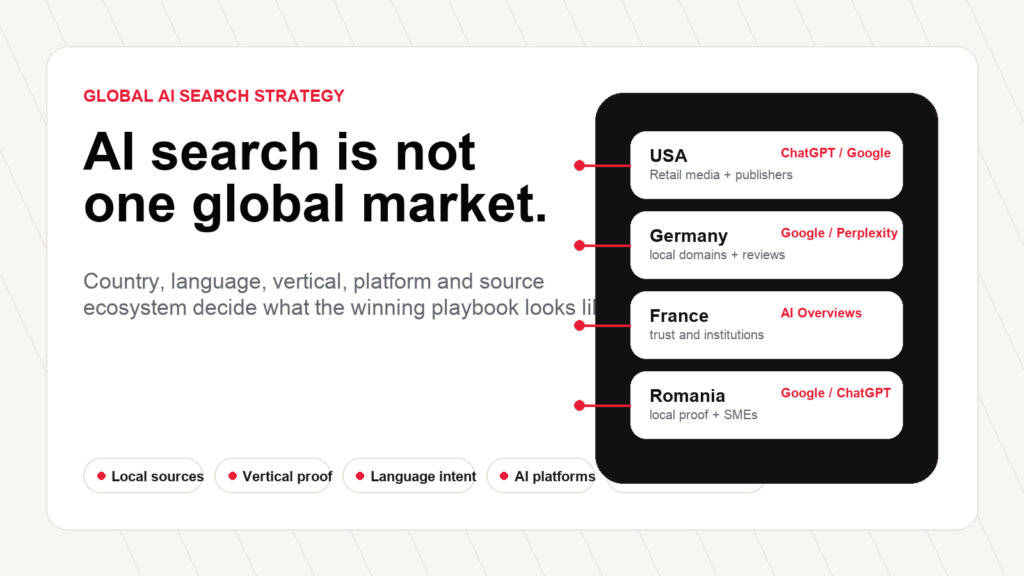
Executive summary: Global AI Search strategy is not “do SEO in English, translate the best pages, and monitor a few ChatGPT prompts.” AI search visibility changes by country, language, vertical, platform, regulation, source ecosystem, review culture, ecommerce infrastructure and local trust signals. A company can be visible in one market and almost invisible in another, even when the website has strong Domain authority.
This article builds on Aleyda Solis’ analysis of global AI search strategy and connects it with the AYSA point of view: AI visibility becomes useful only when it turns into Approved Execution. The winning system is not one generic AI SEO checklist. It is a repeatable operating model: map the market, understand local queries, audit the source ecosystem, improve evidence assets, localize technical foundations, monitor AI visibility and execute changes continuously.
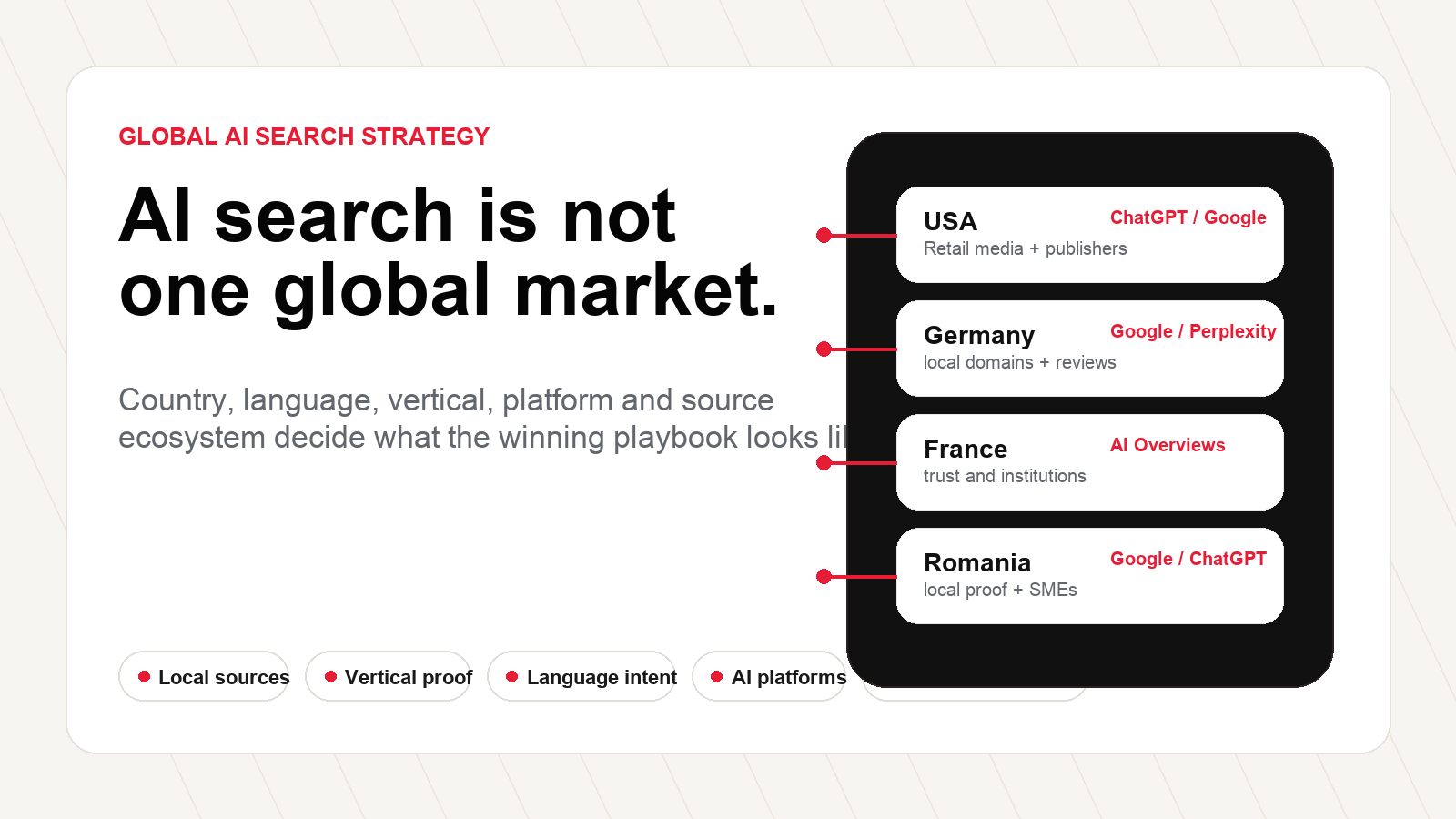
Why global AI search is different
For many years, International SEO had a familiar structure. Build a strong website, research keywords by market, create localized pages, implement Hreflang, avoid duplicate translations, earn local links, monitor rankings, and improve technical quality. That structure still matters. But AI search adds a new layer: synthesized answers are shaped by the sources, entities, formats and trust signals available in each market.
A user in the United States may ask an AI system for “best software for Local SEO agencies.” A user in Germany may ask a more compliance-sensitive version of the same question. A Romanian business owner may ask in Romanian, mix English product names with local market terms, and expect examples from the local ecosystem. A French ecommerce buyer may trust local publishers, regulated reviews and established comparison sources more than a generic English guide.
The answer system is not only matching keywords. It is trying to assemble a useful answer from the web it can access and interpret. That means your global visibility depends on how well your brand, products, services and proof are represented inside local source ecosystems. It also depends on whether your pages are technically accessible, locally credible, semantically clear and easy to cite.
This is why Aleyda Solis’ point is important: global AI search strategy cannot be treated as a copy-paste version of classic global SEO. The same brand may need different evidence assets in different markets. It may need local reviews in one market, publisher authority in another, product feed quality in another, expert authorship in another, and better language-specific entity clarity everywhere.
In my opinion, the biggest mistake companies will make in 2026 is assuming that AI search is a single global surface. It is not. It is a set of answer environments that behave differently depending on user intent, geography, language, platform and available sources.
Why the old international SEO playbook is incomplete
The old international SEO playbook was built around localized landing pages and classic rankings. If the page ranked, the strategy looked successful. If the page did not rank, the team improved content, links, technical setup or localization. AI search does not remove this model, but it makes it incomplete.
First, the user may not click immediately. SparkToro and Datos’ 2024 zero-click study found that for every 1,000 Google searches, only 374 clicks went to the open web in the United States and 360 in the European Union. AI-assisted answers intensify the need to measure visibility before the click, because the answer itself can influence brand perception and choice.
Second, the page that ranks is not always the page that influences the answer. A product page may receive the final click, but a buying guide, review page, Google Business Profile, policy page, comparison article, support page or local publisher mention may shape whether the brand appears in the generated recommendation. As we discussed in our article on ecommerce AI search citations, the citation surface is wider than the click surface.
Third, localization is no longer only linguistic. A translated page can still fail if it does not answer local decision criteria. A hotel page in one market may need parking, breakfast, pet policy and transport details. A clinic page may need location, insurance, appointment process, doctor credibility and emergency guidance. A B2B SaaS page may need data residency, procurement language and local case studies.
Fourth, AI systems are source-sensitive. If the local web around your topic is dominated by certain publications, directories, communities, review platforms or public data sources, your strategy must understand those sources. You cannot optimize only your own domain and ignore the ecosystem that AI systems may use to build answers.
The factors that change by market
A global AI search strategy should start with market mapping. The map should not be a list of countries where you want traffic. It should describe how users search, which languages they use, which platforms answer their questions, which sources are trusted, which competitors are visible and which content formats carry authority.
Language is the first layer. English queries often have more published content, more third-party comparisons and more AI training visibility. Smaller languages may have thinner source ecosystems, which can be an opportunity or a risk. If the available local content is weak, a brand that creates excellent local pages may become easier to retrieve. But if the local AI system relies heavily on English sources, the brand may need both local-language clarity and English-language entity consistency.
Search behavior is the second layer. Users in different countries ask different questions, even for the same product. They may care about different payment methods, warranties, delivery standards, regulations, seasonality, local competitors, social proof or price sensitivity. A global content plan that ignores these differences becomes generic very quickly.
Vertical is the third layer. Healthcare, finance, legal, ecommerce, travel, restaurants, floristry, parking, car rental, education and SaaS do not need the same evidence. A pediatric clinic needs trust, qualifications, reviews, process clarity, location and medical safety language. An ecommerce store needs product data, delivery, returns, comparison criteria and reviews. A hotel needs availability, amenities, local attractions, policies and visual proof. A SaaS company needs use cases, integration details, pricing clarity, documentation and security information.
Platform is the fourth layer. Google AI Overviews, Google AI Mode, ChatGPT, Perplexity, Gemini and other answer systems do not behave identically. They may cite different sources, format answers differently and serve different user expectations. A strategy that monitors only one platform can create false confidence.
Regulation and trust culture are the fifth layer. In Europe, privacy, consumer protection and sector-specific rules influence how companies should present claims. In sensitive sectors, unsupported claims are risky. Google’s guidance for AI features still points back to useful, reliable, people-first content and accessible pages. That is not a loophole. It is a quality bar.
Source ecosystems and citations matter more than most teams expect
Classic SEO teams are used to thinking about backlinks. AI search requires a wider concept: source ecosystems. A source ecosystem includes local publishers, directories, forums, review platforms, marketplaces, product feeds, official databases, social media, videos, partner pages, industry associations and the brand’s own website.
The question is not simply “who links to us?” The better question is: “When an AI system tries to answer this market-specific query, which sources does it appear to trust, retrieve or cite?” For some queries, the answer may use government pages, documentation, Wikipedia-like sources or major publishers. For commercial local queries, it may lean on reviews, maps, directories and business profiles. For ecommerce, it may use product pages, guides, reviews, policies and feeds.
This is where global strategy becomes very practical. If your brand is strong in English but absent from local source ecosystems, you may not appear in local AI answers. If local sources mention you with outdated positioning, the answer may inherit that weakness. If competitors are easier to explain because they have clearer comparison pages, local citations and better structured content, they may win even if your product is better.
Authority building should therefore become controlled and editorial, not random link buying. For AYSA, this is also why the Adverlink ecosystem matters. In markets where relevant publisher mentions can help build authority and context, the workflow should surface opportunities, explain them, ask for approval and track delivery. The business owner should understand what is being bought or approved, why it matters and how it fits the strategy.
Technical international SEO still matters
AI search does not make technical SEO optional. It makes technical mistakes more expensive. If pages are blocked, slow, duplicated, incorrectly canonicalized, poorly linked or difficult to render, AI systems and search engines have less reliable material to work with.
Google’s documentation on localized versions remains important. Hreflang should help Google understand alternate language or regional versions of a page. Canonicals should be consistent. A localized page should not canonicalize to a different language version if it is meant to be indexed. Internal links should use final canonical URLs, not redirects. Sitemaps should include indexable canonical URLs. Query parameters and faceted pages should not waste crawl resources.
For global AI search, technical foundations include hreflang, canonical consistency, clean URL structures, localized metadata, translated and adapted content, structured data that matches visible content, fast mobile pages, accessible HTML, strong internal links and crawlable evidence assets. This is not glamorous, but it is the foundation that lets answer systems understand the brand.
As we discussed in our Google AI Mode guide, optimization for AI-assisted search is not about creating special hidden content for machines. It is about making the visible website clearer, more useful and easier to retrieve.
Vertical-specific strategy: the same market can need different playbooks
Even inside one country, the AI search playbook changes by vertical. A Romanian florist, a private clinic, a hotel, a parking company near the airport and a B2B SaaS platform do not need identical AI visibility assets.
A florist needs occasion pages, delivery area pages, freshness proof, same-day rules, substitutions, photos, customer reviews, local authority and clear service coverage. A private clinic needs doctor profiles, appointment process, medical disclaimers, location details, reviews, specialty pages, FAQ content and trust signals. A hotel needs amenity clarity, neighborhood information, transport, policies, room details, reviews and visual proof. A parking service needs airport distance, shuttle process, pricing, security, booking flow and review credibility. A SaaS product needs use cases, documentation, integrations, pricing, comparisons, security and customer proof.
This is why “global AI search strategy” should not be owned only by the international SEO team. It requires collaboration across product, content, PR, support, analytics, sales, local market teams and technical SEO. The goal is not to publish more content. The goal is to make each market and vertical easier to understand, cite and recommend.
For SMEs, the challenge is volume. A small company cannot manually monitor every platform, source, market, keyword, prompt, page and technical issue. That is exactly where execution systems become important. Reports alone do not solve the problem. They create a backlog.
Measurement and KPIs: do not chase one fake AI visibility number
AI search measurement is still immature. A single AI visibility score can be useful as a directional signal, but it should not become the entire strategy. Different platforms produce different answers. Answers can vary by location, personalization, freshness, query wording and source availability. Teams need a layered measurement model.
The first layer is classic SEO health: impressions, clicks, CTR, rankings, indexation, crawl errors, Core Web Vitals, internal linking and structured data. The second layer is market visibility: which pages and entities are visible for local queries. The third layer is AI answer presence: whether the brand is mentioned, cited or recommended in representative prompts. The fourth layer is source influence: which domains appear in answers and what evidence they provide. The fifth layer is business impact: leads, assisted conversions, branded demand, revenue and sales conversations.
McKinsey’s 2025 State of AI survey reported that 88% of respondents say their organizations use AI regularly in at least one business function. That does not mean every buyer uses AI search every day. But it does show that AI behavior is becoming normal inside work and decision processes. Search strategy should prepare for that reality without pretending measurement is perfect.
The right KPI question is not “What is our AI visibility score?” The better question is: “Are we becoming easier to discover, understand, compare, trust and act on in each important market?”
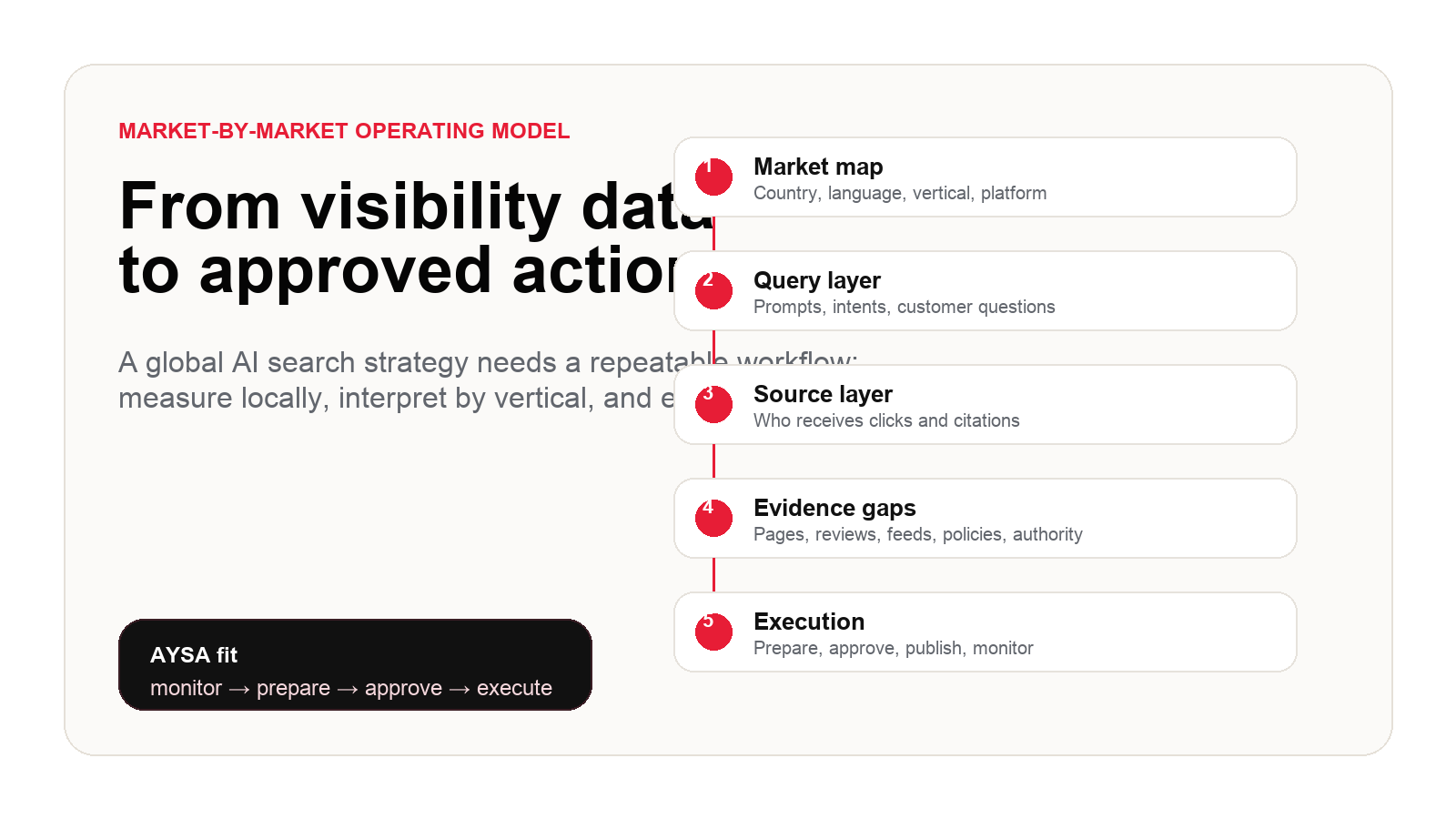
A practical global AI search operating model
A practical workflow starts with market prioritization. Choose the countries and languages that matter commercially. Do not start with every market. Pick the markets where revenue, opportunity or strategic risk is real.
Then build query sets by market and vertical. Include classic search queries, conversational prompts, comparison prompts, local prompts, problem-led prompts and decision prompts. Translate only after adapting intent. A direct translation may miss how users actually ask.
Next, audit the answer and source ecosystem. Which competitors appear? Which sources are cited? Which formats dominate? Are local publishers involved? Are reviews important? Are product feeds involved? Are government or institutional sources shaping the answer? Are your own pages cited, ignored or misunderstood?
After that, map evidence gaps. You may need better localized landing pages, clearer FAQs, stronger author bios, better product data, updated policy pages, comparison content, local case studies, Google Business Profile improvements, schema fixes, internal links or authority-building actions.
Finally, execute in cycles. AI search strategy is not a quarterly deck. It is a loop: monitor, prepare, approve, execute and measure again. The team should not only collect observations. It should turn those observations into changes on the website and across the source ecosystem.
What usually happens
A team monitors a few AI prompts, exports a report, debates the interpretation and leaves local teams with another backlog.
What should happen
Where AYSA fits
AYSA is built for the operational side of this problem. Global AI search strategy creates many small but important tasks: update localized pages, improve entity clarity, fix technical signals, strengthen internal links, prepare FAQs, improve product or service pages, surface authority opportunities, monitor AI visibility and keep action history. Most SMEs do not have the team structure to execute that manually every week.
AYSA does not replace strategy with magic. It turns strategy into a workflow. The agent can monitor website and search signals, prepare SEO, AEO and GEO actions, explain why they matter, ask for approval and execute accepted changes inside the website workflow. For WordPress websites, execution is available now; the product direction is broader website execution across platforms.
That distinction matters. A global AI visibility report is useful, but it is not enough. If it does not become approved action, it becomes another dashboard. The future belongs to teams that can learn from the market and execute faster than the market changes.
If you are tired of trying to coordinate global SEO, AEO and AI visibility work through spreadsheets, disconnected reports, manual copy-paste and slow implementation queues, AYSA is built for the near future of agentic SEO: one agent that understands the website, prepares the work, keeps the business owner in control and helps turn market-specific visibility gaps into approved execution.
Agentic SEO for the near future
Stop turning AI search insights into another manual backlog.
AYSA helps SMEs monitor SEO, AEO and AI visibility, prepare market-specific website actions, ask for approval and execute accepted changes without forcing you to become a full-time SEO specialist.
Sources and further reading
This article cites and builds on Aleyda Solis’ global AI search strategy analysis, Google Search Central’s AI features optimization guide, Google’s documentation on localized versions and hreflang, SparkToro and Datos’ zero-click search study, and McKinsey’s 2025 State of AI survey. The AYSA sections are our product and author perspective. We do not claim guaranteed rankings, guaranteed AI citations, guaranteed AI Overview inclusion or guaranteed traffic growth.
Continue the AI search topic inside AYSA.
Use these pages to connect the article with AI SEO tools, AI visibility monitoring, AI Overviews and approved website execution.
Turn this topic into a website action plan.
Use these AYSA hubs to move from reading to technical fixes, AI visibility monitoring, research, glossary context and approval-first SEO execution.